Rạch Vẹm Beach — best known as Starfish Beach — is a free-entry fishing village shore about 20–25 km north of Duong Dong Town, and the ideal visit is an early morning in the dry season (November to April) around low tide, when the bay is calm and sea stars sit in ankle-deep water. The one thing to know before you go: Rạch Vẹm is not a swimming beach. The water is shallow, often silty and heavily tide-dependent, the shoreline is a working harbour, and there are no lifeguards.
What and where is Rạch Vẹm Beach?
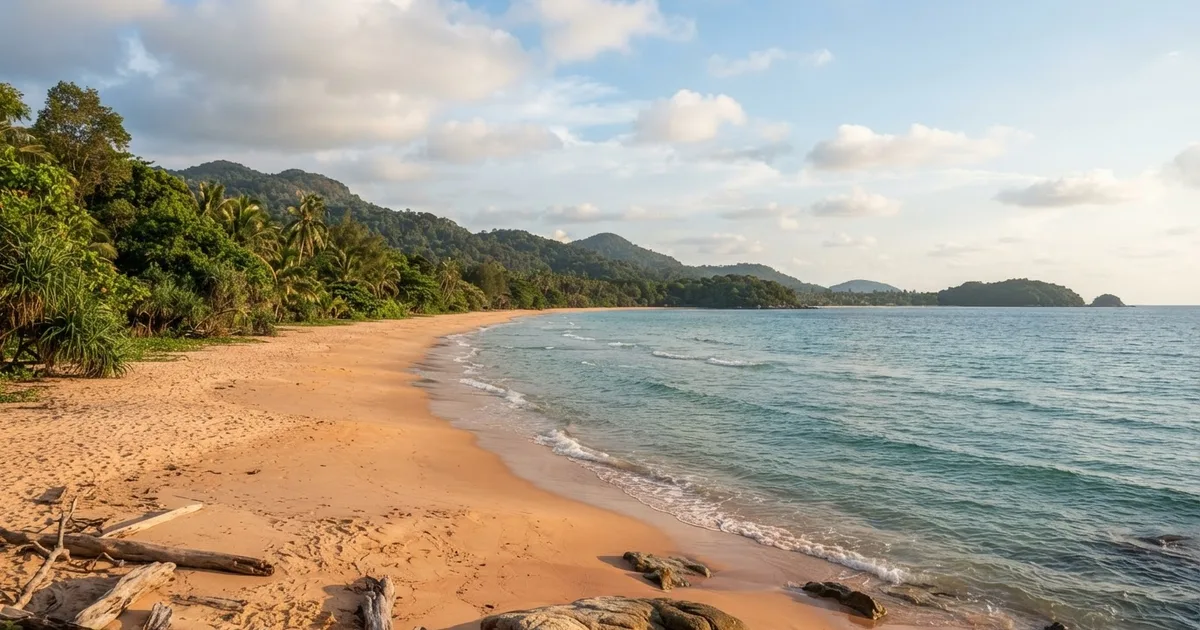
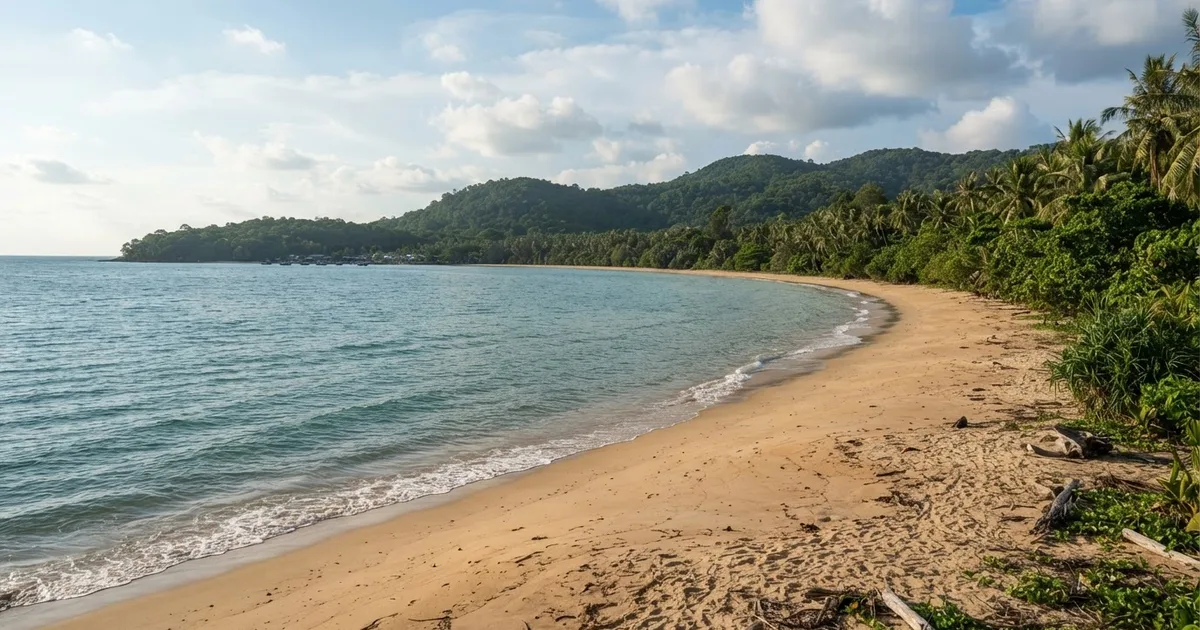
Rạch Vẹm sits on the north coast of Phu Quoc, roughly 20–25 km from Duong Dong Town, the island's main town and tourism hub. Most travellers know it by its nickname, Starfish Beach, thanks to the sea stars that gather in the shallow seagrass beds just off the village. It is the same stretch of coastline that runs past Cua Can towards Ganh Dau, and it remains one of the least developed shorelines on the island.
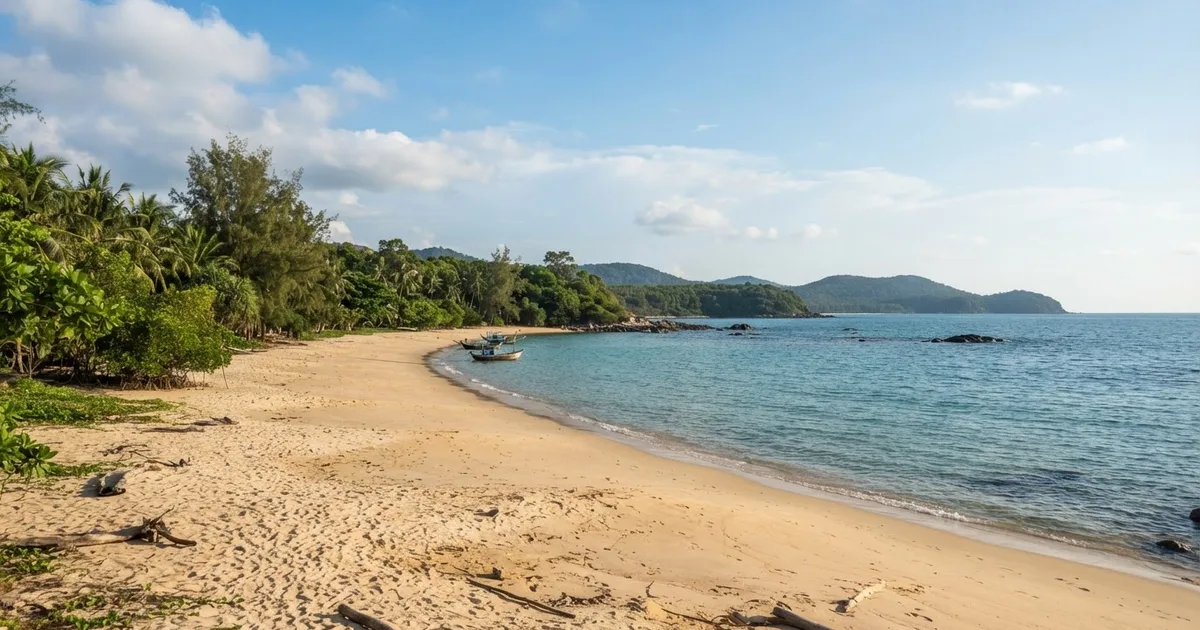
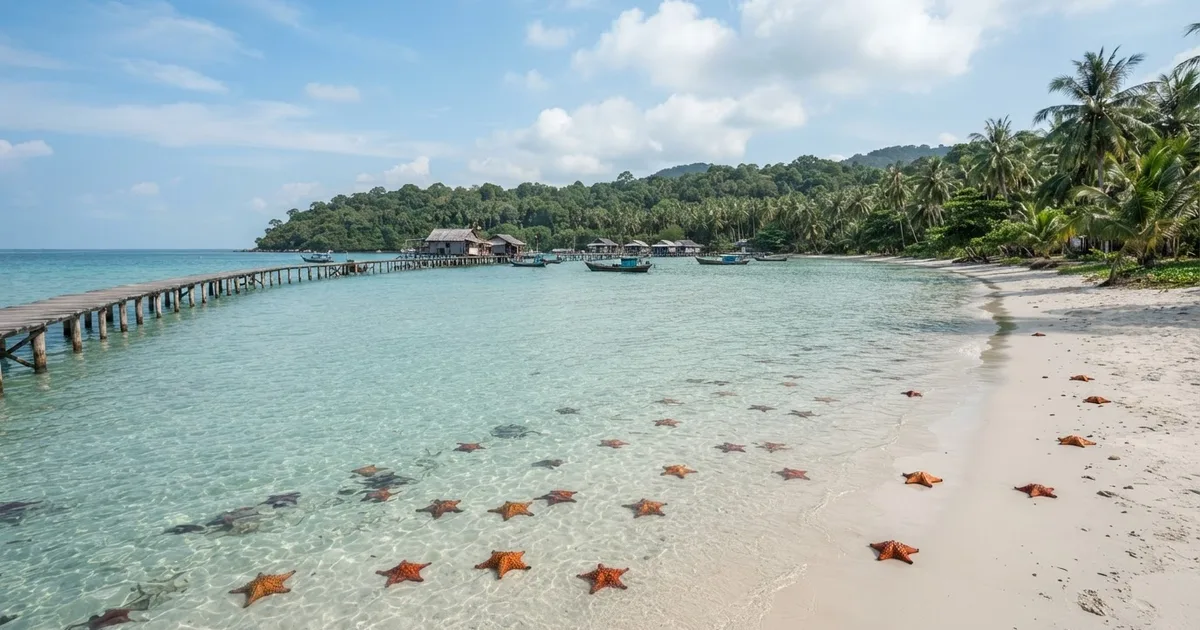
What you actually arrive at is a fishing village, not a resort. Wooden stilt houses and family-run seafood restaurants stand on posts over the water, small fishing boats are moored along the sand, and pearl farms float offshore. The beach itself is a narrow ribbon of sand in front of all of that. That village character is exactly why people love Rạch Vẹm — and exactly why it does not behave like a resort beach.
The water is shallow and frequently silty, with seagrass patches on the bottom. On calm dry-season days you can see the sandy bottom clearly, and some guides claim visibility of 10–15 metres in the best conditions; other descriptions of the same bay call it shallow, muddy or seagrass-covered. The honest answer is that it varies enormously with tide, wind and season — the photographs you see online were taken on the best mornings of the year.
Entry is free. There is no entrance ticket for Rạch Vẹm beach or the village, although you will pay a small parking fee of about 10,000–20,000 VND if you ride there yourself. There are no sun loungers, no beach clubs and no umbrella-and-cocktail infrastructure — this is a working waterfront where you wade, watch, eat and photograph.
Bring cash and small notes. The far north of Phu Quoc has very few working ATMs, and the seafood stalls at Rạch Vẹm deal in cash. Carry enough Vietnamese dong for lunch, drinks, parking and fuel, plus a little extra in case you decide to stay for the sunset or buy pearl jewellery from a village farm.
How to get to Rạch Vẹm — motorbike, taxi or private car
There is no public bus to Rạch Vẹm, so the realistic options are a self-drive motorbike, a taxi or private car, or a guided northern-island tour. The journey from Duong Dong takes 40–60 minutes depending on your transport, with the route running north along the coastal road through Ong Lang and Cua Can before turning onto the rural lane that leads to the village. The final few kilometres are narrow concrete and red-dirt road, shaded by palms, with the occasional pothole and the occasional water buffalo.
| Getting there | Time from Duong Dong | Typical cost | Notes |
|---|---|---|---|
| Self-drive motorbike | 45–60 minutes | 100,000–250,000 VND/day rental plus roughly 50,000 VND fuel for the round trip | Most flexible option; the last stretch is a narrow rural lane |
| Taxi or private car | 40–50 minutes | About 400,000–700,000 VND one way | Agree the fare before you set off; return taxis are not waiting in the village |
| From Corona Resort & Casino | 15–20 minutes | - | Head north along the coastal road |
| Ride-hailing app | 45–60 minutes | Varies by demand | Fewer drivers accept the northern run — book early and confirm the return |
| Parking at the beach | - | 10,000–20,000 VND | The lot is small and fills up by mid-morning in high season |
If you are riding yourself, fill the tank before you leave the main road — fuel stops thin out dramatically north of Cua Can. If you take a taxi, arrange a pickup time with the driver or keep their number, because there is no taxi rank at Rạch Vẹm and phone signal can be patchy on the village shore. Many travellers combine Rạch Vẹm with a stop at Cua Can or Ganh Dau on the same northern loop, which makes the drive feel much shorter.
Ride the final section slowly. The lane into Rạch Vẹm is shared by motorbikes, cars, dogs and children. Dust and loose sand on the corners are the main hazards, and a scooter slipped on the last 5 km is the most common way a good day at Starfish Beach goes wrong.
The best time to visit Rạch Vẹm: dry season, low tide, early morning
Timing matters more at Rạch Vẹm than at almost any other beach on Phu Quoc, because the bay is shallow and the experience is dictated by water clarity and tide height. The dry season, roughly November to April, is the window when the water is calm and clearer and starfish are much more likely to be visible in the shallows. In the rainy months, from about May to October, the bay clouds up with sediment and runoff, and the starfish are effectively off the menu.
Within the day, early morning is clearly the best slot. The bay is at its calmest before the wind picks up, the sea stars are still in shallow water before the area gets stirred by feet, boats and afternoon chop, and the light is soft for photographs. The fishing boats also come in early, so the waterfront is at its most alive between roughly 6am and 9am.
The tide is the second variable, and it is the one most visitors forget. Check a tide table before you go: low tide exposes the shallow flats and seagrass where the starfish sit, while a high tide covers them and pushes siltier water inshore. Swimming and wading conditions at Rạch Vẹm change dramatically between high and low water — a spot that is knee-deep at 9am can be mud at noon and chest-deep that evening.
One more timing note: Rạch Vẹm faces slightly east, which makes it a sunrise spot rather than a sunset one. If a spectacular sunset over the sea is your priority, you are better off on the west-coast beaches further south such as Ong Lang or Long Beach. Come to Rạch Vẹm in the morning and save the sunset for the drive home.
Starfish Beach: seeing the sea stars without harming them
The starfish are the reason most people make the drive, and they are genuinely visible — at low tide in the dry season, sea stars rest on the sandy bottom and among the seagrass in water shallow enough that you barely need to get your knees wet. They are not guaranteed on every visit, because their visibility depends on tide, season and how much traffic the shallows have already had that day.
What matters more is how you behave around them. Handling a starfish — lifting it for a photo, turning it over, passing it to a child, or taking it out of the water — can seriously harm or kill it. Sea stars move slowly, breathe through their skin surface and cannot tolerate being out of water or repeatedly stressed. This is why every responsible guide in Phu Quoc repeats the same instruction: look, photograph, do not touch, and absolutely do not take one home.
- Keep your distance - Stand back and photograph from above; a zoomed shot beats a handled animal every time.
- Do not stand on seagrass - Seagrass is the starfish's habitat and food source; walking across it crushes both.
- Never lift one out of the water - Even a few seconds in the air causes stress that can be fatal.
- No collecting, ever - Removing a starfish from the bay is both harmful and, in a protected marine area, illegal.
- Watch your fins and shoes - Drag your feet slowly rather than stepping down hard on the sandy bottom.
- Move on after a few minutes - Popular starfish patches get crowded; a short, quiet visit is better than a long, churned-up one.
If you arrive and see no starfish at all, don't assume the bay is empty — it usually means the tide is high or the season is wrong. Come back on another morning at low water, or ask a local boat owner whether they have been seen that week.
Swimming, snorkeling and safety at Rạch Vẹm
Set your expectations correctly: Rạch Vẹm is not a swimming beach. The water is shallow, often silty and seagrass-covered, and swimming is challenging and heavily tide-dependent. What the bay is genuinely good for is wading — paddling in calf-deep water, watching the boats, and cooling off at the edge. It is not a place for laps or for floating around for an hour.
It is also not ideal for snorkeling. Rạch Vẹm is a sandy-bottomed beach rather than a reef site, so there is very little coral structure and limited fish life compared with Phu Quoc's southern islands. If snorkeling is on your list, the An Thoi archipelago in the south — reachable on boat trips from An Thoi harbour — is the correct destination, not the northern shore.
Safety at Rạch Vẹm is straightforward but entirely on you. There are no lifeguards reported at the beach, so keep children within arm's reach near the water, and be especially careful around moored boats, mooring lines, propellers and the stilt-house ladders that lead down into the shallows. Working boats come and go through the same water you are wading in, and they do not always see someone standing waist-deep behind them.
Check tide tables before you travel, and avoid wading far out across the flats on a falling tide — the shallow bay has soft mud and deeper channels that are easy to misjudge. Medical facilities are not close: the nearest hospital is back in the Duong Dong area, roughly 25 km south. Pack water, sun protection and a charged phone, and treat Rạch Vẹm as a village shore where you look after yourself.
Best use of the water: wade at the edges, keep an eye on the horizon for incoming boats, and leave the serious swimming for a west-coast beach such as Ong Lang or Long Beach, where the sand is deeper and the water is clearer.
Eating and staying at Rạch Vẹm
Food is where Rạch Vẹm quietly excels. Several family restaurants sit on stilts directly over the water, serving whatever came off the boats that morning: grilled squid, whole fish, prawns, crab, sea-snail hotpot and simple rice or noodle dishes. A generous seafood lunch typically runs about 150,000–350,000 VND per person depending on what you order and how much of it is shellfish. Ask the price before ordering if it is not displayed, and expect a slower pace — this is a village kitchen, not a restaurant with a service line.
Vegetarians and picky eaters have limited options, so plan around rice, noodles, morning glory and egg dishes, or eat before you arrive. Drinks are usually cold beer, soft drinks, fresh coconut and sugarcane juice; coffee is basic but welcome after the early start.
Most visitors treat Rạch Vẹm as a half-day trip rather than an overnight stop. That said, overnight accommodation does exist in the village itself — one property listed on Expedia offers rooms at around $200 per night with a blue-green bay view, which suits travellers who want the bay at sunrise before anyone else arrives. Budget-conscious visitors usually base themselves in Duong Dong or Ong Lang and drive north for the morning; the trade-off is a 45–60 minute drive each way.
Beyond eating and sleeping, the village is worth a slow walk. Pearl farms operate in the area and some welcome visitors, fishing families mend nets on the shore, and the stilt-house lanes are genuinely photogenic. Bring cash, keep your voice down around working boats, and ask before photographing people close up — it is a small community, and courtesy goes a long way.
Who Rạch Vẹm is right for — and who should skip it
Rạch Vẹm rewards a specific kind of traveller and frustrates another. If you know which one you are, you will either love it or save yourself a long, dusty drive.
Great for
- Starfish spotting at low tide in the dry season
- Photographers chasing stilt houses, boats and village life
- Seafood lovers happy to eat over the water for 150,000–350,000 VND
- Families with small children who only want to wade in calf-deep water
- Motorbike riders building a northern-island loop with Cua Can and Ganh Dau
- Travellers who want a Phu Quoc beach with no entrance fee, no loungers and no crowds at 7am
Less suited to
- Swimmers — the water is shallow, silty and tide-dependent
- Snorkelers and divers, since the bottom is sand rather than reef
- Sunset chasers — the bay faces slightly east and is a sunrise spot
- Anyone expecting beach clubs, sun loungers or waiter service
- Travellers without their own transport or a booked driver
- Visitors with limited mobility, as the stilt-house walkways and shore are uneven
- Anyone who wants a guaranteed starfish sighting regardless of tide and season
If your priorities are clear turquoise swimming water, coral and a poolside afternoon, base yourself on the west or south coast and skip the northern drive. If you want a morning that feels like the Phu Quoc of fifteen years ago — wooden boats, pearl farms, a shallow bay full of sea stars and a grilled squid lunch on a stilt deck — Rạch Vẹm is one of the best half-days on the island.
Frequently Asked Questions
How far is Rạch Vẹm Beach from Duong Dong?
Rạch Vẹm is about 20–25 km north of Duong Dong Town, which translates to roughly 40–50 minutes by taxi or private car and 45–60 minutes by motorbike. From Corona Resort & Casino in the north-west, the drive is only 15–20 minutes heading north along the coastal road.
Can you swim at Rạch Vẹm Beach?
Not really. Rạch Vẹm is a village shore with shallow, often silty water and a working waterfront, so it is a wading and eating beach rather than a swimming one. Conditions also swing hard with the tide, and there are no lifeguards on duty at any time.
When is the best time to see starfish at Rạch Vẹm?
The dry season from November to April, in the early morning around low tide. That is when the bay is calmest, the water is clearest and sea stars rest in the shallows before the area gets stirred up by visitors, boats and afternoon wind.
Is there an entrance fee for Rạch Vẹm Beach?
No. The beach and the village are free to enter, with no entrance ticket charged. If you ride there yourself you will typically pay about 10,000–20,000 VND for parking in the small lot near the shore, and restaurants and boat trips are priced separately.
Is Rạch Vẹm good for snorkeling?
No. Rạch Vẹm is a sandy-bottomed beach rather than a reef site, so there is very little coral or marine life to snorkel over. For proper snorkeling on Phu Quoc, head south to the An Thoi islands and join a boat trip from An Thoi harbour instead.
Can you watch the sunset at Rạch Vẹm?
Rạch Vẹm is not an ideal sunset spot. The bay faces slightly east, so it is far better suited to sunrise, when the water is calm and the fishing boats are returning. For a classic sunset over the sea, stay on the west coast at Ong Lang or Long Beach.
Are there lifeguards at Rạch Vẹm Beach?
No lifeguards are reported at Rạch Vẹm. Keep children close and within arm's reach in the water, supervise them around moored boats and mooring lines, and check tide tables before you go, because the shallows change depth quickly through the day.
Can you stay overnight at Rạch Vẹm?
Yes, but options are limited. One property listed on Expedia sits in Rach Vem itself with rooms at around $200 per night and a blue-green bay view. Most visitors day-trip instead and base themselves in Duong Dong or Ong Lang, roughly 45–60 minutes away by road.
Planning a morning at Rạch Vẹm? Sabrina Rental can sort your motorbike, arrange a private driver for the northern loop, and tell you which tide and which hour will actually put starfish in the shallows on the day you are here. Message us with your dates and we will build the route around Cua Can, Ganh Dau and Starfish Beach.
Ask Sabrina About Rạch Vẹm