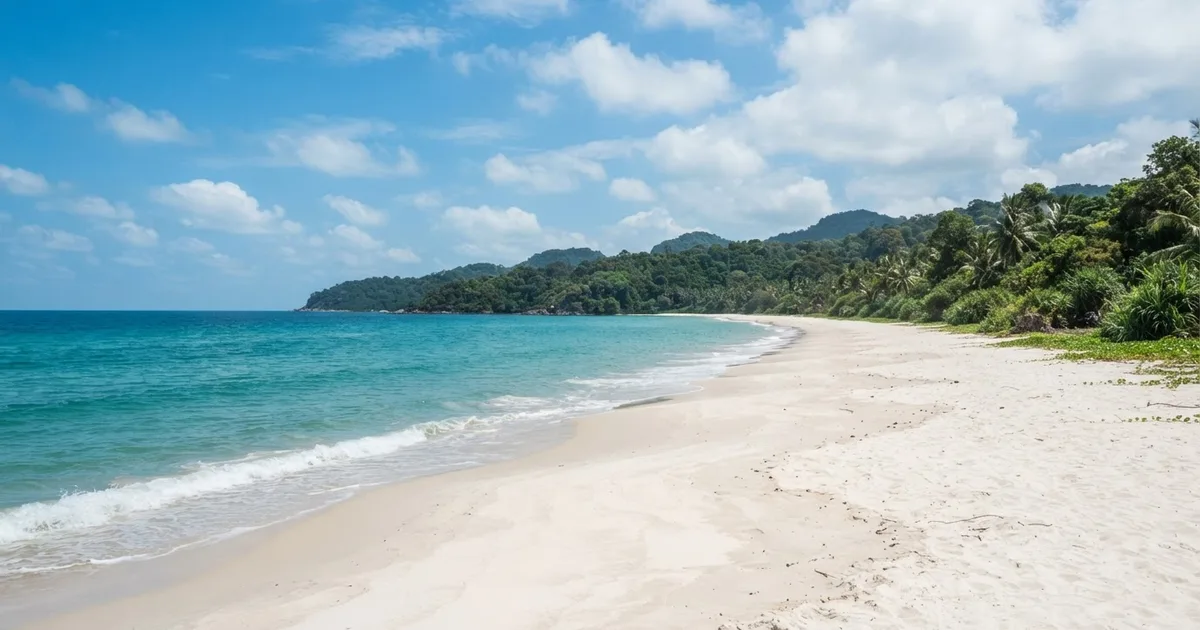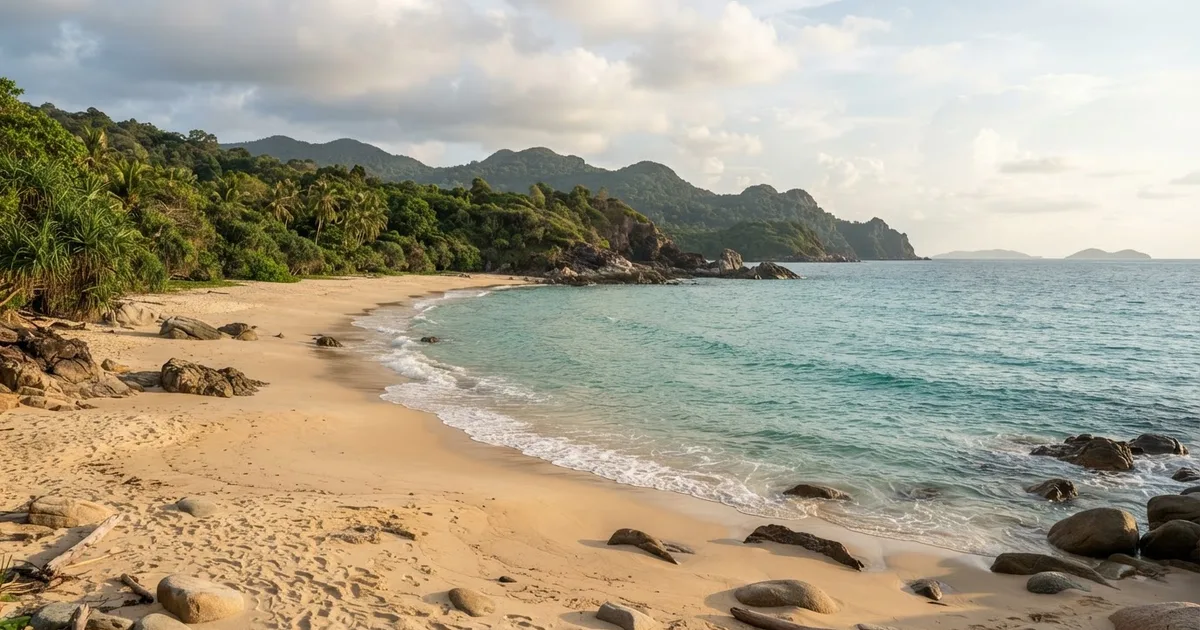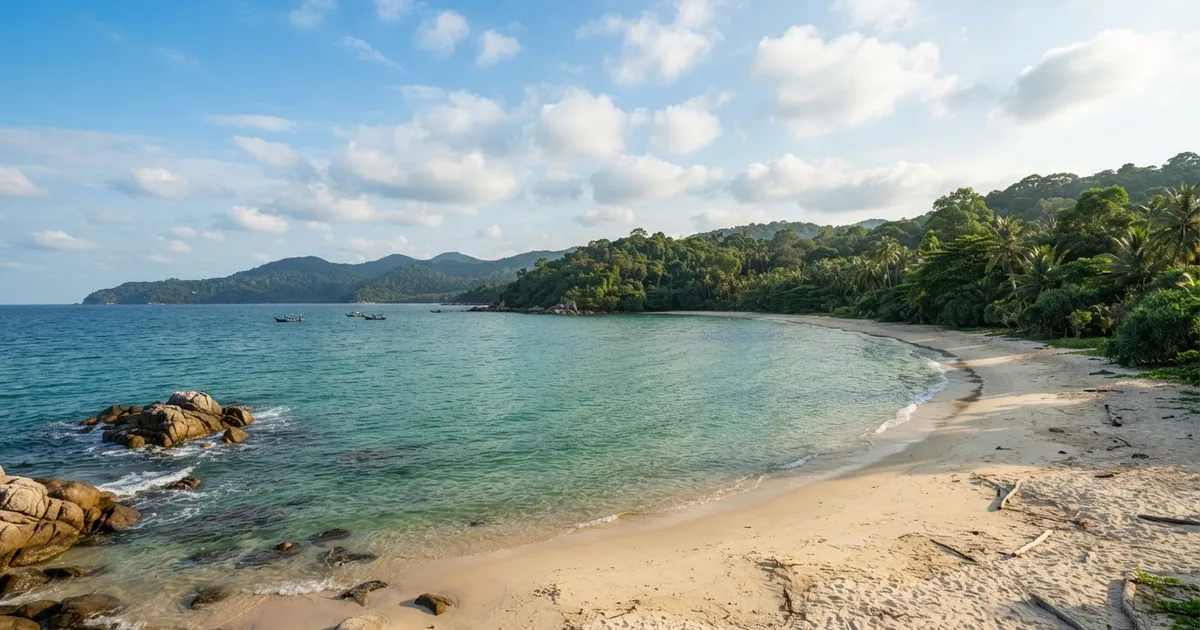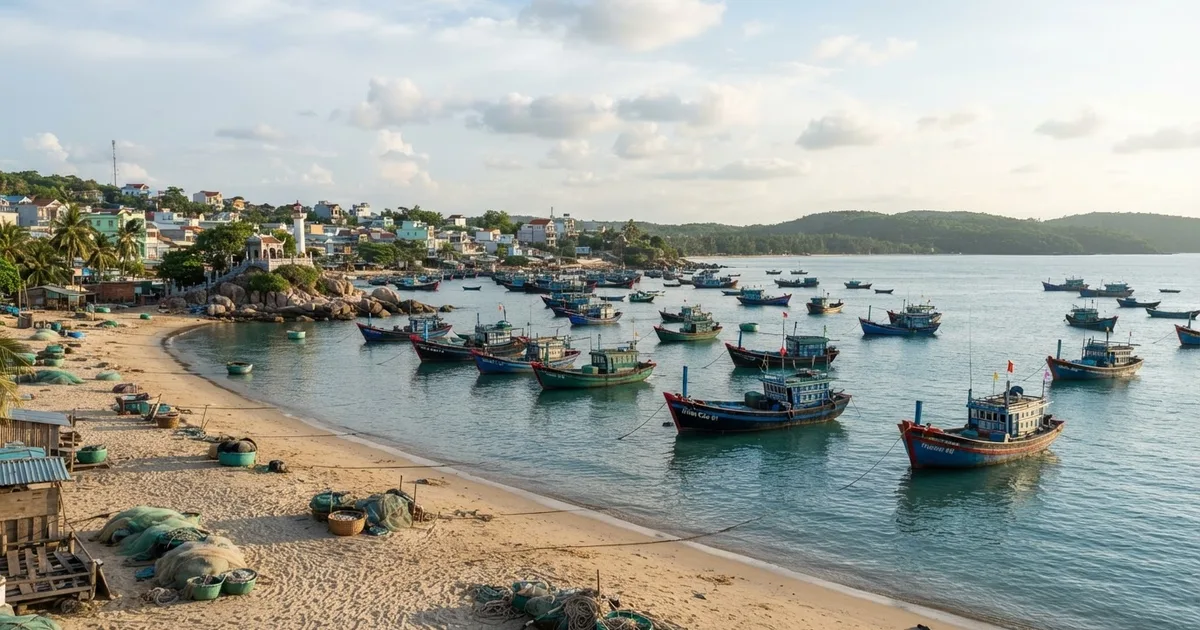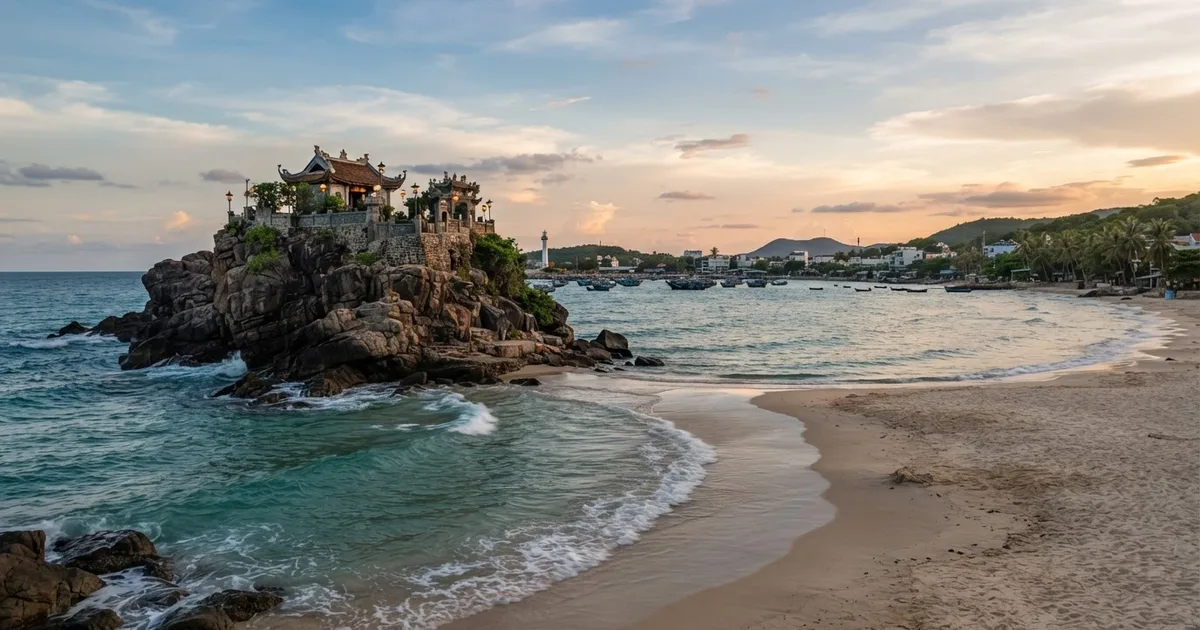
Dinh Cau Beach is a small, centrally located stretch of soft, off-white sand in the heart of Duong Dong town, Phu Quoc's main town — walkable from Dinh Cau Night Market and best used for a quick swim, a sunset and an evening out rather than a full beach day. It is at its best from November to April, when the west coast sea is calm and clear, and least appealing from May to October, when larger waves and runoff turn the water murky and often unsafe for swimming. Go for the sunset, the temple and the atmosphere; if you want kilometres of empty white sand, you need a different beach.
Where Is Dinh Cau Beach, and Why Is It So Easy to Reach?
Dinh Cau Beach sits on the west coast of Phu Quoc in Duong Dong Ward, Phu Quoc City — which means it is not a beach you have to build a day trip around. It is the town beach of the island's main settlement: a compact strip of soft, off-white sand running along the Bach Dang Street waterfront and ending at the rocky headland of Dinh Cau Temple. A Vietnam Airlines guide describes it simply as being in the heart of Duong Dong Town, and that is the whole point of the place.
The headland is the landmark everyone recognises. On top of the rock sits a small shrine dedicated to the Goddess of the Sea, reached by a short flight of concrete steps, with a lighthouse standing on the same outcrop. Entry is free, the view over the Gulf of Thailand is wide open, and from up there you can look straight back down onto the beach you were just swimming from.
Distances here are tiny by island standards. Phu Quoc International Airport (PQC) is roughly 10 km away — a 20-25 minute taxi or Grab ride, expect around 200,000-300,000 VND (USD 8-12). Dinh Cau Night Market is about 200 m from the sand, a three-minute walk. Duong Dong Market, the town's main morning market, is around 1 km north. If you are staying anywhere in Duong Dong, you can simply walk.
The beach is public and free, open around the clock, with motorbike parking along the street for about 5,000-10,000 VND (under USD 0.50). There is no entrance gate, no sunbed concession war and no queue — which is exactly why it feels more like a neighbourhood beach than a resort one.
When Is the Best Time to Visit Dinh Cau Beach?
The most important planning fact is seasonal. Phu Quoc's dry season runs from November to April, and the west coast — the Dinh Cau area included — is at its clearest and calmest then. December to March is peak: the driest weather, the calmest sea and the most reliable blue water. From May to October the same coastline catches the southwest monsoon, bringing larger waves and murkier water; by mid-rainy-season the sea is frequently too rough to swim in at all, and that applies to the whole west coast, not just this beach.
| Period | Typical sea conditions | Swimming | Verdict |
|---|---|---|---|
| November | Settling down; clarity returning | Good | Quiet, good value, occasional showers |
| December-March | Calm, clear, gentle waves | Excellent | Peak season — best water and best sunsets |
| April | Still calm, hot and bright | Very good | Great swimming; book rooms early around public holidays |
| May-June | Waves building, water less clear | Variable | Swim early in the day and check conditions |
| July-September | Rough seas, big waves, frequent rain | Not recommended | Enjoy the town and the night market, skip the swim |
| October | Transitional and unsettled | Hit and miss | Short storms; conditions improve late in the month |
Time of day matters just as much as the month. Mornings are the quietest and the coolest — good for a swim before the heat peaks. Late afternoon, from about 16:30 onward, is when the beach fills up, because that is when local families come down to swim, eat and watch the sun go down. If you want the sand to yourself, come before 09:00. If you want the atmosphere, come for sunset.
Tip: Two minutes of looking at the sea beats any forecast. If the fishing boats are bobbing hard and there is a foam line running past the headland rocks, treat it as a no-swim day and move your plans to the night market instead.
Swimming, Snorkelling and What the Water Is Really Like
Dinh Cau Beach has gentle waves and a shallow shoreline, which makes it one of the friendlier spots on the island for families with small children and for anyone who wants a quick, easy dip without a current to fight. In the dry season the water can be genuinely crystal-clear, and on a calm December morning it does not look like a town beach at all.
Be honest about the trade-off, though. This is a beach in the middle of a working town with a fishing harbour at one end, and traveller reviews consistently rate the water as less pristine than Phu Quoc's southern and outlying beaches — Sao Beach, the An Thoi islands, Ong Lang — especially after rain or during the monsoon months. It is a lovely place to swim; it is not a snorkelling destination.
Snorkelling here is shallow and limited to sand, small rocks and the occasional fish around the temple headland. If snorkelling is a priority, the An Thoi archipelago boat trips off the south of the island are the answer. Kayaking is easier: a paddle along the Duong Dong waterfront at sunrise is calm, flat and scenic. Photographers get the best of the beach at both ends of the day, when the light is low and the sand is not blown out white.
- Swim inside the bay, away from the harbour entrance where boats are constantly coming and going.
- Wear sandals or water shoes for the rocky patches near the Dinh Cau headland.
- Check the sea before you commit. If it is rough, it is rough — there are no lifeguards or flagged swimming zones here.
- Leave valuables at your hotel rather than on the sand.
- Rinse off after swimming: the beach sits beside a working harbour and town runoff.
Sunset at Dinh Cau: the Island's Most Accessible Golden Hour
Dinh Cau faces west-southwest with an open horizon, which is why it is one of the most popular sunset spots on Phu Quoc. Sunset falls between roughly 17:40 in December and 18:30 in June. Arriving 30-40 minutes early gets you a parking spot, a drink and a good position before the colour starts.
The best vantage points are the steps and terrace of Dinh Cau Temple, the rocks at the southern end of the beach, and any of the seafood restaurants and cafes along Bach Dang Street, several of which have first-floor views straight over the water. The temple is an active place of worship, so cover shoulders and knees and keep voices low inside the shrine.
Then there is the scene itself. On any dry-season evening the beach fills with local families, kids in the shallows, groups eating grilled seafood on mats, couples photographing each other against the lighthouse. Tripadvisor reviews of the beach mention exactly this mix: sand busy with locals in the evening, strong sunset views, children playing in the water. Treat it as part of the attraction rather than an obstacle.
As the light goes, the evening continues 200 m inland at Dinh Cau Night Market, open roughly 17:00-23:00, with fresh seafood, skewers, tropical fruit, pearls and souvenirs. Dinner for two — grilled scallops, prawns, squid and a couple of cold beers — usually lands somewhere between 200,000 and 500,000 VND (USD 8-20) depending on how much seafood you order. Prices are posted, but confirm the price of anything sold by weight before it hits the grill.
Who Dinh Cau Beach Suits — and Who Should Skip It
Dinh Cau is a convenience beach rather than a destination beach. Judged against that brief it is excellent; judged as a tropical paradise it is only average. Here is the honest split.
Great fit if you...
- Are staying in Duong Dong and want a swim without paying for a taxi
- Have small children — the shoreline is shallow and the dry-season waves are gentle
- Want sunset, dinner and a night market within a 300-metre walk
- Have a few spare hours before a flight, since the airport is 20-25 minutes away
Still worth it if you...
- Want one photograph of the temple and lighthouse at golden hour
- Are a light snorkeller or a kayaker looking for an easy, flat paddle
- Prefer a lively local scene over an empty beach
Poor fit if you...
- Want a long, wide, powdery white-sand beach — the strip here is short and town-backed
- Expect resort-standard water clarity and silence
- Are chasing the island's best snorkelling — that is the An Thoi islands in the south
- Want a genuinely peaceful coastline. Bai Bon, on the island's quieter northern shore, is one of Phu Quoc's emptier stretches and suits travellers seeking calm far better
- Are visiting in July-September and mainly want to swim — the west coast sea is rough and often unsafe
If you want the classic postcard sand, the usual alternatives are Sao Beach in the south (about 25 km, 40 minutes by motorbike), Ong Lang, and the northern half of Long Beach (Bai Truong). Long Beach is the closest easy upgrade: you can be on a longer, quieter stretch of sand within five minutes of Dinh Cau, and it faces the same sunset.
Practical Tips: Getting There, Parking, Costs and What to Bring
Getting there. Walk or cycle if you are in Duong Dong. A taxi or Grab from anywhere in town is 30,000-60,000 VND; from the airport, roughly 200,000-300,000 VND (USD 8-12) and 20-25 minutes. The easiest self-drive option is a rented scooter — expect 120,000-250,000 VND per day (USD 5-10) in Duong Dong, with a full tank costing about 70,000-100,000 VND. Street parking along Bach Dang costs 5,000-10,000 VND.
What to bring. Sandals or water shoes, since there are rocks and shells around the headland and the sea floor is not uniformly sandy. A quick-dry towel, cash in small notes for the night market, a dry bag if you are kayaking, and a light layer for the temple. Reef-safe sunscreen is worth packing for any Phu Quoc beach day.
What to expect on the ground. No entrance fee, no sunbed rentals to negotiate, no lifeguard flags and only limited public showers and toilets — most people rinse off at their hotel or in a nearby cafe. The beach is short: a few hundred metres of sand, so do not plan a half-day of walking. Combine a swim, the temple steps, the sunset and the night market and you have a very good evening in town without touching a taxi.
Combine it: swim at 16:00, climb the temple steps at 17:30, watch the sun drop from the rocks at 18:15, and be at the night market for grilled seafood by 19:00 — the whole evening is under one kilometre of walking.
Frequently Asked Questions
Where exactly is Dinh Cau Beach?
It is in Duong Dong Ward, Phu Quoc City, on the island's west coast, in the heart of Duong Dong town. The beach runs along Bach Dang Street and ends at the Dinh Cau Temple headland. It is about 10 km and 20-25 minutes from Phu Quoc International Airport, and about 200 m from Dinh Cau Night Market.
Is Dinh Cau Beach safe for swimming?
In the dry season, yes — the shoreline is shallow and the waves are gentle, which suits families. From May to October the west coast sea turns rough with big waves and is not safe for swimming. There are no lifeguards or flagged zones, so check the water visually and stay away from the harbour entrance where boats move in and out.
What is the best month to visit Dinh Cau Beach?
November to April is the dry season, with December to March the peak window of calm seas and clear blue water. April is still calm but hotter. May to October brings the southwest monsoon, larger waves and murkier water — June and July are the least rewarding months for a swim here.
Is Dinh Cau Beach good for sunset?
Yes — it faces west-southwest with an open horizon and is one of the most accessible sunset spots on the island. Sunset falls between roughly 17:40 in December and 18:30 in June. Arrive 30-40 minutes early to secure a spot on the temple steps, the rocks at the south end, or a first-floor cafe on Bach Dang Street.
Is Dinh Cau Beach crowded?
It gets busy in the evening, when local residents come down to swim, eat and watch the sunset — reviews regularly note the sand filled with locals after about 17:00. Mornings before 09:00 are much quieter, and outside peak season (December-March) even the evenings are relaxed rather than packed.
Do I have to pay to visit Dinh Cau Beach?
No. The beach is public and free, and the Dinh Cau Temple above it is free to enter, though donations are welcome. Motorbike parking along the street costs about 5,000-10,000 VND. Budget roughly 200,000-500,000 VND (USD 8-20) if you follow the evening with a seafood dinner for two at the night market.
Which is better, Dinh Cau Beach or Sao Beach?
They serve different purposes. Sao Beach, about 25 km south and 40 minutes by motorbike, has the long white sand and turquoise water people picture. Dinh Cau is short, central and town-backed, but you can walk to it, swim with small children and stay for sunset and dinner. For convenience and atmosphere, Dinh Cau wins; for scenery, Sao does.
What should I wear and bring to Dinh Cau Beach?
Swimwear, a towel and sandals or water shoes for the rocky patches near the temple headland. Bring cash in small notes for parking and the night market, and a shoulder-and-knee cover if you plan to enter Dinh Cau Temple. Leave valuables at your hotel, as there are no lockers or supervised storage on the sand.
Sabrina Rental is based on Phu Quoc and can sort out the practical side of your trip — a scooter delivered to your hotel in Duong Dong, a room a few minutes from Dinh Cau Beach, or a boat trip south to the An Thoi islands when the sea is calm. Message us before you arrive and we will tell you honestly what the water is doing this week.
Contact Sabrina Rental