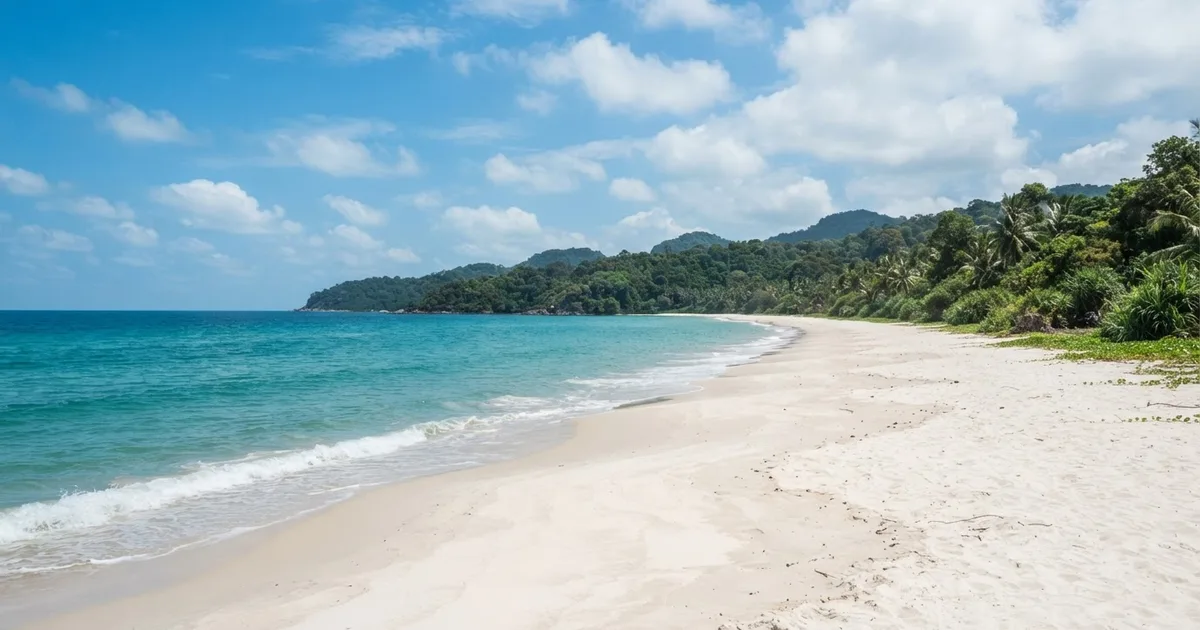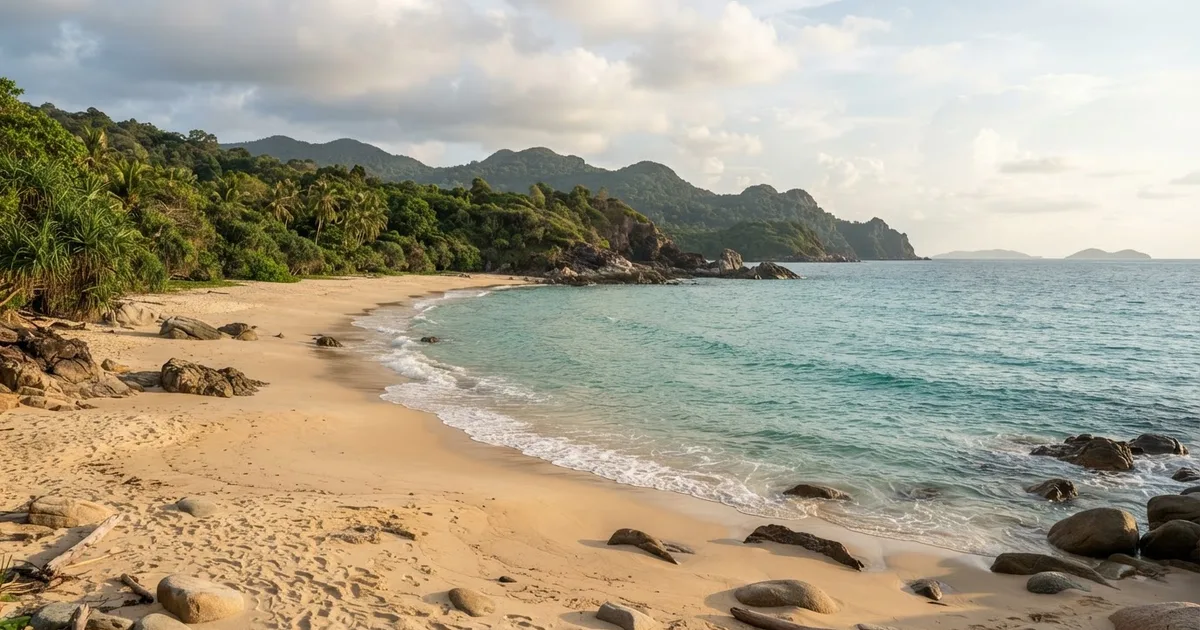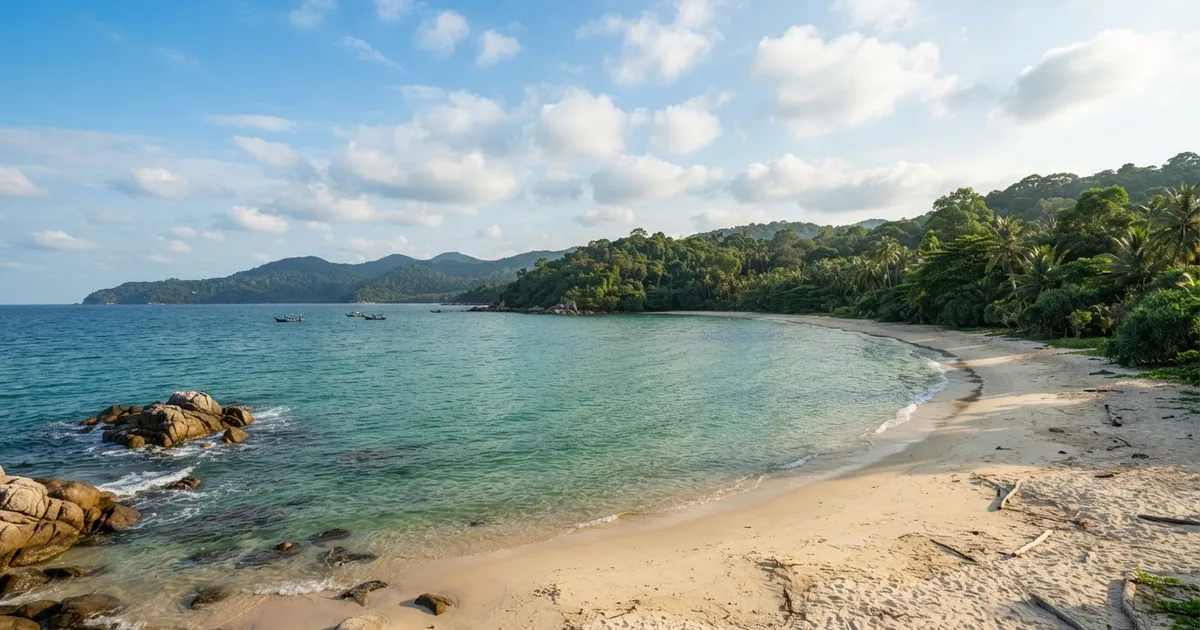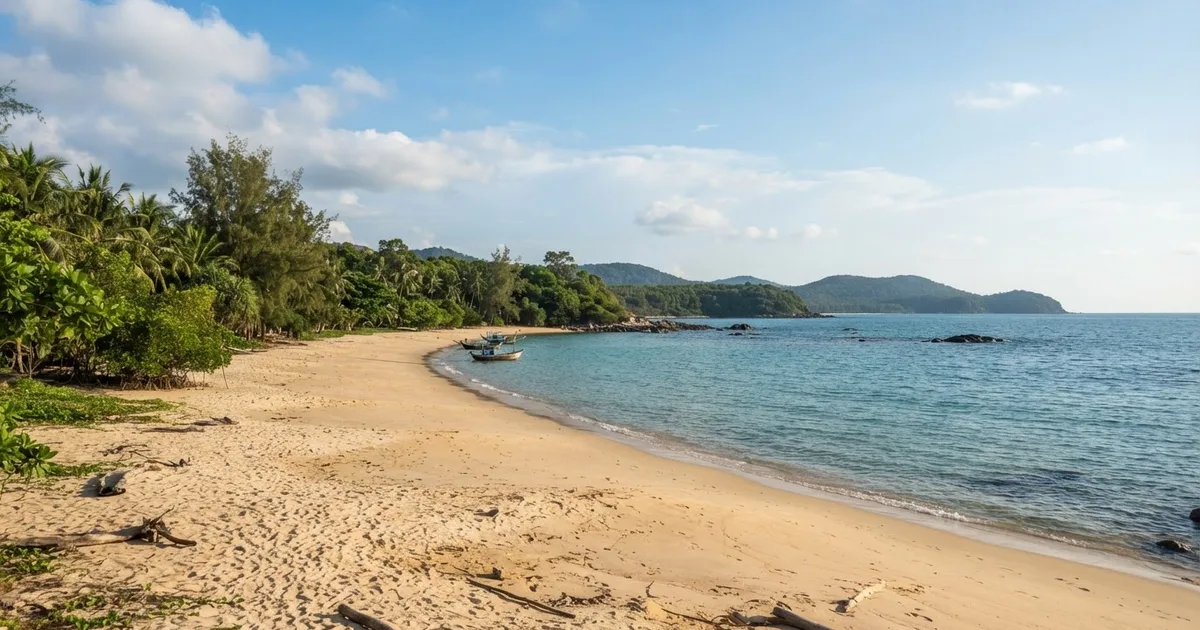
Cây Sao Beach — almost always written as Bãi Sao, or simply “Sao Beach” on maps — is a free, public stretch of roughly 7 km of powder-white sand about 25 km south of Duong Dong on Phu Quoc's southeast coast. There is no entry ticket, no gate and no closing time. The most reliable window is the dry season from November to April, with April to early June rated the cleanest, and the single best hour of any day is sunrise, when the water is glassy and the beach is nearly empty.
What Is Cây Sao Beach, and Where Exactly Is It?
The naming confuses a lot of visitors, so let's clear it up first. Bãi Sao means “Star Beach” in Vietnamese. On Google Maps, hotel websites and tour flyers you will also see it written Bai Sao, Cây Sao, Cay Sao Beach and Sao Beach. These all refer to the same long white-sand bay on Phu Quoc's southeastern shore. If a driver or hotel receptionist nods when you say “Cây Sao”, you are both talking about the same place.
Geographically, the beach sits roughly 25 km south of Duong Dong, Phu Quoc's main town and night market hub, and just a few minutes northeast of An Thoi, the port town at the island's southern tip where the Hon Thom cable car departs. From the Duong Dong area that is a 40–50 minute drive by car and 45–60 minutes by scooter, depending on traffic through An Thoi.
What makes it famous is the sand. It is genuinely fine — closer to flour than to grit — and it runs in a broad crescent for around 7 km of coastline, backed by coconut palms and low green hills. The water deepens slowly, so you can wade out a long way before it reaches your chest. In the dry season it is usually calm and clear, with that postcard turquoise band near the shore.
Critically for planning: Bãi Sao is public land. There is no official entry ticket and no gate, and you can walk onto the beach free at any hour of the day or night. Resorts and restaurants have built along parts of it and occupy sections with sunbeds, but the beach itself is not private.
| Quick fact | Detail |
|---|---|
| Local name | Bãi Sao (also written Bai Sao, Cây Sao, Sao Beach) |
| Distance from Duong Dong | ~25 km south, 40–50 min by car |
| Coastline | ~7 km of beach |
| Sand | Very fine, powdery white |
| Entry fee | None — public land, open at all hours |
| Best months | November–April; peak reliability April to early June |
| Water in dry season | Calm, clear, shallow close to shore |
| Sunset | None — the beach faces east |
| Scooter rental nearby | From ~150,000 VND/day (~$6) |
| Parking | 10,000–20,000 VND at the beach access points |
When Is the Best Time to Visit Cây Sao Beach?
The short answer: the dry season, from November through April. This is when the water at Bãi Sao is usually calm and clear, the sand is at its whitest and the beach delivers the version of itself that ends up on the postcards. Within that window, April to early June is consistently described as the cleanest and most reliable time to visit — the sea is flat, visibility is good and the rubbish that can wash in during rougher weather has largely cleared.
The southwest monsoon runs roughly May through October and is the period to be wary of. Onshore wind and swell push sediment into the bay, the water turns murky, and the beach can be considerably less appealing. That said, Sao Beach has one real advantage: it is sheltered on Phu Quoc's southeastern coast, so it often stays swimmable in the early wet season when west-coast beaches such as Long Beach and Ong Lang are being hammered by chop. If you are on the island in late May or June and the west coast looks rough, driving south to Bãi Sao is a legitimate plan B.
Reality check on conditions: In early January 2026, Bãi Sao was reported to have thick layers of water hyacinth and rubbish along the shoreline, and many visitors chose not to swim that day. This is not a permanent state — it is a weather-driven event, and currents and monsoon run-off can dump floating debris on any Phu Quoc beach within 24 hours. The lesson is simple: check conditions on the day you plan to go, ideally by asking your hotel or a local rental shop before you commit to the 25 km drive south. A beach that was pristine on Tuesday can be a mess on Thursday, and vice versa.
Time of day matters almost as much as the month. At dawn, Bãi Sao is glassy, still and almost empty — this is the beach at its best, and photographers should aim to arrive by 6 am. The beach then fills up through the morning as day-trip groups and hotel shuttles arrive, and the central stretch around the restaurant cluster stays busy until mid-afternoon. Shade is limited outside the paid sunbed areas, and there is very little natural tree cover on the main stretch, so if you come at midday bring sun protection and expect heat.
How Do You Get to Cây Sao Beach?
By scooter. This is the classic way to reach Bãi Sao, and it is the option most independent travellers choose. Scooter rental on the island is quoted at around 150,000 VND per day (roughly $6), which makes it by far the cheapest way to do the trip. From Duong Dong, head south on the main road towards An Thoi, then follow the signed turn-off inland and over the hill to the beach. Allow 45–60 minutes each way and fuel up before you leave — there are petrol stations in An Thoi but nothing at the beach itself.
By taxi or Grab. From the Duong Dong area, expect to pay roughly 500,000–600,000 VND one way (~$20–24). Grab works on Phu Quoc and usually prices similarly to a metered taxi; availability is good in the Duong Dong and An Thoi areas but can be thin on the return leg later in the evening, so ask your driver for a card or arrange a pick-up time. From Phu Quoc International Airport the drive is longer, in the region of an hour.
The final approach. The last few kilometres to Bãi Sao run over a narrow, winding road with a couple of hairpins. The surface is generally well paved and perfectly manageable on a scooter in dry weather. In heavy rain, treat it with respect — the corners get slick and there are no street lights. Parking at the beach access points costs 10,000–20,000 VND, and an attendant will usually wave you into a numbered spot.
What does not exist: there is no public bus service to the beach, and no regular shuttle unless your hotel runs one. Organised day tours from Duong Dong are widely sold and typically bundle the beach with the Hon Thom cable car or the An Thoi islands, which is convenient but puts you there in the middle of the day with everyone else.
Swimming, Snorkelling and Safety at Sao Beach
In normal dry-season conditions, Sao Beach is a genuinely good swimming beach. The water close to shore is shallow and calm, there is no heavy surf, and the gradual entry makes it far more forgiving than many of Phu Quoc's steeper west-coast beaches. It is widely described as suitable for swimming and sunbathing, and the gentle, shallow water is considered quite safe for tourists and for families with children.
You will, however, find conflicting reports online, and it is worth understanding why. Some sources say Cây Sao is not great for ocean swimming because of slimy rocks, and at least one guide claims the sea is too shallow to swim properly. Both complaints are describing real features of specific parts of the bay rather than the beach as a whole. The northern end and the outer edges have rocky, algae-covered patches and broad, very shallow flats where you walk a long way out and stay knee-deep. The central and southern stretches — the areas in front of the restaurant cluster and further along the crescent — have cleaner sand underfoot and water deep enough to actually swim in. Ask a local or a sunbed attendant where the best entry point is that day; it takes ten seconds and saves an disappointing paddle.
Safety notes. There are no lifeguards on Bãi Sao, so you are on your own. Rip currents can develop after storms or heavy rain, and the calm appearance of the bay does not always reflect what is happening further out — if the water looks churned or you see a channel of darker, moving water, stay on the sand. Avoid isolated stretches of the beach after dark: the road in is unlit, the beach empties out completely after sunset, and there is no patrol. Keep valuables with you rather than leaving them on a towel, and never swim alone at dusk.
Snorkelling. You can snorkel directly off Sao Beach on calm days, but be realistic about it — the reef quality is not especially notable compared with Phu Quoc's offshore islands. If snorkelling is the point of your trip, book a boat to the An Thoi archipelago instead and treat Bãi Sao as a beach day, not a dive day.
The sunset issue. Bãi Sao faces east, so there is no sunset over the water here. The sun drops behind the island's interior and the bay goes into shade well before the sky turns orange. If you want the classic Phu Quoc sunset, be on the west coast — Long Beach, Ong Lang or anywhere facing the Gulf of Thailand — by about 17:30. The good news is that the east-facing orientation gives you a proper sunrise, and the dawn light at Sao Beach is arguably the best free experience on the island.
Food, Facilities and What Things Actually Cost
Sao Beach is not a deserted strip of sand. The central access point has a cluster of open-air seafood restaurants, drink shacks and sunbed operations, and most visitors end up parked there for the day. Prices sit above what you would pay at the Duong Dong night market, because you are paying for the location and there is no competition within walking distance.
| Item | Typical price |
|---|---|
| Beach entry | Free (public land) |
| Scooter parking | 10,000–20,000 VND (~$0.40–0.80) |
| Sunbed or hammock for the day | 50,000–100,000 VND (~$2–4), often waived if you order food |
| Fresh coconut | 40,000–50,000 VND (~$1.60–2) |
| Local beer | 30,000–50,000 VND (~$1.20–2) |
| Seafood or Vietnamese main course | 120,000–250,000 VND (~$5–10) |
| Kayak hire (per hour) | 100,000–200,000 VND (~$4–8) |
| Outdoor shower or toilet | 10,000–20,000 VND |
Practical points worth knowing before you go. There is no ATM at the beach, and card payment is unreliable outside the larger restaurants, so bring enough cash in small notes. Mobile signal is patchy in pockets along the coast road, which matters if you are relying on Grab for the return trip. The sunbed operators are persistent but not aggressive, and there is a steady trickle of vendors selling fruit, sunglasses and cold drinks along the sand.
Timing tip: arrive early and eat lunch at the beach, or arrive late and eat in An Thoi on the way back. Lunch service at the beach restaurants peaks between about 12:00 and 14:00, when the day-trip groups all sit down at once, and waits can stretch well past 30 minutes for a simple plate of rice and grilled squid.
Who Cây Sao Beach Suits — and Who Should Skip It
Bãi Sao is one of the most photographed beaches in Vietnam, but it is not the right beach for everybody. Here is an honest split.
Book the trip if you are…
- A family with small children. The shallow, calm entry and lack of heavy surf make it one of the safest swimming beaches on the island.
- A first-time visitor who wants to see the famous white-sand Phu Quoc beach without paying a resort day-pass fee — entry is free.
- A photographer or early riser. Between 6 am and 8 am you get glassy water, soft light and an almost empty beach.
- Someone combining it with the south. It pairs naturally with An Thoi, Sunset Town and the Hon Thom cable car on one loop.
- Travelling in late May or June. The southeastern shelter means it may still be swimable when the west coast is not.
Skip it if you are…
- A snorkeller or diver. Reef quality directly off the beach is modest; the offshore islands are far better.
- Chasing a sunset. The beach faces east. There is no sunset over the water here, ever.
- Looking for an empty, undiscovered beach. The central stretch is busy and commercial from mid-morning.
- On a tight food budget. Beach restaurant prices run noticeably above Duong Dong.
- Uncomfortable on winding roads, or riding a scooter for the first time. The last few kilometres are narrow with hairpins.
- Visiting after sustained monsoon weather. Debris can wash in and make swimming unpleasant — the January 2026 water hyacinth build-up is a good example.
How to Build a Full Day Around Cây Sao Beach
Because Bãi Sao sits in the far south, it makes sense to combine it with the other southern sights rather than driving down and back for four hours of sand. One well-tested loop looks like this:
06:00 — Sunrise at Sao Beach. Leave Duong Dong before dawn, ride south, and be on the sand as the light comes up. Swim, walk the northern end of the crescent while it is still cool, then have a slow breakfast at one of the beach restaurants.
10:00 — An Thoi and the Hon Thom cable car. Drive the short hop to An Thoi and take the cable car across to Hon Thom. Round-trip tickets are roughly 600,000–700,000 VND for adults, and the crossing gives you the aerial view of the islands that you cannot get from the beach. Note that the cable car typically has a midday maintenance window, so check departure times when you buy your ticket.
13:00 — Lunch in An Thoi. The harbour market area is cheaper than the beach and the seafood is fresher than it has any right to be. This is also where you refuel the scooter.
15:00 — Ho Quoc Pagoda and Khem Beach. The pagoda is on the coast road back north and is one of the largest on the island. A few kilometres north, Bãi Khem is a quieter, steeper alternative if you want a second swim with far fewer people.
17:30 — Sunset on the west coast. Ride back across the island to Long Beach or Ong Lang and finish the day watching the sun drop into the Gulf of Thailand. This is the one thing Sao Beach structurally cannot give you.
If you would rather not plan any of this yourself, a local operator can arrange the scooter, the timing and the cable car tickets in one go, which is worth considering if you are only on the island for two or three days.
Frequently Asked Questions
Is Cây Sao Beach free to enter?
Yes. Bãi Sao is public land with no official entry ticket and no gate, and you can walk onto the beach free at any time of day or night. The only costs are optional: parking at the access points runs 10,000–20,000 VND, sunbeds are 50,000–100,000 VND, and food and drinks are priced separately.
How far is Sao Beach from Duong Dong?
About 25 km directly south, which works out to roughly 40–50 minutes by car or taxi and 45–60 minutes by scooter, depending on traffic through An Thoi. It is around 10 km from An Thoi town, so if you are already in the south of the island the drive is very short.
What is the best time of year to visit Cây Sao Beach?
The dry season from November to April gives the calmest, clearest water. Within that, April to early June is consistently rated the cleanest and most reliable window of the year. The southwest monsoon from May to October can turn the water murky, though the beach's southeastern shelter means it often stays swimmable early in the wet season.
Can you actually swim at Sao Beach?
Generally yes. The water is shallow and calm with no heavy surf in normal conditions, and it is considered quite safe for tourists. Be aware that some parts of the bay, especially the northern end, have slimy rocks and very shallow flats — the central and southern stretches have the best swimming.
Is there a sunset at Cây Sao Beach?
No. The beach faces east on Phu Quoc's southeastern coast, so the sun sets behind the island's interior rather than over the water. Come here for sunrise instead, then head to the west coast — Long Beach or Ong Lang — for sunset, arriving by about 17:30.
How much is a taxi from Duong Dong to Sao Beach?
Expect roughly 500,000–600,000 VND (about $20–24) each way by metered taxi, with Grab pricing similarly. Return availability can be thin later in the evening, so ask your driver for a contact number or arrange a fixed pick-up time before you are dropped off.
Is Cay Sao Beach the same as Bãi Sao?
Yes — it is one beach with several spellings. Bãi Sao means “Star Beach” in Vietnamese, and you will see it written Bai Sao, Bãi Sao, Cay Sao, Cây Sao and Sao Beach depending on the map or listing. Tour drivers and hotel staff treat them as the same destination.
Should I bring cash to Sao Beach?
Yes. There is no ATM at the beach and card payment is unreliable outside the bigger restaurants. Bring small VND notes for parking, sunbeds, drinks and showers. Mobile signal is also patchy along the coast road, which can complicate paying by app or booking a Grab for the return leg.
Planning a day at Bãi Sao? Sabrina Rental is based on Phu Quoc and can sort your scooter, brief you on current beach conditions and road access before you set off, and help you build a south-island route that actually fits your timetable. Message us and we'll tell you honestly whether Sao Beach is worth the drive on the day you're here.
Get in touch with Sabrina