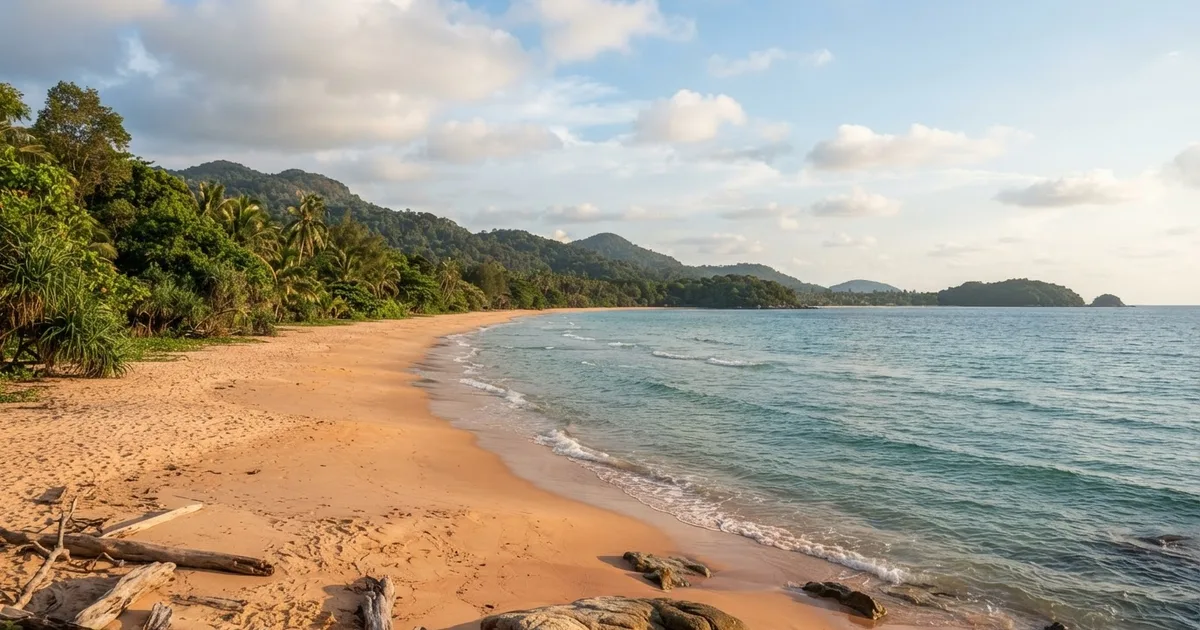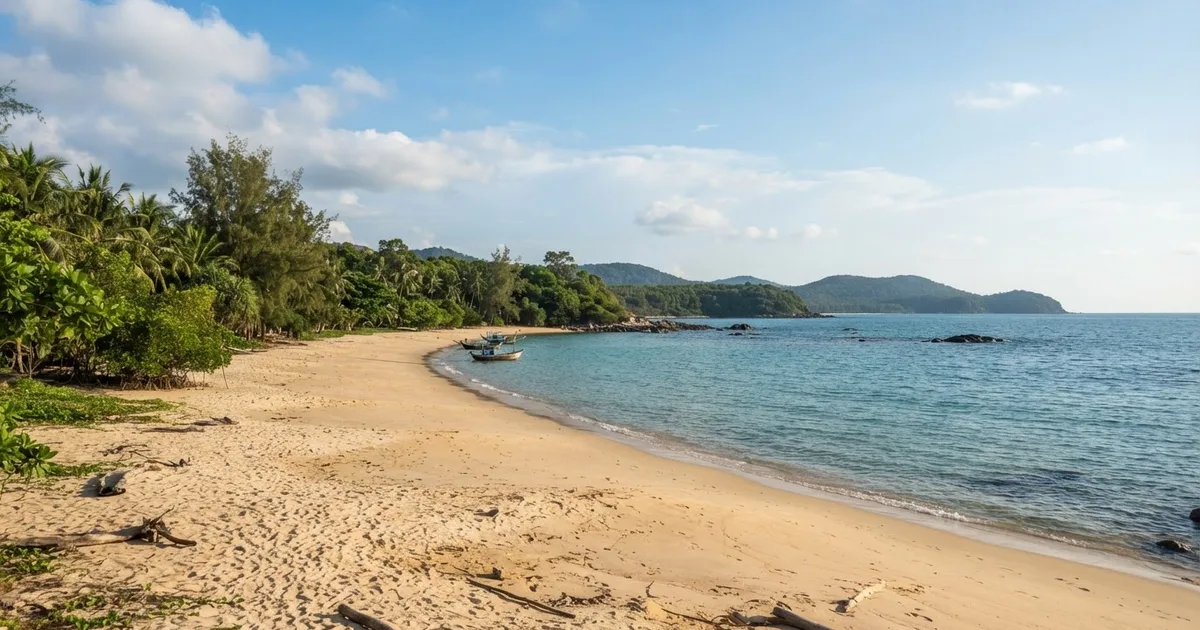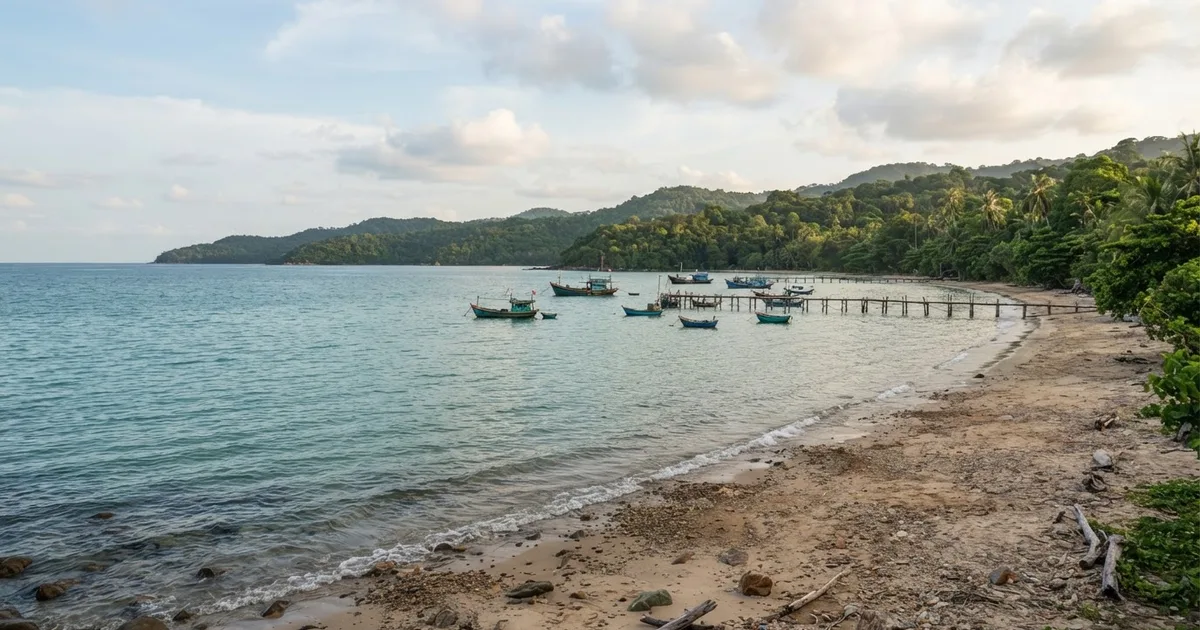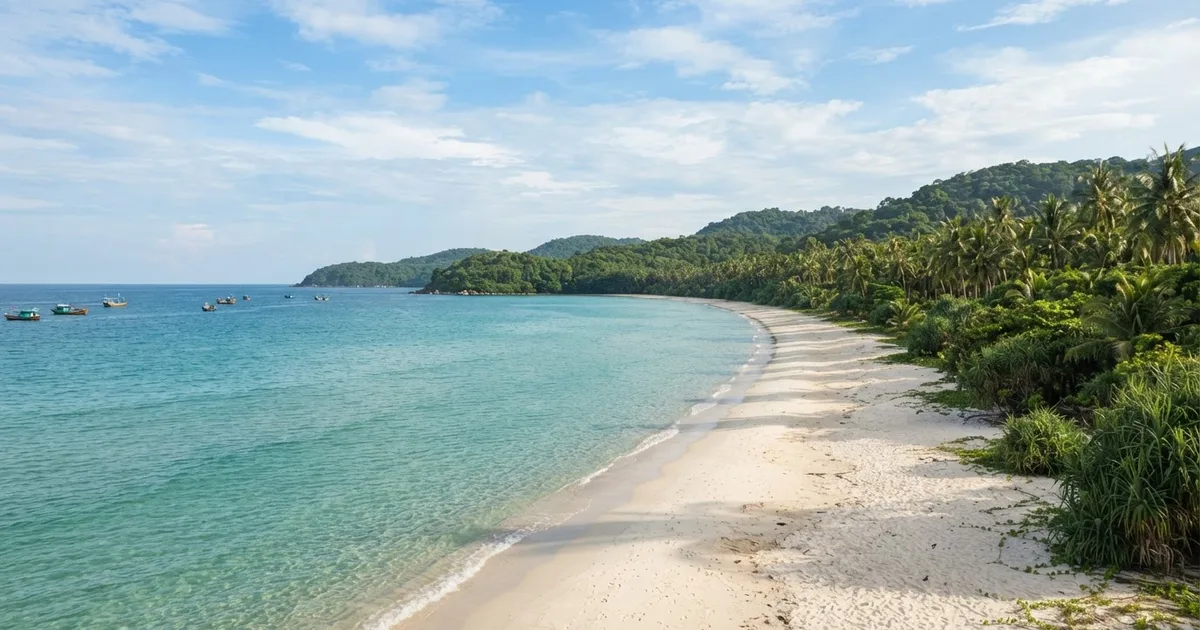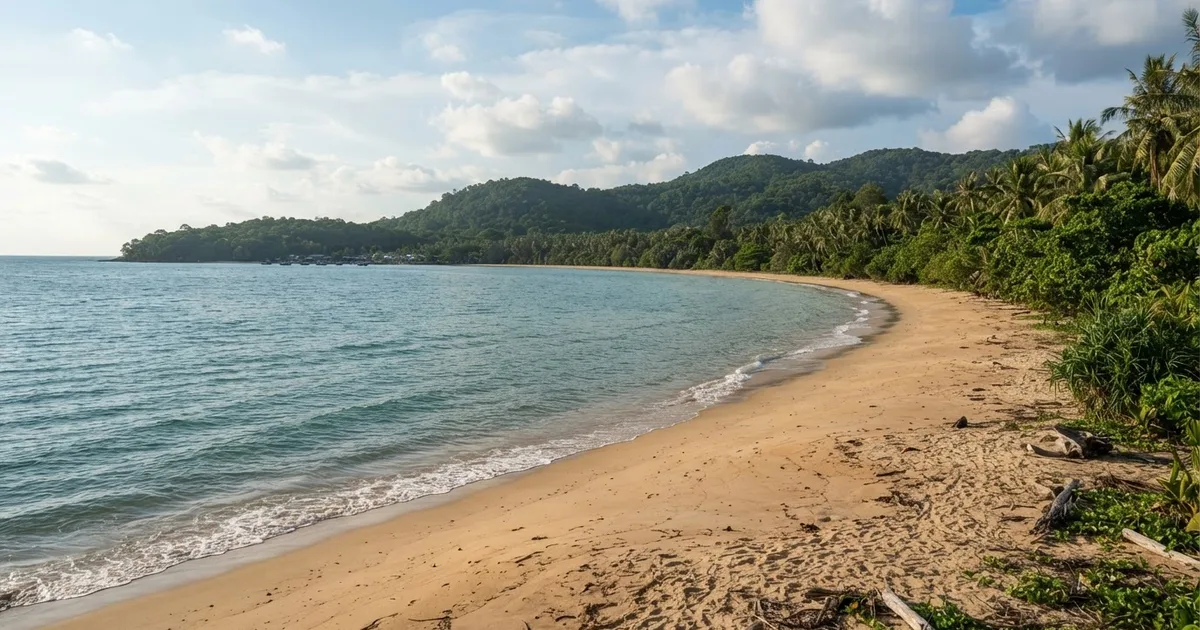
Cua Can Beach (Cửa Cạn) is the closest thing Phu Quoc has to a free, undiscovered beach: a 15 km, roughly 25-30 minute ride north of Duong Dong, with fine soft sand, coconut palms, no entrance fee and very few people. In the dry season (November to April) the gently sloping sandbar gives shallow, clear water that is genuinely good for wading and calm family swimming. From June to September the Cua Can River runs high and pushes silt into the sea, turning the water near the river mouth murky - so swim on the open sand, not at the estuary. There is no lifeguard service.
What and Where Is Cua Can Beach?
Cua Can Beach sits on Phu Quoc's west coast, roughly 15 km north of Duong Dong, between Ong Lang Beach to the south and the Ganh Dau peninsula to the north. The name is written both ways on the island: locals say Cua Can, and Vietnamese signage uses Cửa Cạn - literally the "shallow estuary", which describes exactly what you find here. The Cua Can River drains the island's interior and meets the sea in the middle of the beach, splitting the sand into a southern stretch and a longer, emptier northern stretch.
The shoreline itself is a band of fine, soft sand backed by coconut palms and dense green scrub, with almost no construction on the public sections. There are no beach clubs, no rows of sunbeds, no water-sports touts and no ticket booth. That is the whole appeal: this is a working natural beach rather than a resort product. The trade-off is that there is very little to do beyond swim, paddle and watch the horizon, so come prepared with your own water, snacks and shade.
A resort holds a private stretch of sand close to the river mouth, but reviews of that particular beach are mixed and most visitors find the public sand further north cleaner, wider and quieter. Bring a mat or a light hammock-friendly setup and you effectively have the same experience for free.
If you only have time for one northern beach day, pair Cua Can with a stop at Ong Lang Beach about 8 km south on the way home - Ong Lang has sunset bars and food, Cua Can has the emptiness.
How to Get to Cua Can Beach: Motorbike, Taxi and Costs
The easiest and cheapest way to reach Cua Can Beach is by motorbike from Duong Dong town. From the centre, head east along Cach Mang Thang 8 Street, then follow the coastal road north towards Cua Can and Ganh Dau. The route is paved the whole way, with the last few hundred metres turning to soft sand near the beach access. Renting a scooter on the island typically costs 150,000-300,000 VND per day (roughly $6-12), including helmets, and a return trip of 30 km uses well under two litres of petrol at around 25,000-30,000 VND per litre.
If you would rather not drive, a metered or pre-booked taxi from Duong Dong to Cua Can runs about 350,000-500,000 VND one way (roughly $14-20), and a ride-hailing app is usually a little cheaper for a car and around 150,000-200,000 VND for a motorbike ride. Agree the pickup time with your driver or keep the app open for the return leg, because there is no taxi rank waiting at the beach. Hiring a car with a driver for a half day is a comfortable option for families.
| Option | Typical cost (one way) | Travel time | Notes |
|---|---|---|---|
| Rented motorbike | 150,000-300,000 VND per day + fuel | 25-30 min | Most flexible; park on hard ground, not soft sand |
| Taxi from Duong Dong | 350,000-500,000 VND | 25-30 min | Best for families and groups of 3-4 |
| Ride-hailing car | 300,000-450,000 VND | 25-30 min | App coverage in the north can be patchy for the return |
| Ride-hailing motorbike | 150,000-200,000 VND | 30 min | One rider only, no beach gear |
| Private car with driver | 900,000-1,400,000 VND half day | Flexible | Good for combining Cua Can with Ong Lang and the safari |
There is no parking fee as such, but informal vendors who watch motorbikes may expect a 10,000-20,000 VND tip (under $1). Arrive before 4 pm if you want daylight for the ride back - the coastal road north of Ong Lang has few streetlights and wandering dogs after dark.
Swimming Conditions at Cua Can Beach, Month by Month
Cua Can's sea state is driven by two things: the monsoon and the river. In the dry season the beach has a gently sloping sandbar and relatively shallow water, which is why it has a reputation as a calm, family-friendly swimming spot. In the rainy season the west coast of Phu Quoc takes higher waves and the river outflow carries sediment straight into the bay, so the water quality at the river mouth and the open sand can be very different on the same day.
| Period | Sea state | Clarity on open sand | Clarity at river mouth | Verdict |
|---|---|---|---|---|
| November - February | Calm, small swell, occasional strong afternoon breeze | Clear | Mostly clear | Good for wading and gentle swimming |
| March - April | Calmest and warmest of the year | Clearest | Usually clear | Best window of the year |
| May | Transitional, first afternoon showers | Mostly clear | Can cloud after rain | Fine early in the month |
| June - September | Choppy on the west coast, higher swell | Often clear away from the estuary | Murky, brown plume | Swim only on open sand, well clear of the mouth |
| October | Rains taper, occasional storms | Improving | Recovering slowly | Variable; check conditions on the day |
Practical rule: if the Cua Can River is running high or brown, walk 150-300 metres north of the river mouth and swim there instead. The open sand clouds far less after rain, and the water is usually shallow enough to stand in comfortably. The name "shallow estuary" is not marketing - the sandbar genuinely shelves very gently for the first 20-30 metres.
Check the river colour from the bridge before you commit. If the river under the bridge is brown and moving fast, the beach at the mouth will be murky for at least a day afterwards.
The River Mouth: Why It Changes Everything
The Cua Can River is the single most important feature to understand before you swim here, because it affects both water quality and safety. The estuary channel can change depth unexpectedly - the flat sandbar that you walked out on can drop away into a deeper, faster-moving channel within a few metres, especially on an outgoing tide or after heavy rain when the river is pushing hard against the sea.
Phu Quoc has no reported lifeguard cover at Cua Can Beach. That means no flags, no patrols and no one watching the water, so the responsibility sits entirely with you. Swimmers should avoid the river channel when it is flowing strongly, and anyone who is not a confident swimmer is better off staying on the sandbar side altogether.
Children need particular care. The calm dry-season water genuinely does make this a good beach for families, but only on the flat sandbar on the open-sand side, well away from the main channel and with life jackets on. A child can be standing in knee-deep water on the sandbar and be two steps from a noticeably deeper drop at the channel edge.
Finally, remember that this is an unmanaged beach. There is no shower block, no first-aid post and no rubbish collection on the sand, so take everything back with you.
Who Cua Can Beach Suits - And Who It Does Not
Cua Can is a very specific kind of beach day. It rewards travellers who want space, silence and a free stretch of sand, and it frustrates anyone expecting services, shade rentals or a guaranteed swimmable sea in every season.
Great for
- Couples and solo travellers with a rented motorbike who want an empty beach 15 km from Duong Dong
- Families with young children in the dry season, swimming on the flat sandbar with life jackets
- Photographers and drone pilots looking for palms, sand and no crowds
- Travellers who want a genuine free public beach with no entrance fee or resort gate
Less suited to
- Anyone visiting between June and September expecting clear turquoise water at the river mouth
- Travellers who want sunbeds, umbrellas, beach bars, showers or lifeguards
- Non-swimmers and weak swimmers, because there is no supervision and the channel has depth changes
- Visitors without transport - there is no public bus and no taxi rank at the beach
- People who want a full day of activities; beyond swimming and paddling there is little to do
If you fall into the second group, consider Ong Lang Beach 8 km south for sunset bars and food, or Sao Beach in the south for a more organised, service-heavy beach day. Cua Can is not trying to compete with either.
What to Do Near Cua Can Beach
The beach itself is a two-hour stop, so build it into a half-day loop. The most natural pairing is the Cua Can River, which is popular for kayaking and stand-up paddleboarding near the bridge; kayak hire is typically 100,000-200,000 VND per hour (roughly $4-8) and the sheltered upper river is calm even when the coast is choppy.
Cua Can village, a short ride inland from the sand, is a genuine local fishing settlement rather than a tourist strip, with small seafood eateries where a grilled fish or a bowl of noodle soup costs a fraction of Duong Dong prices. A couple of pearl farms and small producers sit along the coastal road between Duong Dong and Cua Can and make an easy 30-minute stop on the way.
Heading north, Vinpearl Safari and the Grand World complex are roughly 15-20 km away, and the starfish beach at Rach Vem is a further 25 km or so up the coast. Heading back south, Ong Lang Beach is about 8 km, and Duong Dong with its night market is the full 15 km. A comfortable plan is: Cua Can mid-morning, kayaking on the river, lunch in the village, Ong Lang for sunset, then the night market in Duong Dong.
Tide and season matter more than time of day here. Mid-morning to early afternoon on a dry-season day gives you the widest sandbar and the clearest water.
Practical Checklist for a Cua Can Beach Day
- Bring at least 1.5 litres of drinking water per person - there are no shops on the sand
- Pack reef-safe sunscreen, a hat and a light long-sleeve layer; shade is limited to the palms
- Take a dry bag for phones and keys if you plan to wade or paddle
- Wear sandals or water shoes for the hot sand and the shell fragments near the estuary
- Bring life jackets for children and swim only on the flat sandbar, away from the river channel
- Carry cash in small notes (10,000-50,000 VND) for parking tips and village food
- Fill the fuel tank in Duong Dong or Cua Can village before the coastal stretch north
- Take all rubbish away with you; the beach has no bins or collection service
- Save an offline map - mobile signal is patchy on parts of the northern coast road
Best Time to Visit and a Half-Day Plan
The best time to visit Cua Can Beach is the late dry season, particularly March and April, when the sea is at its calmest and clearest and the sandbar is widest. November to February is also excellent, though the afternoon breeze picks up. Avoid June to September if clear water is your priority: the west coast gets higher waves and the river mouth turns murky, even though the open sand further north often stays swimmable.
A realistic half-day itinerary from Duong Dong: leave at 8:30 am, ride the 15 km north along the coastal road, arrive around 9:00 am and swim on the northern sandbar. Paddle or kayak on the Cua Can River around 11:00 am, eat a late lunch in Cua Can village at about 12:30 pm, then either continue north to the safari and Grand World or turn south for sunset at Ong Lang Beach. You will be back in Duong Dong in time for the night market, having spent almost nothing on the beach itself.
Frequently Asked Questions
Is there an entrance fee to visit Cua Can Beach?
No. Cua Can Beach is a public natural attraction with no entrance fee, no gate and no ticketed access - you can walk onto the sand from the coastal road at any hour. The only money you may spend is a small informal parking tip of 10,000-20,000 VND (under $1) with a local vendor, plus fuel or taxi fare to get there.
How far is Cua Can Beach from Duong Dong?
About 15 km north of Duong Dong town, which takes roughly 25-30 minutes by motorbike or taxi. From the centre, head east along Cach Mang Thang 8 Street and then follow the coastal road north. A taxi costs around 350,000-500,000 VND one way, so agree a return pickup or keep a ride-hailing app open.
Is Cua Can Beach good for swimming?
Yes in the dry season. From November to April the sea is calm and shallow over a gently sloping sandbar, which makes it suitable for gentle swimming and wading. In the rainy season the west coast gets higher waves and the river outflow clouds the water, so swim on the open sand well away from the river mouth.
When is the water clearest at Cua Can Beach?
March and April are usually the clearest months, at the end of the dry season, followed closely by November to February. The most consistent clarity is on the open sand 150-300 metres away from the river mouth; the estuary itself clouds fastest after any rain, and stays murky for a day or more once the river runs high.
Why is the sea sometimes brown or murky at Cua Can?
Silt from the Cua Can River. During the rainy season, roughly June to September, the river runs high and carries sediment straight into the bay, creating a brown plume around the river mouth. The open sand further along the beach often stays clear, which is why locals simply move up or down the beach after heavy rain.
Is Cua Can Beach safe for children?
The calm, shallow dry-season water makes it a good beach for families, but there is no lifeguard cover and the river channel can change depth unexpectedly. Keep children on the flat sandbar away from the main channel, put them in life jackets, and never let them swim unsupervised. Avoid the estuary entirely when the river is flowing strongly.
Are there restaurants, sunbeds or lifeguards at Cua Can Beach?
No lifeguards, no sunbed or umbrella rental and no beach bars on the public sand - the beach is barely developed, so there is little to do beyond swimming, paddling and watching. Small seafood eateries in Cua Can village, a short ride inland, serve cheap local food, so bring your own water and snacks for the beach itself.
Can I visit Cua Can Beach without renting a motorbike?
Yes. A taxi or ride-hailing car from Duong Dong costs roughly 300,000-500,000 VND each way and takes 25-30 minutes, and a private car with driver for a half day runs about 900,000-1,400,000 VND. There is no public bus to the beach and no taxi waiting there, so plan your return trip in advance.
Planning a beach day at Cua Can? Sabrina Rental delivers serviced motorbikes and scooters to hotels in Duong Dong, Ong Lang and Cua Can, arranges taxis and private drivers, and can build a half-day northern coast loop around Cua Can Beach, the river and Ong Lang. Message us with your dates and we will sort the transport, the helmets and the local advice.
Contact Sabrina Rental