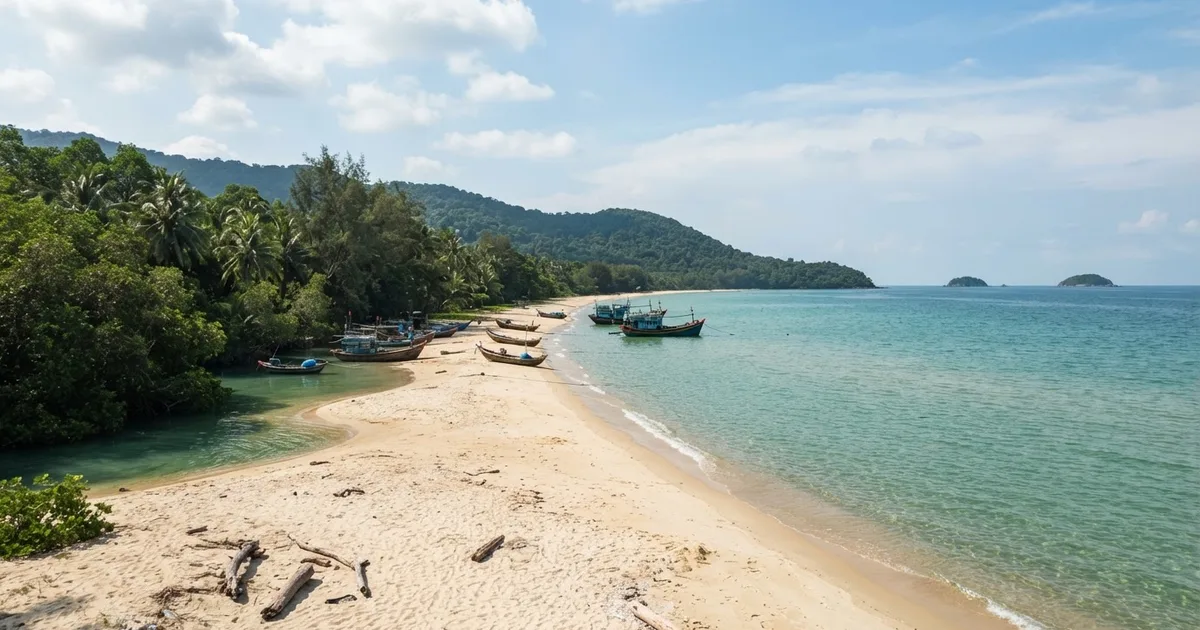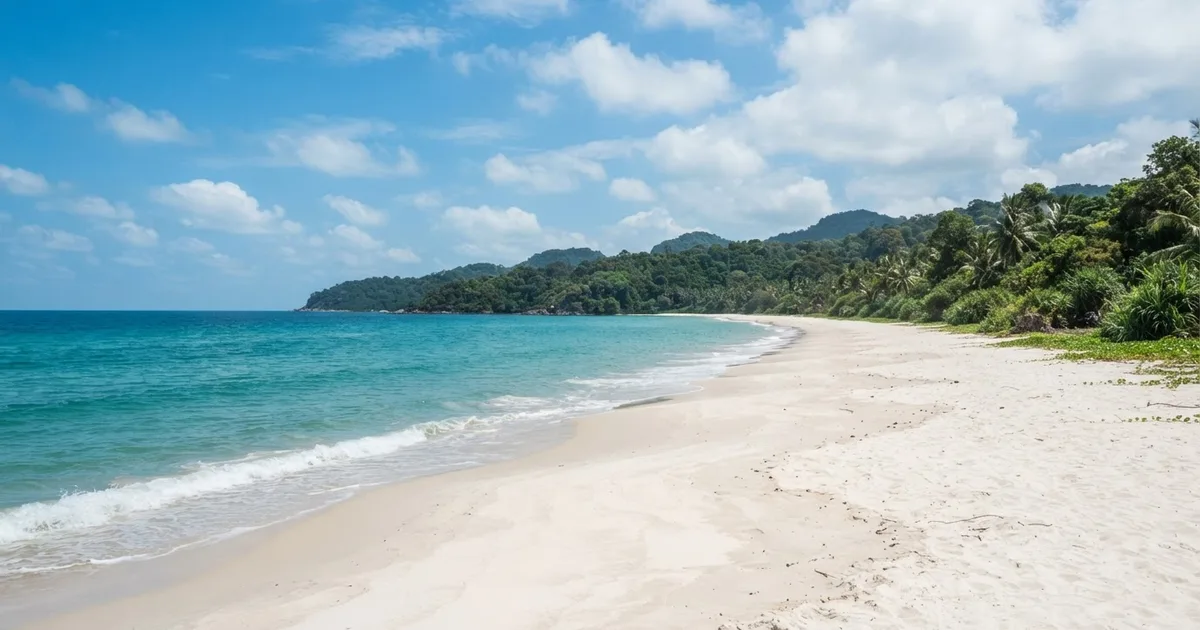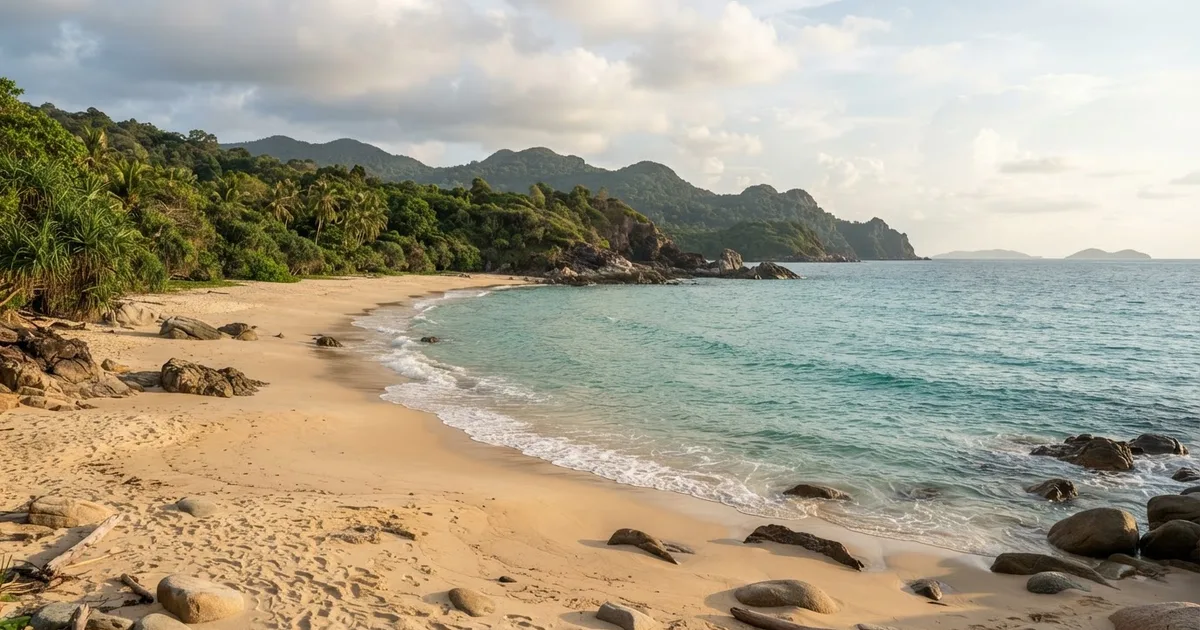
Đất Đỏ Beach (Bãi Đất Đỏ) is a free, undeveloped bay on Phu Quoc's southwest coast, reached only by a bumpy dirt road from the north or the south. There are no facilities, no lifeguards and no accommodation at the beach itself. Swimming is rated moderate at best and varies sharply by season — conditions are most stable from April through October, while the northern end of the bay is often not very clean and can be thick with jellyfish. Come for the emptiness, not the amenities.
Where Is Đất Đỏ Beach on Phu Quoc?
Đất Đỏ Beach sits on the south-west coast of Phu Quoc, the long thin island off Vietnam's Kien Giang province. It lies roughly halfway down the island's western flank — north of the An Thoi archipelago and its cable car, south of Duong Dong Town, the island's main town and ferry arrival point. Unlike the west-coast beaches that run north from Duong Dong (Ong Lang, Cua Can, Vung Bau), Đất Đỏ faces a quieter stretch of water and has never been absorbed into a resort strip.
The bay itself is genuinely pretty. One travel guide describes it as having soft golden sands and crystal-clear waters, and in the good months the water is calm enough that swimming is rated "pretty good." It is a rounded bay backed by palms and low scrub, with a long enough stretch of sand to walk for 20 to 30 minutes without meeting more than a handful of people — often none at all.
That said, the beach is not uniform. The northern part of Đất Đỏ Beach is often not very clean and can be thick with jellyfish in the warmer months. Debris and weed wash in from the north and tend to collect at that end. If you walk the bay, start at the southern end and work north, and judge the northern section on sight rather than on reputation.
There is no accommodation at Đất Đỏ Beach itself. No guesthouses, no bungalows, no beach bars, no parking attendant. What you see is sand, trees and, often, a few local fishing boats. That absence is exactly why some travellers rate it and why others drive past it.
How to Get to Đất Đỏ Beach
Every route to Đất Đỏ ends the same way: on a bumpy dirt road, approached either from the south or from the north. There is no sealed access road directly to the sand. In the dry season a standard motorbike or car handles it fine; after heavy rain the track gets rutted and slick, and a low-slung sedan will scrape.
If you are coming by car from Duong Dong Town, the standard route runs along Tran Hung Dao Street (DT46) and then onto Nguyen Trung Truc Street. From Duong Dong, allow roughly 45 minutes to an hour in dry conditions, longer if the final dirt section has been churned up. Public transport is limited: the practical option is the bus from Duong Dong Town heading toward An Thoi, then a walk or a short paid lift down to the beach — but no bus drops you at the sand, so budget extra time and carry water.
Most visitors arrive by rental motorbike or by hired car and driver. A rental bike on Phu Quoc typically runs 150,000–250,000 VND (about $6–10) per day, and a Grab or private car from Duong Dong to the An Thoi side of the island generally costs 250,000–450,000 VND ($10–18) depending on vehicle and negotiation. Agree on the price before you get in, and if you are going by car, ask the driver to wait — phone signal is patchy and there is no taxi rank at the beach.
| Option | Route | Approx. cost | Notes |
|---|---|---|---|
| Rental motorbike | Duong Dong → DT46 → Nguyen Trung Truc → dirt track | 150,000–250,000 VND/day ($6–10) | Best option. Not suitable for complete beginners on the dirt section. |
| Car or Grab | Duong Dong via Tran Hung Dao St (DT46) and Nguyen Trung Truc St | 250,000–450,000 VND ($10–18) | Ask the driver to wait for the return leg. |
| Public bus | Bus from Duong Dong Town toward An Thoi | Around 20,000–40,000 VND ($1–2) | Cheapest, slowest. Still leaves a walk or a short lift at the end. |
| From the south | Dirt road up from the An Thoi / Sun Group side | Free if self-driving | Rougher in the wet season; fine on a scooter in dry weather. |
| From the north | Dirt road down the coast from the Duong Dong side | Free if self-driving | Easier to get lost; bring an offline map. |
Local tip: Fill your fuel tank in Duong Dong or An Thoi before you turn off the paved road. There are no petrol stations on the dirt stretch, and the only "service" you will find at Đất Đỏ Beach is whichever local family happens to be fishing that day.
Swimming at Đất Đỏ Beach: Season by Season
This is the part most guides gloss over. Swimming at Đất Đỏ Beach is rated moderate at best, and conditions vary significantly by season. In the better months the bay is calm and the swimming is described as pretty good — soft golden sand, clear water, a gentle shelf into the sea. In the wrong months the same bay turns rough, and there is nobody on the sand whose job it is to tell you that.
The most stable window is April through October, which is when water conditions at Đất Đỏ Beach are at their best. Plan beach days in that period if swimming matters to you. November through March is the risky stretch on Phu Quoc's exposed coasts, when northeast winds build strong waves and conditions can be genuinely hazardous — and even on a more sheltered southwest bay like this one, swell and drift can shift fast within a single afternoon.
| Period | Typical water at Đất Đỏ | Swim verdict |
|---|---|---|
| April – October | Calmest and most consistent; clearest water | Best window. Swimming rated pretty good in the calmer weeks. |
| November – March | Wind-driven chop, stronger waves, shifting sand | Risky. Treat swimming as optional and stay shallow. |
| After heavy rain | Murky, debris and runoff along the shoreline | Skip it. Visibility drops and the water carries rubbish. |
Three safety facts matter more than any rating. First, there are no lifeguards at Đất Đỏ Beach — none at all, in any month. Second, there are no facilities: no first-aid point, no shade to rent, no phone-charging, no fresh water to rinse off with. Third, you should never swim alone here. Because the bay is empty most days, there is no one to notice if you get into trouble, and no one to raise an alarm.
Jellyfish deserve their own mention. The northern half of the bay is frequently thick with them, and the problem peaks when the water is warm and calm — precisely the conditions that make swimming appealing. Wear a rash guard or long-sleeved swim top, shuffle your feet in the shallows rather than diving straight in, and keep vinegar or a sting-relief cream in your bag. If the sand at the north end is dotted with stranded jellies, that is your cue to swim at the southern end, or not at all. And if you are travelling with small children or weak swimmers, be honest: this is not the beach for them.
Facilities, Food and Where to Stay Near Đất Đỏ Beach
There are no facilities at Đất Đỏ Beach. That means no toilets, no changing rooms, no showers, no restaurants, no beach chairs, no umbrella rental, no bins to speak of. Bring everything you need and carry everything back out with you.
The nearest places to stay are to the south, in the Sun Group resort and theme-park area around An Thoi — the same zone that includes Sunset Town, the Kiss Bridge and the long Hon Thom cable car out to the islands. That area has hotels at every price point, plus restaurants, convenience stores and a night market, which makes it the logical base if you want Đất Đỏ as a day trip rather than as your whole trip. An Thoi is also where the bulk of Phu Quoc's boat trips and island-hopping departures leave from.
Because the beach has no food, plan your day around it. Eat in Duong Dong before you drive down, or in An Thoi afterwards; pack at least two litres of water per person, a proper picnic, and a bag for your rubbish. If you are staying on the island long-term, note that there is no convenience store of any kind within easy reach of the sand.
What to bring to Đất Đỏ Beach
- Two or more litres of drinking water per person
- Food — there is nothing to buy at the beach
- Rash guard or long-sleeved swim top for jellyfish protection
- Vinegar or sting-relief cream
- Reef-safe sunscreen and a hat; shade is whatever the palms give you
- Sarong or towel — no changing rooms exist
- Cash in small notes; no card readers, no ATMs
- A rubbish bag to take your waste back to town
- Offline maps and a power bank; signal is unreliable on the dirt road
Who Đất Đỏ Beach Suits — and Who Should Skip It
Đất Đỏ is a specialist beach, not an all-rounder. If you want a lounger, a cocktail and a lifeguard, Phu Quoc has better answers — Sao Beach and Ong Lang both offer far more infrastructure. If you want a bay that is genuinely empty, with the trade-off of zero comfort, Đất Đỏ delivers.
The same logic applies to nearby Bãi Bổn Beach, which is described as one of Phu Quoc's emptier stretches of coastline and suits travellers seeking a genuinely peaceful beach rather than a lively scene. The two make a natural pairing for anyone building a "quiet coast" itinerary.
A great fit if you…
- Have your own transport and are comfortable on an unsealed road
- Want an empty beach with no entrance fee and no crowd
- Visit between April and October and mainly want to walk, swim briefly, and photograph the bay
- Are happy to be self-sufficient — water, food, shade, first aid
- Are based in An Thoi or Duong Dong and want a half-day escape
A poor fit if you…
- Want facilities: toilets, showers, sunbeds, food, drink service
- Are travelling with very young children or non-swimmers
- Visit between November and March and expect calm water
- Only have a low-clearance car or no vehicle at all
- Need guaranteed swimming conditions or a lifeguard present
- Want a lively beach scene with music, bars and people
Best Time of Day and How to Pair It With Nearby Beaches
Đất Đỏ faces roughly south-west, which makes it a late-afternoon beach. Arrive by about 15:30 and you get softer light, cooler sand and — on a clear day — a sunset over the water with no buildings in the frame. Mornings are calmer for swimming but hotter for the walk down, and the dirt road is at its best before the daily traffic has churned it up.
A sensible itinerary looks like this: leave Duong Dong or An Thoi after an early lunch, drive the Tran Hung Dao Street (DT46) and Nguyen Trung Truc Street route, spend two to three hours on the sand, swim only if the water is calm and only with company, then continue south to An Thoi for dinner in the Sunset Town area. If you have a full day, add a stop at one of the island's other quiet stretches — Bãi Bổn to the north is a similarly empty option — and keep the busy beaches like Sao for a different day.
Do not treat this as a full-day beach destination. Three hours is ample. And build in daylight for the return trip: the dirt road is unpleasant in the dark, and there is no lighting on it whatsoever.
Timing tip: If you only have one day on Phu Quoc's west coast, spend it at a serviced beach and skip Đất Đỏ. If you have three or more days and a rental bike, Đất Đỏ is worth half a day — especially on a weekday, when you may have the entire bay to yourself.
Frequently Asked Questions
Is there an entry fee to visit Đất Đỏ Beach?
No. Đất Đỏ Beach has no entry fee and no gate — it is a free, open stretch of public coastline, accessible at any hour. The only costs are your transport, fuel and any food and water you bring with you from town.
Can you swim at Đất Đỏ Beach?
Yes, but with caveats. Swimming is rated moderate at best. Conditions are most stable from April through October, when the water is calm and swimming is described as pretty good. November through March brings wind-driven chop. There are no lifeguards, so never swim alone.
When is the best time of year to visit Đất Đỏ Beach?
April through October. This is the period when water conditions at Đất Đỏ Beach are at their best, with calmer seas and clearer water. The riskier months are November through March, when northeast winds create strong waves on Phu Quoc's exposed coasts.
Is there anywhere to stay at Đất Đỏ Beach?
No. There is no accommodation at Đất Đỏ Beach at all — no hotels, guesthouses or bungalows. The nearest places to stay are to the south in the Sun Group resort and theme-park area around An Thoi, roughly 15 to 20 minutes away by car. Duong Dong Town is a longer but well-serviced alternative.
How do I get to Đất Đỏ Beach?
By car from Duong Dong Town via Tran Hung Dao Street (DT46) and Nguyen Trung Truc Street, or by rental motorbike. The final approach is always a bumpy dirt road, reachable from either the north or the south. Public transport is a bus from Duong Dong Town toward An Thoi, plus a walk or short lift at the end.
Are there jellyfish at Đất Đỏ Beach?
Yes, particularly at the northern end of the bay, which can be thick with jellyfish — worse in the warm, calm months. The northern section is also often not very clean, with debris washing in. Swim at the southern end, wear a rash guard, shuffle rather than dive, and carry sting-relief cream.
Are there restaurants, toilets or shops at Đất Đỏ Beach?
None. There are no facilities of any kind: no toilets, showers, changing rooms, restaurants, beach chairs or shops. Bring at least two litres of water per person, your own food, and a bag to carry your rubbish back out. Buy fuel and supplies in Duong Dong or An Thoi beforehand.
Is Đất Đỏ Beach safe for children?
Generally no — not as a swimming beach. There are no lifeguards, no first-aid facilities and no shade to rent, and the bay is usually empty, meaning nobody would notice an emergency. Strong swell in the November-to-March window makes it worse. Families are better served by serviced beaches like Sao or Ong Lang.
Planning a quiet-coast day on Phu Quoc? Sabrina Rental can sort your rental motorbike or car, arrange a driver who knows the dirt-road turnoffs to Đất Đỏ Beach, and match you with a room in An Thoi or Duong Dong close enough to make it an easy half-day trip.
Ask Sabrina About Bikes, Cars and Rooms