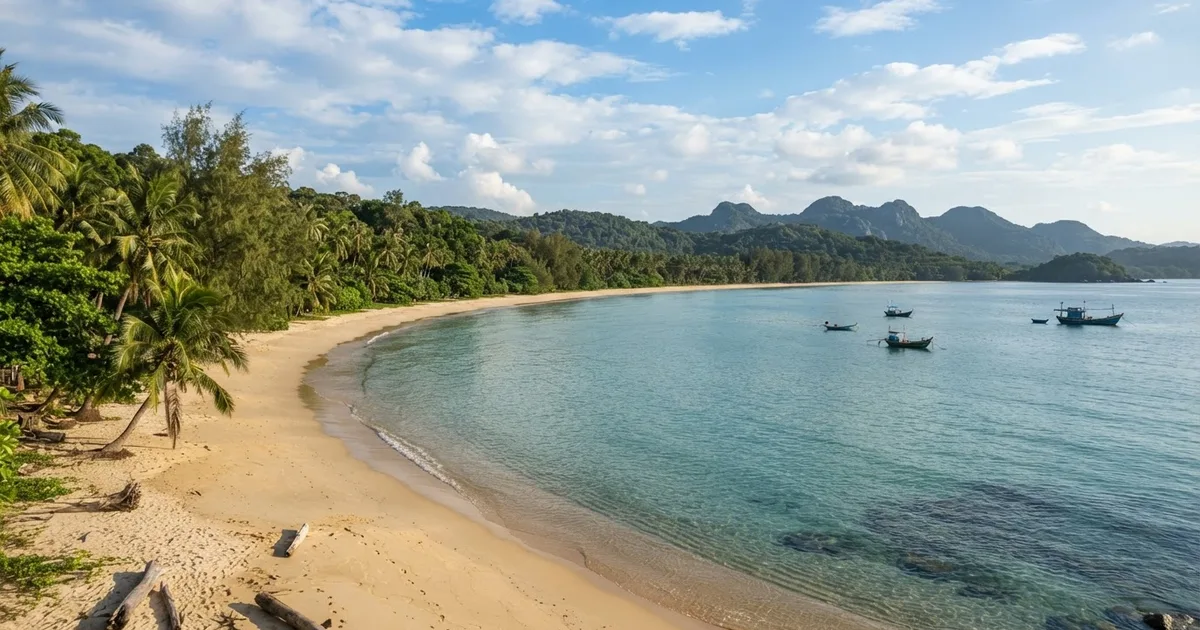
Bãi Bổn Beach is a free, undeveloped stretch of Phu Quoc's east coast — soft, light-coloured sand in places, a mostly rocky shoreline, and no entrance fee, no sunbeds and no lifeguards. It is a beach for quiet scenery and empty coastline rather than a swimming day: the water is only reliably calm and clear from November to April, and even then it can be shallow. If you want a classic swim-and-beach-chair afternoon, head to Sao Beach or Long Beach instead.
Where Is Bãi Bổn Beach on Phu Quoc?
Bãi Bổn sits on Phu Quoc's east coast, along the coastal road that runs south from Ham Ninh fishing village toward the island's southern tip. It is on the opposite side of Phu Quoc from the sunset beaches of Long Beach and Ong Lang, which means it behaves like a completely different island: no sunset, no beach bars, and far fewer people.
You reach it by scooter or car on the east-coast road, and in most cases the final approach is on a small dirt or concrete path rather than a paved driveway — there is no big signposted resort entrance. From Duong Dong, the island's main town, plan on roughly 20 to 30 minutes of riding depending on your starting point and how often you stop for photos. From Ham Ninh, it is a short hop of a few minutes.
There is no entrance fee and no ticket gate. Local listings do not mention any charge for Bãi Bổn, and Phu Quoc's public beaches in general — Long Beach, Sao Beach and the rest — are free and open access. What you will not find is infrastructure: no car park with an attendant, no rental chairs, no drinks stand. Treat it as a wild beach that happens to be reachable by road.
| Bãi Bổn at a glance | Detail |
|---|---|
| Location | East coast of Phu Quoc, on the coastal road south of Ham Ninh |
| Access | Scooter or car via the east-coast road, then a short small path |
| Entrance fee | None — free public beach |
| Shoreline | Mostly rocky, with some soft light-coloured sand sections |
| Water | Calm and clear in good conditions; shallow or less clear in rough periods |
| Facilities | Very limited — no lifeguards, no chairs, no food stalls |
| Best season | November to April (peak clarity December to February) |
Is Bãi Bổn Beach Good for Swimming?
Honestly: not really, and it is worth saying that plainly before you ride across the island for a swim. Bãi Bổn is generally not ideal for swimming because the sea can be shallow, rocky or pebbly, and less clear than the west-coast beaches — a pattern that applies to much of Phu Quoc's east coast. The beach is most dependent on calm conditions. When the sea is flat, you get clear water and a pleasant paddle; when it is not, the water turns shallow and murky and swimming stops being appealing.
The bigger picture is seasonal. Phu Quoc's beaches have their clearest water in the dry season from November to April, with a stronger clarity window from December to February. From around May to October, the rainy season makes the sea rougher and the water often less clear across the island, and the east coast feels it as much as anywhere.
Even in the best months, Bãi Bổn's shallows hide stones. Bring sandals or reef shoes if you plan to wade in, and walk the waterline before you commit to a swim spot. There are no lifeguards and no flagged swimming zones here, so you are entirely responsible for your own judgement.
Bãi Bổn is a good fit if you want…
- An empty beach with almost no other visitors
- Photographs of rocky coastline, fishing boats and floating fish farms
- A quiet scooter ride along the east-coast road
- A free stop with no tickets, no parking fees and no crowds
- A short paddle or a foot-dip on a calm, clear day
Bãi Bổn is a poor fit if you want…
- A long, safe swimming session with clear turquoise water
- Sunbeds, umbrellas, beach bars or waiter service
- Lifeguards, showers, toilets or any beach facilities
- A family beach day with small children in the water
- A guaranteed beach day during the May to October monsoon
Best Time to Visit Bãi Bổn Beach, Month by Month
The single most useful planning rule for Phu Quoc beaches is this: November to April is the dry season, with sunny weather and calm seas; May to October is the monsoon period and the less favourable half of the year. Within the dry season, December to March is the peak — this is when you get the most reliable combination of flat water and blue sky.
For Bãi Bổn specifically, the calculation is slightly different from a west-coast beach. Because the east coast is quiet and scenic but has an empty coastline with very limited facilities, the reward for visiting is atmosphere rather than swimming. That makes the shoulder weeks at the start and end of the dry season genuinely attractive: you get the same emptiness with fewer people on the island overall. Tripadvisor notes that Phu Quoc beaches can be less crowded after peak season, with April described as light competition for beach chairs elsewhere on the island.
| Period | Sea and weather | Swimming at Bãi Bổn | Crowds |
|---|---|---|---|
| December – February | Peak dry season; clearest water of the year | Best chance of a pleasant dip, still watch the rocks | Highest island-wide, but Bãi Bổn stays quiet |
| March – April | Hot, sunny, sea usually still calm | Good on calm days; April can bring early haze and wind | April is lighter than peak season |
| November | Transition into the dry season; improving conditions | Variable — check the water before committing | Low |
| May – October | Rainy season; rougher sea, often less clear water | Not recommended — shallow or murky water is common | Very low |
Tip: If your trip falls between May and October and you still want a beach day, plan around the west and south coasts and check conditions on the morning itself. On Phu Quoc, a beach that looks unswimmable at 9am can be flat calm by 3pm — and the reverse is just as true.
What Bãi Bổn Beach Is Actually Like
Set your expectations to wild and quiet rather than polished. The sand at Bãi Bổn is soft and light in colour, and in good conditions the water is calm and clear enough to look genuinely inviting. But the coastline is mostly rocky, with sand in some sections rather than all along the shore. This is not the long, uninterrupted white-sand sweep you see in Phu Quoc's marketing photographs.
The sea on Phu Quoc's north and east coasts is very shallow and calm, and it is a working seascape: fishing boats and floating fish farms sit out on the water, and you will often see local fishing activity while you are there. That is a large part of the appeal. It is one of the emptier stretches of coastline on the island, which makes it a good match for travellers who want a genuinely peaceful beach rather than a lively scene.
What you will not find is any support structure. There are no restaurants on the sand, no shops, no toilets, no bins, no shade structures. The nearest food and drink is back in Ham Ninh or in Duong Dong. Bring everything you need and take everything out with you.
What to bring to Bãi Bổn
- At least 1.5 litres of water per person — there is nothing to buy at the beach
- Sandals or reef shoes for the rocky shallows
- Sun cream, hat and a light long-sleeve layer; east-coast shade is scarce
- A dry bag or waterproof phone pouch
- Snacks, and a bag to carry your rubbish back out
- A fully charged phone with an offline map — signal on the east coast can be patchy
- Cash in Vietnamese dong for fuel and any stop in Ham Ninh
Getting to Bãi Bổn: Scooter, Car or Taxi?
A scooter is the most practical way to reach Bãi Bổn. Automatic scooters are the standard rental on Phu Quoc and typically cost around 150,000 to 250,000 Vietnamese dong per day (roughly 6 to 10 US dollars), plus fuel — a full tank is inexpensive and covers a full day of island riding. The east-coast road is generally quiet, but it is also narrow in places, with sand, gravel and occasional livestock, so ride conservatively and wear a helmet.
A car or a private driver works too, and is the better option in the rainy season or if you are travelling with children. The catch is the return leg: because Bãi Bổn has no facilities and no taxi rank, a taxi that drops you off may leave you waiting a long time for a ride back. If you go by taxi, arrange a pickup time with the driver or keep a local taxi number saved.
Once you leave the main coastal road, expect to finish the approach on a small path. These paths are usually fine on a scooter in dry weather and considerably less fun after heavy rain. If a path looks too sandy or too steep, park at the road and walk the last stretch — it is rarely more than a couple of minutes.
Riding note: If you are not a confident rider, Phu Quoc's east coast is not the place to learn. Book a scooter you are comfortable with, test the brakes before you leave, and avoid riding the coastal road after dark — lighting is limited and the road surface is uneven in sections.
Who Bãi Bổn Suits — and Who Should Skip It
Bãi Bổn is one of the clearest examples on Phu Quoc of a beach where the experience depends entirely on what you came for. Travellers who want an empty coastline, a quiet place to sit with a book, and photographs of fishing boats and shallow water will find it memorable. Travellers who want to swim properly, rent a sunbed and order a smoothie will find it a wasted afternoon.
Families with young children should be cautious. The combination of shallow water, a rocky bottom and no lifeguards on Phu Quoc's east coast means there is no safety net if something goes wrong. Strong swimmers should also treat the water with respect: shallow does not mean harmless, and rocks under the surface are easy to miss.
It is also worth being honest about the trade-off in time. A round trip from Duong Dong costs you roughly an hour of riding. If your holiday is short and your priority is swimming, that hour is better spent on the west or south coast. If your priority is seeing a side of Phu Quoc that most visitors never reach, Bãi Bổn earns the ride — especially when combined with a stop in Ham Ninh for seafood.
Pairing Bãi Bổn With the Rest of the East Coast
Bãi Bổn works best as one stop on an east-coast loop rather than a single destination. Ham Ninh fishing village, a few minutes north, is the island's classic seafood stop, with stilted restaurants over the water and crab and shellfish sold by weight. Because the east coast is quiet and scenic but has an empty coastline and very limited facilities, planning your food and fuel around Ham Ninh and Duong Dong is essential.
A sensible half-day route looks like this: leave Duong Dong in the morning, ride the east-coast road south, stop at Ham Ninh for an early seafood lunch, continue to Bãi Bổn for an hour or two of quiet beach time, then loop back via the south of the island if you want to combine it with a stop at Sao Beach or the fishing village at An Thoi. Fuel up before you leave town — petrol stations on the east coast are sparse.
During the dry season from November to April this makes an excellent, low-traffic day out. During the May to October monsoon, keep the plan flexible and be prepared to abandon the beach stop if the sea is rough and the water is murky.
Frequently Asked Questions
Is there an entrance fee at Bãi Bổn Beach?
No. Bãi Bổn is free and open access, with no ticket gate and no parking fee mentioned in local listings. Like Phu Quoc's other public beaches such as Long Beach and Sao Beach, you simply arrive and walk onto the sand. Budget nothing for entry, but do budget for your own water, snacks and fuel.
Is Bãi Bổn Beach good for swimming?
Generally no. The sea can be shallow, rocky or pebbly and less clear than on the west coast, and it is heavily dependent on calm conditions. In good weather you can wade or take a short dip, but this is not a beach for a long, confident swim. There are no lifeguards on this stretch of coast.
What is the best time of year to visit Bãi Bổn Beach?
November to April, the dry season, when Phu Quoc's seas are usually calm and the water clearer. December to February gives the strongest clarity window. From May to October the rainy season makes the sea rougher and the water often less clear, so swimming becomes unattractive even though the beach itself remains open and quiet.
How do I get to Bãi Bổn Beach?
Take the east-coast road south from Ham Ninh, by scooter or car, then follow a small path for the final approach. From Duong Dong it is roughly 20 to 30 minutes of riding. A scooter rental typically costs about 150,000 to 250,000 dong (6 to 10 US dollars) per day plus fuel.
Are there restaurants, shops or toilets at Bãi Bổn?
No. Facilities are essentially non-existent: no food stalls, no shops, no toilets and no sunbeds on the sand. The nearest food and drink is in Ham Ninh fishing village or back in Duong Dong. Bring at least 1.5 litres of water per person and carry all your rubbish out with you.
Can I visit Bãi Bổn during the rainy season?
Yes, but go for the scenery rather than the water. Between May and October the sea is often rough and the water shallow or murky, so swimming is not recommended. The upside is that the east coast is at its emptiest, and the fishing boats and floating fish farms remain worth the ride if you have your own transport.
Is Bãi Bổn Beach crowded?
No — it is one of the emptier stretches of coastline on Phu Quoc. Even in peak dry season, from December to March, you may see only a handful of other visitors. Phu Quoc's beaches generally become less crowded after peak season, and Bãi Bổn stays quiet year-round because it has no facilities and no swimming reputation.
Do I need a scooter to reach Bãi Bổn Beach?
It is strongly recommended. A scooter gives you the flexibility to ride the east-coast road, stop where you like and leave when you want. A taxi can drop you at the access path, but there is no taxi rank at the beach, so you must arrange a return pickup in advance or you may be stranded.
Planning an east-coast day out on Phu Quoc? Sabrina Rental can sort your scooter, help you map a realistic route to Bãi Bổn and Ham Ninh, and give you honest, up-to-date advice on sea conditions before you ride.
Contact Sabrina Rental