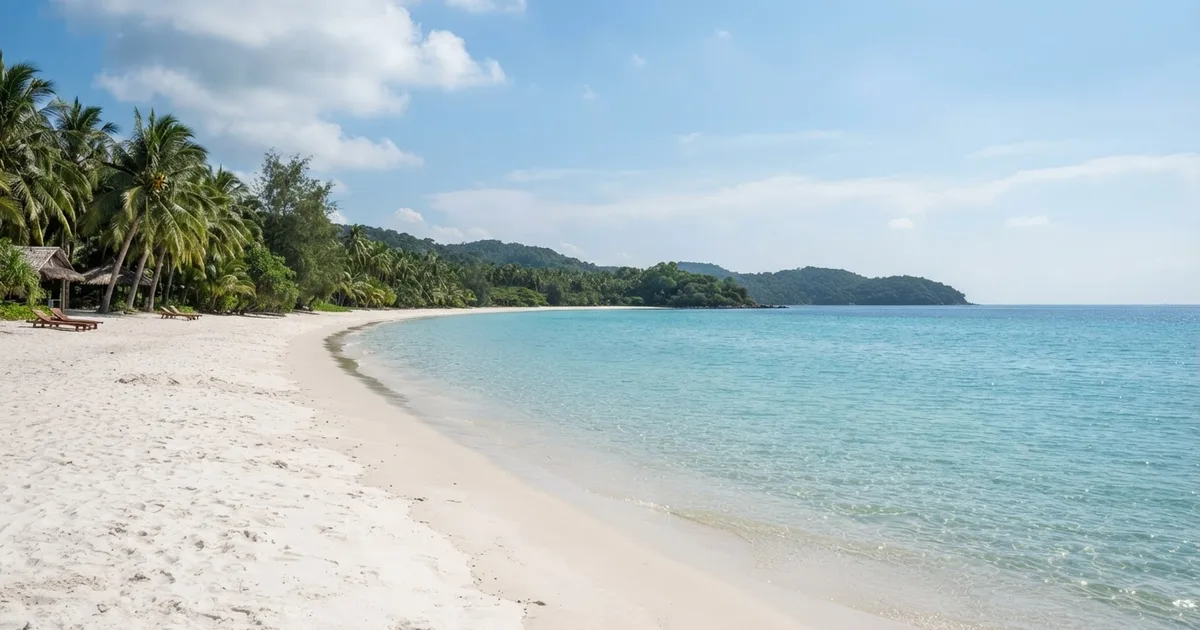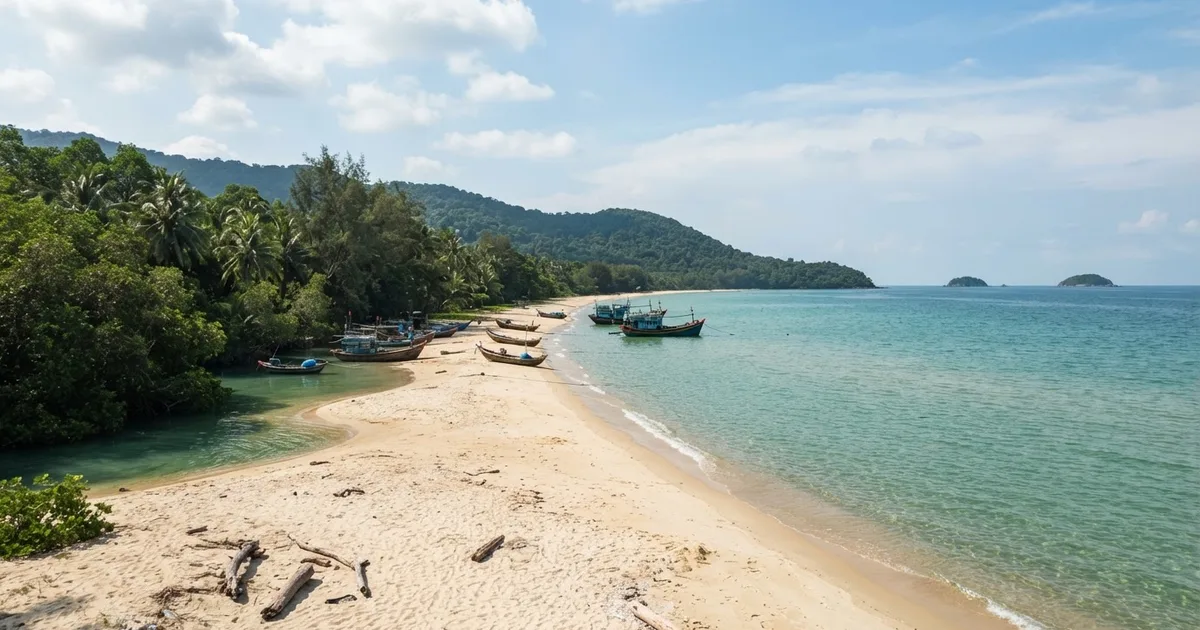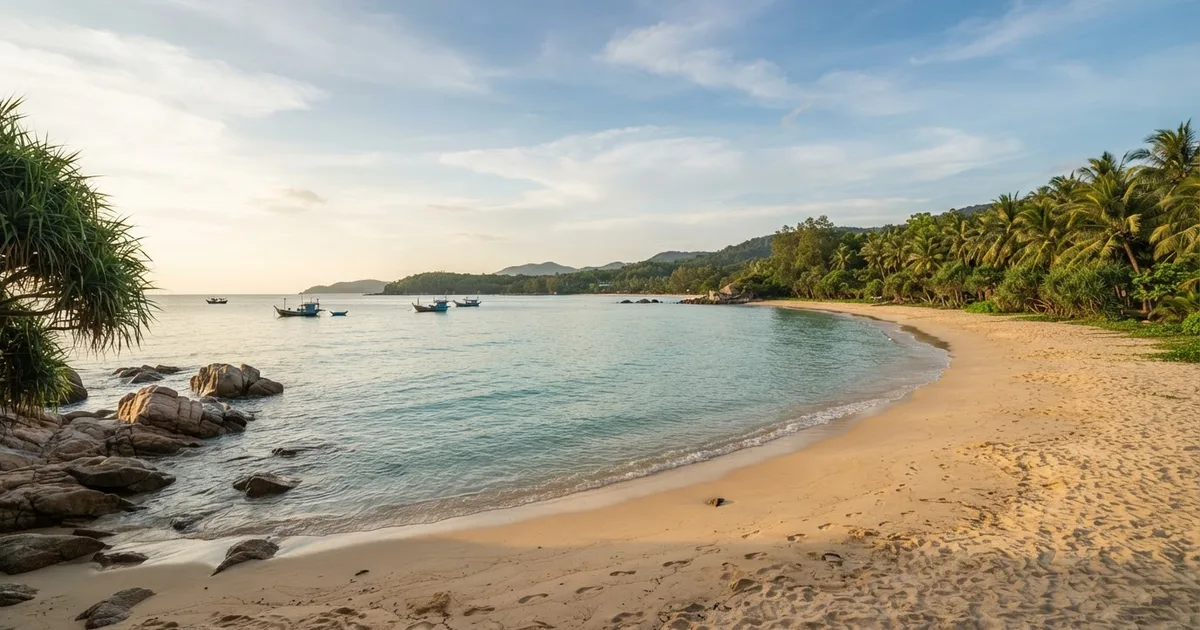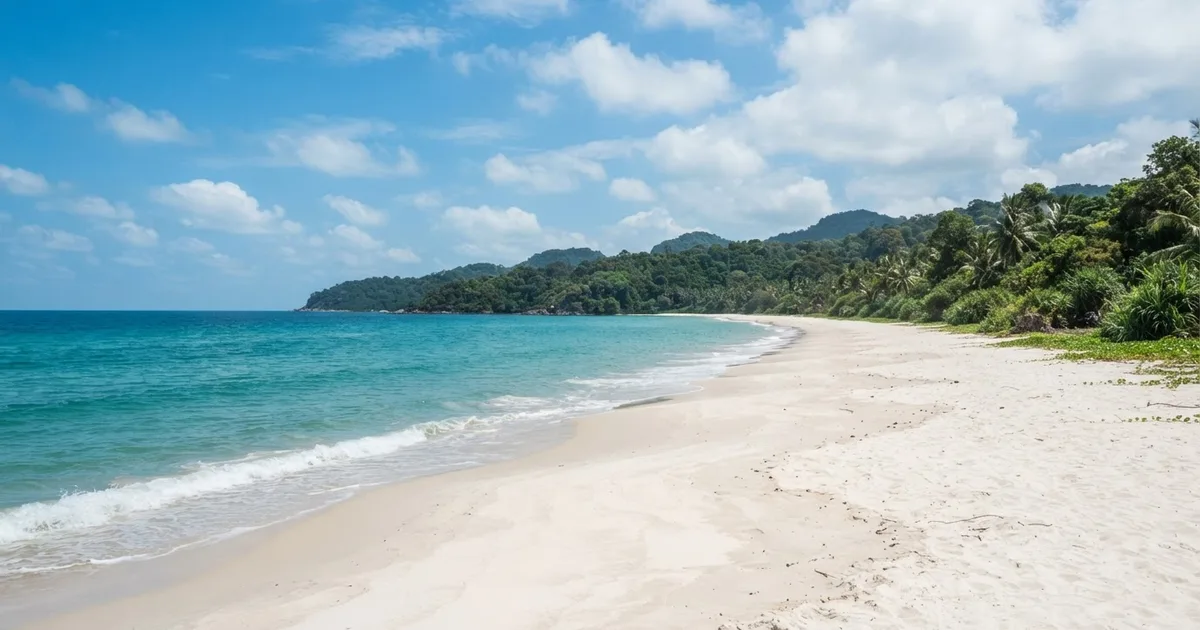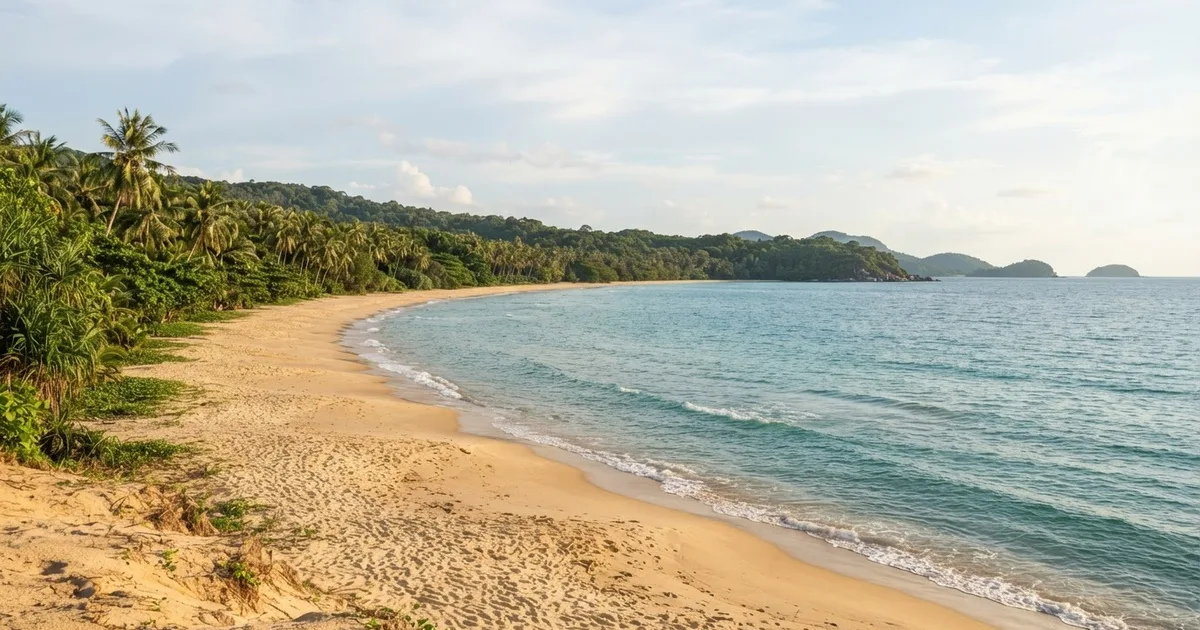
Trường Beach (Bãi Trường, also called Long Beach) is a roughly 20 km strip of fine yellow sand running from Dương Đông town south to An Thới, and it is Phu Quoc's most practical everyday swimming beach rather than its most photogenic one. It is free and open to the public, sun loungers at the beach clubs cost about 50,000–80,000 VND (roughly $2–3), and the sea is calm, shallow and clear enough for easy bathing from November to April. From May to October the southwest monsoon turns it choppy, murky and jellyfish-prone — that is the season to stay out of the water.
What Is Trường Beach? Phu Quoc's 20 km West-Coast Strip
Trường Beach — Bãi Trường in Vietnamese, and Long Beach in almost every English-language guide and hotel listing — is the long ribbon of fine yellow sand that follows Phu Quoc's western shoreline from Dương Đông town in the north down to An Thới at the southern tip. It measures roughly 20 km end to end, which makes it by far the longest beach on the island and the one most visitors meet first, because the international airport and the main town sit right at its northern end.
Two names cause most of the confusion. Bãi Trường and Long Beach are the same beach; some sources place it on the southwest coast, some on the west, and both are describing the same arc of sand, which curves from a north-south orientation in Dương Đông to a more southwesterly line as it approaches An Thới. If you book a hotel described as "Long Beach" and another described as "Bãi Trường", you are almost certainly booking the same stretch of coast.
What kind of beach is it? Honestly: a resort strip. Hotels, beach clubs, seafood restaurants and sunset bars back onto the sand for most of its length, and it is busy by Phu Quoc standards. It is also, with equal honesty, the island's practical everyday swim beach — the place locals, expats and long-stay visitors go for a quick dip before dinner rather than the place they take a day trip to photograph. Phu Quoc's postcard beaches are elsewhere: the white sand of Bãi Sao in the south, or the quieter coves around Ông Lang and Cửa Cạn further north.
Where Trường Beach wins outright is the evening. Bãi Trường is famous for its sunsets, and because the whole 20 km faces west, you get an unobstructed horizon over the Gulf of Thailand from almost anywhere along the sand. The classic view — sun dropping behind the islands offshore, fishing boats silhouetted — is best from the northern stretch near Dương Đông, where the beach is widest and the horizon least obstructed by headlands.
When to Visit Trường Beach: Season-by-Season Guide
The single most useful thing to know about Trường Beach is that its character changes completely between the two monsoons. In the dry season the sea is placid, shallow and clean enough for easy bathing. In the wet season the same beach faces the full force of the southwest monsoon.
| Period | Sea conditions | Water clarity | Swimming verdict |
|---|---|---|---|
| November – April (dry season) | Calm, shallow, gentle bathing; sea described as placid and clean for much of the year | Clearest of the year | Best window. Suitable for swimming, snorkelling and families |
| Late October & early May (shoulders) | Variable — usually swimmable, but wind-dependent | Good to moderate | Fine if the sea looks calm; some guides extend the season to November–May |
| May – October (southwest monsoon) | Choppy surf, strong onshore wind, jellyfish | Murky, with seaweed and debris washing in | Stay out of the water. Beach walks and sunsets only |
You will see slightly different date ranges quoted for the good season — some guides say November to April, some November to May, and one recommends the dry season from October to April. The practical answer is that November to April is the safe core, and the weeks immediately either side are usually fine if you use your eyes: flat water and a clean tideline mean go, brown water and breaking surf mean don't.
Water clarity follows the same pattern. Trường Beach is generally clear in the dry season and noticeably murkier in the wet season, when rain runoff and onshore swell push seaweed and debris onto the sand. If clear water for swimming is the priority, plan your trip around the dry months and treat any wet-season swim as a bonus rather than a plan.
Swimming at Trường Beach: Conditions and Safety
For most of the dry season, Trường Beach is genuinely easy swimming. Guides describe calm, shallow water that is gentle for bathing, with a beach that shelves gradually in most places — good news if you are wading in with children or nervous swimmers. Entry gradients do vary along a 20 km beach: some stretches stay ankle-deep for 30 metres, others drop off more quickly. Check your own stretch before you commit.
The critical safety fact is this: no lifeguards are reported at Bãi Trường. There is no flagged swimming zone, no patrol, and no one watching from a tower. That puts the responsibility entirely on you, and it matters more here than on a small sheltered cove, because Phu Quoc's west coast is exposed.
Swimming checklist for Trường Beach
- Swim only in allowed areas — if a resort or beach club marks a swimming zone, stay inside it.
- Do not swim far from shore. The drop-off and any current intensify quickly with distance.
- Watch for rip currents, which are a documented hazard on Phu Quoc beaches. If you are caught in one, swim parallel to the shore rather than against it.
- Never swim alone, and never swim after drinking, especially at sunset when the light goes fast.
- Between May and October, stay out of the water altogether — the monsoon brings choppy surf and jellyfish.
- Jellyfish also appear in the shoulder weeks. If you see them washed up on the sand, do not get in.
- Keep an eye on children at all times — the shallow, calm dry-season water is exactly what makes the beach appealing, and exactly why it is easy to look away.
Wet-season rule of thumb: from May to October, Trường Beach is a beach for walking, photographing and watching sunsets — not for swimming. The southwest monsoon drives choppy surf and jellyfish onto this coast, and with no lifeguards on duty, there is nobody to call you back in.
What Trường Beach Costs: Free Entry, Paid Comfort
Trường Beach is free and open access. There is no gate, no entry ticket and no charge to walk onto the sand or swim. What you pay for is comfort and facilities, and the charges are modest by international standards.
| Item | Typical cost | Notes |
|---|---|---|
| Beach entry | Free | Open public access along the whole 20 km |
| Sun lounger and umbrella at a beach club | 50,000–80,000 VND (about $2–3) | 2026 beach-guide pricing; often waived or offset if you order food and drinks |
| Drinks and food | 30,000–150,000 VND per item | Fresh coconut, beer, seafood and Vietnamese dishes at the beachfront venues |
| Resort private beach stretches | Varies; sometimes day-pass only | Some hotels restrict loungers to guests, or sell a day pass with a food credit |
| Watersports and boat trips | Quoted per activity | Booked through the beach clubs or operators in Dương Đông and An Thới |
The pattern along the strip is simple: pick a beach club, order a drink or a plate of something, and the lounger is usually yours for the afternoon. That is why the real cost of a day at Trường Beach is often less about the 50,000–80,000 VND sun lounger and more about how long you stay and how many coconuts you get through.
Bring small Vietnamese dong notes — cash is the default, and change for a 500,000 VND note can be a slow process at a busy sunset bar. Card payment is increasingly common at the larger venues but not something to rely on at a family-run beach shack.
Who Trường Beach Suits — and Who Should Skip It
Trường Beach is a good beach with a specific job. Being clear about who it is not for will save you a disappointing day.
Good fit if you are…
- Staying in Dương Đông or near the airport. The northern stretch is minutes away — the easiest real beach to reach on the island.
- Travelling with young children in the dry season. Calm, shallow, gently shelving water from November to April is close to ideal for paddling.
- A sunset chaser. The whole beach faces west and Bãi Trường is famous for its sunsets.
- On a long stay and want a daily swim. This is the practical everyday swim beach, not a day-trip destination.
- Looking for convenience over wilderness. Restaurants, bars, shops and transport are all on the doorstep.
Less suited if you are…
- Chasing a postcard beach. Trường is fine yellow sand and a resort strip, not the powder-white, jungle-backed image on Phu Quoc posters. Head to Bãi Sao in the south instead.
- Looking for solitude. One 2026 guide describes Trường Beach plainly as busy; the central-west resort strip is the island's most developed coastline.
- Visiting between May and October to swim. The monsoon season brings choppy surf, murky water and jellyfish — do not plan your swimming around it.
- Allergic to traffic. The northern end is congested with traffic all year, and roadside parking is limited.
- Wanting guaranteed safety cover. With no lifeguards reported, weak swimmers and unsupervised children are better off at a supervised pool or a sheltered, shallow bay.
Getting There, Traffic and Practical Logistics
Trường Beach is the easiest beach on Phu Quoc to reach because you barely have to leave the road. The coastal road runs parallel to the sand for the full length of the beach: from Dương Đông in the north, past the airport turnoff, south through the resort strip and on down to An Thới. Driving the whole stretch end to end takes roughly 40–50 minutes without stops, and the airport is around 10 minutes from the northern part of the beach.
A motorbike is the best way to see it. Because the beach is 20 km long rather than one single cove, the experience is different at each end — busy and built-up in the north, quieter and more localised as you head south. Having your own wheels lets you stop where the sand looks good rather than committing to one beach club for the day. If you would rather not drive, taxis and ride-hailing apps are easy to find along the strip, and most hotels north of An Thới are within a short ride of the sand.
Two practical warnings. First, the northern end of Trường Beach is congested with traffic all year — it is the main road through Dương Đông and the busiest stretch of coast on the island, so allow extra time at peak hours and do not expect to pull up right at the water. Second, park with care: dedicated beach parking is rare, and the shoulder of the coastal road is not a safe place to leave a bike at sunset when the strip fills up.
Tip: If you are exploring the island's beaches over several days, base yourself on the Trường Beach strip for convenience and treat Bãi Sao, Ông Lang and the southern islands as day trips. Renting a scooter locally for the duration costs far less than repeated taxis and gives you the freedom to pick your stretch of sand each morning.
Sunsets, Seafood and the Evening on Bãi Trường
The evening is when Trường Beach justifies its reputation. Sunset along this coast falls somewhere between roughly 17:45 and 18:30 depending on the time of year, and the west-facing sand means you can watch it from a lounger rather than hunting for a viewpoint. Arrive 45 minutes early to claim a table at one of the beachfront venues.
The strip is well set up for it. Beach clubs and seafood restaurants line the sand, grilling fish, squid, scallops and shellfish to order — the Vietnamese habit of picking your seafood by weight from a tank or ice tray is standard here, so agree the price per kilogram before it hits the grill. Sunset bars run from barefoot-and-cheap to polished resort terraces; the lounger-and-drinks pricing above applies at most of them.
If you want to extend the evening, Dương Đông's night market sits a short ride from the northern end of the beach and is the classic stop for seafood, skewers and fruit smoothies. At the southern end of the beach, An Thới has its own night market and is the departure point for the cable car and the boat trips out to the southern islands — useful if you plan to pair a Trường Beach stay with an island-hopping day.
What you will not get on Bãi Trường is an empty shoreline at golden hour. This is the busiest beach on Phu Quoc, and in high season the sunset stretch in front of the main resort cluster fills up. If quiet is what you are after, drive 15–20 minutes north of Dương Đông towards Ông Lang and Cửa Cạn, where the sand is similar and the crowds are not.
Frequently Asked Questions
Is Trường Beach free to visit?
Yes. Trường Beach is free and open access along its entire 20 km, with no entry ticket or gate fee. The only charges are for facilities: sun loungers and umbrellas at beach clubs typically cost 50,000–80,000 VND (about $2–3), and that is often waived or offset when you order food and drinks.
What is the best time of year to visit Trường Beach?
November to April. That is the dry season, when the sea is calm, shallow and at its clearest, and it is the window most guides recommend for swimming. Some sources extend the good conditions to November–May or October–April, so the shoulder weeks are usually usable if the water looks flat and clean.
Can you swim at Trường Beach?
Yes, in the dry season. From November to April the water is calm, shallow and gentle for bathing, which makes it the island's most practical everyday swim beach. From May to October the southwest monsoon brings choppy surf, murky water with seaweed and debris, and jellyfish — that is the season to stay out of the water.
Are there lifeguards at Trường Beach?
No lifeguards are reported at Bãi Trường. There is no flagged swimming zone or patrol along the beach, so you are responsible for your own safety. Stay inside any marked swimming area, do not swim far from shore, watch for rip currents, and never swim alone or after drinking.
How long is Trường Beach and where does it start?
Trường Beach is about 20 km long, running from Dương Đông town in the north to An Thới in the south along Phu Quoc's west coast. Driving the coastal road the full length takes roughly 40–50 minutes, and the international airport sits about 10 minutes from the northern end of the beach.
Is Trường Beach crowded?
Yes — it is the busiest beach on Phu Quoc, described as a resort strip and as busy, because hotels, beach clubs and restaurants line the sand for most of its length. The northern end near Dương Đông is also congested with traffic all year. For quieter sand, head to Bãi Sao in the south or the northern beaches around Ông Lang.
Is Bãi Trường the same as Long Beach?
Yes. Bãi Trường and Long Beach are two names for the same 20 km beach on Phu Quoc's west coast, between Dương Đông and An Thới. If one hotel listing says "Long Beach" and another says "Bãi Trường", they are describing the same stretch of coastline.
Is Trường Beach good for children?
In the dry season, yes. The water is calm and shallow with a gentle entry, which suits young swimmers from November to April. But there are no lifeguards, so keep children within arm's reach, stay in the shallows, and avoid the beach entirely during the May–October monsoon season when surf and jellyfish are present.
Planning your Phu Quoc beach days? Sabrina Rental is based right here on the island and can sort your motorbike, a room near the Trường Beach strip, or a boat trip out to the southern islands — plus honest local advice on which beach is worth your time on any given day. Message us with your dates and we will tell you exactly what conditions to expect.
Contact Sabrina Rental