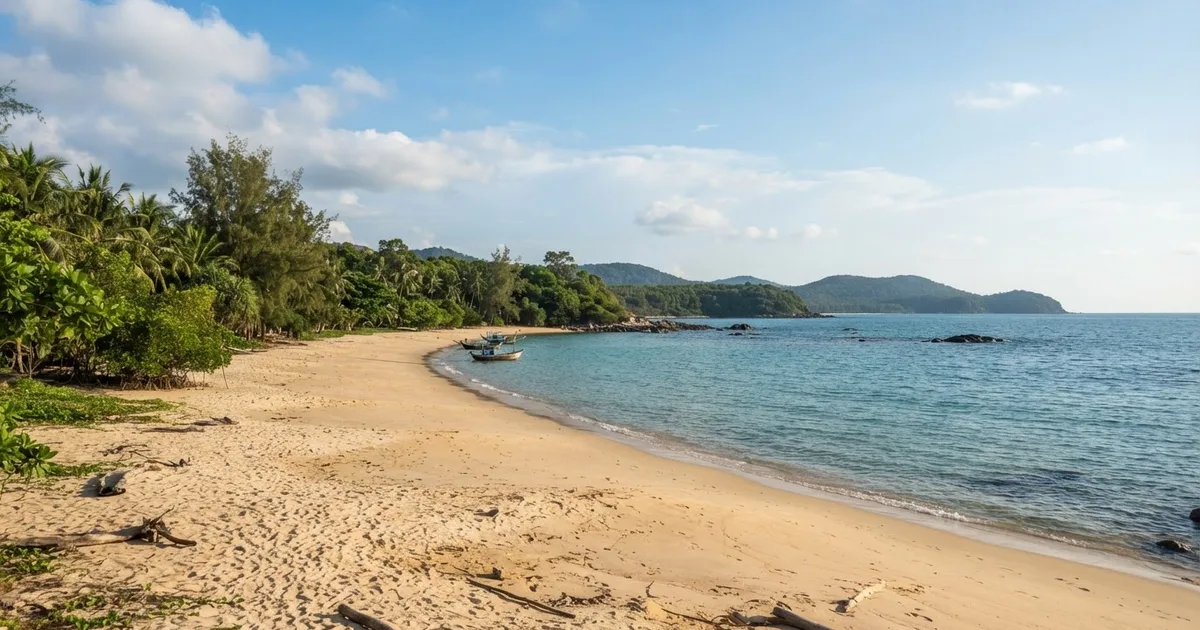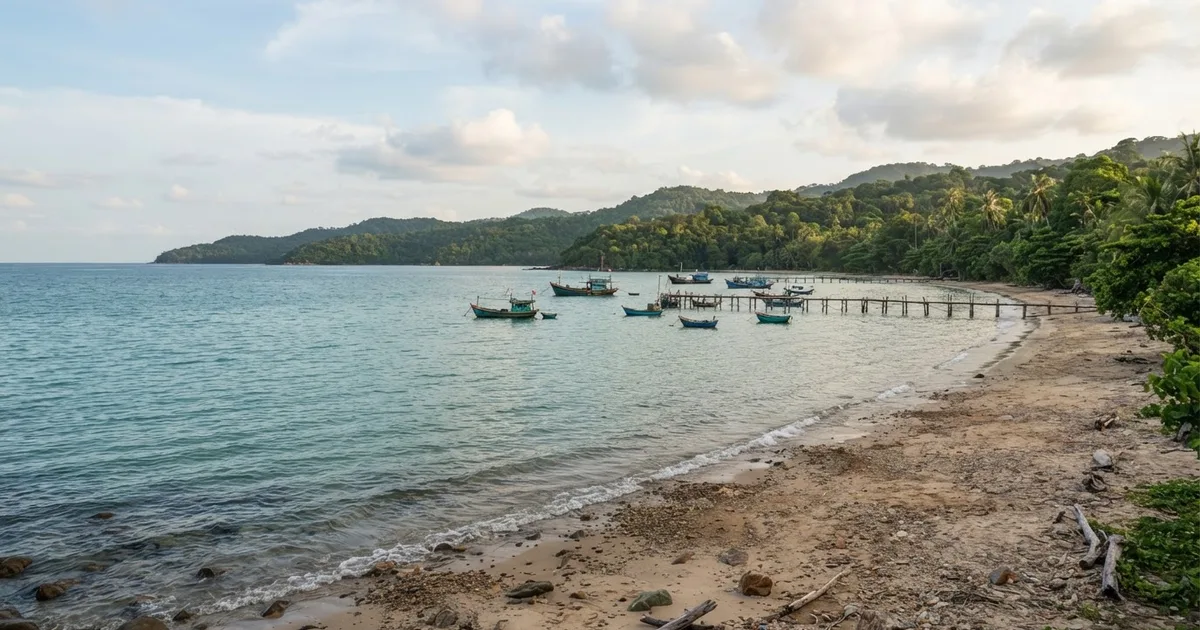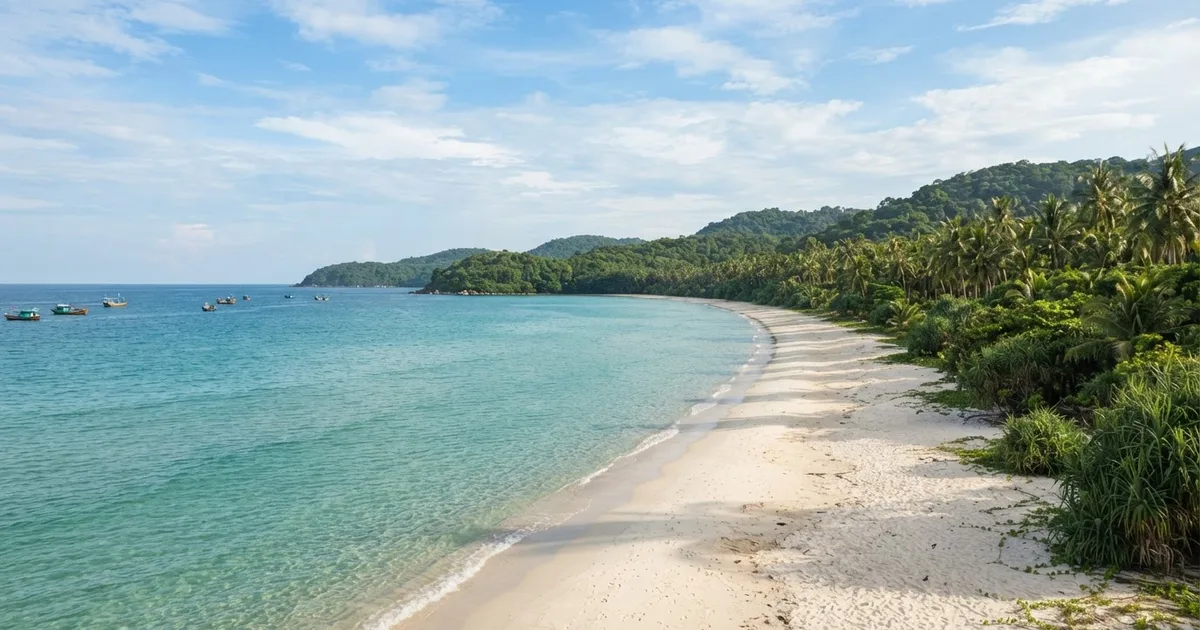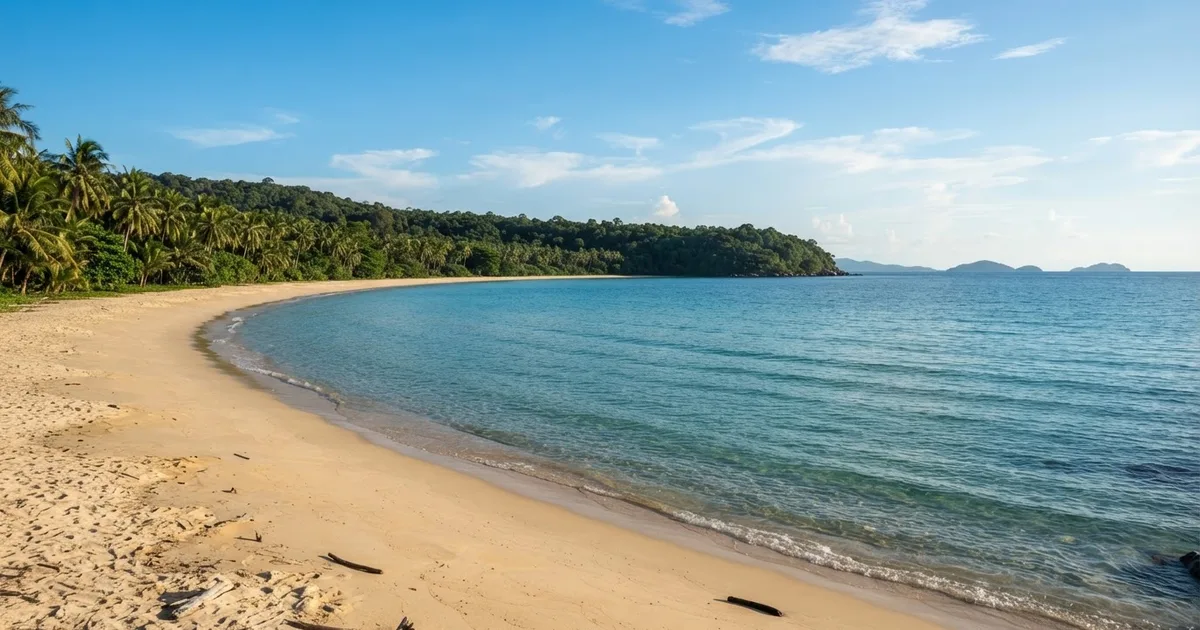
There is no officially named Shri Beach on Phu Quoc. The beach almost everyone means is Bai Sao, also called Star Beach, on the island's south coast near An Thoi, roughly 25 km from Duong Dong. It has the clearest water on Phu Quoc, snow-white flour-fine sand, and a day-pass option at around 500,000 VND (about $20) that includes a shuttle from An Thoi. Go between December and March, arrive before 9am, and check the tide before you swim.
Is Shri Beach the Same as Bai Sao on Phu Quoc?
Shri Beach is a label rather than a place on the map. Phu Quoc's named beaches are Bai Sao, Bai Khem, Long Beach (Bai Truong), Ong Lang, Ganh Dau, Rach Vem and a scattering of smaller coves. No sign, ticket desk, resort or local business on the island uses the name Shri Beach, and it does not appear on Vietnamese maps of Phu Quoc. Every detail that gets attached to the name - snow-white sand, the clearest water in Phu Quoc, a south-coast setting close to An Thoi - matches Bai Sao, which translates literally as Star Beach. That is the beach this guide covers.
One clarification matters, because it changes your plans completely. Shri Murdeshwara Beach is a different beach altogether, on India's Karnataka coast, and none of the practical details below apply there: not the dong prices, not the day-pass shuttle from An Thoi, not the June to September monsoon timing. If your search was aimed at the Indian beach, this page is not the one you need. If you were looking for Phu Quoc, everything here applies to Bai Sao.
Bai Sao's reputation is earned rather than marketed. Travel guides describe the sand as snow-white and fine, flour-like in texture, and the water as clear blue - the clearest on the island's south coast. In the dry season, south-coast beaches such as Bai Sao and neighbouring Bai Khem are described as clear and gentle, which makes them the easiest places on Phu Quoc for a relaxed swim rather than a fight with chop.
It is also one of the quieter options. Phu Quoc's eastern and southern beaches, Bai Sao and Bai Khem included, stay quiet compared with the busier western strips around Duong Dong, where development is densest. On a mid-morning in the low season you can find long stretches of Bai Sao with almost nobody on them. In February and March, the island's peak period, that picture changes quickly.
Naming tip: If a booking site, tour desk or social post sells you a trip to Shri Beach, ask them to confirm the beach name in Vietnamese before you pay. A legitimate south-island beach trip from An Thoi should mention Bai Sao, Bai Khem or Star Beach in writing.
Where Is Bai Sao (Star Beach) and How Do You Get There?
Bai Sao sits on Phu Quoc's south coast in the An Thoi area, a short ride from Bai Khem and from the Sunset Town development at the island's southern tip. It is roughly 25 km from Duong Dong town, the island's main population centre and ferry and night-market hub. By motorbike the ride takes about 35 to 45 minutes; the final approach includes a steep stretch and some rough tarmac, so take it slowly, especially after rain. Taxis and ride-hailing cars cover the same route in a similar time and are the better choice if you are carrying children or beach gear.
If you would rather not drive, the day-pass product is designed exactly for this: it bundles a shuttle from An Thoi, beach facilities and a food and beverage credit into one price. Travelers staying in the far north of the island, around Ganh Dau or the Vinpearl area, should treat Bai Sao as a full-day commitment rather than a quick stop - the one-way drive is well over an hour.
| Route | Approximate distance | Typical travel time | Notes |
|---|---|---|---|
| Duong Dong to Bai Sao | About 25 km | 35-45 minutes | Steep final stretch; ride with care in wet weather |
| An Thoi to Bai Sao | About 5-6 km | 10-15 minutes | Shuttle from An Thoi is included in the day pass |
| An Thoi to Bai Khem | A few km | 5-10 minutes | Quieter neighbour beach, easy to combine |
| Northern Phu Quoc to Bai Sao | 50 km and up | 1.5 hours or more | Plan a full day, not a half-day trip |
Most independent travelers reach Bai Sao by rented motorbike, which is also the cheapest way to combine it with Bai Khem and the An Thoi cable car in a single loop. Confirm your bike's brakes and tyres before you leave town - the southern road has a couple of gradients that punish tired brakes.
When Is the Best Time to Visit Shri Beach (Bai Sao)?
The short answer is December through March, when Phu Quoc's beach water is at its clearest. That window sits inside the dry season, which runs from November to April and delivers the island's best overall beach conditions. February and March are also the peak tourist months, so the water is at its finest exactly when the beach is at its busiest - another reason to arrive early.
The wet season from June to September is the period to avoid if swimming is your priority. Monsoon conditions bring heavy rain and rough seas that make swimming risky, water sports stop, and constant rain limits outdoor exploration. Even within the wetter months there is a meaningful difference between beaches: one 2026 beach ranking describes Long Beach as wind-churned and murky in the wet season, while Sao Beach remains more swimmable. That makes Bai Sao the more sensible wet-season fallback if your travel dates are fixed - though it is a fallback, not a substitute for the dry season.
| Period | Water and weather | What to expect |
|---|---|---|
| November to April (dry season) | Calm, gentle water; south-coast beaches clear | Best overall beach conditions of the year |
| December to March | Clearest water of the year | The sweet spot for swimming and snorkelling |
| February to March | Excellent water, hot days | Peak season; busiest crowds at Bai Sao |
| April to May | Still warm and largely dry; heat builds | Good swimming, fewer people than February |
| June to September (monsoon) | Heavy rain, rough seas, risky swimming | Water sports stop; outdoor time limited by rain |
| October | Tail of the wet season, improving | Patchy; check conditions week by week |
Time of day matters almost as much as time of year. An early morning visit is recommended for swimming because crowds are smaller and temperatures are cooler. Bai Sao is almost empty in the morning, and the light on the white sand is at its best for photographs before 9am. By early afternoon the sand is hot underfoot and the beach fills up.
One expectation worth correcting before you plan: Bai Sao faces east. It is a morning and sunrise beach, not a sunset one, and no reliable sunset rating exists for it. If a golden-hour photo is the goal, plan that evening on the west coast instead.
What Does a Day at Bai Sao Cost?
Budget travelers can treat Bai Sao as a cheap half-day: fuel, parking and a beach-side drink. Travelers who want facilities and a transfer have a packaged option - day visitors can buy a beach pass for about 500,000 VND (roughly $20) that includes shuttle service from An Thoi, beach facilities, and food and beverage credit. Run the maths on your own group: for two people, the pass is usually competitive with a return taxi plus sunbed and lunch charges, and considerably less hassle.
Do not assume every south-island beach is free. One 2026 guide notes that Sunset Sanato Beach is not free and charges an entrance fee of 70,000 VND. Beach clubs and beachfront restaurants across the island work the same way: the sand may be public, but sunbeds, showers, parking and toilets are privately operated and priced. Agree on the price of a sunbed before you sit down, and carry cash in small notes.
| Item | Typical price | Notes |
|---|---|---|
| Bai Sao day pass | About 500,000 VND (roughly $20) | Includes shuttle from An Thoi, beach facilities and food and drink credit |
| Sunset Sanato entrance fee | 70,000 VND | Explicitly not free; a west-coast alternative, not Bai Sao |
| Motorbike rental | Commonly 150,000-250,000 VND per day island-wide | Confirm the rate and any fuel policy with your rental shop |
| Fuel for a south-island loop | Modest; a few litres | Fill up in An Thoi or Duong Dong before the final stretch |
| Sunbeds, showers, parking | Small cash fees | Set by the beachfront operator; confirm before use |
Bring cash: South-coast beach operators and small restaurants rarely handle cards reliably, and mobile signal at the beach can be patchy for QR payments. Carry enough dong for the whole day before you leave An Thoi.
Swimming, Snorkelling and Safety at Bai Sao
The water is the reason to come. Bai Sao's shore is shallow and calm, with a sandy bottom close in, which makes it suitable for swimming and especially good for novice swimmers and children who are comfortable in waist-deep water. The southern beaches generally are described as the island's best for snorkelling precisely because the water is shallow near shore with a sandy bottom - you can wade out and look down without needing a boat.
Two cautions apply. First, currents can strengthen during high tide, so swimmers should check local conditions before entering the water rather than assuming a calm morning means a calm afternoon. Second, lifeguards may not be stationed at the beach at all times, so there is no guarantee of supervision. Treat Bai Sao as a swim-at-your-own-risk beach and keep non-swimmers and young children within arm's reach. During the June to September monsoon, do not swim at all: the sea turns rough and water sports stop entirely.
No retrieved source gives a dedicated snorkelling rating for Bai Sao, and the honest picture is that it is a good beginner snorkel rather than a reef destination. For coral and fish, book a boat trip out to the An Thoi islands and Hon Thom, and keep your Bai Sao swim for the beach itself.
Swim-safety checklist for Bai Sao:
- Check the tide before you swim - currents strengthen at high tide.
- Swim in the morning, when the water is calmer and the wind has not yet built.
- Do not assume a lifeguard is on duty; supervision is not guaranteed at all times.
- Keep children within arm's reach in the shallows, even in knee-deep water.
- Avoid swimming alone, and skip the water entirely after heavy rain.
- Do not enter the sea during the June to September monsoon.
- Use high-factor, reef-friendly sunscreen and reapply after swimming.
Who Bai Sao Suits - and Who Should Skip It
Bai Sao is the strongest single beach choice on Phu Quoc for a classic white-sand day, but it is not the right beach for everyone. Here is the honest split.
Suits you if...
- You want the clearest water and the whitest sand on Phu Quoc, with swimming that is calm and shallow near shore.
- You are traveling with novice swimmers or children who prefer waist-deep water to waves.
- You are based in the south, around An Thoi or Sunset Town, and want a beach 10 to 15 minutes away.
- You want a quiet beach: eastern and southern beaches such as Bai Sao and Bai Khem stay quiet compared with the developed west coast.
- You are happy to start early - the beach is nearly empty before mid-morning.
Less suited to you if...
- You are chasing sunsets. Bai Sao faces east; plan sunset on the west coast instead.
- You are staying in northern Phu Quoc, where Bai Sao is over an hour each way.
- You are visiting between June and September and expect calm seas and water sports.
- You expect guaranteed lifeguards, free sunbeds and no entry or facility charges.
- You want nightlife on the sand - this is a daytime beach with little going on after dark.
- You are looking for serious reef snorkelling straight off the beach rather than a boat trip.
How Bai Sao Compares with Other Phu Quoc Beaches
Phu Quoc's beaches divide roughly into a developed west coast and a quieter east and south coast. Understanding that split saves you a wasted afternoon. Long Beach, the long western strip running past Duong Dong, is where most hotels sit and where sunsets happen, but it is also the beach most affected by wet-season wind and murk. The south coast, where Bai Sao and Bai Khem sit, trades convenience and nightlife for cleaner water and far fewer people.
| Beach | Location | Water and sand | Crowds and cost | Best for |
|---|---|---|---|---|
| Bai Sao (Star Beach) | South coast, near An Thoi | Clearest water on the island; snow-white, flour-fine sand | Almost empty in the morning; busier February to March; day pass about 500,000 VND | Swimming, beginner snorkelling, photography |
| Bai Khem | South coast, near An Thoi | Clear and gentle in the dry season | Stays quiet; low-key local food stalls | A quieter swim close to Bai Sao |
| Long Beach (Bai Truong) | West coast, Duong Dong to An Thoi | Wind-churned and murky in the wet season | Busy and developed; easy to reach | Sunsets, hotels, convenience |
| Sunset Sanato | West coast, near Duong Dong | Calm and shallow | Popular at sunset; entrance fee 70,000 VND | Sunset photos, families |
If your priority is water clarity and a beach that feels emptier, Bai Sao wins. If your priority is walking out of your hotel onto the sand at sunset, stay on the west coast and accept that the water will not be as clear - particularly between May and October.
Practical Tips for a Smooth Bai Sao Day Trip
Before you go:
- Leave Duong Dong by 7.30am to be on the sand before 9am, when it is coolest and quietest.
- Carry cash in dong for the day pass, parking, sunbeds and lunch.
- Pack water, a towel, sun protection, a hat and a dry bag for your phone.
- Check your motorbike's brakes and tyres - the southern approach has steep sections.
- Fill the fuel tank in Duong Dong or An Thoi rather than relying on roadside stalls.
- Take your rubbish back with you; bins are limited and the sand is the whole attraction.
- Confirm the sunbed or day-pass price before you settle in, not after.
Bai Sao combines naturally with the rest of the south island in one loop: Bai Khem for a second, quieter swim, the An Thoi cable car out to Hon Thom, and Sunset Town for dinner on the way back. That route makes a full, well-paced day without any long driving, which is exactly why travelers based in the south tend to rate Bai Sao as the island's best beach and travelers based in the north often skip it.
Frequently Asked Questions
Is Shri Beach the same as Bai Sao on Phu Quoc?
Yes, in practice. There is no officially named Shri Beach on Phu Quoc. The beach that matches the descriptions attached to that name - snow-white fine sand, the clearest water on the south coast, a setting near An Thoi - is Bai Sao, also called Star Beach. Note that Shri Murdeshwara Beach in India is a completely different place.
How much does a day at Bai Sao cost?
Day visitors can buy a beach pass for about 500,000 VND, roughly $20, which includes a shuttle from An Thoi, beach facilities, and food and beverage credit. Independent travelers driving themselves pay only fuel, parking and whatever they order. Other south-island beach clubs charge separately: Sunset Sanato, for example, has a 70,000 VND entrance fee.
What is the best month to visit Bai Sao?
December through March, when Phu Quoc's beach water is clearest. That window sits inside the dry season from November to April. February and March give the best water but also the biggest crowds. Avoid June to September, when monsoon rain and rough seas make swimming risky and water sports stop.
Can you swim at Bai Sao?
Yes. The water is shallow and calm near shore with a sandy bottom, which suits novice swimmers and children. Two cautions: currents can strengthen at high tide, so check conditions before entering, and lifeguards may not be stationed at the beach at all times. Do not swim during the June to September monsoon.
How do you get to Bai Sao from Duong Dong?
It is roughly 25 km south of Duong Dong, about 35 to 45 minutes by motorbike or taxi. The final approach has a steep stretch. If you prefer not to drive, the day pass includes a shuttle from An Thoi, which is only about 5 to 6 km from the beach.
Is Bai Sao crowded?
Not in the morning. Bai Sao is described as almost empty in the morning, with more tourists arriving during the February to March peak season. Compared with the developed western beaches around Duong Dong, the southern and eastern beaches including Bai Sao and Bai Khem stay quiet throughout the year.
Is Bai Sao good for snorkelling?
The southern beaches are the island's best for snorkelling because the water is shallow near shore with a sandy bottom, so you can wade out and look down. There is no strong reef right off the beach, however. For coral and fish, take a boat trip to the An Thoi islands and Hon Thom during the dry season.
Is Bai Sao good for sunset?
No. Bai Sao faces east, so it is a morning and sunrise beach rather than a sunset one. If a sunset is your priority, head to the west coast - Long Beach, which is near Duong Dong, or Sunset Sanato with its 70,000 VND entrance fee - where the sun drops straight into the sea.
Planning a beach day on Phu Quoc's south coast? Sabrina Rental can set you up with a serviced motorbike for the Bai Sao and Bai Khem loop, arrange a room nearby, or help you book a boat trip out to the An Thoi islands - and we will tell you honestly whether the tide and weather are worth the ride that day.
Ask Sabrina About Beach Days and Rentals