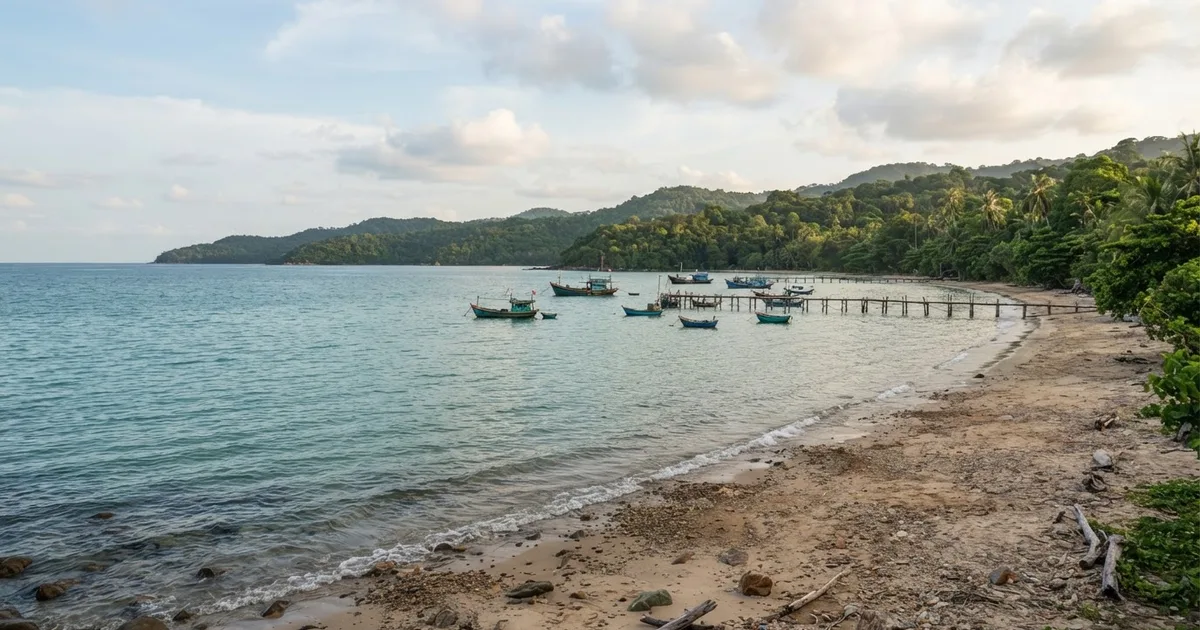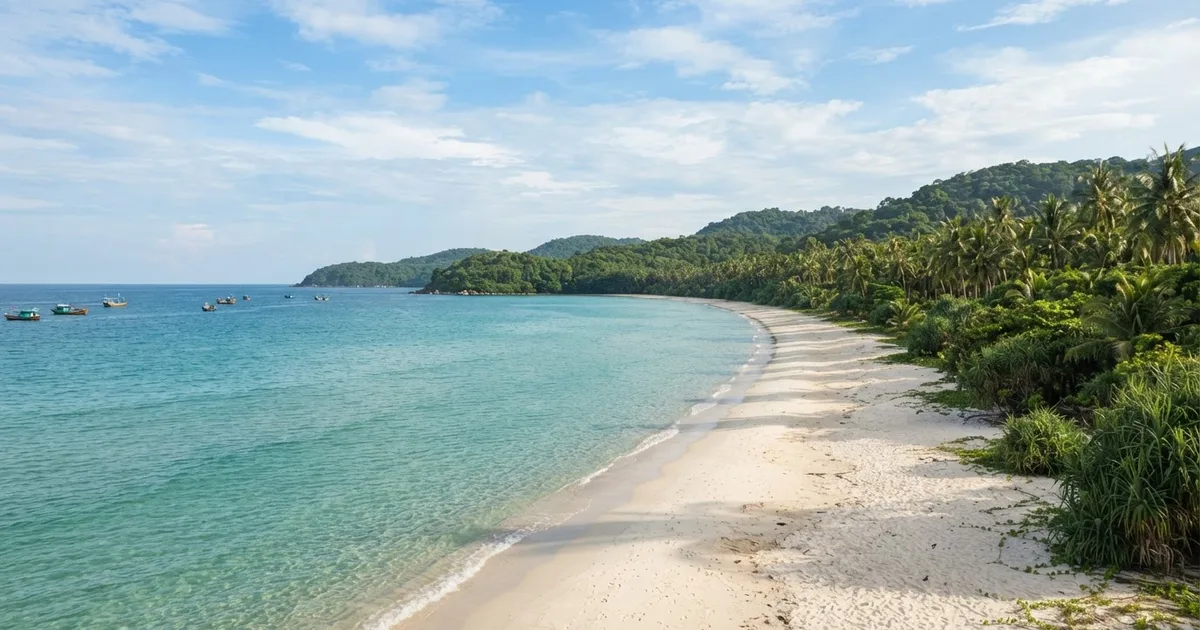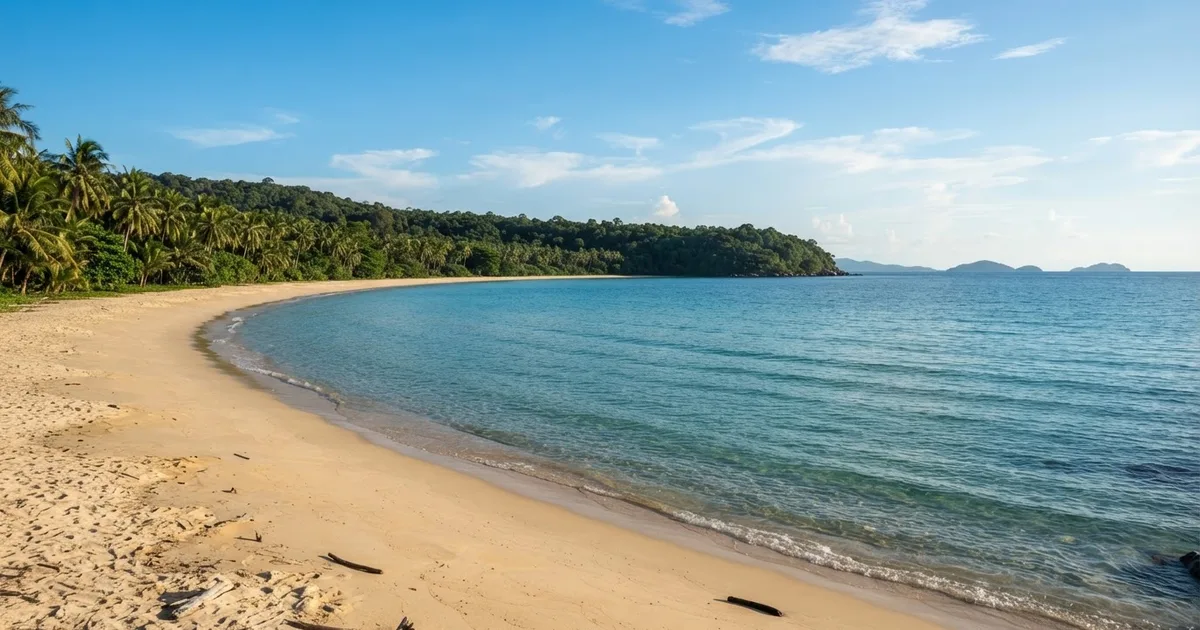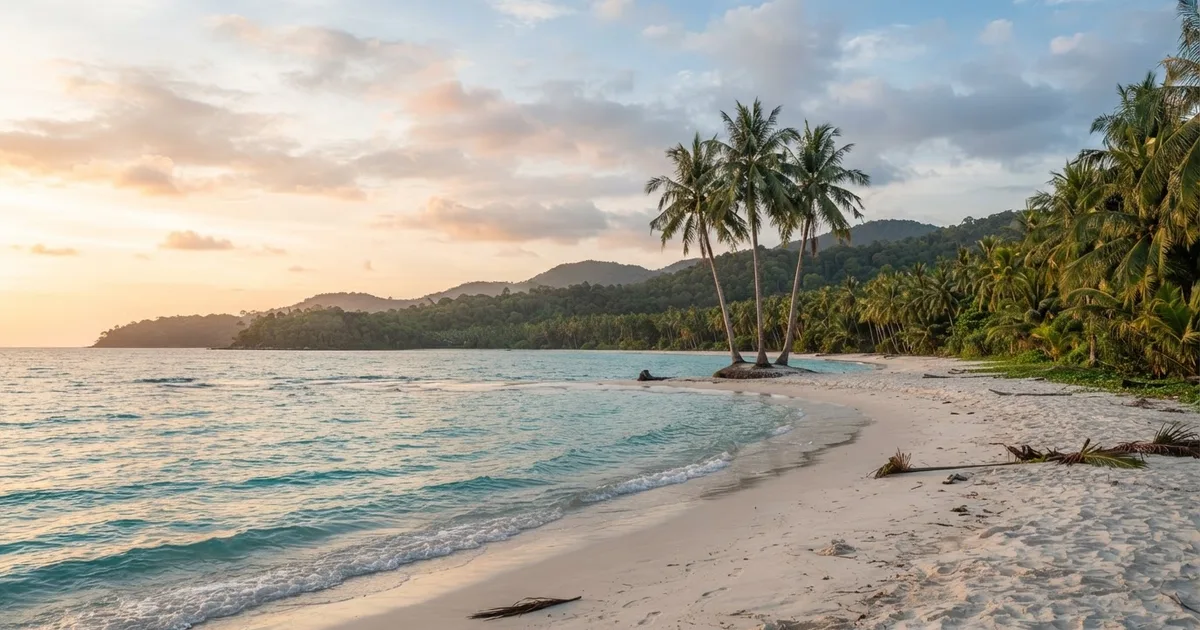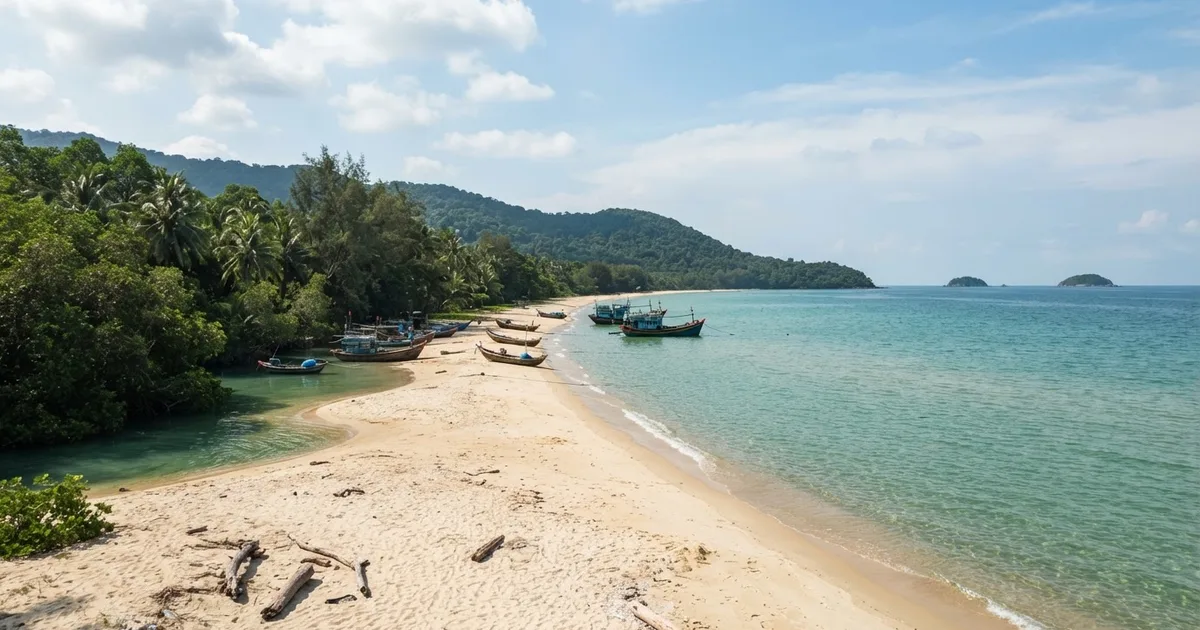
Rạch Tràm Beach is Phu Quoc's most genuinely undeveloped stretch of coastline. Entry is free, there are no resorts, no beach clubs and no lifeguards, and a sunbed — if you find one — costs 50,000–125,000 VND ($2–$5) for the day. It sits beside the tiny Rach Tram fishing village at the far north of the island, roughly 30–35 km from Duong Dong, and the dry season from November to April is the only window when the sea here is reliably calm, clear and turquoise. Come for empty white sand and a quiet swim, not for services.
Where Is Rạch Tràm Beach, and What Is It Actually Like?
Rạch Tràm sits at the far north-western end of Phu Quoc, where a small river — the rạch — empties into the Gulf of Thailand beside a working fishing hamlet. The beach itself is a long, low arc of fine white sand backed by coconut palms and casuarina trees, with a calm, clear, turquoise sea in front of it. There is no wall of resorts behind the sand, no line of sunbeds, no music. On a weekday in the dry season you may share the entire bay with a handful of fishermen and two or three other travellers.
That emptiness is the whole point. Rạch Tràm is consistently described as completely undeveloped, and the description holds up on the ground: the shoreline is natural, the vegetation runs right down to the sand, and the only buildings are village houses and a few small seafood kitchens clustered near the river mouth. If you have seen photographs of Phu Quoc from twenty years ago, this is the closest thing left to them.
It also means you arrive prepared. There is nothing to buy except what the village cooks that morning, nowhere to charge a phone, and no one watching the water. Treat Rạch Tràm as a half-day expedition rather than a resort day and it delivers exactly what it promises.
| Detail | What to expect |
|---|---|
| Entry fee | Free — no gate, no ticket booth |
| Sunbed and shade | 50,000–125,000 VND ($2–$5) per day where available; often nothing at all |
| Distance from Duong Dong | Roughly 30–35 km, 50–70 minutes by motorbike |
| Distance from Ganh Dau | About 12–15 km |
| Sand | Fine, white, uncrowded |
| Water | Calm, clear, turquoise through the dry season |
| Lifeguards | None |
| Best season | November–April, peak December–March |
| Nearest accommodation | Rach Tram fishing village area; no resort sits on the beach itself |
| Mobile signal | Patchy — download an offline map before you ride |
How to Get to Rạch Tràm Beach from Duong Dong
There is no public bus to Rạch Tràm. Your two realistic options are a rented motorbike or a private car, and the ride is half the experience — the road climbs through the buffer zone of Phu Quoc National Park, past pepper farms and rubber trees, before dropping down to the coast.
By motorbike. Head north from Duong Dong towards Cua Can, continue past Vung Bau, then follow the signs towards Rach Tram and Ganh Dau. Expect 30–35 km and 50–70 minutes each way depending on how often you stop for photos. A semi-automatic scooter rents for around 150,000–250,000 VND ($6–$10) per day on the island; a larger automatic is 250,000–400,000 VND ($10–$16). Fill your tank before you leave — there is no petrol station near Rạch Tràm, so top up in Cua Can or Ganh Dau.
By car or taxi. A private car or ride-hailing trip from Duong Dong typically runs 450,000–700,000 VND ($18–$28) one way. Many drivers will only take a sedan as far as the village, because the last stretch is unpaved, so agree the exact drop-off point before you set off. If you want the driver to wait, negotiate that in advance and expect to pay for the waiting time.
Road reality check: the final few kilometres into Rạch Tràm are concrete and red dirt, with potholes and loose sand. In the wet season (May–October) sections turn slick and muddy. This is not a route for a first-time rider, and it is not a route to attempt after dark — there is no street lighting at all between Ganh Dau and the village.
What Is Actually at Rạch Tràm: Village, Food and Facilities
The beach and the village are the same place, separated only by a shallow river mouth. Rach Tram fishing village is authentic and working: wooden boats, drying nets, fuel drums, children on bicycles. A handful of family-run kitchens near the water will grill whatever came off the boats that morning — squid, prawns, reef fish, sometimes sea urchin — usually for 50,000–150,000 VND ($2–$6) per plate. Bring cash in small notes; nobody here takes cards and there is no ATM.
Where the beach meets the village you may find a few plastic chairs under palms and a locally run sunbed or two at the 50,000–125,000 VND ($2–$5) per day rate. Do not count on it. On quiet weekdays in low season there may be no shade for hire at all, which is another reason to carry water and a hat.
Accommodation is the one thing you cannot plan around. The nearest place to stay is the Rach Tram fishing village area itself, and no specific hotel or resort is established directly on this beach. Travellers who want a bed within walking distance of Rạch Tràm generally base themselves in Ganh Dau, about 12–15 km south, where there is a wider spread of guesthouses and small hotels, and ride or drive up for the day.
What to bring to Rạch Tràm
- Cash — 200,000–500,000 VND in small notes; no cards, no ATM, no bank within 12 km.
- Water — 1.5–2 litres per person; there are no shops on the sand.
- Reef-safe sunscreen and a hat — shade is scarce if no sunbeds are set up.
- Offline map — mobile signal is patchy on the northern coast.
- Full fuel tank — top up in Cua Can or Ganh Dau, not at the beach.
- Sarong or towel — there are no changing rooms or showers.
Is Rạch Tràm Beach Good for Swimming? Safety Reality
In the dry season, the water at Rạch Tràm is calm, clear and ideal for swimming and wading, and the sandy bottom shelves gently, which makes it comfortable for confident paddlers. But this is an unmanaged beach. There are no lifeguards, no flags, no patrols, and no one to notice if you get into trouble. That changes the calculation entirely.
Standard beach-safety rules apply and are worth repeating because they are genuinely relevant here: never swim alone, do not swim at night or during a thunderstorm, stay close to shore, and do not go in while it is raining or if you can see lightning anywhere on the horizon. Where a beach does have red flags, red means no swimming and the beach may be closed. Managed beaches with flags or patrols are safest in calm conditions — and Rạch Tràm is not one of them.
The wet season is the real hazard. From May to October the north-west coast takes the brunt of the monsoon swell, and what looks like a calm bay in the morning can build a strong shore break and heavy rip currents by afternoon. If you visit between May and October, swim only in the morning, stay in knee-to-waist depth, and stay within sight of your group at all times.
Rip current rule: if you are caught in a current pulling you out, do not fight it head-on. Swim parallel to the beach until the pull eases, then angle back in. At Rạch Tràm there is nobody to come and get you, so keep the situation from starting: swim near other people and keep your feet within reach of the bottom.
Best Time to Visit Rạch Tràm: Dry Season vs Wet Season
The best time to visit Phu Quoc beaches is November through April, and Rạch Tràm is no exception. December to March is peak dry season: sunny skies, light wind, calm seas and the clearest water you will get on the island. This is when Rạch Tràm looks like the photographs — flat turquoise water, dry white sand, and a horizon with nothing on it.
The wet season, May to October, brings far fewer visitors and a much quieter road, but also real showers and heavier seas. If you go then, plan to arrive early morning, aim to be off the beach by early afternoon before the build-up, and be ready to abandon the swim if the weather turns. Mid-afternoon thunderstorms are common from June to September.
| Period | Sea and weather | What it means for you |
|---|---|---|
| November | Rain tails off, seas settling | Quiet, green, good value; roads still muddy in places |
| December–January | Sunny, calm, clear water | Best overall conditions; peak season island-wide |
| February–March | Peak dry season, lightest wind | Best swimming and the clearest turquoise water |
| April | Hot, still calm, building humidity | Go early; little shade on the beach |
| May–July | Showers return, swell builds | Few visitors; morning visits only; swim with caution |
| August–October | Wettest, heaviest seas | Access road rough; swimming genuinely risky |
One more scheduling note: Rạch Tràm faces west and north-west, so late afternoon light here is excellent — but the return road has no lighting. Plan to leave the beach with at least an hour of daylight left, which in the dry season means around 5 pm at the latest.
Who Rạch Tràm Beach Suits — and Who Should Skip It
Rạch Tràm is not a general-purpose beach, and being honest about that saves people a wasted 70-minute ride. It rewards travellers who actively want emptiness and are comfortable with self-reliance, and it frustrates anyone expecting a beach day with services.
Rạch Tràm is a great fit if you...
- Want a genuinely undeveloped beach with kilometres of fine white sand and no crowds.
- Have your own wheels and ride confidently on dirt and potholed roads.
- Are happy swimming in calm but completely unpatrolled water during Nov–Apr.
- Want to eat simple grilled seafood in a working fishing village for $2–$6 a plate.
- Value landscape and photography over facilities and service.
Rạch Tràm is a poor fit if you...
- Need lifeguards, beach flags or patrolled swimming — there are none.
- Are travelling with toddlers who need shallow, monitored water and shade on demand.
- Want sunbeds, umbrellas, showers, toilets and beach bars guaranteed.
- Rely on public transport, ride-hailing or a bus to get there and back.
- Are a beginner rider, or would be driving back after sunset.
- Want a lively scene, watersports or a sunset party.
Families with young children are the clearest mismatch. If calm, shallow, family-friendly water is the priority, Bai Khem is a far better fit — it is characterised by calm, shallow sea and is well suited to families with young children. Equally, if you want postcard-white powder sand and clear water in the dry season with facilities nearby, Sao Beach is the island's standout choice.
Nearby Beaches and How to Combine Them Into One Day
Because Rạch Tràm is a long ride north, it makes sense to treat it as the anchor of a northern-loop day rather than a there-and-back trip. The natural route runs Duong Dong to Cua Can, up to Vung Bau and Rạch Tràm, then back south via Ganh Dau.
Bãi Bổn Beach is the easiest pairing and a good gauge of your own taste: it is one of Phu Quoc's emptier stretches of coastline, mostly undeveloped and uninhabited, with a long, empty shoreline and a very shallow, calm sea. It suits travellers chasing a genuinely peaceful beach rather than a lively scene, and there are hardly any facilities beyond a couple of sleepy hamlets. If you find Bãi Bổn too quiet, Rạch Tràm will be too quiet as well.
Ganh Dau, 12–15 km south, is where you refuel both the bike and yourself, and it is the practical base if you want to be near Rạch Tràm without camping in the village. Further south and east, Sao Beach and Bai Khem deliver the opposite experience — the finest powdery white sand on the island at Sao, and shallow, calm, family-friendly water at Bai Khem — but both are busy in high season and neither is remotely as empty as Rạch Tràm.
| Beach | Character | Best for |
|---|---|---|
| Rạch Tràm | Undeveloped, free, no facilities, unpatrolled | Solitude, photography, self-sufficient travellers |
| Bãi Bổn | Mostly undeveloped, uninhabited, very shallow calm sea | Quiet beach days, swimming in shallow water |
| Ganh Dau | Village services, guesthouses, fuel and food | Base for the north, practical stopovers |
| Sao Beach | Finest powdery white sand, calm clear water in dry season | Classic beach day with facilities |
| Bai Khem | Calm and shallow | Families with young children |
Frequently Asked Questions
Is Rạch Tràm Beach free to enter?
Yes. There is no entry fee, no gate and no ticket booth at Rạch Tràm. If someone has set up sunbeds or shade on the sand, expect to pay 50,000–125,000 VND ($2–$5) per day for it. Bring cash in small notes, because there is no card payment and no ATM anywhere near the village.
How far is Rạch Tràm Beach from Duong Dong?
Roughly 30–35 km by road, which takes 50–70 minutes by motorbike depending on stops. A private car or ride-hailing trip costs about 450,000–700,000 VND ($18–$28) one way. There is no public bus, and the last few kilometres are unpaved, so agree the drop-off point with your driver in advance.
What is the best time of year to visit Rạch Tràm?
November to April, with December to March the peak dry season — that is when the sea is calmest, clearest and most turquoise, and the sand is dry and white. May to October brings fewer visitors but real showers and heavier swell, so plan a morning visit and leave before the afternoon build-up.
Is it safe to swim at Rạch Tràm Beach?
In the dry season the water is calm and clear and comfortable for confident swimmers, but the beach is completely unmanaged: no lifeguards, no flags, no patrols. Never swim alone, stay close to shore, avoid the water at night or during thunderstorms and rain, and treat the sea as genuinely risky from May to October when monsoon swell arrives.
Are there hotels or resorts on Rạch Tràm Beach?
No. Nothing is built on the beach itself; the nearest accommodation is the authentic Rach Tram fishing village area, and no specific hotel or resort is established directly on this stretch of sand. Most travellers base themselves in Ganh Dau, about 12–15 km south, and ride up to Rạch Tràm for the day.
Can I get food and drink at Rạch Tràm?
Yes, but only basic village food. A handful of family-run kitchens near the river mouth grill whatever the boats brought in — squid, prawns, reef fish — for around 50,000–150,000 VND ($2–$6) per plate. There are no shops, no beach bars and no convenience stores, so carry your own water, ideally 1.5–2 litres per person.
Do I need a motorbike to reach Rạch Tràm Beach?
It is the most practical option. Scooter rental on Phu Quoc runs about 150,000–250,000 VND ($6–$10) per day for a semi-automatic and 250,000–400,000 VND ($10–$16) for a larger automatic. Alternatively take a private car, but note the final stretch is dirt and sand — not suitable for a first-time rider or for driving after dark.
Is Rạch Tràm Beach good for sunsets?
The beach faces west and north-west, so it does get late-afternoon light and open horizon views — but the road back to Duong Dong has no street lighting at all. Plan to leave with at least an hour of daylight remaining, which in the dry season means departing the sand by about 5 pm.
Planning a day trip to Rạch Tràm or exploring northern Phu Quoc? Sabrina Rental can sort your motorbike, arrange a car and driver for the dirt-road stretch, or put together a northern loop that takes in Rạch Tràm, Bãi Bổn and Ganh Dau in one day. Message us with your dates and we will tell you honestly whether the conditions suit you.
Ask Sabrina About Rạch Tràm and Bike Rental