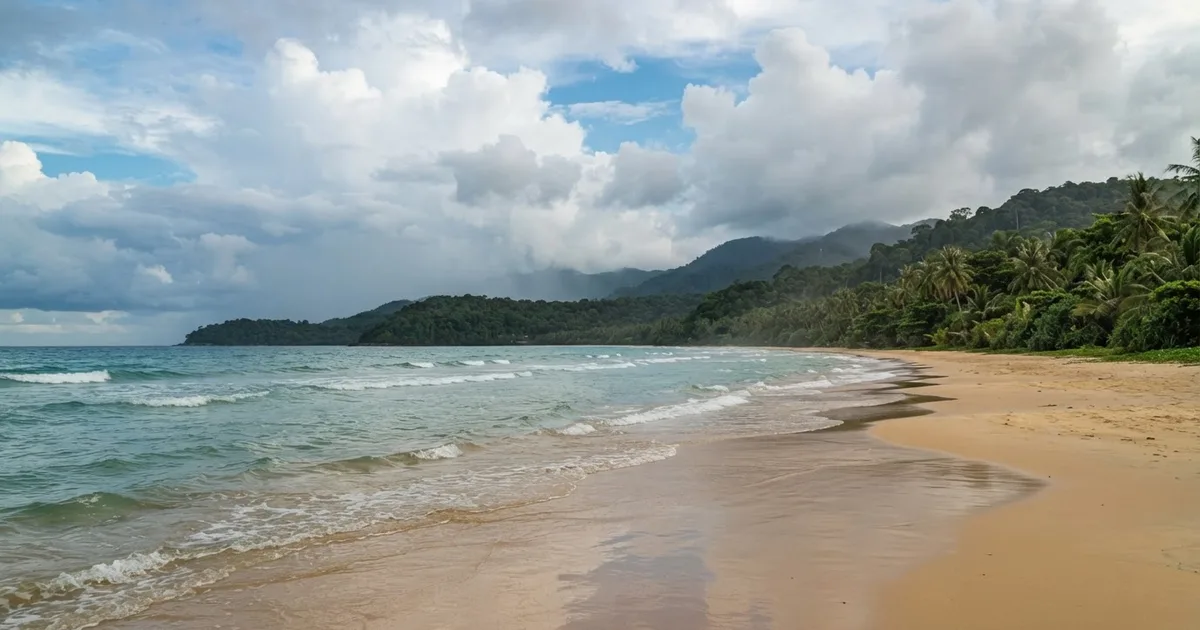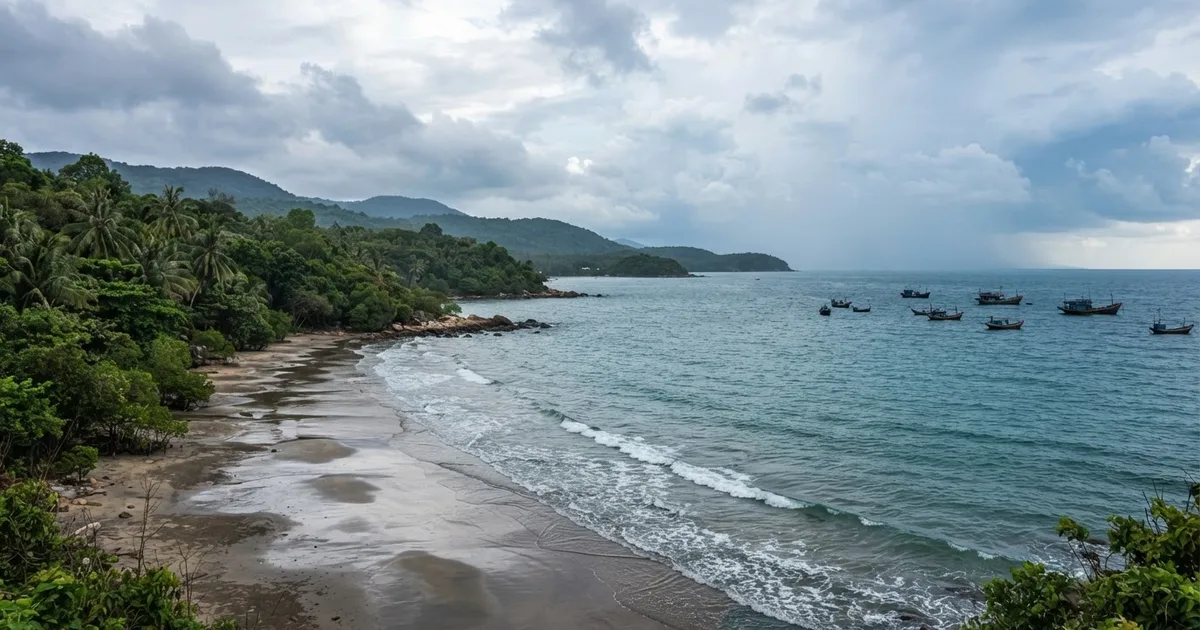
Direct typhoon hits on Phu Quoc are rare: the island's position in the Gulf of Thailand, off the main Pacific storm tracks, means most systems decay before they arrive. The genuine risk is monsoon weather — from May to October the island takes heavy rain and rough seas, peaking in September with roughly a 50% typhoon risk and a 55% probability of tour cancellations. Visit between November and April and storm risk falls to near zero, with February the safest and sunniest month of all.
Does Phu Quoc actually get hit by typhoons?
Short answer: very rarely. Phu Quoc sits in the Gulf of Thailand, roughly 15 km off the Cambodian coast and about 45 km west of the Vietnamese mainland at Ha Tien. The typhoons that form in the western Pacific and the South China Sea almost always track north and east toward central Vietnam (Da Nang, Hue), Hainan or southern China. By the time any remnant system crosses the Indochinese peninsula into the Gulf, it has usually weakened into a tropical depression at most.
That geography is why every serious guide repeats the same line: Phu Quoc rarely faces direct typhoon impact. What the island does get, from June to October, is rough monsoon conditions — sustained onshore wind, high seas and heavy rain — plus the indirect effects of passing tropical depressions. Local meteorological summaries put those indirect impacts at around 2–4 events per year, concentrated between August and October.
During the July–September peak, forecasters typically count 2–3 potential tropical storms that either directly or indirectly affect Phu Quoc's waters. In practice that means a handful of days each season when boats stay tied up, ferries from Ha Tien and Rach Gia are suspended, and beach bars stack their chairs. It very rarely means a destructive landfall.
Storm and rainfall risk, month by month
The table below combines published monthly rainfall figures for Phu Quoc with typhoon-risk and tour-cancellation estimates for the rainy months. The percentages are probability estimates for disruption, not guarantees — a 50% typhoon-risk figure for September means roughly half of Septembers see a tropical storm or depression affect the island's waters in some way.
| Month | Rainfall | Storm / typhoon risk | Tour-cancellation risk | What it feels like |
|---|---|---|---|---|
| January | ~10 mm | Very low | Very low | Peak dry season, calm seas |
| February | ~4 mm | Very low | Very low | Driest and best beach month |
| March | ~15 mm | Very low | Very low | Hot, dry, glassy seas |
| April | ~60 mm | Low | Low | Transition month, first showers |
| May | ~150 mm | Low–moderate | ~20% | Rainy season begins, afternoon bursts |
| June | 325 mm | 20% | 28% | Wet but usually manageable |
| July | 375 mm | Moderate–high | ~40% | Storm season building, 2–3 storms brewing |
| August | 390 mm | 45% | 52% | Heavy rain, rough seas, peak rainfall |
| September | 340–400 mm | 50% | 55% | Peak storm risk, 18–20 rain days |
| October | 275 mm | ~25–30% | ~30% | Improving but still showery |
| November | ~90 mm | Low | Low | Dry season starts, seas calm down |
| December | ~15 mm | Very low | Very low | Peak season returns |
Two patterns matter most when you read this table. First, the risk curve is sharply asymmetric: June (20% typhoon risk, 28% tour cancellations) is a far safer bet than August (45%, 52%) or September (50%, 55%). Second, the sea shuts down before the sky does — by mid-September, wind-driven waves on the exposed west and south coasts routinely cause boat-tour cancellations even on days that later turn out dry. Plan around the marine forecast, not just the rain radar.
What rainy season actually feels like on the island
A common mistake is treating Phu Quoc's rainy season as three months of continuous downpour. The typical pattern in southern Vietnam is different: May to October brings short 1–2 hour afternoon bursts of heavy rain, often spectacular but usually over quickly, followed by a cooler, rinsed-clean evening. Even September — the wettest month, with 340–400 mm spread across 18–20 rain days — regularly starts with bright mornings and swimmable water before noon.
The difficulty is not volume but timing and wind. In the dry season you can plan an island-hopping day at 8 am with near-total confidence; in August, with 390 mm falling that month, the morning sky can look perfect and a midday squall still strand your afternoon. That is why raw rainfall numbers understate the practical disruption — tour-cancellation probabilities (28% in June, 52% in August, 55% in September) run well above what you would guess from "it rains a few hours a day."
Who the rainy season is a poor fit for: travelers with one fixed week and a must-do list of boat trips, snorkeling days and sunset cruises. If your entire Phu Quoc plan collapses when the 4-island tour is cancelled twice, book the dry season instead. It suits flexible travelers, remote workers, couples happy to swap a beach afternoon for a spa or a cooking class, and anyone chasing low-season prices — accommodation from May to October can cost 30–50% less than in the December–February peak.
Rough seas: how storms hit boat tours, ferries and diving
On Phu Quoc, wind matters more than rain. The island's signature experiences — snorkeling around the southern An Thoi archipelago, day trips to Hon Mong Tay and Hon May Rut, night squid-fishing boats and fishing charters — all depend on sea state. When a tropical depression passes within a few hundred kilometers, even without making landfall, the south coast can see waves high enough that operators suspend trips entirely. That is the mechanism behind the 52% cancellation probability in August and 55% in September.
Ferries are equally exposed. The Ha Tien–Phu Quoc crossing (about 2 hours 15 minutes) and the longer Rach Gia route (roughly 2.5–3.5 hours) are suspended whenever the maritime authority raises warnings — common in the August–October window. If you are arriving overland from the Mekong Delta during storm season, build in a buffer day, or simply fly into Duong Dong airport (PQC), which handles the vast majority of arrivals and closes only briefly in genuinely severe weather.
Snorkeling & island-hopping
Excellent November–April. Marginal in May–July. High cancellation risk August–September (52–55%).
Ferry arrivals
Reliable in the dry season; expect sporadic suspensions June–October. Fly to PQC if your dates fall in September.
Beach days on land
Swimmable even in the wet season on calmer mornings; west-coast Long Beach and Ong Lang soften the swell better than the open south coast.
A worst-case week: what a September storm actually looks like
So what happens when a real depression heads for the island? Typically, a low-pressure area forms over the Gulf or drifts in from the east two to three days out. Local weather warnings go up, dive shops and boat operators start rescheduling, and the ferry lines post suspension notices. Rain falls in longer, heavier sessions — Phu Quoc's September totals of 340–400 mm often arrive in just a handful of these days rather than spread evenly across all 18–20 rain days.
For 24–48 hours, boat tours stop, some beachfront restaurants pull in their umbrellas and the wind howls through the coconut palms. Then the system passes, the port authority reopens routes, and the island bounces back remarkably fast — roads drain, crews sweep the beaches, and tours run again the next morning. Very few visitors lose more than one or two activity days, provided they built flexibility into their plans. The 55% cancellation figure for September is a warning to book refundable options, not a reason to cancel the trip.
When to go instead: the dry-season safety window
If avoiding storms entirely is a priority, the answer is simple: November to April. This is Phu Quoc's dry season, with the most reliable beach weather of the year, calm seas and the least rainfall — ideal for beach time and island hopping. December to February is the island's peak season, and December through March offers consistently strong dry-season conditions. February stands out as the single best month: the driest skies, lightest winds and the flattest sea of the year, with storm risk effectively at zero.
The trade-off is cost and crowds. Peak-season hotel rates can roughly double versus the rainy months, and every sunset spot on Long Beach comes shared. If you want a middle path, aim for the shoulder edges of the dry season — November, when the seas have just calmed, or April, before the rains properly arrive — or accept June's 20% typhoon risk if low prices matter more to you than a guaranteed boat schedule.
Booking a rainy-season trip? Do this
- Book tours and accommodation with free cancellation up to 24–48 hours before.
- Schedule boat trips early in your stay so bad-weather days leave room to reschedule.
- Check the Vietnamese marine and hydro-meteorological forecast 3–4 days before ferry or dive days.
- Carry travel insurance that covers weather-related tour and ferry cancellations.
- Have a wet-weather plan: the Grand World evening show, Duong Dong night market, the Hon Thom cable car (runs in light rain, stops in storms), museums, cooking classes and spas.
Frequently Asked Questions
Has a typhoon ever hit Phu Quoc directly?
Direct typhoon landfalls on Phu Quoc are rare because the island sits in the Gulf of Thailand, outside the main western Pacific storm tracks. What reaches the island are usually weakened tropical depressions — roughly 2–4 indirect events per year, concentrated between August and October — bringing heavy rain and rough seas rather than structural destruction.
Which month has the highest typhoon risk in Phu Quoc?
September carries the highest risk of the year: about a 50% typhoon-risk rating and a 55% probability of tour cancellations, with 340–400 mm of rain over 18–20 rain days. August is close behind at 45% risk and 52% cancellations, making the late-August-to-September window the least predictable time to visit.
Will my boat tour or ferry be cancelled in rainy season?
It depends heavily on the month. Estimated cancellation probabilities run from around 28% in June to 52% in August and 55% in September. In the dry season (November–April), weather-related cancellations are uncommon. Book refundable tours, schedule sea trips early in your stay, and check the marine forecast the night before.
Does it rain all day in Phu Quoc during the wet season?
Usually no. The typical May–October pattern is short 1–2 hour afternoon bursts rather than all-day rain. Even September, the wettest month with 340–400 mm across 18–20 rain days, often has bright mornings. The bigger problem is wind and sea state, which affect boat trips far more than the rain itself.
When is the safest time to visit Phu Quoc for storm-free weather?
November to April, the dry season, offers the most reliable beach weather with calm seas and minimal rainfall. December to February is peak season, and February is generally considered the single best month — the driest skies and flattest seas of the year, with storm risk effectively at zero.
Are June or October reasonable compromises?
Yes, if you accept some rain. June records 325 mm of rain but carries only a 20% typhoon risk and 28% tour-cancellation probability; October improves to 275 mm with risk falling fast after September. Both months trade roughly 30% lower accommodation prices for a moderate chance of one or two disrupted days.
How many tropical storms affect Phu Quoc each year?
During the July–September peak, typically 2–3 potential tropical storms directly or indirectly affect Phu Quoc's waters. Across the whole year, tropical depressions and indirect typhoon effects occur about 2–4 times, mainly from August to October. Most produce heavy rain and closed ports for a day or two, not severe damage.
Confused about which week to book, or already on the island with a cancelled boat tour? The team at Sabrina Rental lives here year-round — we track the daily marine forecast, know which trips run when, and can arrange motorbikes, rooms and last-minute plans whatever the sky is doing. Message us for honest, local, same-day advice.
Contact Sabrina Rental