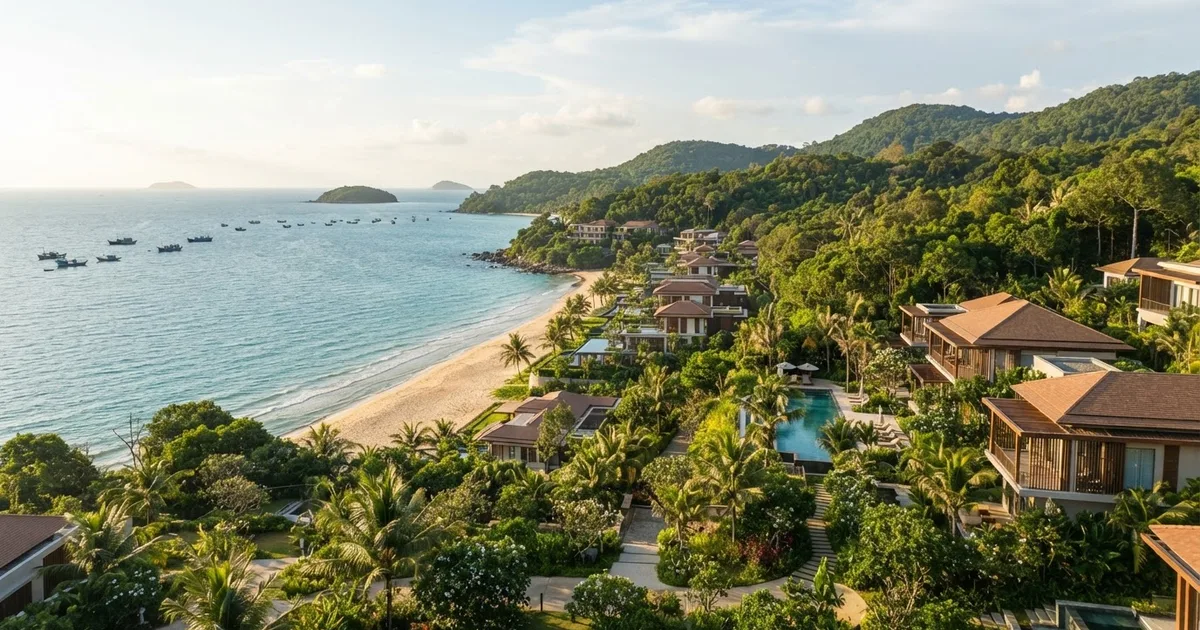
Yes — foreigners can legally buy property in Phu Quoc, but only apartments or houses inside licensed commercial housing projects, and never the land itself. Ownership is granted as a 50-year leasehold, renewable once, under Vietnam's Housing Law 2023, with a strict cap of 30% foreign-owned units per apartment building. Entry-level studios start around US$50,000, while branded beachfront resort product typically sells for US$2,200–$3,000 per square meter.
The Short Answer: What Foreigners Can and Cannot Buy in Phu Quoc
Foreigners can buy property in Phu Quoc — but the law draws a hard line around land. In Vietnam, all land is owned by the state and administered on behalf of the people; private buyers, Vietnamese or foreign, only ever hold land-use rights. What foreigners can acquire is the building itself: an apartment or a house inside a commercial housing project that has been formally approved for sale to foreign buyers.
In practice this means the market open to you is project-based. You cannot buy a plot of land, you cannot buy an old house in a fishing village, and you cannot acquire a beachfront bungalow on its own private lot outside a licensed development. Everything must sit inside an approved project with a defined foreign quota.
| Property type | Can foreigners buy it? | Key condition |
|---|---|---|
| Apartment in a licensed project | Yes | Max 30% of units per building foreign-owned; 50-year renewable term |
| House in a commercial housing project | Yes | Max 250 standalone houses per area for foreign buyers |
| Condotel / tourist apartment | Often marketed, weaker legal basis | Usually quoted on 50–70 year terms, outside standard housing quotas |
| Tourism villa in a resort project | Sometimes | Depends on the project's licence; typically 50–70 year terms |
| Bare land or land plot | No | Land is state property; foreigners cannot own it |
| Standalone house on private land | No | Only Vietnamese citizens with land-use rights can hold this |
How the 50-Year Leasehold Actually Works
Under Vietnam's Housing Law 2023, a foreign individual who enters the country on a valid visa may buy an apartment or house in an eligible project and hold it for 50 years. That term can be renewed once, so in theory a single purchase can be held for up to around 100 years. The certificate issued in your name covers the unit — the land beneath it remains state land on which you hold usage rights for the duration of the term.
This is different from freehold ownership, and it has practical consequences. The value of a unit is partly a function of how many years remain on its term: a brand-new apartment with a full 50 years ahead of it is worth more on resale than the same unit with 15 years left. Foreign owners can sell, lease, gift, or pass the property to heirs during the term, and the buyer simply inherits the remaining years.
Phu Quoc adds a wrinkle: much of the island's signature inventory — condotels and tourism-land villas — is sold under resort and tourism licences rather than the standard housing-law route, on terms commonly quoted at 50–70 years. These products can be perfectly legitimate, but they sit on a weaker legal footing than a quota apartment, so the developer's paperwork deserves extra scrutiny before you commit.
What Property Types Are Actually for Sale — and What They Cost
Phu Quoc's market is dominated by resort-style product rather than ordinary city apartments. The three categories foreign buyers encounter most are: (1) foreign-quota apartments in commercial housing projects, which are the most legally robust but relatively scarce; (2) condotels — hotel-room-style units sold to individuals and run by an operator; and (3) tourism-land villas inside gated resort communities, often with private pools and hotel services.
Pricing in 2026 reflects the island's shift toward branded, managed product:
| Product | Typical price (2026) | Notes |
|---|---|---|
| Studio in a new development | From ~US$50,000 | Entry-level condotel and tourist units |
| Two-bedroom apartment | From ~US$100,000 | Reported starting level in 2026 data |
| Branded Phu Quoc resort product | ~US$2,200–$3,000 per m² | Managed, hotel-services inventory |
| Beachfront product (Vietnam-wide) | ~US$2,000–$4,000 per m² | Location and brand drive the spread |
| Lagom Phu Quoc (resale) | VND 4.9–5.6 billion (~US$190,000–$220,000) | Resort-villa resale listings, 2026 |
For perspective, a VND 5 billion resale at Lagom Phu Quoc works out to roughly US$195,000–$200,000 at 2026 exchange rates — squarely in the range of a two-bedroom beachfront apartment elsewhere in Vietnam, but on an island where supply is controlled and demand is heavily seasonal and international.
The Buying Process, Step by Step
The mechanics are simpler than many buyers fear, but the order matters — the most expensive mistakes happen before the contract stage.
- 1. Confirm your eligibility. You need a valid entry visa or visa exemption to buy. Phu Quoc itself grants a 30-day visa exemption to foreigners arriving directly on the island, which is enough for an inspection trip and even a signing.
- 2. Verify the project. Check the Kien Giang Provincial People's Committee list of projects permitted to sell to foreigners, and confirm the building still has foreign quota available (30% of units per building; 250 houses per area for landed product).
- 3. Reserve and deposit. Reservation fees are typically small and refundable within a short window; the deposit agreement that follows usually commits 5–10% of the price with a staged payment schedule.
- 4. Sign and notarize the Sale and Purchase Agreement. Notarization is mandatory. Read the handover date, penalty clauses, and — for condotels — the management contract attached to the unit.
- 5. Pay taxes and fees. Budget for VAT (10%, often already included in the quoted price — always confirm), a one-off maintenance fund contribution of about 2–3%, and the 0.5% registration levy.
- 6. Register the unit. The developer or your lawyer registers ownership so the certificate (the "pink book") is issued in your name for the unit, for the remaining term.
A straightforward resale purchase typically completes in 30–60 days from deposit to registration; off-plan purchases instead follow the developer's construction and handover schedule.
Costs, Taxes and Ongoing Fees to Budget For
The purchase price is only the headline number. Foreign buyers in Phu Quoc should model the full cost stack before comparing projects:
| Item | Typical cost | When |
|---|---|---|
| VAT | 10% (frequently included in quoted prices — always confirm) | Purchase |
| Maintenance fund contribution | ~2–3% of purchase price, one-off | Purchase |
| Registration levy | 0.5% of property value | Registration |
| Notary and administrative fees | Minor (a few hundred USD) | Closing |
| Management / service fees | Varies; condotels are the most expensive per m² | Ongoing, monthly or annual |
| Resale tax | 2% personal income tax on the transfer price for non-resident sellers | When you sell |
| Rental income tax | ~10% withholding (5% VAT + 5% PIT) for non-resident landlords, or via operator structure | Ongoing |
Financing is the other constraint. Vietnamese banks can in principle lend to foreigners — some will consider loan-to-value ratios up to around 50% — but approvals are rare in practice, and most foreign buyers either pay cash or use the developer's own installment plan, which on off-plan projects is often interest-free for 12–24 months during construction.
Who Phu Quoc Property Suits — and Who Should Look Elsewhere
Well suited to
- Investors who want a managed, resort-branded unit and are comfortable underwriting rental yield rather than land appreciation.
- Buyers planning a personal holiday base inside a gated, serviced community on an island with direct international flights and a 30-day visa exemption.
- Cash buyers with a 5–10 year horizon who accept the 50-year leasehold structure as the price of access.
Less suited to
- Buyers who want freehold land or plan to build their own villa on a private plot — that route is closed to foreigners anywhere in Vietnam.
- Anyone counting on mortgage leverage; foreign lending is theoretically possible but rarely approved, so purchases are effectively cash or developer-installment deals.
- Short-term flippers — leasehold decay, the 2% resale tax, and a young resale market make quick exits expensive.
- Buyers unwilling to travel; while remote purchases via power of attorney are possible, Phu Quoc's condotel-heavy market strongly rewards an on-site inspection.
If your goal is simply to spend one to six months a year on the island, renting long-term is usually the smarter first move: it costs a fraction of ownership, requires no legal structure, and lets you learn the island's neighborhoods — Duong Dong, Ong Lang, An Thoi, the south-coast resort belt — before committing capital. Sabrina Rental specializes in exactly this kind of long-term stay.
Due Diligence Checklist Before You Pay Anything
Phu Quoc's market includes excellent licensed projects — and a long tail of condotel schemes with murky paperwork. Work through this list before transferring a single dollar:
- Project appears on the Kien Giang Provincial People's Committee list of projects permitted to sell to foreigners.
- Your passport is valid and you hold (or will hold on arrival) a valid visa or the island's 30-day exemption.
- Written confirmation of remaining foreign quota in your specific building (30% of units) or area (250 houses).
- Developer's project approval, construction permit, and 1/500 master plan documents.
- For condotels: the operator agreement, revenue-share formula, and any "guaranteed yield" fine print — who funds the guarantee and for how many years.
- Deposit agreement states refund conditions in writing.
- Evidence that earlier buyers in the same project have actually received their ownership certificates.
- Independent lawyer review of the Sale and Purchase Agreement before notarization.
Frequently Asked Questions
Can foreigners own land in Phu Quoc?
No. All land in Vietnam is state-administered, and foreigners cannot hold land ownership anywhere in the country, including Phu Quoc. What you can own is the building — an apartment or house in an approved commercial project — together with land-use rights attached to it for the duration of your term, typically 50 years and renewable once.
How long can a foreigner own property in Phu Quoc?
Under the Housing Law 2023, foreign buyers hold their unit for 50 years, renewable once — potentially up to about 100 years in total. Condotels and tourism villas, sold under resort licences rather than standard housing rules, are commonly quoted on 50–70 year terms. The remaining term directly affects resale value, so always check the term's start date before buying.
What is the 30% foreign ownership quota?
No more than 30% of the apartments in any single building may be owned by foreigners. Once that quota is sold, foreigners can no longer buy in that building, even if individual units are listed for sale. For landed housing, the cap is 250 standalone houses per area. Always ask for written confirmation of remaining quota before paying a deposit.
Do I need a visa to buy property in Phu Quoc?
Yes — foreign buyers must hold a valid entry visa or visa exemption to legally purchase. Helpfully, Phu Quoc grants a 30-day visa exemption to foreigners who arrive directly on the island, which is usually enough for an inspection trip and even signing. For a longer search, Vietnam's e-visa allows stays of up to 90 days.
How much does property in Phu Quoc cost?
Entry-level studios in new developments start around US$50,000, and two-bedroom apartments from about US$100,000 (2026 figures). Branded resort product on the island runs roughly US$2,200–$3,000 per square meter, in line with Vietnam-wide beachfront pricing of $2,000–$4,000 per m². Lagom Phu Quoc resales currently list at VND 4.9–5.6 billion, roughly US$190,000–$220,000.
Can foreigners get a mortgage in Vietnam?
In theory yes — some Vietnamese banks will consider foreign borrowers at loan-to-value ratios up to around 50% — but approvals are rare in practice because of income-verification and residency requirements. Most foreign buyers in Phu Quoc pay cash or use developer installment plans, which on off-plan projects frequently offer 0% interest for 12–24 months during construction.
Can I rent out my Phu Quoc property?
Yes. Most condotel and resort-villa owners rent through the project's operator under a revenue-share or management agreement — read the fee structure carefully, as operator take and service charges materially reduce net yield. Non-resident landlords are generally subject to about 10% tax withholding on rental income (5% VAT plus 5% personal income tax) unless a different structure applies.
What happens when the 50-year term expires?
The term can be renewed once, so owners should apply for renewal before expiry. If a term is not renewed, the state can reclaim the property, with compensation mechanisms applying to the structure. In practice, most foreign owners either renew or sell well before expiry — units with fewer than 15–20 years remaining become noticeably harder to resell.
Thinking about a base on Phu Quoc — or just a two-month stay to test the island before you buy? Sabrina Rental is on the ground in Duong Dong with motorbikes, long-term rooms, and honest local advice. Get in touch and we'll help you plan the trip.
Contact Sabrina Rental