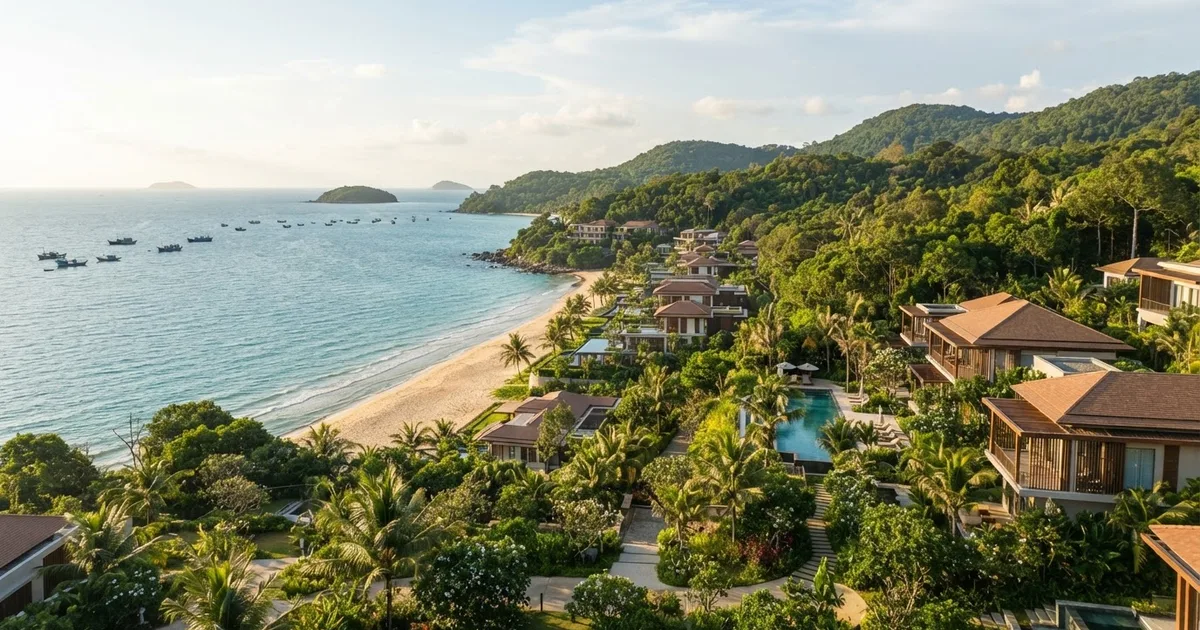
Foreigners can legally buy property in Phu Quoc, but only apartments and houses inside commercial projects specifically approved for foreign sale, and never land. A foreign individual owns on a 50-year term counted from the ownership certificate, renewable once, and foreign buyers are capped at 30% of the units in any one apartment building. Every price, yield and risk question below flows from those three rules.
Can Foreigners Buy Property in Phu Quoc? The Short Answer
Yes, but the market you are allowed to buy into is far narrower than most listings suggest. Foreigners may purchase apartments and houses only inside commercial housing projects that have been approved for sale to foreign buyers. You cannot buy land, and you cannot buy a house in an ordinary residential street the way a Vietnamese citizen can. Land in Vietnam is state-administered, and the land use right that citizens trade is not open to foreign individuals.
Three numbers define the foreign position on Phu Quoc: 50, 30 and 250. A foreign individual holds the property for 50 years counted from the ownership certificate date, with one renewal possible. Foreign buyers may own no more than 30% of the units in a single apartment building. For villas and townhouses the ceiling is about 250 houses per ward-equivalent area, or 10% of the homes if only one project exists in that area.
Phu Quoc adds one further filter. As an island in a strategically sensitive location, parts of it fall under national defence and security restrictions, and projects inside those zones are excluded from foreign sale. That rule exists nationwide, but on an island it removes a meaningful slice of the map. The practical first step for any buyer is therefore to check the Kien Giang Provincial People's Committee list of projects permitted to sell to foreigners before a single deposit payment leaves your account.
Everything else on this page, from what a studio costs to what it earns per night, follows from those constraints.
Do this before anything else: ask the developer or agent for the project approval documents and cross-check the project against the provincial list of developments permitted to sell to foreigners. If the project is not on that list, no contract you sign will produce an ownership certificate in your name.
What Foreigners Can Legally Own, and What They Cannot
The most common misunderstanding among buyers is that Phu Quoc is a special case with looser rules than the mainland. It is not. Phu Quoc runs on the same legal framework as the rest of Vietnam, with the island's security zoning layered on top.
| Property type | Can a foreigner own it? | Term | Quota and notes |
|---|---|---|---|
| Apartment in an approved commercial project | Yes | 50 years from the certificate, renewable once | Maximum 30% of the units in that building |
| Villa or townhouse in an approved project | Yes | 50 years from the certificate, renewable once | About 250 houses per ward-equivalent, or 10% if only one project exists there |
| Land or land use right | No | - | Land is state-administered; only Vietnamese citizens and qualifying entities hold land use rights |
| House in a non-approved project or a defence or security zone | No | - | Excluded from foreign sale at any price |
| Condotel or officetel unit | Contract only | Long-term lease tied to the project | Usually sold as a lease contract rather than residential ownership, so no residential ownership certificate |
Two exceptions change the picture materially. A foreigner married to a Vietnamese citizen can own property on the same terms as a citizen, which means ownership is not capped at 50 years. Overseas Vietnamese who qualify under the law sit in a similar position. If either applies to you, the leasehold clock in this guide does not.
If you are a foreign individual with no Vietnamese spouse, plan around the 50-year term from day one. It is long enough for a normal investment horizon and it is renewable once, but it is not the freehold that buyers from Europe, Australia or North America instinctively expect.
What Property in Phu Quoc Actually Costs in 2026
Phu Quoc's land market and its apartment market tell two different stories. Central land in the main town area was reported at VND 100-400 million per square meter (roughly US$3,900-15,700 per square meter at about VND 25,400 to the US dollar), while land in other parts of the island was reported at VND 20-50 million per square meter, or roughly US$790-1,970 per square meter. Foreigners cannot buy either of those directly, but those figures explain why almost all foreign-eligible product is vertical: the land cost per unit only works if you build many units on it.
| Segment | Reported price level | USD equivalent | Open to foreign buyers? |
|---|---|---|---|
| Central Phu Quoc land | VND 100-400 million per sqm | About US$3,900-15,700 per sqm | No |
| Land elsewhere on the island | VND 20-50 million per sqm | About US$790-1,970 per sqm | No |
| Studio and one-bedroom apartments, Sunset Town | Rents of VND 1.2-1.5 million per night | About US$47-59 per night | Yes, where the project is approved |
| Approved villas and townhouses in licensed projects | Priced individually by project | Verify current developer price lists | Yes, within the roughly 250-house ceiling per ward-equivalent |
For sale prices, treat any number you read online as a starting point to verify rather than a benchmark. Entry-level studio and one-bedroom units in the south of the island are commonly marketed from the high five figures into the low six figures in US dollars, and the spread is driven by building, floor, sea view, furniture package and, increasingly, whether the unit sits inside the 30% foreign quota or outside it. Quota-eligible units in a popular building can carry a premium precisely because the supply of legally purchasable units is capped.
Ask three questions of any price you are quoted. Is this price in VND or USD, and at what exchange rate is the contract settled? Does the price include VAT, the 2% maintenance fund contribution and the furniture package, or are those added on top? And is the unit inside the foreign quota, in writing, from the developer?
Currency note: contracts are usually written in VND. Because the dong has historically drifted against the dollar, agree in the contract which exchange rate applies at each payment date, or you may find the dollar cost of your final instalment has moved by several percent.
Rental Yields: Does the Nightly Rate Math Work?
The headlines look strong. Phu Quoc's occupancy rate was reported at over 90% in January and February 2026, and studios and one-bedroom apartments in Sunset Town were renting for VND 1.2-1.5 million per night, about US$47-59. Run that through a full year, however, and the picture changes, because those occupancy figures describe peak season, not the calendar.
Work an illustrative case. Take a VND 1.35 million (about US$53) average nightly rate and a conservative 60% annual occupancy, which is realistic once you blend the January-February peak with the September-October low season. Gross revenue is about VND 296 million, or roughly US$11,600 a year. Now subtract the costs that owners routinely underestimate: a management or operator fee of 20-30% of revenue, booking platform commissions of 15-18% on the bookings they bring, furniture replacement and repairs, utilities not recovered from guests, insurance, and the weeks the unit sits empty between bad reviews or blocked dates. A realistic net is often 45-55% of gross, or roughly US$5,000-6,400 on that unit.
Against a US$100,000 purchase price, that is a net yield in the region of 5-6%, before any capital appreciation. That is a legitimate return, and it is not the double-digit figure that glossy brochures imply.
Well suited to
- Buyers who want a holiday base that partially pays for itself and can hold for five to ten years.
- Cash buyers or those with access to offshore financing at single-digit rates.
- Buyers who will use a professional operator rather than self-manage from abroad.
- Buyers focused on the strongest rental micro-locations, such as the Sunset Town and cable car area in the south.
Poor fit for
- Anyone expecting to own land or a freehold house; that is simply not available to foreign individuals.
- Buyers who need positive cash flow in year one, before the furniture, fees and low season are accounted for.
- Investors who must exit within two to three years; transaction costs and a deep resale market take time.
- Buyers using high-interest leverage, where a 10%+ borrowing cost exceeds the realistic net yield.
- Anyone who cannot visit and inspect before signing, or who is being pushed to pay a deposit before the project's foreign-sale approval is confirmed.
The Supply Pipeline and the Oversupply Question
Phu Quoc has attracted enormous capital. As of January 2021 the island had drawn 372 investment projects with total registered capital of US$16.5 billion, across an island of 574 square kilometers, making it Vietnam's largest island by area. Sun Group alone is investing nearly VND 91.6 trillion, roughly US$3.6 billion, in a 17,400-room accommodation ecosystem, and from late 2026 onward around 5,500 hotel rooms in Hon Thom were expected to enter operation.
Read that pipeline carefully, because two things are happening at once. The infrastructure, cable car, entertainment and beach investment is what made the island attractive in the first place, and it supports both rental rates and resale values. At the same time, thousands of new hotel rooms and apartments compete directly with your unit for the same guest. A 17,400-room ecosystem is not a rising tide for every landlord; it is a set of new competitors with professional sales teams and brand distribution.
Some experts project real estate values in Phu Quoc growing 20-30% between 2025 and 2027. Treat that as a projection from interested parties rather than a forecast you can bank on, and note that it is an average. In an oversupplied segment, individual units can fall in value while the islandwide average rises.
The defence against oversupply is selectivity. A unit with a genuine sea view, in a completed building with an established operator, a short walk from the Sunset Town beach club and cable car station, competes far better than a unit in a half-finished tower two kilometres inland. Completion status matters as much as location: buying off-plan in a market with this much concurrent construction means carrying schedule risk.
Due Diligence Checklist: Ten Steps Before You Pay a Deposit
Foreign buyers lose money on Phu Quoc for administrative reasons far more often than for market reasons. Work through this list in order, and do not skip a step because an agent assures you it is a formality.
- 1. Confirm the project is on the approved list. Check the Kien Giang Provincial People's Committee list of projects permitted to sell to foreigners. If it is not there, stop.
- 2. Confirm the foreign quota has room. Ask the developer in writing how many units in the building have already been sold to foreigners against the 30% cap.
- 3. Verify the developer. Look at completed projects, not renders. Visit a building the developer finished five years ago and see how it has aged.
- 4. Check the land status. The project should hold a clear land use right and the necessary construction permits. Ask for the documents, not a summary of them.
- 5. Confirm security zoning. Ask directly whether any part of the project falls inside a defence or security zone that restricts foreign sale.
- 6. Use an independent Vietnamese property lawyer. Budget for it. A lawyer who is not paid by the developer is the cheapest insurance you will buy.
- 7. Read the payment schedule and the late-delivery clause. Know what happens, and what you are owed, if handover slips by twelve months.
- 8. Separate the rental guarantee from reality. If a developer promises a fixed return for two years, check whether it is funded by a price premium you are paying up front.
- 9. Budget the full transaction cost. Registration fees, VAT, the maintenance fund contribution, furniture, notary and legal fees all sit on top of the headline price.
- 10. Inspect in person before final payment. Check the actual view from the actual unit, the noise, and whether the finishes match the show apartment.
Visas, Residency and Living on the Island as an Owner
Owning property does not entitle you to live in Vietnam. Those are separate legal systems, and confusing them is an expensive mistake. Foreigners and overseas Vietnamese can visit Phu Quoc without a visa for up to 30 days, which is generous for inspections, holidays and short stays, but it is not residency.
If you plan to spend months at a time on the island, arrange the appropriate visa or temporary residence status through the normal immigration process, independent of your purchase. Your ownership certificate gives you the right to hold the asset, lease it out and sell it under the rules that apply to foreign owners; it does not give you the right to remain in the country indefinitely.
For the day-to-day side of owning here, the practical support network matters as much as the legal paperwork: someone who can collect keys for guests, arrange servicing between lets, deal with the building management office in Vietnamese, and get a technician to the unit when the air conditioning fails in the middle of high season. Most foreign owners on the island rely on a local operator or concierge for exactly this, and the quality of that arrangement usually determines whether the unit earns in the 5-6% range or underperforms it.
Frequently Asked Questions
Can foreigners buy property in Phu Quoc?
Yes, but only apartments and houses inside commercial housing projects specifically approved for sale to foreign buyers, and subject to a 30% foreign ownership cap per apartment building. Foreigners cannot own land in Phu Quoc or anywhere in Vietnam, since land is state-administered. Always confirm the project appears on the Kien Giang Provincial People's Committee approved list before paying a deposit.
How long can a foreigner own property in Phu Quoc?
A foreign individual typically holds the property for 50 years from the date of the ownership certificate, with one possible renewal. Foreigners married to Vietnamese citizens, and qualifying overseas Vietnamese, can own on citizen terms rather than a 50-year term. Plan your investment horizon around the 50-year clock if neither exception applies to you.
Can foreigners buy land or a villa in Phu Quoc?
Land is out of reach entirely, because land is state-administered and the land use right is not available to foreign individuals. Villas and townhouses are possible only inside approved commercial projects, and only up to about 250 houses per ward-equivalent area, or 10% of homes where only one project exists in that area.
What does an apartment in Phu Quoc cost?
There is no single figure, since pricing varies by building, floor, view and furniture package, and quota-eligible units often carry a premium. Land benchmarks give context: central Phu Quoc land was reported at VND 100-400 million per square meter, and land elsewhere on the island at VND 20-50 million per square meter. Always request the current developer price list in writing and confirm the currency and exchange rate.
What rental income can a Phu Quoc apartment generate?
Studios and one-bedroom units in Sunset Town were renting for VND 1.2-1.5 million per night, about US$47-59, and island occupancy was reported above 90% in January-February 2026. But that is peak season. Blending in low season and deducting management, platform commissions and maintenance, many owners net roughly 45-55% of gross revenue, often a 5-6% net yield on a US$100,000 unit.
How do I check if a project can legally be sold to foreigners?
Ask the developer for the project approval documents and cross-check the project against the Kien Giang Provincial People's Committee list of developments permitted to sell to foreigners. Also request written confirmation of how many units in the building have already been sold to foreign buyers against the 30% cap. If either check cannot be answered in writing, do not pay a deposit.
Does buying property in Phu Quoc give me a visa or residency?
No. Property ownership and immigration status are separate. Foreigners and overseas Vietnamese can visit Phu Quoc without a visa for up to 30 days, which covers inspections and holidays, but longer stays require the appropriate visa or temporary residence status arranged through normal immigration procedures, independent of your purchase.
Is Phu Quoc property a good investment right now?
Some experts project values growing 20-30% between 2025 and 2027, and the island had attracted 372 projects worth US$16.5 billion as of January 2021. But Sun Group's nearly VND 91.6 trillion, 17,400-room development and about 5,500 Hon Thom hotel rooms from late 2026 add direct rental competition. Selectivity matters more than the islandwide average.
Thinking about buying on Phu Quoc, or visiting to inspect a project before you commit? Sabrina Rental is based on the island and helps buyers and long-stay visitors with transport, accommodation, project visits and practical local coordination, so you can see the buildings and the neighbourhoods in person before you sign anything.
Talk to Sabrina Rental about your Phu Quoc plans