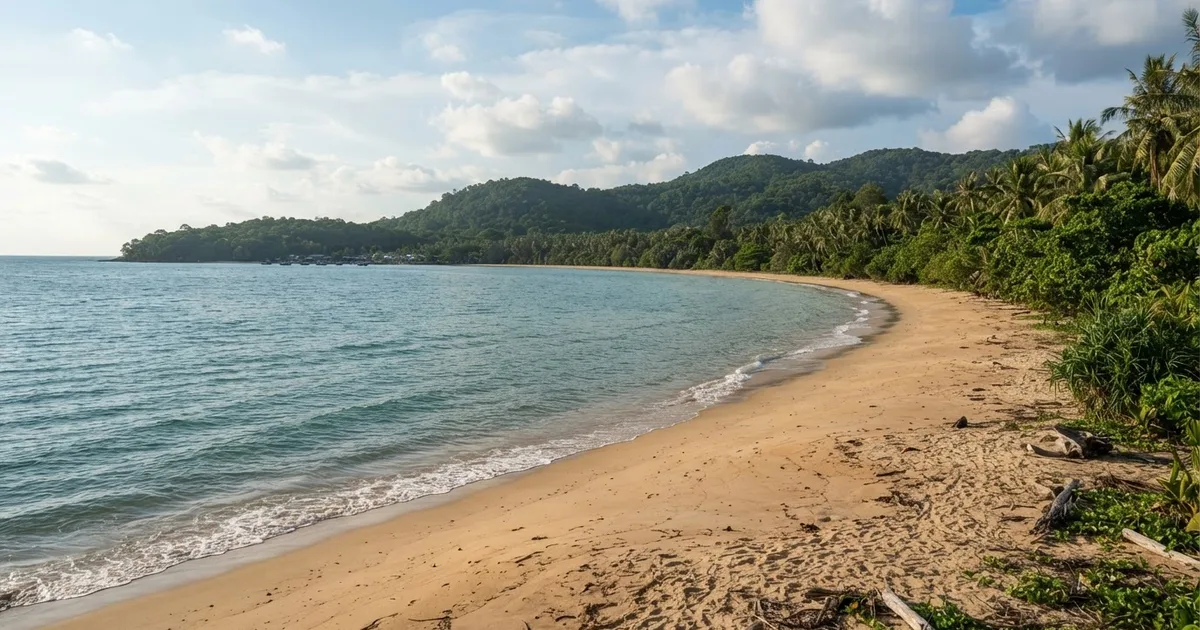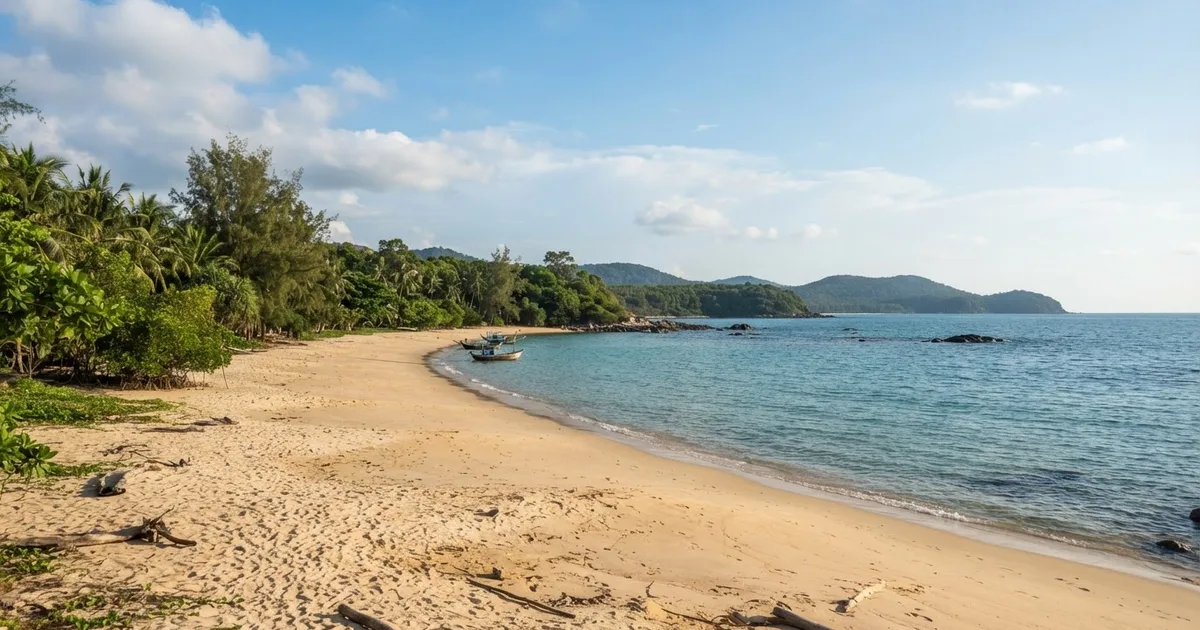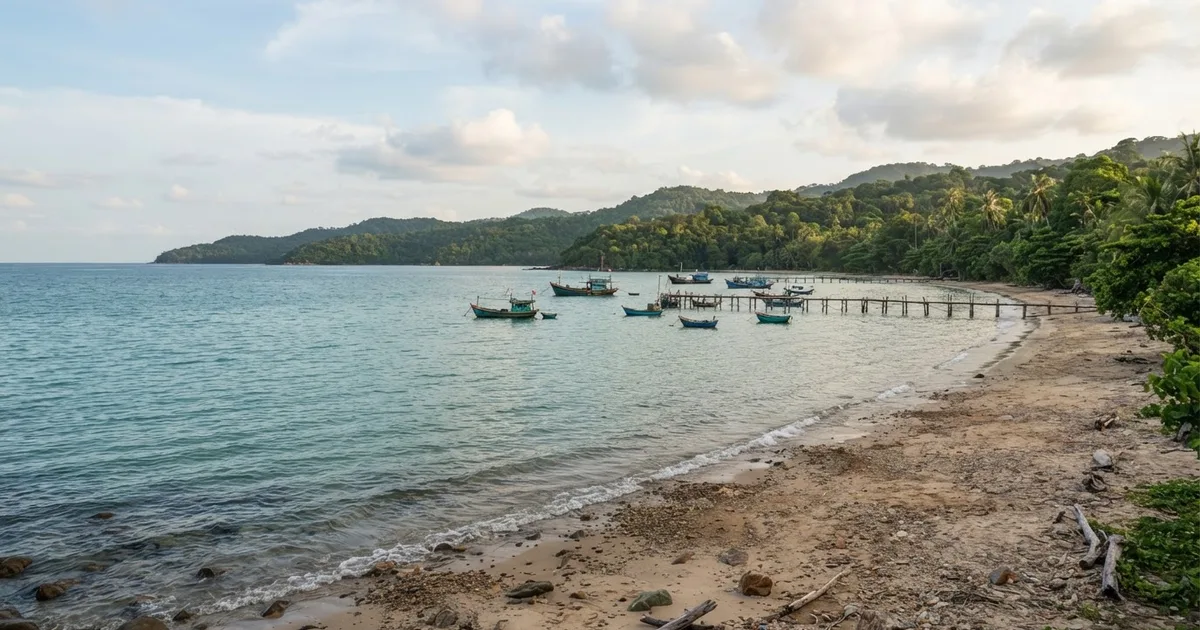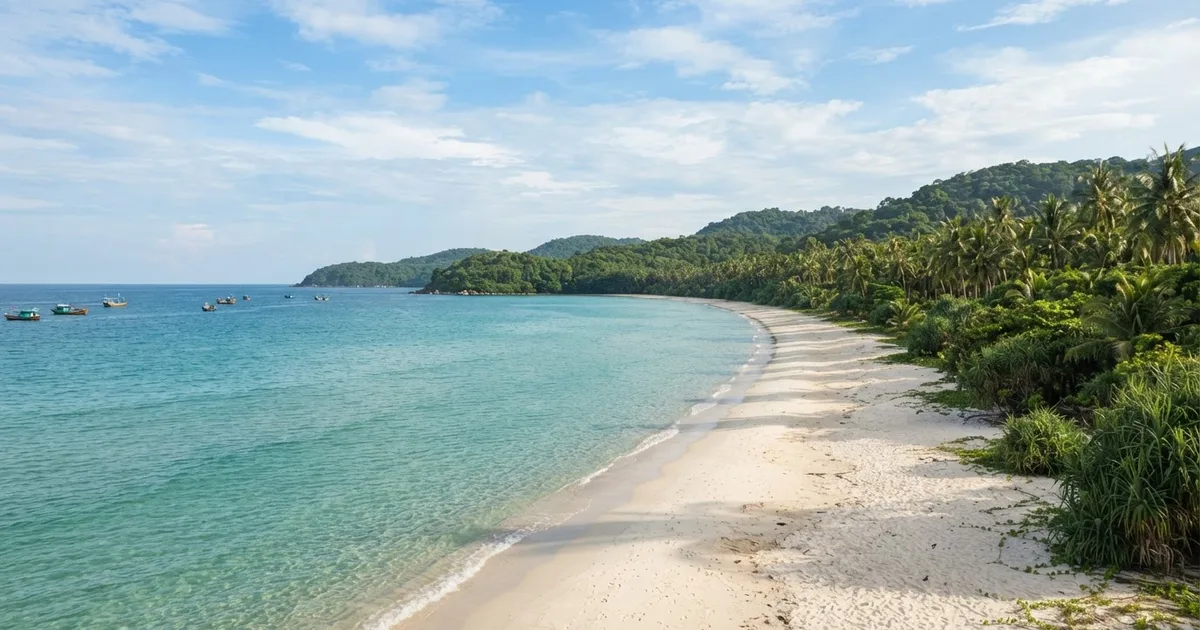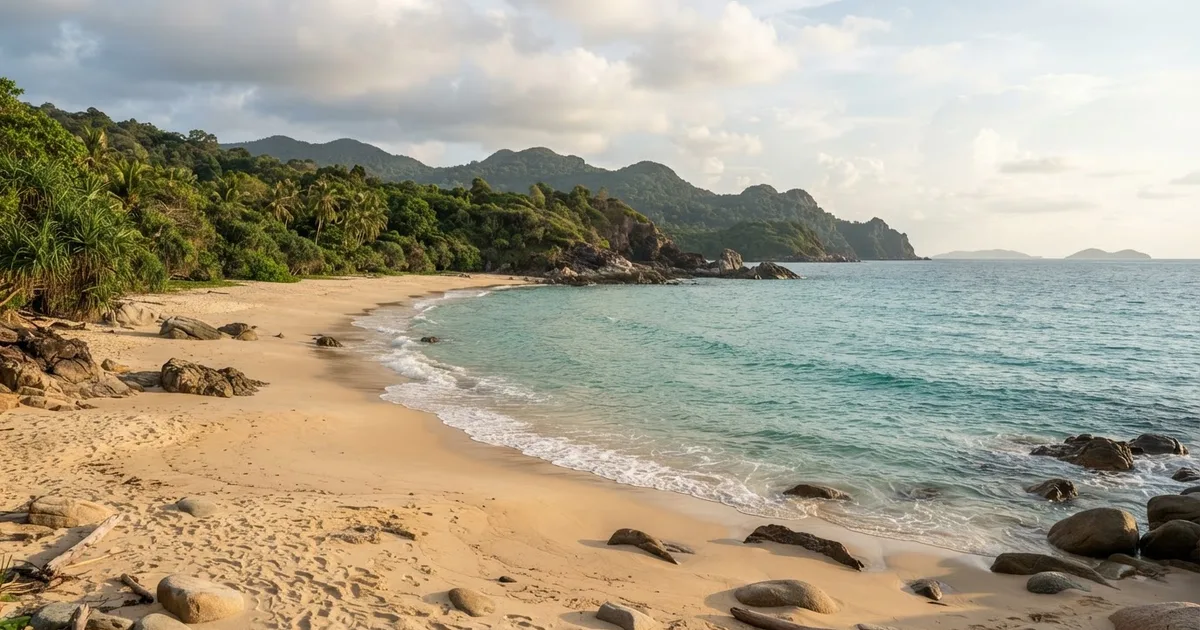
Hàm Rồng Beach — also called Dragon Beach or Ham Rong Cape — is a boat-only beach about 30 km north of Dương Đông town, reached by first driving to the fishing village of Rạch Vẹm and then continuing by boat. There is no entry fee and no road access, crowds are very low, and the beach itself is a long, narrow strip of white sand with shallow, turquoise water and gentle waves on a calm day. The best window is the dry season from November to April; from May to September the water at Dragon Beach often turns murky and wind can stop small boats from running at all.
What Is Hàm Rồng Beach? Dragon Beach at a Glance
Hàm Rồng sits in Phu Quoc's quiet north-west corner, the same stretch of coast as Rạch Vẹm, Ganh Dau and the island's national park hills. The Vietnamese name means roughly "dragon's jaw", which is why English-language guides almost always list it as Dragon Beach. Descriptions of the beach are consistent: a long, narrow strip of white sand backed by green hillside, with shallow, turquoise water in front and crystal-clear visibility on calm days. Gentle waves rather than surf are the norm.
The single most important thing to understand before you plan a visit is that you cannot drive there. Every source that documents Hàm Rồng agrees the beach is accessible only by boat, with the approach made from Rạch Vẹm. That logistical barrier is precisely what keeps it empty — it filters out almost everyone who is not willing to arrange a boat.
| Feature | Detail |
|---|---|
| Also known as | Dragon Beach, Ham Rong Cape, Bãi Hàm Rồng |
| Distance from Dương Đông | About 30 km north |
| Access route | Road to Rạch Vẹm, then boat |
| Access type | Boat only — no road, no walking track |
| Sand and water | Long, narrow white-sand strip; shallow, turquoise, crystal-clear water when calm |
| Crowd level | Very low; described as peaceful and less crowded |
| Entry fee | None documented for the beach |
| Best months | November to April (dry season) |
| Facilities | No documented shops, restaurants, sunbeds or lifeguards |
One honest caveat: Hàm Rồng is not well documented for swimming and snorkelling conditions. There are no reliable published reports on currents, reef quality or visibility below the surface, so treat the water as unknown until you see it with your own eyes and ask your boat captain directly.
How to Get to Hàm Rồng Beach: Rạch Vẹm First, Then a Boat
Getting to Hàm Rồng is a two-stage trip, and both stages need a little planning.
Stage 1 — Reach Rạch Vẹm. From Dương Đông, head north along the coast road past Ông Lang and Cửa Cạn, then follow the turn-off to Rạch Vẹm. It is about 30 km in total — roughly 45 to 60 minutes on a motorbike, or 40 to 50 minutes by car or taxi. The final kilometres narrow into the fishing village itself, where you will find small jetties, floating seafood restaurants and parked scooters. Arrive in the morning if you can: seas are usually calmer before midday and you will have more boats to choose from.
Stage 2 — Cross by boat. At Rạch Vẹm you charter a local boat for the run to Hàm Rồng. The crossing is short — typically somewhere between 15 and 30 minutes depending on the boat and the sea state. Expect to pay in the region of US$30–70 for a small private boat for a half-day outing; the price depends on boat size, group size and how long you stay on the beach, so agree the total, the route and the pickup time before you leave the dock. Some north-island boat tours and kayak trips also include Hàm Rồng as a stop — worth asking about in Dương Đông if you would rather not negotiate a charter yourself.
Practical tips for the crossing: bring cash in Vietnamese dong — card payments are unreliable in the village; wear the life jacket even if it looks unnecessary on a flat sea; take motion-sickness precautions if you are sensitive, because the afternoon chop can build quickly; and fix a firm pickup time and meeting point, since mobile signal offshore is patchy.
If you are riding yourself, the trip north is one of the most rewarding half-days on the island by motorbike — you can combine the beach run with breakfast at Rạch Vẹm's floating restaurants before or after your boat. If you would rather not ride 30 km of coastal road, a car with a driver for the day is the simpler option.
Best Time to Visit Hàm Rồng Beach
Phu Quoc has a strongly seasonal climate, and Hàm Rồng — being boat-only — is more weather-dependent than almost any other beach on the island. Vinpearl lists the dry season from November to April as the best time to visit Hàm Rồng Beach. VinWonders notes that rainy-season conditions from May to September can make the water at Dragon Beach murky.
That matters twice over. Murky water is one problem; the other is that wind and swell in the wet season can make the crossing uncomfortable or, on some days, impossible. If your only chance to visit falls between May and September, check the marine forecast on the morning itself and be ready to change plans.
| Period | Conditions | Verdict |
|---|---|---|
| November – April | Dry season; calm sea, clearest water, gentle waves | Best window for the boat trip |
| December – March | Peak dry season; highest visitor numbers island-wide | Best window — Hàm Rồng still stays quiet |
| May – September | Rainy season; water often murky, more wind and chop | Avoid for a beach day; boats may not run |
| October | Transitional and unsettled; mixed sea conditions | Check conditions daily before committing |
Weekday mornings in the dry season are the sweet spot: calmest water, the best light for photos on the white sand, and the greatest chance that a captain will be free at short notice. Vietnamese public holidays and the Tet period around late January to early February can make the north of the island busier, and boat availability tighter.
What Is Actually on the Beach: Sand, Water and Facilities
Set your expectations correctly and Hàm Rồng delivers exactly what it promises: space, quiet and colour. Guides describe a long, narrow strip of white sand, shallow turquoise water, crystal clarity on calm days and gentle waves instead of surf. Because there is no road, there is also no resort strip, no beach club and no line of sunbeds — the atmosphere is peaceful and markedly less crowded than Phu Quoc's southern beaches.
What you will not find is equally important. There are no documented shops, cafés or restaurants on the beach, no sunbed or umbrella rental, and no evidence of lifeguards or supervised swimming areas. Bring everything you need: at least one litre of water per person, snacks, a hat, high-factor sunscreen, a rash shirt, and something for shade if you plan to stay for hours. Take all your rubbish back to the mainland — there is no collection service on a beach with no road.
- Water: 1–2 litres per person, more in the middle of the day
- Food: bring your own, or arrange a seafood lunch back at Rạch Vẹm afterwards
- Shade: there is limited natural shade on a narrow sand strip
- Sun protection: hat, sunglasses, reef-safe sunscreen, long-sleeve top
- Footwear: sandals for the boat and the shoreline
- Dry bag and a towel — spray is normal on a small boat
- Cash for the boat, the driver and any village food stops
- A rubbish bag: pack out everything you pack in
On snorkelling and swimming below the surface, be cautious with any marketing you read elsewhere: the retrieved sources simply do not document visibility, reef quality or current behaviour at Hàm Rồng, so no responsible recommendation can be made from published information alone. Ask your captain what the water is doing that day — he will know better than any guidebook.
Swimming and Safety at Hàm Rồng Beach
Hàm Rồng is a beautiful beach with no documented safety infrastructure, which makes personal judgement the main safeguard. General ocean-safety guidance is clear on which beaches are comparatively suitable for swimming: calm waves and gently sloping sandy bottoms. General guidance also warns that areas near headlands and structures such as groynes can have sudden drop-offs or complex, strong currents — relevant here, because Hàm Rồng is a cape, and capes are exactly where currents behave unpredictably.
- Swim only where lifeguards or supervised safety staff are on duty. If there are none — as appears to be the case at Hàm Rồng — treat the beach as unsupervised and keep risks low.
- Never swim alone. Stay within sight of someone on shore who is watching you.
- Do not enter the water when red warning flags are posted. No flags does not mean no hazard; it means no warning system.
- Check for rip currents, rocks and shorebreak before you go in, and watch the water for a full two minutes first.
- Ask about beach and surf safety before swimming — your boat captain is the local expert on the day's conditions.
- Stay away from the headland edges and any drop-off zones near rocks; currents concentrate there.
- Keep children within arm's reach at all times, and use flotation aids for weak swimmers.
In practice: knee- to waist-deep paddling on a calm dry-season day is a very different proposition from swimming out past the headland in a rising swell. Match your activity to the conditions in front of you, not to the photos you saw online.
Who Hàm Rồng Beach Suits — and Who It Does Not
Hàm Rồng is a specialist beach, not an all-purpose one. Being honest about that saves a wasted day.
An excellent fit if you are…
- A traveller who values empty coastline over facilities and is happy to pack in your own water and food
- Planning a boat day anyway and want a genuinely quiet stop rather than a busy snorkelling circuit
- A photographer chasing white sand, turquoise shallows and clean, uncluttered horizons
- A couple or small group of confident swimmers who will split the roughly US$30–70 boat charter between you
- Staying in the north of the island near Vinpearl, Grand World or Ganh Dau and want a half-day escape from the resort strip
A poor fit if you are…
- Traveling with toddlers or elderly relatives who need shade, toilets, food and easy access from a car park
- Expecting beach bars, sunbeds, restaurants or lifeguards — none are documented here
- Relying on public transport or a Grab car to reach the beach independently; there is no road arrival
- A weak or nervous swimmer, since the beach is effectively unsupervised
- On a tight budget or a tight schedule — a charter plus the 30 km transfer north eats half a day
- Visiting in the rainy season and hoping for clear water; May to September often turns it murky
Hàm Rồng Compared With Other Northern Phu Quoc Beaches
The north-west of Phu Quoc has several quiet beaches, and Hàm Rồng is the most remote of them. If your priority is simply an uncrowded shoreline without a boat, Bãi Bổn Beach is described as one of Phu Quoc's emptier stretches of coastline — a good match for travellers seeking a genuinely peaceful beach rather than a lively scene, and easier to reach than Dragon Beach.
| Beach | Access | Crowd level | Best for |
|---|---|---|---|
| Hàm Rồng (Dragon Beach) | Boat only, from Rạch Vẹm | Very low | Empty white-sand beach, boat day trips, photography |
| Rạch Vẹm | Road, about 30 km from Dương Đông | Low | Floating seafood restaurants, boat departures, village life |
| Bãi Bổn | Road, north-west coast | Very low | Peaceful beach time without arranging a boat |
| Starfish Beach (north-west) | Road plus short boat | Medium to high | Seeing starfish — but expect boat traffic and crowds |
| Ông Lang | Road, about 15 km north of Dương Đông | Medium | Easy sunset beach with bars and restaurants |
| Bãi Dài / Long Beach (north-west strip) | Road, along the resort coast | Medium, high near resorts | Long walks and resort convenience |
If you have two free days in the north, pair them rather than choosing: Bãi Bổn for a lazy, no-logistics beach afternoon, and Hàm Rồng for a boat adventure the following morning.
Pairing Hàm Rồng With the Rest of North Phu Quoc
Because the transfer north is about 30 km each way, it makes sense to build a full day around Hàm Rồng rather than treating it as a standalone stop.
A strong itinerary: leave Dương Đông early, ride or drive north past Ông Lang and Cửa Cạn, stop at a pepper farm or the national park edge on the way, reach Rạch Vẹm mid-morning, take a boat to Hàm Rồng for two to three hours of swimming and photography, then return for a late seafood lunch at one of Rạch Vẹm's floating restaurants. From there you are close to Ganh Dau's viewpoint, and to the north-island entertainment cluster around Vinpearl, VinWonders and Grand World if you want an evening of restaurants and shows before heading back south.
Timing tip: aim to be back at the Rạch Vẹm jetty by mid-afternoon. Seas typically build through the day, and you do not want to be crossing in a small boat at dusk or after dark.
Frequently Asked Questions
Can you drive to Hàm Rồng Beach?
No. Hàm Rồng Beach is only accessible by boat. There is no road, track or walking route to the sand. You drive to Rạch Vẹm, about 30 km north of Dương Đông, and continue from there by local boat — usually a crossing of 15 to 30 minutes.
How far is Hàm Rồng Beach from Dương Đông?
About 30 km north of Dương Đông town. By motorbike the drive to Rạch Vẹm takes roughly 45 to 60 minutes; by car or taxi, around 40 to 50 minutes. Add another 15 to 30 minutes for the boat crossing to the beach itself.
Is there an entrance fee for Hàm Rồng Beach?
No entry fee is documented for the beach. Your only costs are transport to Rạch Vẹm plus the boat charter, which typically runs around US$30–70 for a small private boat for a half day, depending on boat size, group size and how long you stay.
What is the best time of year to visit Hàm Rồng Beach?
The dry season, November to April, when the sea is calm and the water is clearest. From May to September, rainy-season conditions can make the water murky and wind can make the boat crossing uncomfortable or impossible on some days. October is transitional — check conditions before committing.
Is Hàm Rồng Beach safe for swimming?
Conditions at Hàm Rồng are not well documented, and there is no evidence of lifeguards. General safety advice applies: swim only where supervised staff are on duty, never swim alone, avoid the water when red flags are posted, check for rip currents and rocks, and stay clear of the headland where drop-offs and strong currents are more likely.
Are there restaurants, shops or toilets on Hàm Rồng Beach?
No facilities are documented on the beach itself — no shops, cafés, sunbeds or toilets. Bring your own water and food, carry out all rubbish, and plan to eat back at Rạch Vẹm, where floating seafood restaurants sit right beside the jetty you depart from.
Is Hàm Rồng Beach crowded?
No — it is one of the quietest beaches on Phu Quoc. Sources describe it as peaceful with very low crowds, largely because boat-only access limits how many people can reach it. Even in the December to March peak season, you may share the sand with only a handful of others.
Can you snorkel at Hàm Rồng Beach?
Snorkelling conditions here are not well documented, so no reliable recommendation can be made from published information. Take mask and fins if you like, but judge visibility and currents on the day and ask your boat captain first — he will know the local water far better than any guide.
Planning a boat day to Hàm Rồng Beach or exploring Phu Quoc's north-west coast? Sabrina Rental can arrange motorbike or car transport to Rạch Vẹm, advise on sea conditions, and connect you with a local captain who knows the Dragon Beach crossing.
Ask Sabrina Rental