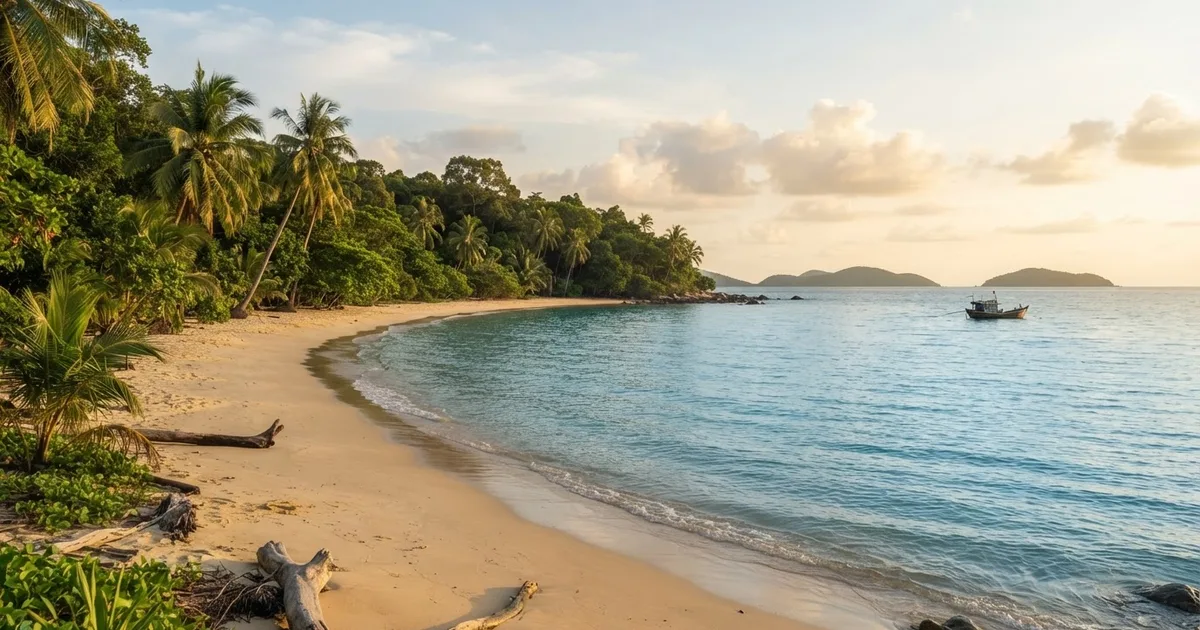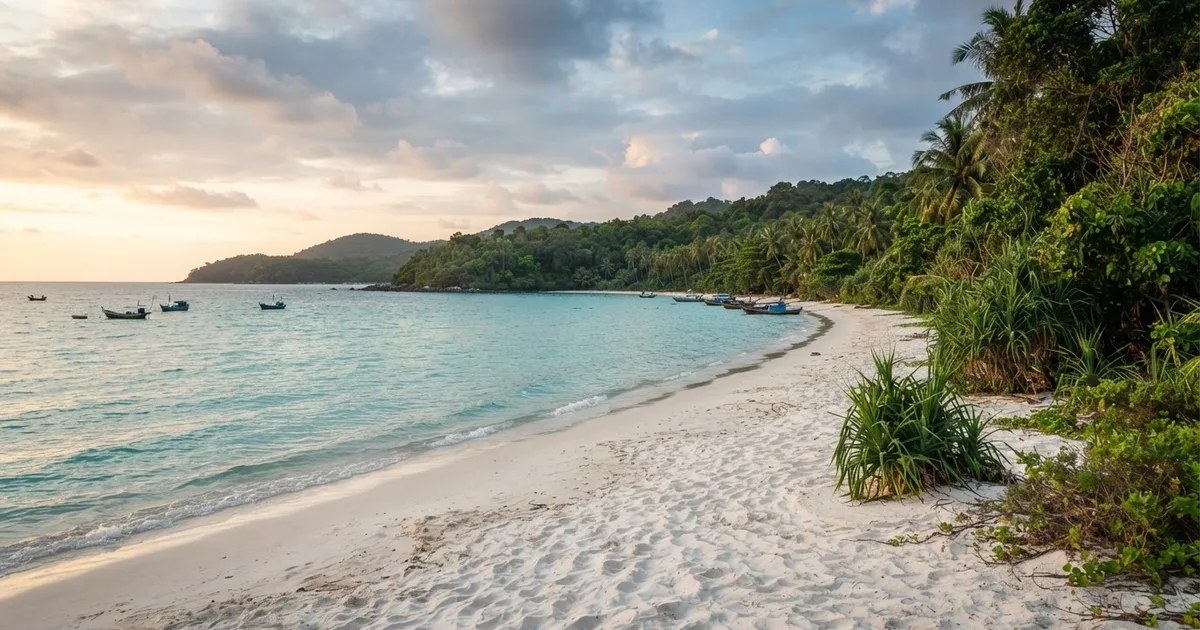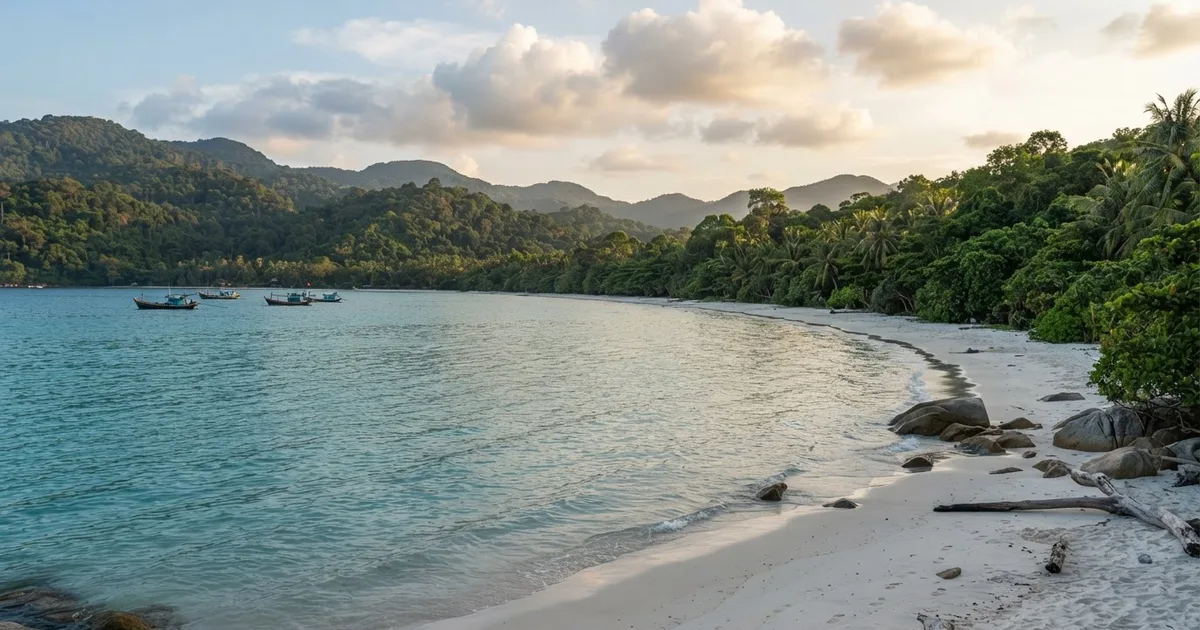
Pick Phu Quoc if you want a quieter, cheaper beach holiday: backpackers spend about $28 a day here versus $35 in Krabi, mid-range hotels cost $25-60 a night, and the long white-sand beaches at Bai Truong and Bai Sao beat Krabi on sand quality alone. Pick Krabi instead if you want vertical drama - limestone cliffs, Railay and boat-based island hopping - because Phu Quoc has none of it. Mid-range travelers spend roughly $80 a day in both destinations, so the real decision is scenery and atmosphere, not price.
Phu Quoc vs Krabi at a Glance
Phu Quoc is Vietnam's largest island, roughly 574 square kilometres of gently sloping land in the Gulf of Thailand, ringed by beaches and largely covered by national park. It is a resort island first and foremost: a 20 km beach strip along the west coast, an international airport, a night market and a southern archipelago used for snorkelling and cable-car day trips. Krabi sits on Thailand's Andaman coast and is defined by the opposite kind of geography - limestone karst towers, hidden lagoons and cliff walls that rise straight out of the sea.
| Factor | Phu Quoc, Vietnam | Krabi, Thailand |
|---|---|---|
| Backpacker daily budget | About $28 | About $35 |
| Mid-range daily budget | About $80 | About $80 |
| Mid-range hotel per night | $25-60 | Similar, with tighter supply in high season |
| Signature scenery | Long sandy beaches, forested interior, no karst cliffs | Limestone cliffs, karst islands, Railay peninsula |
| Beach style | Kilometre-long white sand (Bai Truong, Bai Sao) | Smaller beaches, the best ones reachable by longtail boat |
| Crowds | Noticeably quieter outside Duong Dong | Busy, especially Ao Nang and Railay from December to March |
| Island hopping | An Thoi archipelago, Hon Thom cable car | Four Islands tour, Hong Islands, Phi Phi day trips |
| Family fit | Excellent - calm water, pools, short transfers | Good, but Railay and several beaches require boats |
| Dry season | November to April | November to March |
The short version: Phu Quoc is horizontal, Krabi is vertical. If your mental picture of a perfect holiday is a long walk on near-empty sand followed by a cheap bowl of noodles, Phu Quoc wins. If it is a longtail boat to a cliff-backed beach at Railay with a kayak and a climbing rope waiting, Krabi wins.
How Much Does Each Island Cost? Daily Budgets Compared
Backpackers do better in Vietnam. Realistic 2026 budgets put a backpacker day in Phu Quoc at about $28 - dorm bed, three local meals, a scooter or local bus, one paid activity - against about $35 in Krabi, where food, beer and tours all carry Thai island pricing.
Mid-range travelers, however, hit near-parity: both islands land around $80 per day all-in. The difference is in the mix. In Phu Quoc a comparable mid-range hotel - pool, air conditioning, breakfast, often a short walk from the beach - runs $25-60 per night, which leaves real headroom. Strip out accommodation and a mid-range day of food, transport and activities runs roughly $40-60 on Phu Quoc; add a $25-40 hotel and the all-in total sits close to the $80 mark, matching Krabi.
Two context points matter. First, Phu Quoc prices sit about 10-20% above mainland Vietnam - banh mi, coffee and scooter rental all cost more than in Hanoi or Da Nang, because it is an island with resort demand. Second, it is still cheaper than the Thai islands most people compare it with: a 2026 Vietnam-versus-Thailand comparison puts Phu Quoc at roughly 1.5 times cheaper than Koh Samui, with food and services cheaper than Thailand generally.
| Typical cost | Phu Quoc | Krabi |
|---|---|---|
| Budget guesthouse, per night | $10-15 | $15-25 |
| Mid-range hotel, per night | $25-60 | Similar in low season, higher in December to February |
| Street food meal | $1.50-3 | $2-3.50 |
| Mid-range restaurant main | $5-10 | $7-14 |
| Local beer | $1-1.50 | $2-3 |
| Scooter rental, per day | $8-12 | $8-12 |
| Full-day boat or island tour | $25-45 | $35-60 |
Where Phu Quoc quietly gets expensive: imported wine and spirits, beach clubs and full-day tours booked through hotel desks. Eat Vietnamese food, rent a scooter locally and book boat trips in town, and the savings over Krabi stay real.
Beaches and Scenery: Where Each Island Actually Wins
Phu Quoc's strongest card is sand. Bai Truong, better known as Long Beach, runs roughly 20 km down the west coast - long enough to absorb crowds that would overwhelm a smaller bay, and facing west so you get sunset every evening. Bai Sao in the southeast is the postcard: fine white sand, shallow turquoise water, a gentle shelf that suits weak swimmers and children. Further north, Bai Dai and Ong Lang are quieter still, with low-key resorts and beach bars rather than a resort wall.
Off the south coast, the An Thoi archipelago gives Phu Quoc its island-hopping fix, connected by the Hon Thom cable car, one of the longest over-sea cableways in the world, plus snorkelling day trips to Hon May Rut and neighbouring islets. It is a small, gentle circuit - pleasant, but not the reason you would choose Phu Quoc.
Inland, more than half the island is national park. The rest is pepper farms, fish sauce producers, a busy night market in Duong Dong and a handful of pagodas. It is enjoyable, but it is thin. Phu Quoc is not a culture destination: there is no equivalent of Bali's rice terraces or temple circuit, and no equivalent of Krabi's karst landscape either.
Krabi's scenery is the reason people tolerate the crowds. Railay is a peninsula cut off by cliffs and reachable only by longtail boat, about 15 minutes from Ao Nang, with two beaches - Phra Nang and Railay West - and more than 700 bolted climbing routes on the surrounding walls. Ao Nang is the busy, easy base with the boat pier, restaurants and hotels. The classic day trips are the Four Islands tour (Poda, Chicken Island, Tup and Phra Nang), the Hong Islands, and Phi Phi, roughly two hours away by speedboat.
Be honest about Krabi's beaches, though: Ao Nang itself is tidal, often crowded and not the sand you saw online. The good beaches need a boat, and Phra Nang and the main viewpoints fill up by mid-morning in high season. Phu Quoc's trade-off is the reverse - less dramatic, but you can walk to good sand from most hotels and have space to yourself before 10 a.m.
Who Should Pick Phu Quoc - and Who Should Skip It
Book Phu Quoc if you are...
- A family with young children, grandparents or non-swimmers - calm water, resort pools, 15-45 minute airport transfers and no boat required to reach a beach
- A couple or solo traveler on a slow beach reset of five to seven nights
- Working with a backpacker budget of about $28 a day, or a $1,000-1,200 monthly long-stay budget
- Someone who values clean, quiet, walkable beaches over sightseeing
Skip Phu Quoc if you are...
- A rock climber or photographer chasing cliffs, sea caves and karst silhouettes
- Looking for serious nightlife - Phu Quoc runs to beach bars and a few clubs around Duong Dong, not a full-moon-party scene
- A culture-first traveler wanting temples, markets and heritage sites
- Hoping to hop onward overland - it is an island, so leaving means a flight or a long ferry-and-bus combination
- Chasing surf, which is essentially nonexistent in Phu Quoc's calm, shallow water
The family case is the strongest and the most consistently reported: Phu Quoc is the better island holiday for families who want white sand, shallow water and a resort that does the work for you. That same flatness and quiet is exactly what makes it a poor fit for travelers who measure a holiday in viewpoints and adrenaline.
Who Should Pick Krabi - and Who Should Skip It
Book Krabi if you are...
- A scenery-first traveler who wants limestone cliffs, hidden lagoons and boat-only beaches
- A climber or kayaker - Railay alone offers 700-plus routes
- Planning to keep moving: ferries run from Krabi to Koh Lanta, Phi Phi and Phuket
- Happy to pay about $35 a day backpacking, or $80 mid-range, for a busier, better-serviced island base
- A food-led traveler who wants Thai night markets, seafood grills and a proper restaurant scene in Ao Nang
Skip Krabi if you are...
- Dreaming of empty, quiet beaches in December to February - Ao Nang and Railay are at their most crowded then
- Traveling with a stroller or toddler and hoping to base yourself on Railay, which has no roads and no vehicles
- On a tight budget and expecting beachfront - the $35 daily floor plus high-season room rates adds up fast
- Wanting one hotel for a week with everything within walking distance and nobody selling you a tour every 20 metres
Krabi rewards travelers who treat the sea as the destination. Its weakness is that the two headline beaches, Railay West and Phra Nang, are small and shared with day-trippers, so the quiet, dramatic experience most people imagine is best in the early morning or shoulder season. Phu Quoc's weakness is the opposite: comfortable, affordable and easy, but rarely spectacular.
Flights, Visas and Getting Around on Each Island
Neither destination is difficult to reach. Phu Quoc International Airport (PQC) has direct international flights from Seoul, Kuala Lumpur, Singapore and Bangkok, plus frequent domestic services from Hanoi, Ho Chi Minh City and Da Nang. Krabi International Airport (KBV) is served by multiple daily flights from Bangkok, plus direct routes from Singapore and Kuala Lumpur. Airport to hotel transfers are short on Phu Quoc: roughly 15-20 minutes from PQC to the Long Beach strip, 40-45 minutes to the northern beaches.
Visas work differently. Vietnam issues e-visas to most nationalities, valid for up to 90 days, and exempts a list of countries for shorter stays. Thailand typically grants 60-day visa exemptions to many Western passports, with extensions available. Rules change often - always confirm on the official immigration site for your passport before booking flights.
Getting around Phu Quoc is easiest with your own wheels: the island runs about 50 km north to south, a 125cc automatic scooter rents for $8-12 per day, and ride-hailing works well in Duong Dong and along the main resort strip. In Krabi, songthaews cover Krabi Town, ride-hailing operates in Ao Nang and Krabi Town, and Railay is reached by longtail boat from Ao Nang for a small fixed fare.
Before you book either island
- Check the dry season window: Phu Quoc November to April, Krabi November to March
- Price hotels for your exact dates - Phu Quoc's $25-60 mid-range range holds up better in peak season
- Set your budget: $28 per day backpacking in Phu Quoc, $35 in Krabi, $80 per day mid-range on both
- Confirm current visa rules for your passport
- Decide whether you need boat access - it is the single biggest practical difference between the two
Phu Quoc vs Krabi vs Bali: Is There a Third Option?
If you are comparing island holidays generally, Bali belongs in the conversation. Bali wins for most travelers who want variety: temples, rice terraces, surf at Uluwatu and Canggu, a deep restaurant and nightlife scene, and stronger infrastructure overall. Phu Quoc cannot match that breadth, and its cultural attractions are limited.
But on the beach-and-budget axis, Phu Quoc wins clearly. It runs roughly 30-40% cheaper than Bali across accommodation, food, transport and activities: a budget guesthouse costs $10-15 a night in Phu Quoc against $20-35 in Bali. Phu Quoc also wins on beach quality and cleanliness - Bai Sao in particular - while Bali's beaches vary enormously by area. Bali, meanwhile, is the surf destination, with real waves at Uluwatu and Canggu; Phu Quoc's water is calm and effectively unsurfable.
Krabi sits between the two. It is cheaper than Bali for food and accommodation, but offers scenery and water-based activities that rival it. So: Bali for culture, variety and nightlife; Krabi for cliffs and island hopping; Phu Quoc for pristine beaches at lower cost and less crowding.
Can You Visit Phu Quoc and Krabi on One Trip?
Yes, but not quickly and not cheaply. There is no direct Phu Quoc-Krabi flight. Realistic routings are Phu Quoc to Bangkok to Krabi, or Phu Quoc to Ho Chi Minh City to Bangkok to Krabi, with total travel time of six to nine hours including connections and one-way fares typically landing between $150 and $300 depending on season and how early you book.
A sensible split is five nights on each island, flying into one and home from the other so you are not backtracking. Budget about $28-35 per day on the Phu Quoc leg and $35-80 per day in Krabi depending on your style, plus $8-12 per day if you want a scooter on either island. If your time is limited to a week, pick one - the transit day costs more than the savings.
Frequently Asked Questions
Is Phu Quoc cheaper than Krabi?
Yes, slightly, and mainly for budget travelers. Expect around $28 per day in Phu Quoc versus $35 in Krabi for backpacker-style travel. Mid-range travelers spend roughly the same on both islands - about $80 per day all-in - although a comparable mid-range hotel in Phu Quoc runs only $25-60 per night, which keeps the total down.
Which has better beaches, Phu Quoc or Krabi?
Phu Quoc, on sand quality. Bai Truong (Long Beach) stretches about 20 km and Bai Sao is a genuine white-sand, calm-water beach you can reach by road. Krabi's best beaches, such as Railay West and Phra Nang, are more dramatic but smaller and reachable only by longtail boat, and they get crowded by mid-morning.
Is Phu Quoc or Krabi better for families?
Phu Quoc, comfortably. Calm shallow water, resort pools, airport transfers of 15-45 minutes and no boat transfer required to reach a good beach. Krabi works well for older children, but Railay and several of the best beaches need longtail boats, which is awkward with toddlers, strollers and grandparents.
Which is better for island hopping?
Krabi. The Four Islands tour, the Hong Islands and Phi Phi day trips all leave from Ao Nang, and ferries connect onward to Koh Lanta, Phi Phi and Phuket. Phu Quoc's An Thoi archipelago and the Hon Thom cable car make a pleasant but much smaller circuit, with day tours usually priced at $25-45.
Do I need a visa for Phu Quoc or Krabi?
Different rules apply. Vietnam issues e-visas to most nationalities, valid for up to 90 days, and exempts a list of countries for shorter stays. Thailand typically grants 60-day visa exemptions to many Western passports, with extensions possible. Always confirm your own passport's current requirements on an official government site before booking.
When is the best time to visit each island?
Phu Quoc's dry season runs November to April, with December to March the busiest and priciest stretch. Krabi's is roughly November to March. Both are wet from May to October, and September into October is the riskiest window for heavy rain on Phu Quoc, when some boat trips are cancelled.
Is Phu Quoc good for backpackers?
Yes - at about $28 per day it is one of the cheaper island options in Southeast Asia. Guesthouses run $10-15 per night, local meals $1.50-3 and scooter rental $8-12 per day, which still leaves room for a boat trip or two. The catch is that budget hostels cluster in Duong Dong rather than right on the beach.
How many nights do I need on each island?
Five to seven nights suits either one if you are pairing it with a city. Phu Quoc rewards a slower pace: three nights barely covers Long Beach, Sao Beach and one boat day. In Krabi, four nights is enough for Ao Nang, Railay and a single island-hopping tour without rushing.
Still weighing Phu Quoc against Krabi? Sabrina Rental is based on Phu Quoc and will tell you straight what the island costs, where to stay and how to get around - scooters, rooms and boat trips included. Message us before you book flights and we will help you plan the Phu Quoc half of the trip.
Ask Sabrina Rental