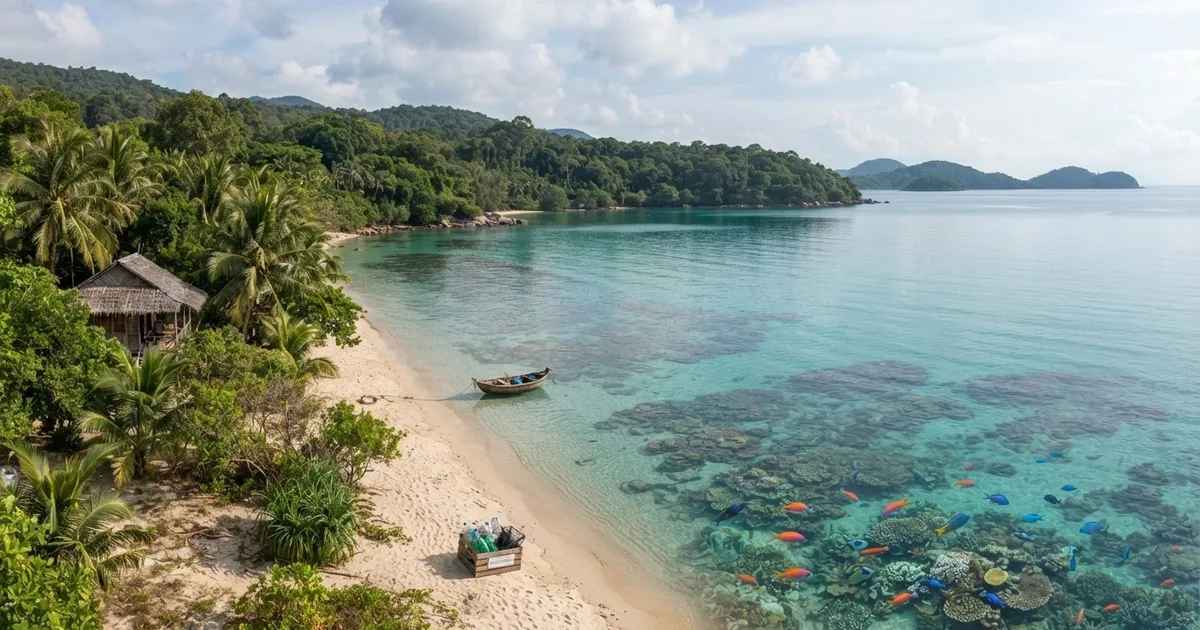
The best reef-safe snorkeling in Phu Quoc is in the southern An Thoi Archipelago, especially around Hon Gam Ghi, Hon Buom, Hon Mong Tay, and Hon Kim Quy. A standard 4-island snorkeling tour costs about $25–55 per person (snorkel-only trips run $20–30), and the single most impactful thing you can do for the reef is switch to a mineral sunscreen with zinc oxide while avoiding oxybenzone and octinoxate entirely.
Where Are the Best Reef-Safe Snorkeling Sites in Phu Quoc?
Almost all of Phu Quoc's genuinely healthy coral lies offshore, in the 15-island cluster known as the An Thoi Archipelago at the island's southern tip. The mainland beaches — Long Beach, Ong Lang, Bai Sao — are lovely for swimming, but if you want living reef and clouds of fish, you need a boat. Water visibility in the dry season (November to April) regularly exceeds 10–15 meters around the outer islands, which is why this is the only area we recommend for serious snorkeling.
The four islands that consistently deliver the best reef experiences are:
| Island | Distance / Location | Why go |
|---|---|---|
| Hon Gam Ghi (May Rut Ngoai area) | About 10 km south of An Thoi Port | Family-friendly reef destination with shallow, calm water and easy entries from the boat — the best pick if you have kids or nervous snorkelers. |
| Hon Mong Tay (Fingernail Island) | About 9.5 km southwest of Phu Quoc | Reef depths of 1–6 meters mean coral is visible right from the surface — ideal for beginners and for photographers. |
| Hon Buom | Southern An Thoi cluster | One of the two clearest-water islands in the archipelago, with less boat traffic than the famous photo stops. |
| Hon Kim Quy (Golden Turtle Island) | Outer southern edge of the archipelago | Often called the clearest water in Phu Quoc; the outer position means the reef gets less sediment run-off. |
A typical 4-island itinerary strings together Hon Gam Ghi, Hon Mong Tay, Hon Buom, and Hon Kim Quy with 3–4 snorkel stops, a beach lunch, and hotel pickup. Tours depart from An Thoi Port (An Thoi Ward, Phu Quoc, Kien Giang Province), about 45 minutes' drive from Duong Dong town.
How Much Does a Snorkeling Tour Cost — and What Should Be Included?
Phu Quoc snorkeling pricing is straightforward once you know the two tiers:
| Tour type | Price per person | Typically includes |
|---|---|---|
| Snorkel-only day tour (4 islands) | $20–30 (about 280,000–350,000 VND) | Boat transport, snorkel gear, lunch, 3–4 snorkel stops |
| Standard 4-island tour (snorkel + beach time) | $25–55 | Hotel pickup, boat, equipment, snorkel stops, lunch, guide |
If a quote comes in dramatically below that range, something is being cut — usually the guide, the life jackets, or the number of actual snorkel stops. If it comes in far above, ask exactly what justifies the premium: a smaller boat, a marine biologist guide, or genuine eco practices (mooring buoys, small groups) are worth paying for. A plastic-free lunch and a group capped at 10 people are worth an extra $10; a speedboat packed with 25 people is not.
Life jackets and professional guides are standard on most Phu Quoc snorkeling tours, which is one reason this is one of Vietnam's most accessible snorkeling destinations. Confirm both are included before you pay, especially if you are booking a budget snorkel-only trip.
What Does "Reef-Safe" Actually Mean in Phu Quoc?
Reef-safe snorkeling is not just marketing here — it refers to a specific set of behaviors that directly reduce your impact on the coral you came to see:
- Mineral sunscreen only. Use sunscreen whose active ingredient is zinc oxide (non-nano is ideal). Avoid oxybenzone and octinoxate — studies show both chemicals damage coral DNA and cause bleaching at very low concentrations.
- Better still: cover up. A rash guard or long-sleeve swim shirt eliminates most of the need for sunscreen in the water at all. This is the single most reef-friendly choice available and it is free.
- Never touch, stand on, or hold coral. Coral is a living animal; a single touch can kill a polyp colony that took decades to grow. Ask your boat to anchor only at mooring buoys, never to drop anchor on the reef itself.
- Keep your fins off the bottom. In shallow spots like Hon Mong Tay, where depths run just 1–6 meters, careless fin kicks stir up sediment that smothers coral. Float, don't walk.
- Take nothing, leave nothing. No shells, no starfish souvenirs, no feeding fish, and absolutely no plastic waste overboard.
- Small groups. Responsible operators limit groups to 10 or fewer and give a short reef-protection briefing before the first stop. If nobody mentions the reef at all, that tells you something.
Buy your mineral sunscreen before you arrive — it is still difficult to find in shops on the island, where most shelves stock conventional chemical sprays. A 50–100 ml tube lasts an entire snorkeling week.
How to Choose a Genuinely Eco-Conscious Operator
With dozens of boats leaving An Thoi Port every morning, the difference between operators comes down to practices, not brochures. Before booking, ask these five questions:
Green flags
- Uses mooring buoys instead of dropping anchor on reef
- Groups capped at 10 or fewer snorkelers per guide
- Gives a reef-protection briefing before the first stop
- Provides life jackets for every guest and a guide who assists non-swimmers
- Serves lunch on reusable plates, not Styrofoam; collects any rubbish found in the water
Red flags
- Boats carrying 20–30+ passengers with two guides
- Jet-skis, banana boats, or "coral touching" photos offered as activities
- No briefing — just "jump in, 30 minutes"
- Fish feeding or starfish handling promoted on social media
- Anchors dropped directly over coral patches
One honest caveat: reef-safe snorkeling is a poor fit if your priority is a cheap party boat with a DJ and unlimited beer. That product exists in An Thoi and it sells well, but it almost always means overcrowding, anchoring on reef, and no environmental briefing. If sustainability matters to you, spend the extra $10–15 on a small-group operator — or better, charter a private boat with 4–6 friends, which at roughly $120–180 total for the day often costs the same per person as a mid-range group tour.
Why Phu Quoc's Reefs Need Careful Visitors Right Now
Phu Quoc's marine environment is under real, documented pressure. The South China Morning Post has reported that overtourism was already overwhelming the island's drainage system, with rubbish washing up on beaches. IUCN figures put the island's daily waste generation at around 180 tons, almost all of it going to a large landfill in the north of the island — while a separate study estimated Phu Quoc actually produces closer to 300 tons per day, of which only about 150 tons is collected. Where does the rest go? Some of it ends up in the sea.
Academic and local reporting tell the same story from different angles. A paper in the Journal of Tourism Services (JOTS) describes Phu Quoc as facing environmental damage, increasing waste and contamination, and water shortages in the dry season. Tuoi Tre has reported on serious ongoing challenges in infrastructure, environmental management, and service quality. And a 2025 analysis concluded that rapid tourism-driven urbanization and large-scale infrastructure development have caused significant habitat loss on the island.
Against that backdrop, the fact that the southern An Thoi reefs are still among Vietnam's healthiest snorkeling grounds is remarkable — and fragile. Every snorkeler who chooses a mooring-buoy operator, wears a rash guard instead of spraying chemical sunscreen, and refuses to touch coral is casting a small economic vote for keeping it that way. Operators respond to demand: the more guests ask about reef briefings and group size, the more boats adopt them.
Staying Overnight Sustainably: Where to Sleep on the Eco Side of Phu Quoc
If you want your whole trip, not just your snorkel day, to tread lightly, a handful of Phu Quoc properties have built their business model around it:
- Mango Bay Resort (Ong Lang Beach) — widely described as one of the pioneers of sustainable travel on Phu Quoc. It heats water with solar power and runs a plastic-free policy, on a quiet, undeveloped stretch of northwest coast.
- Bamboo Cottages (Vung Bau Bay) — operates entirely on solar power, with no grid dependence, on a secluded bay on the island's northwest coast.
Both are on the opposite (northwest) side of the island from the An Thoi snorkeling grounds, so expect a 60–75 minute transfer to An Thoi Port for a boat tour — worth it if low-impact accommodation is a priority. Elsewhere on the island, the simplest sustainable choices are universal ones: refuse daily single-use plastics, reuse towels, and book snorkeling tours rather than jet-ski or Seawalker attractions, which put pressure directly on the seabed.
Practical Planning: When to Go, What to Bring
Season. The dry season from November to April offers calm seas, 25–31°C air temperatures, and the year's best visibility. May to October brings the southwest monsoon: cheaper tours and fewer crowds, but choppy water and frequent cancellations on outer-island routes.
Getting to An Thoi Port. From Duong Dong, the drive takes about 45 minutes by taxi or rental motorbike (roughly 25 km south on the main coastal road). Most mid-range and premium tours include hotel pickup from Long Beach and Duong Dong — always confirm it, because the $20–30 snorkel-only tier sometimes excludes it, with An Thoi Port (An Thoi Ward, Phu Quoc, Kien Giang) as the meeting point instead.
Day-of packing list:
- Rash guard or long-sleeve swim shirt (replaces most sunscreen)
- Mineral sunscreen with zinc oxide — applied before boarding, reapplied at lunch on shore, never while in the water
- Reef-safe insect repellent and a hat for beach stops
- Refillable water bottle — most boats can refill it, saving dozens of plastic bottles per trip
- Small dry bag, motion-sickness tablets if you're prone (the crossing from An Thoi Port to Hon Kim Quy takes 30–40 minutes)
- Cash in VND for drinks, tips, and island entrance fees, as some outer islands charge a small landing fee of 20,000–50,000 VND
If you'd rather explore at your own pace, renting a motorbike to ride down to An Thoi and watch the boats come and go before choosing one is a great half-day in itself — just skip the self-guided snorkeling from shore, since the mainland coast genuinely does not have the reef the outer islands do.
Frequently Asked Questions
What is the best reef-safe snorkeling in Phu Quoc?
The southern An Thoi Archipelago, particularly Hon Gam Ghi, Hon Buom, Hon Mong Tay, and Hon Kim Quy. These islands hold Phu Quoc's healthiest coral and clearest water, with Hon Kim Quy and Hon Buom generally rated the clearest. All are reached by boat from An Thoi Port, about 45 minutes south of Duong Dong.
How much does a snorkeling tour in Phu Quoc cost?
A standard 4-island snorkeling tour costs about $25–55 per person including hotel pickup, boat, equipment, lunch, and a guide. A snorkel-only day tour runs $20–30, which corresponds to roughly 280,000–350,000 VND per person for the core snorkeling package.
What sunscreen is reef-safe in Phu Quoc?
Mineral sunscreen with zinc oxide as the active ingredient (non-nano preferred). Avoid oxybenzone and octinoxate — two common chemical filters shown to harm coral reproduction and cause bleaching. Even better, wear a rash guard in the water and apply sunscreen only when you're on the beach.
Can non-swimmers snorkel in Phu Quoc?
Yes. Most Phu Quoc snorkeling tours provide life jackets for every guest and professional guides who assist non-swimmers directly in the water. Shallow sites like Hon Mong Tay, with depths of 1–6 meters, let you see coral clearly while floating at the surface, and calm family-friendly spots like Hon Gam Ghi have easy, sheltered entries.
When is the best time of year for snorkeling in Phu Quoc?
November to April, the dry season, when seas are calmest and visibility around the An Thoi islands is at its best. The May–October monsoon brings rougher water, and outer-island trips to places like Hon Kim Quy are often cancelled. Book morning departures in any season — afternoon winds pick up first.
Where do snorkeling tours depart from in Phu Quoc?
Most boats leave from An Thoi Port in An Thoi Ward, at the southern tip of the island (address: An Thoi Ward, Phu Quoc, Kien Giang, Vietnam). It's about a 45-minute drive from Duong Dong. Many mid-range tours include hotel pickup from Long Beach or Duong Dong, but budget snorkel-only tours may require you to meet at the port directly.
Is snorkeling in Phu Quoc bad for the coral?
Snorkeling itself, done properly, has minimal impact — the damage comes from boats anchoring on reef, large groups, and chemical sunscreen. Choose an operator that uses mooring buoys, limits groups to 10 or fewer, and gives a reef briefing, and your visit actually supports reef protection economically rather than harming it.
Is Phu Quoc's environment really under threat?
Yes — independent reporting makes this clear. IUCN estimates the island generates about 180 tons of waste daily, another study suggests around 300 tons per day with only about 150 tons collected, and a 2025 analysis documented significant habitat loss from rapid tourism-driven development. The southern An Thoi reefs remain healthy, which is exactly why low-impact tourism there matters now.
Planning a snorkeling day in the An Thoi islands? Sabrina Rental is based on Phu Quoc and can help you pick a small-group reef-safe tour, arrange transport to An Thoi Port, or set you up with a motorbike to explore the island's coast at your own pace. Just ask — we live here.
Contact Sabrina Rental