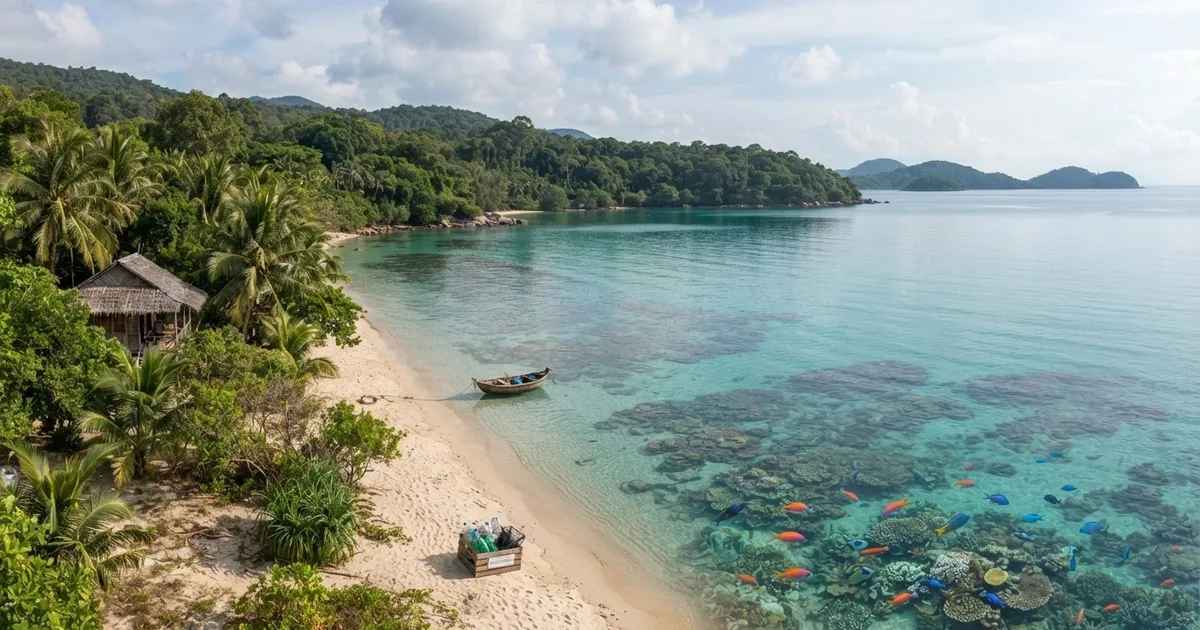
Phu Quoc generates roughly 190 tons of solid waste every day, and while 89% of it is collected and treated, an estimated 1,036 tons of plastic still leaks into the island's environment each year - about 2.83 tons every single day. In early 2026 the island's two most famous beaches, Khem and Sao, were swamped by drifting water hyacinth and household waste. Authorities are targeting a 30% cut in plastic pollution and zero plastic waste in nature by 2030, but the honest picture today is an island whose waste system is running close to its limits.
How Much Waste Does Phu Quoc Actually Produce?
The headline number is about 190 tons of solid waste per day, of which 89% is collected and treated. Phu Quoc City's own figures put daily output at between 180 and 200 metric tons, and IUCN research reaches a similar estimate of around 180 tons per day, noting that most of it ends up at a large landfill in the north of the island.
Not every study agrees, and that disagreement is part of the honest picture. One academic estimate puts the island as high as 300 tons of waste per day, with only about 150 tons actually collected - a far darker reading than the official 89% collection rate. The truth likely sits between these figures and shifts with the seasons: visitor arrivals, construction activity and storm debris all push the total up and down.
What every source agrees on is the direction of travel. A peer-reviewed paper (JOTS) describes Phu Quoc as facing environmental damage, increasing waste and contamination, and water shortages in the dry season - a dangerous combination for an island whose economy depends almost entirely on its beaches, forests and sea.
| Source | Estimate | What it tells us |
|---|---|---|
| Island-wide waste study | ~190 tons/day, 89% collected and treated | The official baseline; collection is strong, treatment less so |
| Phu Quoc City figures | 180-200 metric tons/day | Confirms the ~190-ton ballpark |
| IUCN | ~180 tons/day, most to a large landfill in the north | Most waste is landfilled, not recycled |
| Academic estimate | ~300 tons/day, only ~150 tons collected | The pessimistic scenario; highlights uncollected rural and informal waste |
Where the Plastic Comes From - and Where It Ends Up
Plastic on Phu Quoc is not primarily a tourism-industry problem - it is a household problem. Households generate 52.7% of the island's plastic waste and hotels another 29%, which means residents and accommodation together account for more than 80% of the total. Restaurants contribute a smaller share, but plastic still makes up more than 16% of everything they throw away: straws, cups, takeaway containers and bags.
Of all the plastic used on the island, 11.8% leaks directly into the natural environment. That works out to roughly 1,086 tons of plastic leaked in total, of which about 423 tons - nearly 40% - ends up in the aquatic environment: streams, canals and ultimately the sea that surrounds the island. Spread across a year, that is about 2.83 tons of plastic entering nature every day.
There is a third, less visible destination: open storage. Phu Quoc adds an extra 6,295 tons of plastic waste to an open dumping site every year - plastic that has been collected but never treated, sitting in the open where wind, rain and animals can scatter it. This stored plastic is essentially a delayed leak: it has not reached the sea yet, but nothing is stopping it from doing so.
The Khem and Sao Beach Crisis of Early 2026
In early 2026, Phu Quoc's two iconic beaches - Khem in the island's south and Sao, the postcard-famous white-sand beach on the east coast - were reported covered with floating plants and household waste. Analysis of what washed ashore found roughly 70% was water hyacinth and 30% was household waste: bottles, bags, packaging and everyday rubbish.
The water hyacinth is a natural phenomenon amplified by human ones - the plants drift down waterways after heavy rains and pile up on the sand in stinking mats. The household waste, however, is not natural at all. The South China Morning Post (SCMP) has reported that overtourism was already a problem on Phu Quoc, with the drainage system overwhelmed and rubbish washing up on beaches. A Tuoi Tre article reached a similar conclusion, noting that the island still faces serious challenges in infrastructure, environmental management and service quality.
For travelers, the practical takeaway is timing and expectation. These episodes are periodic, not permanent - Sao Beach's sand is white and swimmable for most of the year - but after heavy rain in the rainy season (roughly May to October) and in the weeks that follow, both beaches can be affected. Checking recent visitor photos and reviews before you go is a genuinely useful habit, not paranoia.
The Treatment Gap: One Incinerator Against an Island's Waste
Phu Quoc's main waste treatment facility is Dong Cay Sao in Cua Duong Commune, with a daily incineration capacity of 144 metric tons. Set against the 180-200 metric tons the city produces each day, that leaves a structural shortfall of roughly 36-56 tons daily - waste that has to go somewhere. Today, much of it goes to open storage: the 6,295 tons of plastic added to the open dump each year is the visible symptom of that gap.
IUCN notes that most of the island's waste ends up at a large landfill in the north - meaning that even the 89% that is counted as "collected and treated" is mostly buried rather than recycled or fully destroyed. The JOTS paper frames the wider risk clearly: environmental damage, increasing waste and contamination, and dry-season water shortages, on an island that has built hotels, resorts and golf courses to match a tourism boom.
The math is simple and worth stating plainly: unless treatment capacity grows or waste generation falls, the gap between what Phu Quoc produces and what it can safely process will keep widening. Closing that gap is exactly what the island's 2030 targets are designed to do - and why the January 2026 national plastic-bag ban matters here more than almost anywhere else in Vietnam.
What Is Being Done: Targets, Bans and the Road to 2030
Phu Quoc has set itself two headline targets: reduce the amount of plastic waste released into the environment by 30% (a goal set for 2025) and achieve zero plastic waste in nature by 2030. Given the current 11.8% leakage rate, the 2025 milestone is ambitious, and progress should be judged against measured numbers rather than announcements - but the direction of policy is unambiguous.
National policy is also moving. From January 2026, the production of certain non-biodegradable plastic bags is banned across Vietnam, which attacks the problem at its source: single-use bags are among the most common items in household waste and among the most damaging once they reach the sea, where they resemble jellyfish to turtles and fish.
On the ground, the response combines regular beach cleaning, hotel-led initiatives to cut single-use plastics, and a growing community cleanup scene. None of this is unique to Phu Quoc - islands from Bali to Koh Lanta face the same equation of tourism growth versus waste capacity - but Phu Quoc's targets are among the more concrete in Vietnam, and the island has both the money (through tourism revenue) and the motivation to act.
What Travelers Can Actually Do
A single tourist cannot fix a 190-ton-per-day waste system, but the data shows why small choices matter: households and hotels produce over 80% of the island's plastic, and tourist consumption flows directly into both streams. Over a one-week stay, one visitor can easily generate several kilograms of plastic waste - most of it from bottles, bags and food packaging that were avoidable.
- Carry a refillable bottle and ask cafes to refill it - most will happily do so, and tap water boiled or filtered at your hotel works for brushing teeth.
- Refuse bags and straws by default; say "khong" (no) with a smile when a vendor reaches for one.
- Choose accommodation that refills amenities instead of replacing small plastic bottles daily - the hotel sector alone accounts for 29% of the island's plastic.
- Take your rubbish back from the beach with you; bins are sparse at Sao, Khem and the northern beaches.
- Join a beach cleanup if your visit coincides with one - several groups on the island organize weekend collections, and dropping a few pieces of trash into your own bag during a beach walk helps too.
- Book with boat and snorkel tour operators who use reusable cups and collect waste at sea rather than leaving it behind.
The Honest Verdict: Should the Waste Problem Change Your Plans?
No - but it should change your expectations and your choices. Phu Quoc remains one of Vietnam's most beautiful islands, and for most of the year its beaches are clean, swimmable and genuinely world-class. The waste crisis is real, measurable and worsening at the margins, but it manifests in episodes (like the early 2026 Khem and Sao events) rather than as a permanent state.
Yes. Roughly 89% of the island's waste is collected, the famous beaches are clean most of the year, and the 2030 zero-plastic target means the trend line is finally pointing the right way.
Travelers who need every beach to look like a brochure photo at all times, anyone unwilling to check conditions during the rainy season, and visitors who will be genuinely upset by visible litter on a single bad day.
Travelers who check recent beach conditions before heading out, minimize their own single-use plastic, and would rather support a destination actively fixing its problems than abandon it.
Frequently Asked Questions
How much waste does Phu Quoc produce every day?
About 190 tons of solid waste daily, with Phu Quoc City figures ranging from 180 to 200 metric tons and IUCN estimating around 180 tons. Officially, 89% of it is collected and treated, though one academic study estimated the true total could be as high as 300 tons per day with only about 150 tons collected.
How much plastic leaks into the environment on Phu Quoc?
Roughly 1,036 tons of plastic per year, or about 2.83 tons every day. The island's plastic leakage rate is 11.8%, with about 1,086 tons leaked in total and around 423 tons of that reaching the aquatic environment - streams, canals and the sea around the island.
Why were Khem and Sao beaches covered in waste in early 2026?
A combination of drifting water hyacinth and household waste: about 70% of the material on the beaches was water hyacinth and 30% was household rubbish. SCMP has reported that overtourism has overwhelmed Phu Quoc's drainage system, allowing rubbish to wash up on beaches after heavy rains.
Where does Phu Quoc's waste actually go?
Mainly to the Dong Cay Sao treatment facility in Cua Duong Commune, which can incinerate 144 metric tons per day - less than the 180-200 tons generated daily. The shortfall goes to a large landfill in the north of the island and an open dump that stores an extra 6,295 tons of plastic every year.
Is Phu Quoc banning plastic?
The island targets a 30% reduction in plastic released into the environment (set for 2025) and zero plastic waste in nature by 2030. Nationally, from January 2026 Vietnam bans the production of certain non-biodegradable plastic bags, cutting off the most common single-use item at the source.
Can you still swim at Sao Beach?
Yes, for most of the year Sao Beach is clean, white and perfectly swimmable. The waste events are periodic, typically following heavy rain in the May-October rainy season - the early 2026 episode was 70% water hyacinth, a seasonal drift. Check recent visitor photos before planning a beach day.
What can tourists do to reduce plastic on Phu Quoc?
Carry a refillable bottle, refuse plastic bags and straws, choose hotels that refill amenities, and take your rubbish back from the beach. Households generate 52.7% of the island's plastic and hotels 29%, so tourist consumption choices feed directly into both of the biggest waste streams.
What are the main sources of plastic waste on Phu Quoc?
Households are the largest source at 52.7% of the island's plastic waste, followed by hotels at 29% - together more than 80% of the total. Restaurants contribute a smaller share, but plastic still accounts for over 16% of everything they discard, mostly straws, cups, containers and bags.
Visiting Phu Quoc and want honest, up-to-date local advice on which beaches are in good condition, which operators run responsibly, and how to explore the island with a rental motorbike instead of a tour bus? The Sabrina Rental team lives here year-round - message us and we will tell you exactly what the island looks like this week.
Ask Sabrina Rental for Local Advice