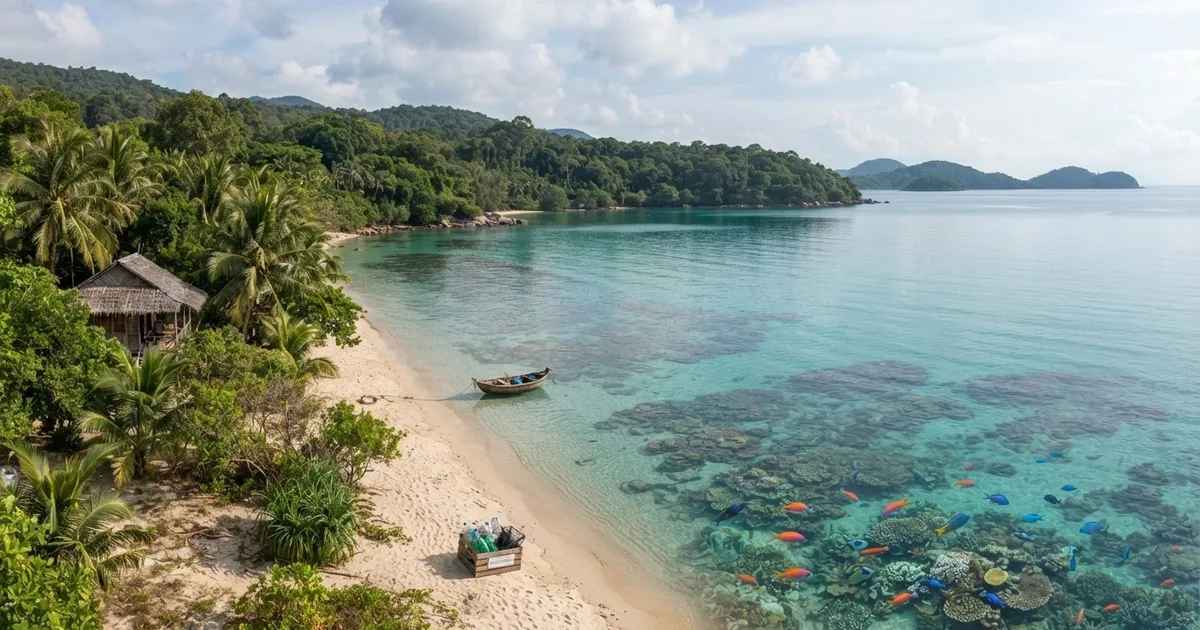
Phu Quoc is growing faster than it is greening. The island welcomed more than 5.7 million visitors in the first six months of 2026, up 30.2% year on year, and expects 8.5 million for the full year, yet only 13% of its tourism sector currently meets Global Sustainable Tourism Criteria. The 26,000-hectare marine protected area, the coral reefs, seagrass beds, dugongs and sea turtles are real; so are roughly 180 tons of waste per day and a Green label and plastic-free pilot that only begins in 2026-2027.
How Big Is Phu Quoc's Tourism Boom, and Why Does It Strain the Island?
Phu Quoc is no longer a quiet island escape. In the first six months of 2026 alone the island received more than 5.7 million visitors, a 30.2% increase on the same period a year earlier. International arrivals passed 1.3 million, up 50.3%, and tourism revenue reached 31.5 trillion VND, roughly USD 1.2 billion in six months. The target for the whole of 2026 is 8.5 million tourists, of which about 2 million would be foreign visitors.
Those numbers are the context for every environmental question on this page. The South China Morning Post reported that overtourism was already a problem on Phu Quoc, with the drainage system overwhelmed during heavy rain and rubbish washing up on the beaches. A Tuoi Tre article noted that the island still faces serious challenges in infrastructure, environmental management and service quality. The growth is real, the revenue is real, and the pressure on reefs, beaches and the waste system is equally real.
| Indicator | Latest figure | Change / note |
|---|---|---|
| Total visitors, H1 2026 | Over 5.7 million | +30.2% year on year |
| International visitors, H1 2026 | Over 1.3 million | +50.3% year on year |
| Tourism revenue, H1 2026 | 31.5 trillion VND (about USD 1.2 billion) | Six-month figure |
| Full-year 2026 forecast | 8.5 million visitors | Including 2 million foreign visitors |
| Global Sustainable Tourism Criteria compliance | 13% | Per Tuoi Tre News citing current assessments |
Read that table together and the shape of the problem is obvious. Phu Quoc is adding visitors far faster than it is adding treatment plants, collection trucks, recycling capacity or certified green accommodation. The island does not need to be perfect to be worth visiting, but travellers who arrive expecting a pristine, untouched tropical island will be disappointed, and travellers who understand the trade-offs will get far more out of a trip here.
What Phu Quoc Actually Protects: 26,000 Hectares of Marine Area
Phu Quoc's marine protected area covers 26,000 hectares, and it is not a paper designation. The island's marine ecosystems include coral reefs and seagrass meadows, plus dugongs and sea turtles. The coastline runs roughly 150 kilometres, and the shallow water between the main island and the An Thoi archipelago in the south holds the densest reef cover, which is why most snorkelling and diving trips launch from An Thoi port.
The 2026 eco-tourism plan explicitly includes restoring degraded coral reefs, seagrass beds and natural forests. That wording matters, because restoration is only necessary where damage has already happened: coral bleaching, anchor damage, sediment runoff from construction, and direct contact from swimmers all take a toll. If you snorkel or dive, the difference between a healthy reef and a degraded one is visible within minutes, and the degraded patches are usually closest to the busiest boat moorings.
Dugongs are the island's most fragile resident. They graze on seagrass meadows, mostly in the quieter northern and northeastern shallows, and they are genuinely rare to see. Sea turtles also nest on some of the smaller islets. No operator can guarantee a sighting, and any tour that promises one should be treated with scepticism.
Reef etiquette that actually matters: never stand on coral, keep fins at least an arm's length from the reef, wear a rash guard instead of sunscreen on snorkelling days, and choose an operator whose boat uses mooring lines rather than dropping anchor onto coral. A single dropped anchor can destroy decades of growth in one afternoon.
The Waste Reality: About 180 Tons a Day and One Landfill in the North
The single most important environmental fact about Phu Quoc is its waste arithmetic. According to the IUCN, the island generates about 180 tons of waste every day, with most of it going to a large landfill in the north of the island. One study put the figure higher, at roughly 300 tons per day, while only about 150 tons was collected. The gap between those two numbers is waste that is burned, buried, dumped or washed into the sea.
A peer-reviewed paper published in JOTS described Phu Quoc as facing environmental damage, increasing waste and contamination, and water shortages in the dry season. That combination is typical of fast-growing resort islands: demand for water and waste services rises steeply, infrastructure lags by years, and the dry season concentrates the strain.
For visitors, this is not an abstract issue. It shows up as litter on less-frequented stretches of beach after heavy rain, as construction dust on inland roads, and as the occasional smell of burning rubbish in the evening. It also means that the small choices you make, such as refusing single-use bottles and bags, have a visible effect here in a way they would not in a city with a functioning collection system.
Practical rule: carry your own rubbish out of beaches, streams and national park trails. Collection coverage on the island is incomplete, and what you leave behind on a remote beach in the north may never be collected at all.
What the Island Is Doing About It: Green Label, Plastic-Free Pilots and Bai Dat Do
Phu Quoc's Global Sustainable Tourism Criteria compliance stands at just 13%, according to Tuoi Tre News citing current assessments. That is a low base, and the official response so far is a set of pilots rather than a finished system. Authorities plan to pilot a Green label certification for tourism businesses in 2026-2027, which would give hotels, guesthouses and tour operators a verifiable sustainability mark rather than a self-declared claim.
Alongside it, local plans include a plastic-free tourism initiative at key destinations in 2026-2027, and authorities intend to ban plastic bags and bottles on ferries and at markets in Phu Quoc. Ferries are a sensible starting point: they are controlled, high-volume, and easy to police at the boarding gate. Markets are harder, but the direction of travel is clear, and visitors who arrive with a reusable bottle and a tote bag will find themselves ahead of the rules rather than behind them.
The largest single project to watch is Bai Dat Do, launched in January 2026. It covers about 88.5 hectares with a total investment of 64,000 billion VND, roughly USD 2.5 billion. Big investment on this island cuts both ways: it brings money and planning capacity that could fund restoration, and it brings construction, land clearing and additional visitor pressure. The question worth asking of any Phu Quoc development right now is not how much it costs, but whether reef, seagrass and forest restoration is written into the contract.
Who Responsible Travel on Phu Quoc Suits, and Who It Is a Poor Fit For
Phu Quoc rewards travellers who are realistic. The island is not a pristine eco-resort destination, and it is not a lost wilderness. It is a busy, developing island with genuine natural assets, real environmental problems, and a sustainability framework that is only just being built. Here is an honest read on who that works for.
A good fit: independent and mid-budget travellers
You will see the island most clearly on a rented motorbike, moving between beaches, fishing villages and the national park, and eating at local markets rather than resort buffets. Your spending lands closer to the communities that carry the environmental cost.
A good fit: snorkellers and divers who book licensed operators
With 26,000 hectares of marine protected area and reef restoration under way, a well-run boat trip out of An Thoi is the best-value nature experience on the island. Smaller groups and mooring-line boats make a measurable difference.
A good fit: families wanting nature days
The national park, Tranh Stream and the northern beaches are cheap or free, and a 10,000-20,000 VND service fee at Tranh Stream is a fraction of a theme-park ticket.
A poor fit: resort guests who never leave the property
If your entire stay happens behind a gate, you contribute to the visitor numbers and the waste stream without experiencing or supporting any of the island's protected areas. That is a valid holiday, but it is not eco-tourism.
A poor fit: anyone expecting untouched, pristine reefs
Only 13% of the tourism sector meets recognised sustainability criteria, and some reef areas are already degraded and under restoration. Travellers seeking guaranteed virgin coral should look elsewhere or adjust expectations.
A poor fit: single-use-plastic-dependent travellers
Plastic bags and bottles are being pushed out of ferries and markets in the 2026-2027 plans, collection coverage is incomplete, and about 180 tons of waste per day already has nowhere good to go.
A Practical Green Travel Checklist for Phu Quoc
Responsible travel here is mostly logistics, not ideology. These are the choices that make a measurable difference on an island generating roughly 180 tons of waste a day.
- Bring a refillable bottle and a filter or refill plan. Most hotels and guesthouses will refill for free; the plastic-free tourism initiative is aimed precisely at cutting bottled water at key destinations.
- Pack reef-safe sunscreen, or better, a long-sleeve rash guard. Chemical sunscreens wash off in the water directly above coral and seagrass.
- Say no to single-use bags, straws and foam boxes. Authorities plan to ban plastic bags and bottles on ferries and at markets, so reusable alternatives are already the practical option.
- Choose a licensed snorkel or dive boat. Ask before booking whether the boat uses mooring lines, how many guests it carries, and whether it feeds fish. Feeding changes behaviour and damages reefs.
- Visit the national park instead of a second beach club. It is about 13 km northeast of Duong Dong town, most areas have free entrance, and forest restoration is part of the 2026 eco-tourism plan.
- Rent a motorbike rather than booking a private car for every trip. It is cheaper, it spreads your money locally, and it lets you reach the quiet northern beaches where litter pressure is lower.
- Take your rubbish back with you. Collection is incomplete, and roughly half of the island's daily waste may never be formally processed.
- Travel in the dry season (roughly November to March). Clearer water for snorkelling, less runoff washing sediment onto reefs, and fewer storm-related drainage overflows.
The Land Side: Phu Quoc National Park, Streams and Forests
Eco-tourism on Phu Quoc is not only underwater. Phu Quoc National Park sits about 13 kilometres northeast of Duong Dong town and protects a large share of the island's remaining forest. Most areas of the park have free entrance, while Tranh Stream charges a small service fee of 10,000-20,000 VND, roughly USD 0.40-0.80. That is one of the cheapest genuine nature experiences available anywhere on the island.
The 2026 eco-tourism plan includes restoring natural forests alongside the coral and seagrass work, which signals that the island's green cover is under the same kind of pressure as its reefs. Forest loss affects the coast directly: without tree cover, heavy rain carries soil and sediment down to the shallows, smothering coral and seagrass. Protecting the forest and protecting the reef are the same project.
A realistic green itinerary for a three-day visit might combine a morning at Tranh Stream or a national park trail, an afternoon on a northern beach with your own refillable water, and one full day of snorkelling from An Thoi with a small licensed boat. That covers the island's three main ecosystems, keeps your spending local, and produces a fraction of the waste of a resort-and-buffet schedule.
Frequently Asked Questions
Is Phu Quoc an eco-friendly destination?
Not yet, though it is moving. Only 13% of Phu Quoc's tourism sector currently meets Global Sustainable Tourism Criteria, according to Tuoi Tre News citing current assessments. Authorities plan a Green label certification pilot for tourism businesses in 2026-2027 and a plastic-free tourism initiative at key destinations, while the island's 26,000-hectare marine protected area remains genuinely protected.
How much waste does Phu Quoc produce every day?
The IUCN estimates Phu Quoc generates about 180 tons of waste daily, with most of it going to a large landfill in the north of the island. One study put the figure at roughly 300 tons per day while only about 150 tons was collected, meaning a significant share is never formally processed at all.
Does Phu Quoc have coral reefs, and can I snorkel them?
Yes. Phu Quoc's marine protected area covers 26,000 hectares and includes coral reefs and seagrass meadows, with the best snorkelling around the An Thoi archipelago in the south. The 2026 eco-tourism plan includes restoring degraded coral reefs, so expect a mix of healthy and recovering sites. Book a licensed operator and never stand on coral.
Is there an entrance fee for Phu Quoc National Park?
Most areas of the national park have free entrance. Tranh Stream charges a small service fee of 10,000-20,000 VND, about USD 0.40-0.80. The park is roughly 13 kilometres northeast of Duong Dong town, so it is an easy half-day trip by motorbike from the main tourist areas.
When will plastic bags and bottles be banned on Phu Quoc?
Authorities plan to ban plastic bags and bottles on ferries and at markets as part of a plastic-free tourism initiative scheduled for 2026-2027. The rules are not fully enforced yet, so bring a reusable bottle and bag now rather than waiting. Ferries are expected to be the first place enforcement becomes visible.
How many tourists visit Phu Quoc each year?
Phu Quoc welcomed more than 5.7 million visitors in the first six months of 2026, up 30.2% year on year, including over 1.3 million international arrivals, up 50.3%. Tourism revenue hit 31.5 trillion VND in that half-year, and the island expects 8.5 million tourists across 2026, including 2 million foreign visitors.
What is the Bai Dat Do project on Phu Quoc?
Bai Dat Do launched in January 2026 and covers about 88.5 hectares with a total investment of 64,000 billion VND, roughly USD 2.5 billion. It is one of the largest developments on the island and is worth watching closely, since large projects can either fund restoration or add pressure on reefs, seagrass and forest.
Can you still see dugongs and sea turtles in Phu Quoc?
Dugongs feed on Phu Quoc's seagrass meadows, mainly in quieter northern and northeastern shallows, and sea turtles nest on some of the smaller islets. Sightings are rare and never guaranteed. Any tour promising a dugong or turtle encounter should be treated with scepticism, and boats should keep a respectful distance if one appears.
Planning a lower-impact trip to Phu Quoc? Sabrina Rental arranges motorbike and car rental, rooms and boat trips on the island, and can point you to the snorkelling operators, national park trails and quiet northern beaches that are actually worth your time. Message us before you arrive and we will help you build an itinerary that leaves Phu Quoc cleaner than you found it.
Contact Sabrina Rental