Entry to every major Phu Quoc pearl farm is free, including Ngoc Hien Pearl Farm, which opens daily from 8:00 AM to 7:00 PM and sits roughly 8 km from Phu Quoc International Airport. A standard visit takes only 15–20 minutes and walks you through the whole cultivation process, from oyster tank to finished jewellery. You spend money only if you choose to buy: freshwater pearl earrings start around 500,000 VND (about $19), pearl strands run 850,000–2,200,000 VND (about $33–85), and a full South Sea set of earrings, pendant and ring starts around 15,000,000 VND (about $575).
What a Phu Quoc Pearl Farm Actually Is
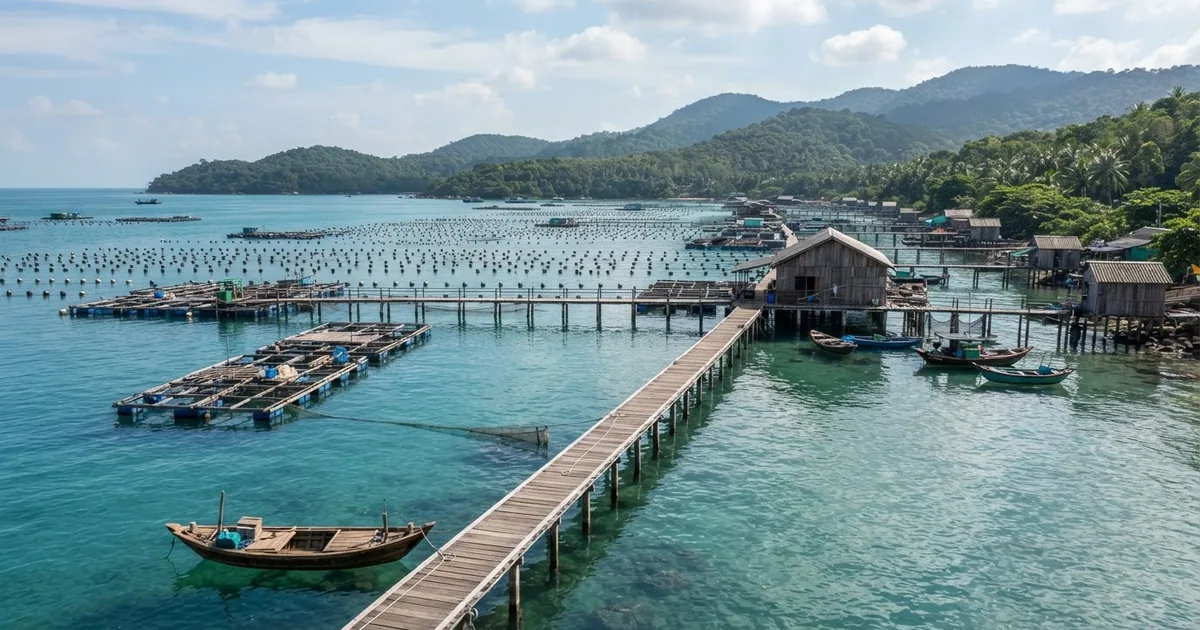
Phu Quoc sits in the Gulf of Thailand with warm, comparatively clear water and a string of sheltered bays — good natural conditions for culturing oysters. Commercial pearl farming took hold on the island in the 1990s, and today several farms welcome visitors, most of them strung along the west coast between the airport and Duong Dong town. The big names are Ngoc Hien, Quoc An and Long Beach Pearl.
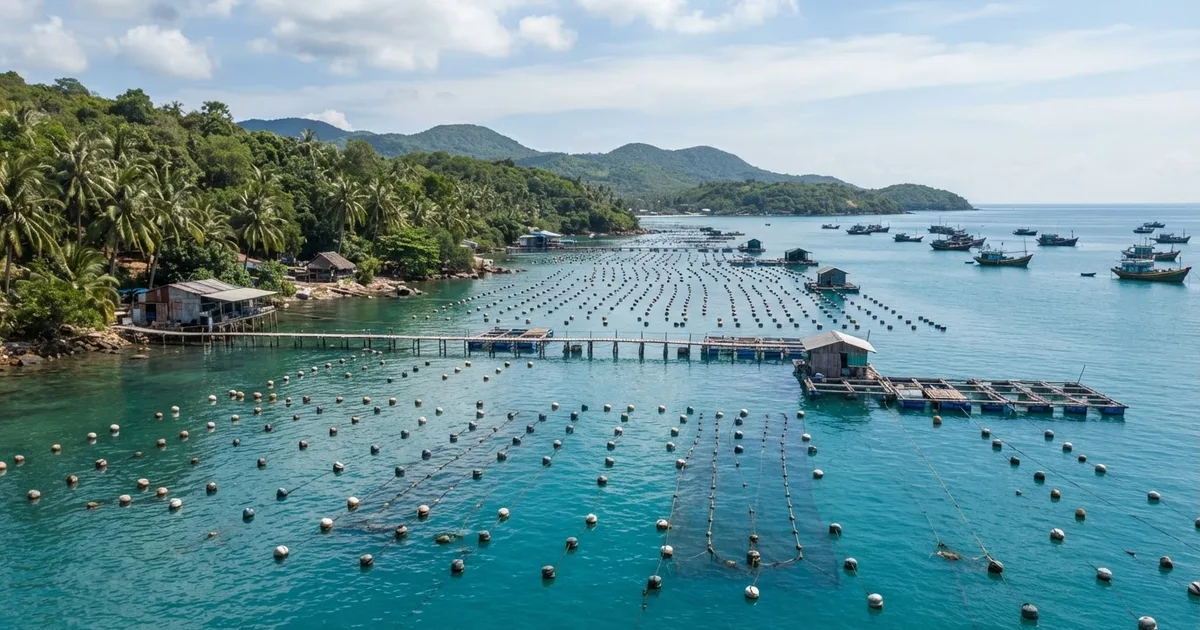
Two product lines dominate the display cases. South Sea pearls, grown in Pinctada maxima oysters, are the headline item: typically 9–14 mm, with thick nacre and a colour range from white and cream through to deep gold. Smaller akoya-style and freshwater pearls fill the entry-level trays, and these are what you see priced from a few hundred thousand dong. A cultured pearl starts life as an implanted nucleus, then spends roughly 18–24 months growing in an akoya oyster, and often two to three years for South Sea stock. That timeline is the reason the price tags say what they say.
One honest expectation to set before you go: the farm you visit is a working hatchery combined with a showroom, not an offshore boat tour. You will see holding tanks, a grafting or extraction demonstration, explanatory displays, and a large retail floor. You will not usually sail out to the oyster lines themselves. That is exactly why the visit is short — and why it costs nothing to walk in.
The three main farms are not interchangeable. Ngoc Hien is the biggest and most visited. Quoc An is the quiet one, built around Japanese cultivation technology. Long Beach Pearl is the most retail-forward, with the largest showroom of the group. Visiting two of them in one afternoon is entirely realistic if you have your own transport.
The Main Pearl Farms Compared — and Who Each One Suits
| Farm | Known for | Entry | Best suited to | Less suited to |
|---|---|---|---|---|
| Ngoc Hien Pearl Farm | Largest display on the island, museum artefacts, live pearl extraction demo | Free, open daily 8:00 AM–7:00 PM | First-time visitors, families, anyone who wants the complete see-everything version | Anyone who dislikes crowded showrooms or being shadowed by sales staff |
| Quoc An Pearl Farm | Japanese cultivation technology, noticeably quieter atmosphere | Free entry policy | Couples, repeat visitors, people who want a calm 20 minutes without a crowd | Visitors hunting for the single biggest selection in one room |
| Long Beach Pearl | Largest showroom of the group, established Vietnamese jewellery brand | Free to browse | Serious buyers comparing stones side by side, shoppers who want brand-name after-sales service | Travellers on a tight schedule who just want the 15-minute version |
The differences matter more than they look on paper. Ngoc Hien feels like a small museum with a jewellery shop attached: you get the historical artefacts, the demonstration, and the widest spread of grades in a single walk-through. Quoc An trades scale for calm — the Japanese-technology angle is a real point of difference if you care about method rather than volume, and the lower foot traffic makes it a better stop for couples who actually want to talk to staff without queueing for attention.
Long Beach Pearl is the most commercial of the three, and its strength is depth of stock and consistency of grading rather than spectacle. If you are comparing two similar strands and want to see them under the same lighting, this is the room to do it in.
Who the pearl farms are a poor fit for: if you are travelling with restless young children, if you have zero interest in jewellery and no intention of buying anything, or if you have a packed island itinerary with only two full days, a pearl farm is a low-priority stop. It is also a poor fit for anyone uncomfortable with persistent sales attention — the showroom staff at the busier farms are proactive to the point that several reviewers describe them as following customers around. If that description makes you tense, go to Quoc An instead, or visit Ngoc Hien right at 8:00 AM when the tour buses have not yet arrived.
What a Visit Looks Like, Step by Step
At Ngoc Hien, the full sightseeing process is free and takes about 15–20 minutes at a normal walking pace. The sequence is remarkably consistent across the island's farms.
1. Arrival and welcome (2–3 minutes). No ticket desk, no entry fee. You walk in and are met by staff who point you toward the display area.
2. Oyster tanks and cultivation explanation (5 minutes). You see live oysters in holding tanks and learn how a nucleus is implanted, how long the oyster grows it out, and why some pearls come out round while others are baroque.
3. The pearl extraction demonstration (3–5 minutes). An attendant opens an oyster in front of you and removes the pearl. This is repeatedly named in reviews as the single best part of the visit.
4. Museum artefacts and history displays (3–5 minutes). A strong point of Ngoc Hien specifically — old tools, historical pearl jewellery and background on the Vietnamese pearl trade.
5. The showroom (10–30 minutes, entirely optional). Graded trays of loose pearls and finished pieces, with staff available to explain and price anything you point at.
The free walk-through genuinely covers the whole pearl-growing process, so there is no admission tier that unlocks a better version. The only variable is how long you spend in the showroom.
Actual Prices: What Pearls Cost on Phu Quoc
These are the entry-level starting prices you will see quoted at Phu Quoc farms. Anything larger, rounder, or more strongly coloured climbs quickly from these floor figures — a 12 mm flawless South Sea strand is a different category of purchase entirely from a 7 mm freshwater strand.
| Item | Starting price (VND) | Approx. USD | Notes |
|---|---|---|---|
| Freshwater pearl earrings | from 500,000 | ~$19 | Cheapest genuine option, ideal souvenir tier |
| Pearl strands | 850,000 – 2,200,000 | ~$33 – $85 | Range covers small freshwater to mid-size cultured strands |
| South Sea pearl earrings | from 2,000,000 | ~$77 | Larger nacre thickness, white/gold tones |
| Full South Sea set (earrings, pendant, ring) | from 15,000,000 | ~$575 | Matched set; price scales steeply with pearl size |
Payment at the larger farms is normally by cash in dong or by card, and a certificate of authenticity is provided with purchases — ask for it explicitly if it is not offered, because it is your only paperwork trail if you need to make a claim later, and it helps at customs if you are declaring high-value jewellery on the way home.
Two buying realities are worth internalising before you walk in. First, pearls are not a commodity with a fixed market price the way gold is; grading is subjective and two farms can quote very different numbers for visually similar strands. Second, the price you are quoted is a starting point. On higher-ticket South Sea items there is usually movement, particularly if you are paying in cash and buying more than one piece. On a 500,000 VND pair of freshwater earrings there is essentially no margin to negotiate, so do not waste your energy there.
How to Tell You Are Buying Real Pearls
Cultured pearls are real pearls — the distinction that matters is between cultured and imitation, not between natural and cultured. Imitation beads are glass or plastic with a coated finish, and they are what you find in night markets rather than at a licensed farm. A few checks work in your favour at the counter.
Rub two pearls together. Real nacre feels slightly gritty and produces a faint powdery friction. Imitation beads glide smoothly against each other like plastic on glass. Check the drill hole. On a real pearl the edge of the hole is clean and the coating continues into it; on a coated fake you often see a flake or a visible seam at the rim. Look for imperfection. Perfectly uniform, perfectly round, suspiciously cheap pearls are the biggest red flag of all — real pearls vary slightly in lustre, shape and surface across a strand, and a strand where every pearl is identical at a low price is imitation.
The certificate of authenticity matters most for South Sea purchases, where a single set can represent several hundred dollars. Buy those from a farm with a physical address and a brand you can look up afterwards, not from a beach vendor or a hotel lobby display case. If a seller refuses to let you examine a pearl closely or rushes the decision, walk away — there is another farm a few minutes down the road.
Getting There: Distances and Logistics
Ngoc Hien Pearl Farm is about 8 km from Phu Quoc International Airport, which translates to roughly 15 minutes by taxi or ride-hailing car outside peak traffic. If you are arriving on an afternoon flight and your hotel is in the Duong Dong or Long Beach area, the farm is a very easy stop to fold into the transfer rather than a separate trip.
The farms cluster along the west-coast road, so a loop taking in two farms plus a beach stop is realistic in half a day. Practical logistics:
Transport. A metered taxi or app-based car for the airport-to-farm leg is inexpensive and takes 15 minutes. Many visitors combine pearl farms with other west-coast stops on a rented motorbike — the road is straightforward and paved, and having your own wheels means you are not dependent on a driver waiting outside while you browse.
Timing. Ngoc Hien is open daily from 8:00 AM to 7:00 PM, so there is no awkward window where you might arrive and find it shut. Late afternoon is the quietest period after the tour-bus wave has passed, though the trade-off is less natural light through the display windows.
What to bring. Cash in dong if you think you might buy, a phone with a ride-hailing app, and sun protection — the walk between the tanks and the showroom is partly open-air. Nothing else is required, because there is no ticket and no booking.
Combining stops. Because the whole visit is only 15–20 minutes, a pearl farm is a natural add-on rather than a destination in itself. Build it into a day that already includes a west-coast beach and a sunset spot, and it costs you almost no time. Build a whole morning around it and you will be done by 9:15 AM wondering what comes next.
Frequently Asked Questions
Is entry to Phu Quoc pearl farms really free?
Yes. Most large farms on the island, including Ngoc Hien and Quoc An, operate a free-entry policy, and Ngoc Hien describes its sightseeing process as completely free. There is no ticket desk and no charge for the cultivation walk-through, the extraction demonstration or the museum displays. You pay only if you buy jewellery.
How long does a pearl farm visit take?
About 15–20 minutes for the standard walk-through at Ngoc Hien, covering the oyster tanks, the pearl extraction demonstration and the museum displays. Add 10–30 minutes if you intend to browse the showroom properly. Most visitors are back in their transport within 40 minutes.
What are the opening hours of Ngoc Hien Pearl Farm?
Ngoc Hien Pearl Farm is open daily from 8:00 AM to 7:00 PM, seven days a week, with no closing day that visitors typically need to plan around. Arriving right at 8:00 AM gives you the quietest experience, before tour groups start arriving mid-morning.
How much do pearls cost at Phu Quoc pearl farms?
Freshwater pearl earrings start around 500,000 VND (roughly $19). Pearl strands run 850,000–2,200,000 VND (about $33–85). South Sea pearl earrings start around 2,000,000 VND (~$77), and a full South Sea set of earrings, pendant and ring starts around 15,000,000 VND (~$575). Prices rise steeply with pearl size and quality.
Which Phu Quoc pearl farm is the best?
Ngoc Hien has the largest display and the museum artefacts, and rates 3.8/5 from 37 Tripadvisor reviews. Quoc An uses Japanese cultivation technology and is noticeably quieter. Long Beach Pearl has the largest showroom for serious comparison shopping. Choose Ngoc Hien for completeness, Quoc An for calm, Long Beach Pearl for selection.
How far is Ngoc Hien Pearl Farm from Phu Quoc airport?
About 8 km, which is roughly 15 minutes by taxi or ride-hailing car in normal traffic. It is close enough to fold into an airport transfer if your hotel is in the Duong Dong or Long Beach area, and easy to combine with other west-coast stops on the same day.
Can I visit a pearl farm without buying anything?
Yes, and most visitors do exactly that. The free walk-through is the main attraction for the majority of guests. Simply say you are just looking. Note that at busier farms sales staff can be persistent and may follow you around the showroom, so Quoc An is the better choice if that bothers you.
Do I get a certificate of authenticity with a purchase?
Yes — visitors can buy jewellery with a certificate of authenticity at the farms, and it comes standard at the larger operations. Ask for it explicitly if it is not offered, especially on South Sea purchases where a single set can start around 15,000,000 VND (about $575).
Planning your island itinerary and want the pearl farms slotted in without wasting a day on logistics? Sabrina Rental is based on Phu Quoc and can arrange motorbike or car rental, point you to the quietest visiting hours, and help with airport transfers that stop at Ngoc Hien on the way. Message us and we will build the route around your hotel and your flight time.
Ask Sabrina About Your Phu Quoc Route