Yes — Dinh Ba Temple is worth visiting, as long as you treat it as what it actually is: a small, genuinely sacred neighborhood shrine rather than a big-ticket attraction. Entry is free, a visit takes about 30–45 minutes, and it sits at 44 Vo Thi Sau Street in central Duong Dong, a few minutes' walk from Dinh Cau. Its 4.5/5 TripAdvisor score (14 reviews, none rated below "Average") tells the story precisely: modest in size, but atmospheric, peaceful and deeply loved by locals.
What Is Dinh Ba Temple — and Who Is Thuy Long Thanh Mau?
Dinh Ba Temple is described by locals and guidebooks alike as one of the holiest places on Phu Quoc Island. The word "dinh" refers to a traditional village shrine — the spiritual heart of a Vietnamese settlement — while "Ba" is an honorific for a lady or grandmother. Together, the name signals exactly what you'll find: not a monumental pagoda built for visitors, but a working village shrine where fishermen, shopkeepers and families from Duong Dong come to pray, burn incense and make offerings.
The temple is dedicated to Thuy Long Thanh Mau, a figure regarded locally as the first person to open up Phu Quoc Island. In the way of Vietnamese folk religion, she is venerated as a mother-deity of the sea and the island itself — a protector of those who live from the water. Fishermen traditionally pray here before long trips and give thanks after safe returns, which is why the shrine sits close to the shore in the middle of town rather than on some remote hillside.
That living, local character is the temple's main appeal. On an ordinary morning you'll see plates of fresh fruit, bottles of soft drink, cups of tea and sticks of incense arranged on the altars — offerings left by real worshippers, not props. During the Lunar New Year period and on the 1st and 15th days of the lunar month, the shrine fills with incense smoke and locals in their best clothes. If your dates line up with those days, you'll see Dinh Ba at its most atmospheric.
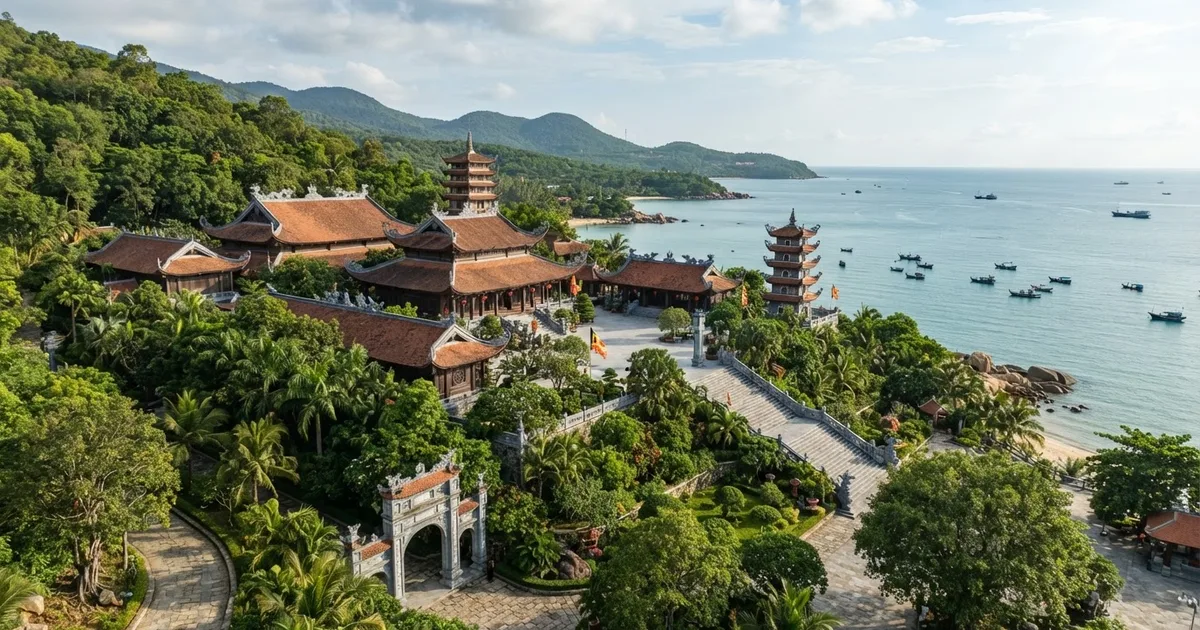
Architecturally, the temple is a good example of a southern Vietnamese coastal shrine: curved tile roofs finished with intricate ceramic decorations of dragons, flowers and mythical figures, gilded altars, and red-and-gold lacquerwork. What sets it apart from similar shrines on the mainland is the setting — the temple sits on rocky ground near the water, and you get scenic sea views just steps from the altars. Travel reviewers frequently mention exactly this combination: a serene setting on rocky shores, beautiful sea views, and intricately detailed architecture worth photographing slowly rather than rushing past.
So, Is Dinh Ba Temple Actually Worth Visiting?
Honestly: yes, for most travelers — with one condition. You should already be in or near Duong Dong. This is not a temple worth crossing the island for on its own, but it is absolutely worth 30–45 minutes of your time if you're in town, which most Phu Quoc visitors are at some point. The reviews back this up. On TripAdvisor, Dinh Ba Thuy Long Thanh Mau holds about 4.5/5 based on 14 reviews — 8 rated Excellent, 5 Very good, 1 Average, and not a single Poor or Terrible rating. The most common theme in those reviews is captured by visitors who call it "not a very large Temple" but "definitely worth a visit," and who advise: "Take a look while you are in the area, it's worth the time." Another writes simply, "I recommend it to anyone who passes by."
What those ratings quietly confirm is the verdict logic: nobody regrets the stop, but nobody pretends it's a half-day destination either. Zero Poor and Terrible reviews across 14 ratings is a remarkably clean record for a free attraction — it means the temple reliably delivers what it promises, and the main risk of disappointment is simply arriving with the wrong expectations (expecting a grand pagoda complex rather than an intimate village shrine).
Worth your time if you...
- Are staying in or passing through Duong Dong town
- Enjoy living cultural sites over staged attractions
- Want a free, low-effort activity that pairs naturally with Dinh Cau and the night market
- Appreciate photography, architecture or quiet places
- Are curious about how local Phu Quoc people actually worship
Less suited to you if you...
- Expect a large temple complex on the scale of Ho Quoc Pagoda — this is a small shrine
- Are staying in the far south (An Thoi area) with no Duong Dong time planned
- Want ticketed attractions, guided tours, facilities or souvenir shops — there are none
- Are unwilling to follow basic temple etiquette (covered shoulders and knees, quiet voice)
- Have a strict beach-only itinerary and no interest in local culture at all
Dinh Ba Temple Opening Hours: When Should You Go?
Here's the honest truth about the hours: different guides genuinely disagree. A Phu Quoc temple guide says Dinh Ba Temple is open daily from 12:00 midday; another 2026 guide lists opening hours of 7:30 am to 7 pm daily; a resort attraction page says it is open all day with a free entrance fee; and Trip.com lists it as open year-round, 24/7. The reason for the spread is simple — Dinh Ba is a functioning village shrine, not a ticketed site with gates and staff. The courtyard and grounds are effectively accessible at all hours, while the main hall may be closed or unattended outside ceremonial times.
Practical advice: visit in the morning, ideally between 7:30 am and 11 am. That's when the main hall is reliably open, locals come to make their morning offerings, and the light is best for photography. Late afternoon before sunset is a good second option — the heat has eased, and you can walk straight on to Dinh Cau for the sunset afterward. Midday is when the site is quietest and the sun is harshest; if a guide's "from 12:00 midday" applies to anything, it is that the hall is best guaranteed to be open after lunch.
| Time of day | What to expect | Best for |
|---|---|---|
| 7:30–11:00 am | Most reliable hall access; locals making offerings; morning light | First choice for most visitors |
| 12:00–3:00 pm | Quietest hours; strongest sun; guides list this as the daily opening | Peace and quiet, few people |
| 4:00–7:00 pm | Cooler air; easy pairing with Dinh Cau sunset | Photography and evening walks |
| After 7:00 pm | Grounds generally accessible (some guides say 24/7) but hall may be unattended | A quick look on your way past |
Where Is Dinh Ba Temple and How Do You Get There?
Dinh Ba Temple sits at 44 Vo Thi Sau Street, Duong Dong town, Phu Quoc Island 920000, Vietnam. That places it within easy walking distance of the center of Duong Dong — the town where almost all Phu Quoc visitors stay at least briefly, since it is home to the night market, Dinh Cau, and most of the island's budget and mid-range hotels. Guides consistently describe it as near the center of town, and it is traditionally visited together with Dinh Cau, the small sea shrine on the rocky headland at the end of the point.
If you're staying in central Duong Dong (for example along Tran Hung Dao Street or near the night market), you can simply walk — expect 5–15 minutes depending on your hotel. If you're based further out, a rented motorbike is the local way to get there: roughly 15–20 minutes from the Long Beach hotel strip, or about 30 minutes from the Ong Lang area. Parking in Duong Dong is informal; leave your bike in the roadside spots near the shrine and be considerate of neighbors, since this is a residential street where people live and work.
Temple Etiquette and What to See Once You're There
Dress modestly — covered shoulders and knees are the baseline for any Vietnamese temple. Keep your voice low, don't step directly in front of worshippers who are praying, and never photograph people at prayer without asking. Shoes come off if you enter the main hall. There is no entrance fee and no ticket booth; if you'd like to support the shrine's upkeep, a donation in the box is appreciated but entirely optional. Small notes (10,000–50,000 VND, roughly $0.40–$2) are the normal gesture.
Once inside, take your time with the details. Look up at the curved roof ridges with their ceramic dragon and flower decorations, examine the gilded altar to Thuy Long Thanh Mau, and note the offering tables laid with fruit, tea and incense. Then step around the side for the other thing reviewers consistently praise: the temple's position on rocky ground near the shore, with scenic views over the water. It's a small site — "not a very large Temple," as one TripAdvisor reviewer put it — so 30–45 minutes is a realistic visit, and honestly, slowing down is the point.
One more practical note: bring small cash if you want to buy incense or an offering set from a nearby shop, carry water in the hotter months (March–May), and keep a light rain layer during the green season (roughly June–October), when Duong Dong downpours can arrive quickly in the afternoon.
- Covered shoulders and knees; remove shoes in the main hall
- Quiet voice; never step in front of someone praying
- Ask before photographing worshippers
- Optional donation: 10,000–50,000 VND in the box
- Visit 7:30–11 am for the fullest experience; pair with Dinh Cau at sunset
- Allow 30–45 minutes, plus 15–20 minutes for the Dinh Cau walk
Frequently Asked Questions
Is Dinh Ba Temple free to visit?
Yes. Multiple 2025–2026 guides confirm there is typically no entrance fee, and a resort attraction page explicitly lists free entrance. Donations are appreciated for the shrine's upkeep — 10,000–50,000 VND (about $0.40–$2) is a normal gesture — but they are entirely optional and nobody will ask you for money at the door.
What are the opening hours of Dinh Ba Temple?
Sources disagree because it's a village shrine, not a ticketed site: one temple guide says daily from 12:00 midday, another lists 7:30 am–7 pm, and others say open all day or even 24/7. In practice the grounds are nearly always accessible; the main hall is most reliably open in the morning, which is the best time to visit.
Where exactly is Dinh Ba Temple located?
The address is 44 Vo Thi Sau Street, Duong Dong town, Phu Quoc Island 920000, Vietnam. It's near the center of Duong Dong, within a few minutes' walk of Dinh Cau and close to the night market area. From the Long Beach hotel strip, expect about a 15–20 minute ride by motorbike or taxi.
How long does a visit to Dinh Ba Temple take?
About 30–45 minutes is realistic, since reviewers describe it as "not a very large Temple." If you follow the local habit of visiting Dinh Ba together with nearby Dinh Cau — including time to stay for sunset — plan on roughly an hour to an hour and fifteen minutes for the combined outing.
Who is Thuy Long Thanh Mau?
Thuy Long Thanh Mau is the deity to whom Dinh Ba Temple is dedicated, regarded locally as the first person to open up Phu Quoc Island. She is venerated as a mother-figure and protector of the sea, and fishermen traditionally pray to her before voyages and give thanks after safe returns — one reason the shrine is so central to Duong Dong life.
Is Dinh Ba Temple the same as Dinh Cau?
No — they are two separate shrines, but they sit close together near the center of Duong Dong and are traditionally visited as a pair. Dinh Cau is the small shrine on the rocky headland by the sea; Dinh Ba is on Vo Thi Sau Street a short walk away. Seeing both in one afternoon, ideally ending with sunset at Dinh Cau, is the classic local itinerary.
What do visitors actually say about Dinh Ba Temple?
On TripAdvisor it scores about 4.5/5 from 14 reviews — 8 Excellent, 5 Very good, 1 Average, 0 Poor, 0 Terrible. Reviewers call it "not a very large Temple" but "definitely worth a visit," praise the peaceful atmosphere and intricate architecture, and commonly advise that if you're in the area, it's well worth your time.
Can I wear shorts or a sleeveless top at the temple?
You'll usually be tolerated, but you shouldn't. As at any Vietnamese temple, cover your shoulders and knees out of respect — a light scarf or a T-shirt over swimwear solves it in seconds. Remember you'll likely be among actual worshippers, not just tourists, and remove your shoes before entering the main hall.
Planning your Duong Dong day and want local advice on temple visits, motorbike rental or a boat trip to fit around it? Sabrina Rental is based right here on Phu Quoc — message us and we'll help you plan the route, rent a bike, or book a boat.
Contact Sabrina Rental