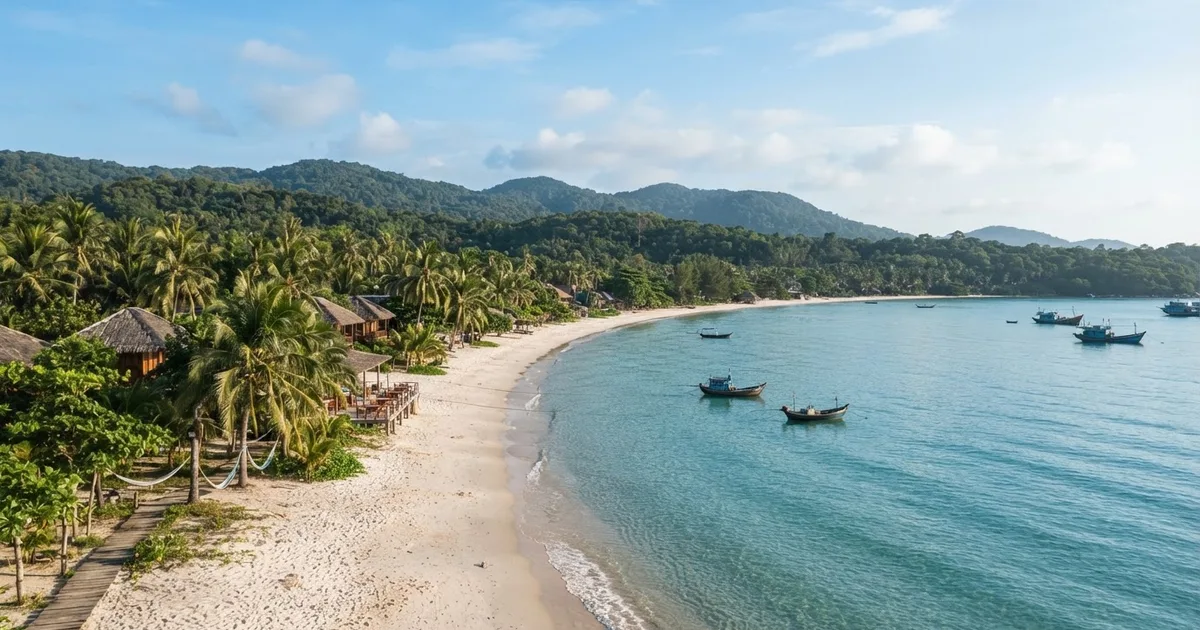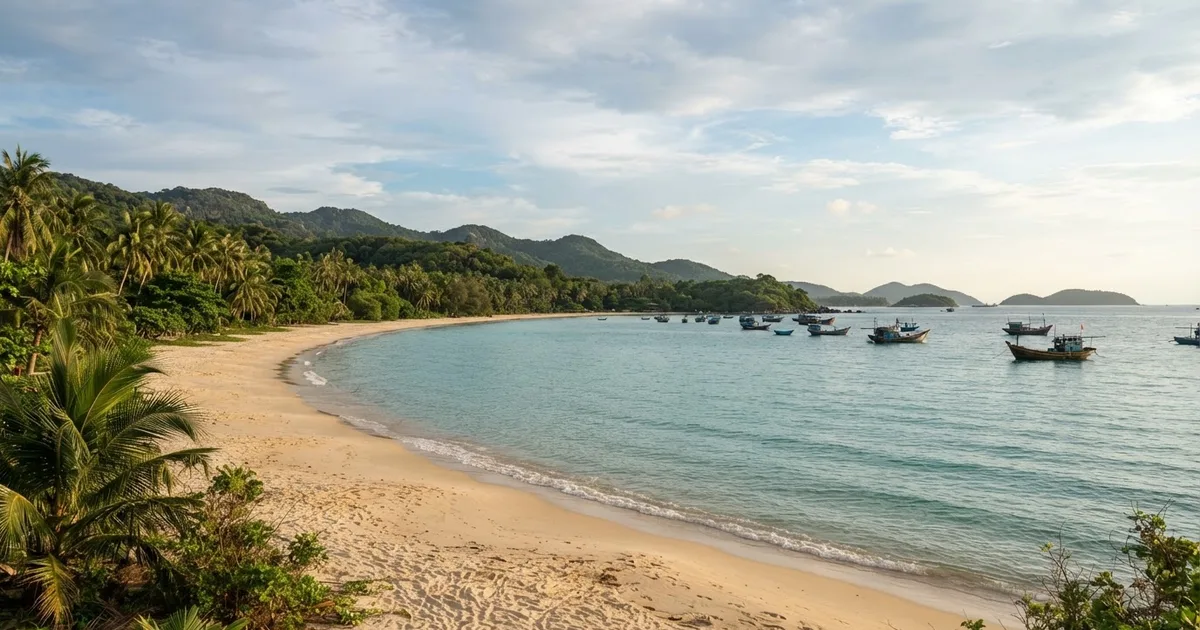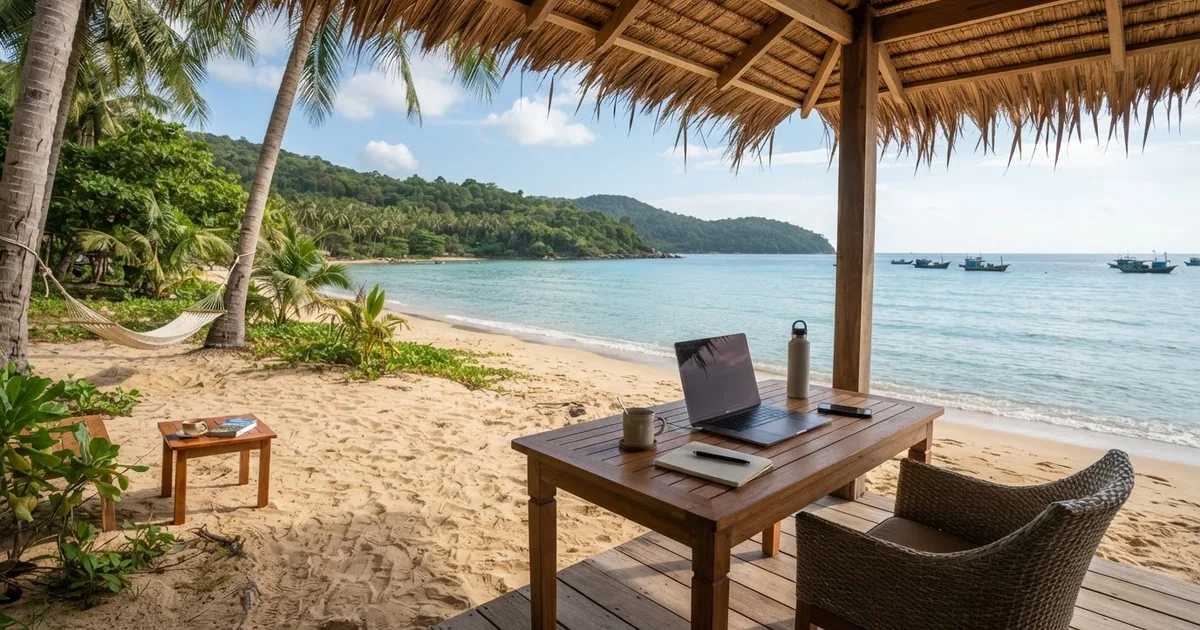
Phu Quoc works as a digital nomad base in 2026 — but only if you want a quiet island, not a coworking hub. Vietnam still has no formal digital nomad visa, yet the island is visa-free for up to 30 days for all nationalities arriving directly, a comfortable month costs about $595, and private apartments deliver 50–100 Mbps fiber that handles daily video calls. There is no established coworking brand with a permanent address on the island.
Can you legally work remotely from Phu Quoc in 2026?
Yes, in practice — but the legal basis is a tourist exemption, not a nomad visa. Vietnam has no formal digital nomad visa as of 2026, and there is no announced timeline for one. What Phu Quoc offers instead is the strongest tourist exemption in the country: visa-free entry for up to 30 days for all nationalities, provided you arrive directly on the island.
The word "directly" carries the weight here. The exemption is tied to arriving at Phu Quoc International Airport (PQC) on an international flight, or by sea on an international route, without having entered Vietnam beforehand. If you land in Ho Chi Minh City, clear immigration there, and then take a domestic flight down to Phu Quoc, you are on a standard Vietnamese tourist entry — typically 45 days for most nationalities under current e-visa and bilateral rules — not the island-specific 30-day exemption. In that case, sort your visa before you fly.
For longer stays, the practical pattern most remote workers use is a 30-day island exemption followed by a regional reset: a short hop to Bangkok, Seoul, or Ho Chi Minh City and back to PQC, which restarts the clock. Flights to Phu Quoc run direct from Ho Chi Minh City, Bangkok, Seoul, and a long list of other Asian cities, so the reset is cheap and quick rather than a major expedition.
Tip: Immigration officers occasionally ask to see onward travel or proof of accommodation. Keep a screenshot of your outbound flight and your first week's booking saved offline — island WiFi is reliable, but airport queues are not the place to be loading a booking app.
What does a month in Phu Quoc actually cost?
A comfortable month lands at about $595, including city-centre rent, dining, transport, and utilities. That figure is not a backpacker's floor — it includes eating out regularly, renting a motorbike, and paying for fast internet. Phu Quoc ranks #54 out of 366 cities in the 2026 affordability guide, which puts it comfortably inside the cheap tier without being the absolute cheapest place in Southeast Asia.
The single biggest lever is your room. At Home'stay Sabrina, the Budget Room is listed at $8.40 per night and the Comfort Room at $12.60 per night. On a monthly booking that is roughly $252 versus $378 — a $126 gap that decides whether you land near $500 or near $600.
| Monthly item | Budget setup | Comfort setup |
|---|---|---|
| Room (monthly rate) | ~$252 (Budget Room, $8.40/night) | ~$378 (Comfort Room, $12.60/night) |
| Food and drinks | $150 (local spots, some cooking) | $200 (mix of local and Western) |
| Motorbike rental + fuel | $60 | $90 |
| Utilities, Viettel data, laundry | $30 | $50 |
| Approximate total | ~$492 | ~$718 |
In other words, the widely quoted $595 comfortable budget sits almost exactly between those two columns: a Comfort Room with restrained spending, or a Budget Room with a generous food and transport allowance. Staying under $600 is entirely doable if you keep the room at the budget tier and eat where locals eat.
Internet, WiFi, and SIM cards for remote work
Connectivity is the reason Phu Quoc makes this list at all. Fiber internet in private apartments commonly runs at 50–100 Mbps and is considered reliable enough for daily video calls — not "good for an island," just good. The caveat is that this applies to apartments with a dedicated line, not to whatever a hotel happens to share across forty rooms during peak season.
Viettel and FPT are the best fiber providers in Duong Dong and Long Beach, the two areas where most long-stay visitors end up. If you are choosing between rooms, ask which provider the building uses and whether the line is dedicated to your unit. That one question separates a smooth month of work from a month of apologising on calls.
For mobile data, Viettel SIM cards are recommended for the strongest island-wide coverage — useful because Phu Quoc is larger than it looks, and the northern beaches and interior roads are where weaker networks drop out. A local Viettel data package costs a fraction of roaming, and tourist SIMs are sold at the airport and in Duong Dong.
Before you book a room for remote work, confirm:
- Dedicated fiber in the unit (not shared building WiFi)
- Provider is Viettel or FPT
- Measured speed of 50 Mbps or better, tested in the room
- A backup: a Viettel SIM with a data package for outages
- A nearby cafe with air-conditioning and power sockets for morning sessions
The coworking question: what Phu Quoc does not have
Be clear-eyed about this. Phu Quoc does not have a developed coworking scene, and has no established coworking brand with a permanent address as of mid-2026. If your working rhythm depends on a dedicated desk, a community manager, Friday networking events, and a Slack channel full of other founders, this island will frustrate you within a fortnight.
What replaces it is a two-part routine that experienced remote workers on the island converge on: an apartment with dedicated fiber for deep work, plus morning cafe sessions for a change of scenery and human contact. Duong Dong and the Long Beach strip have no shortage of cafes with good WiFi, iced coffee, and enough ambient noise to feel like a workplace. It is a self-assembled office, not a provided one.
This is also why Phu Quoc suits a specific temperament. It is best suited for nomads who prefer quiet island life over bustling city coworking culture — people who want a slower pace, beach access, and a simple routine rather than a highly social scene. It is more of a "live and work quietly" destination than a structured nomad hub.
A good fit if you…
- Want low cost, fast internet, and a peaceful work environment
- Work independently and do not need a coworking membership
- Value beach access and a slow daily rhythm over networking
- Are happy on a motorbike, cooking some meals, and living simply
- Can handle a 30-day visa cycle with occasional regional resets
A poor fit if you…
- Need a permanent coworking space, hot desks, or a nomad community
- Rely on frequent in-person meetings or a startup network
- Want big-city nightlife, galleries, and dense urban variety
- Need guaranteed gigabit speeds or a redundant second ISP
- Prefer to stay put for six months without visa runs
Where to stay, and how to structure your days
Most remote workers concentrate in two zones. Duong Dong is the island's main town: markets, pharmacies, repair shops, the densest cluster of cafes, and the best odds of a Viettel or FPT fiber line already installed. Long Beach (Bai Truong) runs south of town and trades convenience for sunset views and quieter evenings, still within a short ride of everything. Both are named as the strongest areas for fiber providers, which is not a coincidence — that is where the infrastructure investment went.
Accommodation choice matters more than location for a working nomad. A room at $8.40 per night (Budget) or $12.60 per night (Comfort) on a monthly arrangement keeps your housing line at $252–$378, which is what makes the $595 comfortable monthly budget achievable rather than aspirational. Paying resort rates for a month would blow that number apart on housing alone.
A workable daily structure on Phu Quoc looks like this: deep work from the apartment in the morning while the connection is quiet and the island is still cool, a cafe session late morning for calls and a change of scene, then afternoons free for the beach, a motorbike loop, or the night market in Duong Dong. Because the island is small, "commuting" is rarely more than fifteen minutes — which means you can genuinely finish work and be swimming before sunset.
Tip: Book your first week only, then inspect the room's actual internet speed and the neighbourhood before committing to a month. Rental rates are negotiated in person, and the difference between two similar-looking rooms is often the fiber line.
Practical daily life: transport, food, and health
Transport. A motorbike is close to essential. Budget around $60–$90 per month for rental plus fuel, depending on the bike. The island's main roads are paved and easy, but rain comes hard in the wet season, so ride accordingly and always wear a helmet — it is both law and common sense.
Food. Local Vietnamese food is cheap and excellent: noodle soups, rice plates, and seafood at the Duong Dong night market. Budget $150–$200 per month depending on how often you eat Western. Cooking in your room or a shared kitchen pulls that number down further.
Health and errands. Duong Dong has pharmacies, clinics, and the practical services you need for a long stay. For anything serious, many long-stayers keep travel insurance that covers evacuation to Bangkok or Ho Chi Minh City, both of which are a short direct flight away.
Weather. Phu Quoc has a distinct dry season roughly from November to April and a wet season from May to October. The dry months are the comfortable ones for working outdoors and exploring; the wet season brings heavy afternoon downpours, lower prices, and a quieter island — many nomads actually prefer it for focused work.
Frequently Asked Questions
Do I need a visa to work remotely from Phu Quoc?
Vietnam has no digital nomad visa as of 2026. However, Phu Quoc is visa-free for up to 30 days for all nationalities if you arrive directly on the island at Phu Quoc International Airport. If you enter Vietnam elsewhere first, standard tourist visa rules apply instead.
How much does a month in Phu Quoc cost for a digital nomad?
A comfortable month costs about $595, covering city-centre rent, dining, transport, and utilities. A leaner setup is possible: a Budget Room at $8.40 per night plus local food and a motorbike can keep the total under $500. Phu Quoc ranks #54 of 366 cities for affordability.
Is the internet fast enough for video calls in Phu Quoc?
Yes. Fiber internet in private apartments commonly runs at 50–100 Mbps and is considered reliable for daily video calls. Viettel and FPT are the best providers in Duong Dong and Long Beach. Always confirm the room has a dedicated line rather than shared building WiFi.
Is there a coworking space in Phu Quoc?
No. Phu Quoc has no developed coworking scene and no established coworking brand with a permanent address as of mid-2026. The standard remote-work setup is an apartment with dedicated fiber for deep work, combined with morning cafe sessions in Duong Dong or along Long Beach.
Which SIM card should I buy in Phu Quoc?
Viettel SIM cards are recommended for the strongest island-wide coverage, which matters if you ride to the northern beaches or interior roads. FPT and Viettel are also the leading fiber providers for apartments. Tourist SIMs are available at the airport and in Duong Dong.
Who is Phu Quoc not suitable for?
It is a poor fit for nomads who need a permanent coworking space, a dense startup community, frequent in-person meetings, big-city nightlife, or guaranteed gigabit internet. Phu Quoc is a "live and work quietly" destination, better suited to independent workers who value low cost and beach access.
How do I stay longer than 30 days in Phu Quoc?
Most remote workers do a regional reset: fly to Bangkok, Seoul, or Ho Chi Minh City and return directly to Phu Quoc, restarting the 30-day visa-free clock. Direct flights from these cities make it a quick, inexpensive trip rather than a major journey.
Planning a working stay on Phu Quoc? Sabrina Rental can set you up with a room on a monthly rate, a motorbike for getting around, and local advice on which buildings actually have fast fiber. Tell us your dates and how long you plan to work from the island.
Contact Sabrina Rental