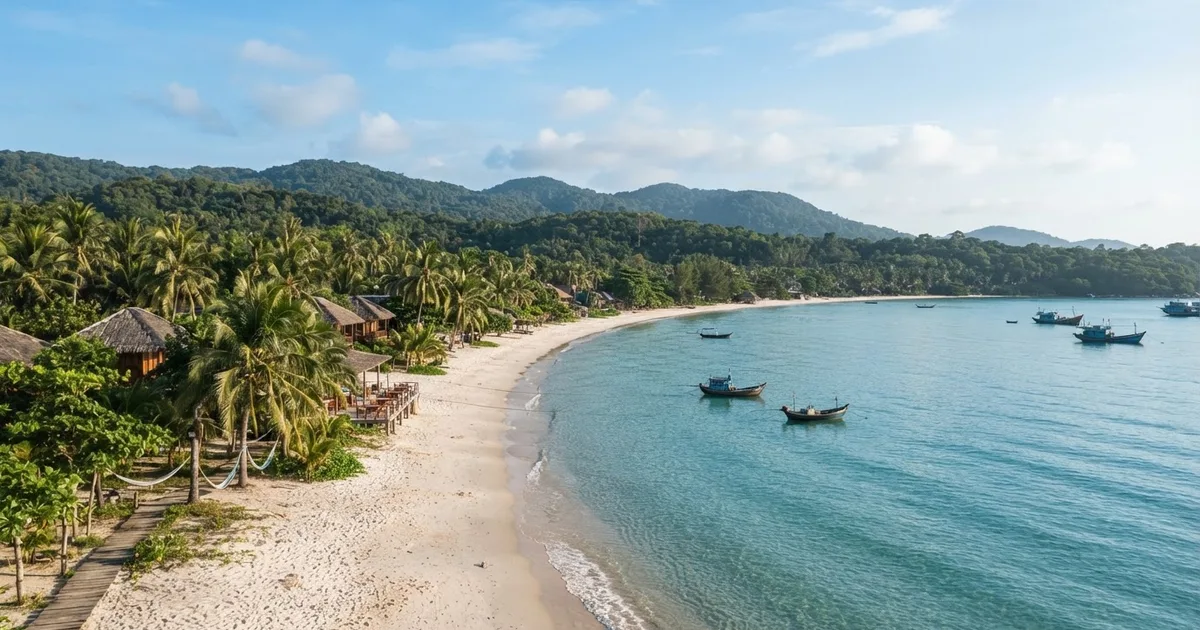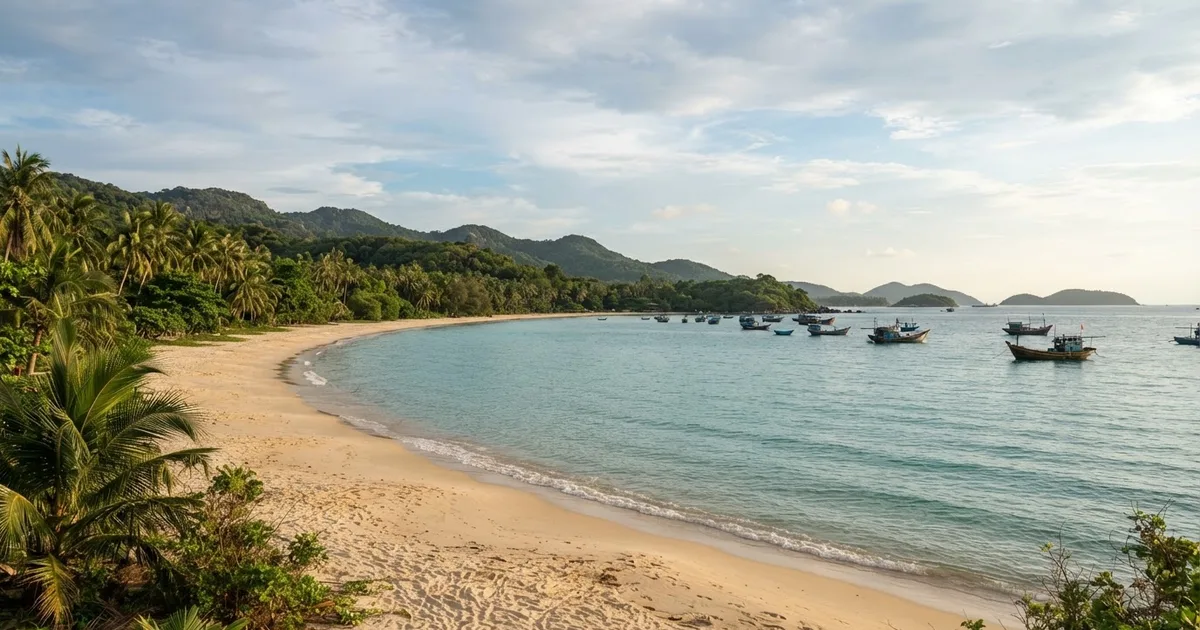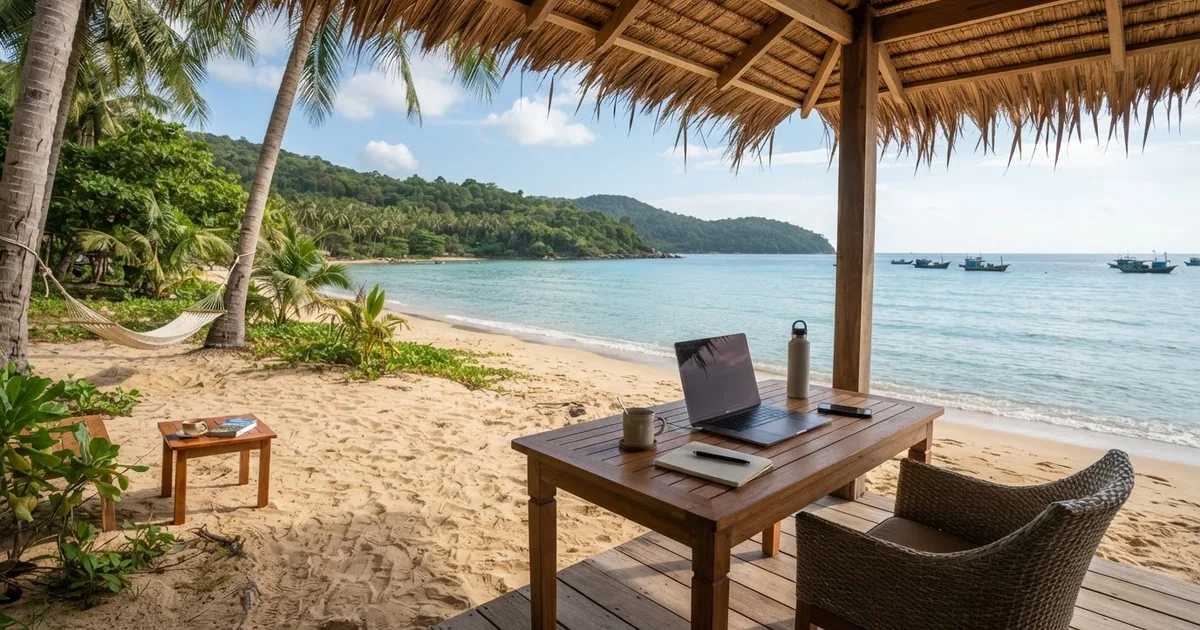
A month on Phu Quoc is one of the easiest long-stay bargains in Southeast Asia: furnished studios start around $250 per month in Duong Dong, utilities add roughly $30–60, and a solo traveler can live comfortably on $600–900 for the entire month. Expect a quiet beach-town rhythm, reliable fiber WiFi in the 50–100 Mbps range, and the best value of the year in November, when the dry season returns but peak-season prices have not caught up yet.
What a Month on Phu Quoc Actually Feels Like
The first week on Phu Quoc feels like any other island holiday — you chase sunsets on Long Beach, wander the Duong Dong night market, and take too many photos of your iced coffee. Somewhere in week two, the switch happens: you have a regular fruit stall, the noodle-stall owner remembers your order, and you stop planning sightseeing days entirely. That is the moment a month-long stay starts paying off.
Practically, the island is very manageable at this length. Phu Quoc is Vietnam's largest island — about 50 km end to end — so the ride from Duong Dong in the northwest down to An Thoi in the south takes roughly 1.5 hours by scooter. You can base yourself in one neighborhood, keep a rented bike for the whole month, and still cover the entire island in a handful of unhurried day trips.
The rhythm most long-stayers settle into is simple: work or errands in the morning while it's cool, a beach or café in the afternoon, and dinner at a market or a local restaurant for a couple of dollars. It is a slow destination by design, and after four weeks most people say the biggest change is not the beaches — it's how much quieter their head feels.
What a Month of Rent Actually Buys You
Long-term rentals in Phu Quoc start from about $250 per month for a basic furnished studio in Duong Dong and scale up smoothly from there. Utilities (electricity and water) are billed separately on top of rent and typically add $30–60 per month. Most landlords ask for a deposit — commonly one month — and monthly rates are negotiable, especially outside the December–March peak.
| Accommodation type | Typical monthly price (USD) | What you get |
|---|---|---|
| Basic furnished studio, Duong Dong | from $250 | Bed, fan or AC, hot shower, small kitchenette, walkable to markets and cheap eateries |
| Studio, Duong Dong | $300–450 unfurnished / $380–550 furnished | More space and finish; furnished units usually include AC, kitchenette and weekly cleaning |
| Studio, Long Beach | $300–420 | Beachside location, sunset walks, restaurants and beach bars on the same strip |
| Studio, Ong Lang | $380–500 | Quiet boutique area, calmer water, smaller resorts and guesthouses |
| 1-bedroom apartment, sea view or pool access | $350–600 | Separate living space, better AC and often a shared pool or partial sea view |
| Private pool bungalow | $600–900 | Standalone bungalow with your own plunge pool — affordable luxury at this tier |
| 3-bedroom villa with pool | $1,200–1,800 | Full villa for families or groups sharing; often cheaper per person than any hotel |
To put those numbers in perspective: budget homestays and guesthouses charge $15–30 per night and mid-range hotels $40–80 per night. Paying nightly for a month at a $20/night homestay would cost you about $600 — while a negotiated long-term rate on a similar private room lands closer to $300. The monthly discount is the single biggest saving on the island, so always ask for the month price rather than booking 30 individual nights.
Where to Base Yourself: Duong Dong vs Long Beach vs Ong Lang
Duong Dong — best all-round value
The main town in the northwest is where most month-long stays happen, and for good reason: studios run $300–450 unfurnished or $380–550 furnished, with basic options from $250. You are walkable to the night market, the wet market, pharmacies, gyms and dozens of cheap eateries — everything daily life requires without riding far.
Less suited to: travelers who want a quiet, nature-first setting — this is the busiest, most built-up part of the island.
Long Beach — the beach-lifestyle base
The stretch just south of town trades some convenience for sand. Studios go for $300–420/month, and you get sunset on the beach every evening plus a long line of beach bars and restaurants. It is the classic "work all morning, walk to the beach at 5 pm" base.
Less suited to: strict budgets — beachfront equals beachfront markups on food and drinks compared to town.
Ong Lang — the quiet corner
About 15 minutes north of Duong Dong, Ong Lang is the boutique escape: smaller resorts, calmer swimming water and studios at $380–500/month. Best for couples, writers and anyone allergic to crowds.
Less suited to: people without a scooter, or anyone who wants nightlife and walkable services — you will be riding into town for almost everything.
A Realistic Monthly Budget (Rent Is Only Half the Story)
Rent is the biggest line item, but it is far from the whole budget. Here is what a realistic month on the island adds up to for a solo traveler:
| Line item | Monthly cost (USD) |
|---|---|
| Studio or apartment rent | $250–600 |
| Electricity and water | $30–60 |
| Food (mix of local meals at $1.50–3 and western meals at $6–12) | $200–350 |
| Scooter rental plus fuel | $60–80 |
| SIM card with a month of data | $5–10 |
| Laundry, toiletries, misc | $30–50 |
| Total (solo, homestay/studio tier) | $600–900 |
That $600–900 range is the honest floor for a solo traveler living well. Once you upgrade the apartment, eat out more often and add boat trips, you land in the comfortable expat bracket: $1,100–2,000 per month for a single person, or $1,500–2,800 for a couple. The second person mainly adds food and leisure costs plus a shared rent upgrade — not a doubling of expenses.
Money-saving tip: book only your first week online, then hunt in person. Ride around your chosen neighborhood, look for rental signs, and negotiate monthly rates directly with owners. Outside the November–March peak, landlords routinely discount 20–30% for a committed month.
Remote Work on Phu Quoc: Quiet, Connected, Not a Party
WiFi is widely available across Phu Quoc, and modern guesthouses and apartments typically run dedicated fiber in the 50–100 Mbps range — plenty for video calls, cloud work and even large uploads. Working from a laptop-friendly café in Duong Dong with a coffee for $1.50–2.50 is an easy default, and most monthly landlords will let you test the connection before you commit.
The honest characterization: Phu Quoc is a "live and work quietly" destination, not a structured nomad hub. The pace is slower than Da Nang or Ho Chi Minh City, and the coworking-and-meetups scene is small. Digital nomads who thrive here are the ones who want a simple routine, beach access and low costs — and who are happy creating their own social life rather than joining a ready-made one.
Less suited to: remote workers who build their trips around coworking spaces, networking events and a large nomad community. If daily social infrastructure is what keeps you productive and happy, you will find Phu Quoc peaceful for a month but thin — treat it as a writing retreat rather than a networking stop.
Timing Your Month: Why November Is the Golden Window
Phu Quoc's dry season runs roughly November through April, and the best window sits right at its start: November is the golden month when the dry season returns but peak-season prices have not kicked in yet. Skies clear, the west-coast sea calms down for swimming and island-hopping, and studios still rent at low-season rates.
December through March is peak season: near-guaranteed sunshine and the best overall conditions, but also the highest rents and fuller guesthouses — book your monthly place several weeks ahead. Around late January or February, Tet (Vietnamese Lunar New Year) brings a wave of domestic travelers and some businesses close for a few days, so plan around it if your month overlaps.
The rainy season (roughly May to October) should not be dismissed for a month-long stay. Downpours are heavy but usually come in bursts rather than all-day soaks, monthly rents drop sharply and become very negotiable, and the island is at its greenest. The trade-offs: rougher seas can cancel snorkeling and southern-island boat trips on some days, and humidity is high. If your priority is cheap rent over beach days, a shoulder or rainy-season month is the budget play.
Practical Stuff: Visas, Scooters and Daily Logistics
Visa: most travelers use Vietnam's e-visa, applied for online before arrival, which allows stays of up to 90 days — comfortable for a one-month stay with room to spare, at a fee of $25 for single entry. Separately, Phu Quoc grants foreign visitors a 30-day visa exemption if you arrive directly to the island on an international flight. Convenient for exactly one month — but note that connecting through Ho Chi Minh City or Hanoi means entering Vietnam on your normal visa instead.
Scooter: effectively mandatory for a month here. Distances are short but real, and taxis add up fast. Monthly rentals run roughly $50–70 (versus about $5–6 per day short-term), fuel is cheap, and an international driving permit with the motorcycle category is strongly recommended since police checks do happen. Renting your room and scooter from the same place for the month usually gets you a better combined price.
Everything else: a Viettel or Vinaphone tourist SIM with a month of data costs around $7–10, laundry by the kilo runs a couple of dollars per load, and there are international clinics and pharmacies in Duong Dong. ATMs are everywhere in town, though carry cash for markets and the smaller beach villages.
Who a Month on Phu Quoc Suits — and Who It Doesn't
After the numbers, the fit question: a month on Phu Quoc is a strong match for some travelers and a poor one for others.
- Digital nomads who value low cost and calm — fast internet at 50–100 Mbps, a $600–900 monthly budget and a peaceful work environment outweigh the small social scene.
- Couples doing a slow reset — a private pool bungalow at $600–900/month is affordable luxury inside a $1,500–2,800 couple budget.
- Snowbirds escaping winter — the November–March dry season lines up perfectly with northern-hemisphere winter, and monthly rates beat $40–80/night hotels by a wide margin.
- Writers and focused creatives — quiet mornings, few distractions, and a routine that happily repeats itself for four weeks straight.
Less suited to: party-first travelers (nightlife is modest and centered on a handful of beach bars), nomads who need a structured coworking community and regular events, and anyone craving big-city shopping, dining variety or international schools. If your ideal month is social and fast-paced, Da Nang or Ho Chi Minh City will fit better; if it is quiet and affordable, Phu Quoc is hard to beat.
Frequently Asked Questions
How much does it cost to stay in Phu Quoc for a month?
A solo traveler in a homestay or studio tier can do a full month for $600–900 all-in: $250–550 rent, $30–60 utilities, $200–350 food, and $60–80 for a scooter with fuel. A comfortable expat lifestyle runs $1,100–2,000 per month for one person and $1,500–2,800 for a couple.
Is $250-per-month rent in Phu Quoc real?
Yes — $250 is the realistic starting price for a basic furnished studio in Duong Dong. Nicer furnished studios run $380–550, a 1-bedroom with sea view or pool access costs $350–600, a private pool bungalow $600–900, and a 3-bedroom villa with pool $1,200–1,800 per month. Utilities add $30–60 on top of every tier.
Do I need a visa to stay a month in Phu Quoc?
Phu Quoc grants foreign visitors a 30-day visa exemption if you arrive directly on an international flight to the island. If you connect through Ho Chi Minh City or Hanoi, you will need a Vietnam e-visa — applied for online, valid up to 90 days and costing $25 for single entry, which covers your month with room to spare.
Is Phu Quoc good for remote work?
Yes for connectivity, quieter for community. WiFi is widely available and many apartments and cafés run fiber in the 50–100 Mbps range, which handles video calls easily. The trade-off is a small coworking and meetup scene — Phu Quoc suits people who work well in a quiet, self-directed routine better than those who rely on a busy nomad hub.
What is Phu Quoc like for a month during rainy season?
Workable and cheap. From roughly May to October you will get heavy but usually short downpours, high humidity and some canceled island-hopping days when the sea is rough. In exchange, monthly rents drop well below the $380–550 furnished-studio peak rates, become very negotiable, and the island is quieter and greener than in high season.
Which month is best for a month-long stay?
November is the sweet spot: the dry season has just returned, the west-coast sea is calm, and peak-season prices have not kicked in yet. December to March offers the most reliable sunshine but the highest rents, so book your monthly place several weeks ahead — especially if your dates overlap with Tet in late January or February.
Do I need to rent a scooter for a month on Phu Quoc?
Practically, yes. Monthly scooter rental costs about $50–70 versus $5–6 per day short-term, fuel is cheap, and a bike turns the island's roughly 50 km length into easy day trips. Taxis and ride-hailing exist around Duong Dong, but relying on them for a month costs far more — and quieter areas like Ong Lang really require one.
Can a couple live comfortably in Phu Quoc on $1,500 a month?
Yes. The comfortable range for a couple is $1,500–2,800 per month, and $1,500 covers a mid-tier apartment ($350–600), utilities ($30–60), eating out regularly, a scooter and occasional tours. Stretch toward $2,000–2,800 and you can hold a private pool bungalow at $600–900/month plus frequent boat trips and restaurant meals.
Planning a month or more on Phu Quoc? Sabrina Rental can set you up with a monthly room, a scooter for your whole stay, and honest local advice on neighborhoods, boat trips and everyday logistics — message us before you land and we'll have it sorted.
Ask Sabrina Rental About a Monthly Stay