Yes — Hung Quoc Tu Pagoda is worth visiting if you are staying in or near Duong Dong town: entry is free, it opens daily from 07:00 to 19:00, and it is one of the oldest pagodas on Phu Quoc Island, built in 1952. It is a 30–45 minute stop rather than a half-day destination, but for a quiet, authentic glimpse of local Buddhist life just steps from the night market, it easily earns your time. What it is not: a grand, monumental temple worth crossing the island for — that role belongs to Ho Quoc Pagoda.
Is Hung Quoc Tu Pagoda Worth Visiting? An Honest Verdict
Online rankings need context here. On Tripadvisor, Hung Quoc Tu Pagoda carries a perfect 5.0 rating — but from a single review — and it is ranked #18 of 18 things to do in Duong Dong. That last-place position sounds damning until you realize what the list contains: Duong Dong is a small town, and the pagoda is competing with free beaches, sunset spots, and the night market. For a working neighborhood temple that asks nothing of you but respect, the low ranking says more about sample size than about the experience.
What you actually get is described consistently across local guides: a peaceful, open, spacious pagoda that travelers visit specifically for its sense of serenity, and which offers a more intimate spiritual experience than the island's large showpiece temples. Asia Pioneer Travel highlights that it is easily accessible right in town — a genuine rarity, since most of Phu Quoc's cultural sights require a 20–40 minute ride.
One honest caveat: at least one recent visitor reported they could not enter at all, because the temple was under repair and the grounds were being tiled. They still admired the building from outside, but it is a useful reminder that this is a living place of worship that occasionally closes sections for maintenance. If it happens to be closed during your stay, Ba Pagoda on Vo Thi Sau street is a short walk away.
Visit it if you...
Are staying in Duong Dong or the northern end of Long Beach, want a free cultural stop between the market and the harbor, enjoy quiet temple courtyards, or have 30–45 spare minutes before or after the night market.
Less suited to you if you...
Expect monumental architecture and photo-spectacle (Ho Quoc Pagoda is bigger and more dramatic), want a full morning's itinerary from one sight, or plan a beach-only trip and dislike modest dress codes. It is also poor value as a destination in itself if you are based in the island's south or northeast.
Where Is Hung Quoc Tu Pagoda and How Do You Get There?
The pagoda sits at 81 Nguyen Trung Truc in central Duong Dong — Phu Quoc's main town and the island's transport hub. That address puts it on or immediately beside the street that hosts the famous Duong Dong Night Market, so from the market entrance you are looking at a 2–3 minute walk. Dinh Cau, the small sea temple on the rocks at the river mouth, is roughly 10 minutes on foot in the other direction.
From Phu Quoc International Airport, the trip is short: the airport lies only about 4 km from central Duong Dong, a 10–15 minute taxi costing roughly 60,000–100,000 VND (around $2.50–4). Most resorts on Long Beach are 10–20 minutes away by car. If you are already in town, you genuinely do not need transport at all.
That said, having a scooter transforms a temple stop into a full island day. Rental motorbikes in Duong Dong typically cost around $5–7 per day, and the pagoda's central location means you can park nearby (informally and usually free or for a small tip) and continue to the harbor, market, or beach. If you prefer not to ride, taxis and ride-hailing cars are plentiful on this side of the island — you will not find that convenience everywhere on Phu Quoc.
A 1952 Temple: The History Behind Hung Quoc Tu
Hung Quoc Tu was constructed in 1952, which makes it over 70 years old today and — in the words of VinWonders' island guide — one of the most ancient pagodas on Phu Quoc. Local travel writer Dong Travel also dates it to 1952 and notes it is more than 60 years old; on an island where most buildings date from the tourism boom of the last two decades, that age alone makes it culturally significant. Multiple guides describe it as one of the holiest places on Phu Quoc Island.
The name itself carries meaning: Vietnamese pagodas are traditionally given aspirational names, and "Hung Quoc" is generally read along the lines of "flourishing nation" — a blessing for the country and the community that built it. Temples like this one served as the spiritual anchor for Duong Dong's fishing families long before the first resort opened.
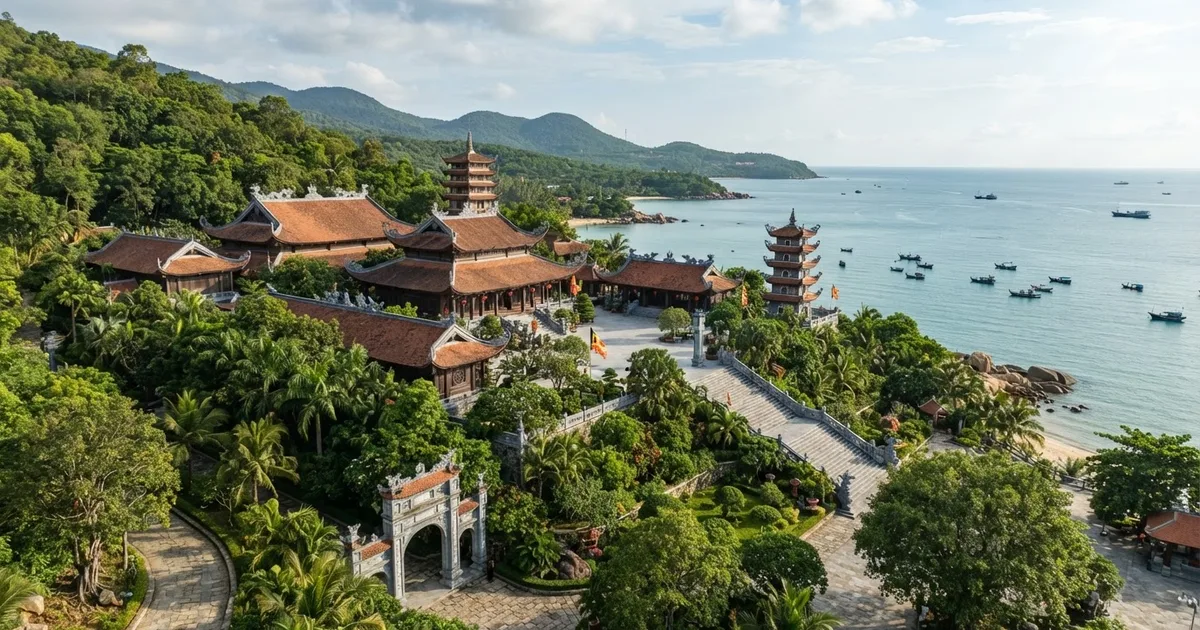
Architecturally, it is small but considered. VinWonders specifically praises the temple's beautiful design in yellow and blue — a palette that glows warmly in the early morning and late afternoon light — while Cassia Cottage describes it as an open, spacious pagoda with a palpable sense of peace and calm. Mytour frames it as a peaceful spiritual destination that draws visitors seeking serenity rather than spectacle. That is the honest pitch: this is a place to slow down, not to tick off.
What You'll See Inside — and Temple Etiquette
Expect the classic layout of a Vietnamese Buddhist temple: a modest gate opening onto a courtyard, an incense burner sending thin smoke into the air, and a main hall with gilded Buddha statues, altars stacked with fruit offerings, and soft red-and-gold detailing. Because it is a small, town-center temple, you will often share the space with locals rather than tour groups — an elderly resident lighting incense, a family praying quietly, occasionally a monk going about daily routine. That is precisely the intimacy Asia Pioneer Travel is describing.
None of this requires expert knowledge, but basic etiquette matters, and locals genuinely notice it:
- Cover your shoulders and knees before you arrive — there is no robe rental here.
- Remove your shoes before stepping into the main hall.
- Keep your voice low and set your phone to silent.
- Never point your feet toward Buddha statues or sit with feet raised toward the altar.
- Ask before photographing worshippers or monks; the buildings themselves are fine to shoot.
- Leave a small donation if you can — 20,000–50,000 VND (about $1–2) is a normal, appreciated amount.
Tip: Come with small banknotes ready. There is no ticket office and no tourist infrastructure — that is part of the charm — but donation boxes sit at the altars, and having exact change makes the gesture simple.
Best Time to Visit (and When to Avoid)
Standard opening hours are 07:00–19:00 daily, so you have a wide window. The sweet spots are early morning between 07:00 and 09:00, when the courtyard is cool, the light is soft on the yellow-and-blue walls, and locals come to make their daily offerings — and late afternoon between about 16:30 and 18:30, when temperatures drop and you can continue straight into the harbor and night market area for the evening.
Avoid the midday block from roughly 11:30 to 14:00: Duong Dong is hot year-round, the courtyard offers limited shade, and the temple is at its emptiest and least atmospheric. One practical warning comes from a recent visitor review: the temple has at times been closed for repairs, with grounds being retiled. If you arrive to find a section fenced off, adjust rather than abandon — admire the exterior, then walk to Ba Pagoda on Vo Thi Sau street.
One deliberate exception: Lunar New Year (Tet, in late January or early February). Anja Resort's local guide notes that Hung Quoc Tu becomes crowded precisely then, as tourists and locals come to pray for peace and prosperity for the coming year. If you want to see the temple at its most alive — incense smoke, flowers, families in their best clothes — Tet is the time. If you want solitude, it is not.
Hours note: Most sources agree on 07:00–19:00 daily, but Cassia Cottage's guide lists visiting hours as late as 22:00. Treat 19:00 as the safe cutoff, and treat anything after that as a bonus if the gates are still open.
Hung Quoc Tu vs. Ho Quoc Pagoda vs. Ba Pagoda
Phu Quoc has three temples that consistently appear in visitor itineraries, and they serve different purposes. Ho Quoc Pagoda, on the southwest coast, is the island's grand statement — a large, dramatic complex also free to enter, open 06:00–18:00. Ba Pagoda, right in Duong Dong at 44 Vo Thi Sau, is a famous and sacred temple where locals pray for peace and good fortune, and it preserves the legend of the sea goddess Thuy Long Thanh Mau. Hung Quoc Tu is the smallest and oldest of the three, and the only one most visitors can reach on foot.
| Temple | Location | Hours | Entry | Best for |
|---|---|---|---|---|
| Hung Quoc Tu Pagoda | 81 Nguyen Trung Truc, Duong Dong (town center) | 07:00–19:00 daily | Free | A quick, authentic 30–45 minute stop; the island's oldest temple (1952) |
| Ho Quoc Pagoda | Southwest coast, ~20 km south of Duong Dong (~30 min by scooter) | 06:00–18:00 | Free | Grand seaside architecture and the best temple photos on the island |
| Ba Pagoda | 44 Vo Thi Sau, Duong Dong | Daytime; busiest around Tet | No ticket; donations expected | Local worship culture and the Thuy Long Thanh Mau legend |
Who each suits: Ho Quoc rewards travelers who will make the ride south and want scale and drama — it is a poor fit if you cannot ride a scooter and dislike paying for taxis. Ba Pagoda suits anyone staying in Duong Dong interested in living folk religion rather than architecture. Hung Quoc Tu, finally, is the one you visit because it is 200 meters from your dinner plans and costs nothing — less suited to anyone assembling an itinerary of headline sights, and ideal for everyone else.
An Easy Duong Dong Half-Day Itinerary Around the Pagoda
Because Hung Quoc Tu sits in the middle of town, the smartest way to see it is folded into a walking loop of Duong Dong's other free sights. Here is a proven morning-to-evening shape:
- 07:30 – Hung Quoc Tu Pagoda: 30–45 minutes in the cool morning calm.
- 08:30 – Vietnamese coffee (ca phe sua da) at a street-side cafe on Nguyen Trung Truc, about 30,000–50,000 VND.
- 09:15 – Walk 10 minutes to Dinh Cau, the little temple on the rocks where the river meets the sea; 20–30 minutes.
- 10:30 – Browse the covered Duong Dong market for dried seafood, pepper, and pearls; pick up snacks for lunch.
- 12:00 – Seafood lunch near the harbor, then retreat to your beach until late afternoon.
- 17:30 – Sunset over the fishing boats at the pier.
- 18:30 – Duong Dong Night Market for grilled squid, skewers, and souvenirs — and, if you skipped it in the morning, Ba Pagoda on Vo Thi Sau is close by.
This loop costs almost nothing beyond food and coffee, needs no car, and shows you more of real Phu Quoc life than any single paid attraction on the island.
Frequently Asked Questions
Is Hung Quoc Tu Pagoda free to enter?
Yes. Trip.com's attraction listing for 2026 shows the ticket price as free entry. There is no ticket office or gate fee; the temple operates on donations, and 20,000–50,000 VND (roughly $1–2) in the donation box is a courteous amount if you enjoyed your visit.
What are the opening hours of Hung Quoc Tu Pagoda?
The most widely cited hours are 07:00–19:00 daily, seven days a week. Cassia Cottage's local guide lists visiting hours extending to 22:00, so some evenings the gates stay open later. The safe plan is to arrive before 19:00, and remember it becomes crowded during Lunar New Year.
How much time should I budget for a visit?
Plan for 30–45 minutes. The temple is compact: a courtyard, a main hall, and some quiet corners for sitting. Anyone claiming it needs half a day is padding; conversely, even a rushed 20-minute visit captures the atmosphere. Combine it with Dinh Cau and the market for a fuller morning.
Is there a dress code?
Yes, and it is enforced by custom rather than staff: shoulders and knees should be covered, and shoes come off before entering the main hall. Since there is no robe rental on site, wear or carry a light scarf or T-shirt if you are coming from the beach in swimwear.
How far is the pagoda from Phu Quoc International Airport?
Only about 4 km. The airport sits just outside Duong Dong, so a taxi takes 10–15 minutes and typically costs around 60,000–100,000 VND ($2.50–4). If you have a layover-sized gap or an early hotel check-in, the pagoda is one of the closest cultural sights to the airport.
Can I visit Hung Quoc Tu and Ho Quoc Pagoda on the same day?
Easily. They are roughly 20 km apart — about 30 minutes by scooter — and Ho Quoc stays open until 18:00. A common plan is Ho Quoc in the cooler morning or late afternoon, then Hung Quoc Tu in the evening combined with the Duong Dong night market. Both are free, so the day costs only fuel.
Why might the pagoda be closed when I visit?
It is a working temple that occasionally undergoes maintenance. At least one recent visitor found the interior closed because the building was under repair and the grounds were being tiled. If that happens during your trip, admire the architecture from outside and walk five minutes to Ba Pagoda at 44 Vo Thi Sau instead.
Is Hung Quoc Tu Pagoda worth visiting with kids?
Yes — its small size is an advantage with children. There is no ticket pressure, a 30-minute visit matches most kids' attention spans, and the courtyard is safe and car-free. Keep children's voices low inside the main hall and steer them away from the lit incense burners and offering tables.
Planning a Phu Quoc trip? Sabrina Rental is based right here in Duong Dong — we rent scooters from the town center, arrange rooms and boat trips, and happily share honest local tips like the best hour to see Hung Quoc Tu Pagoda. Message us and we will help you build your day.
Contact Sabrina Rental