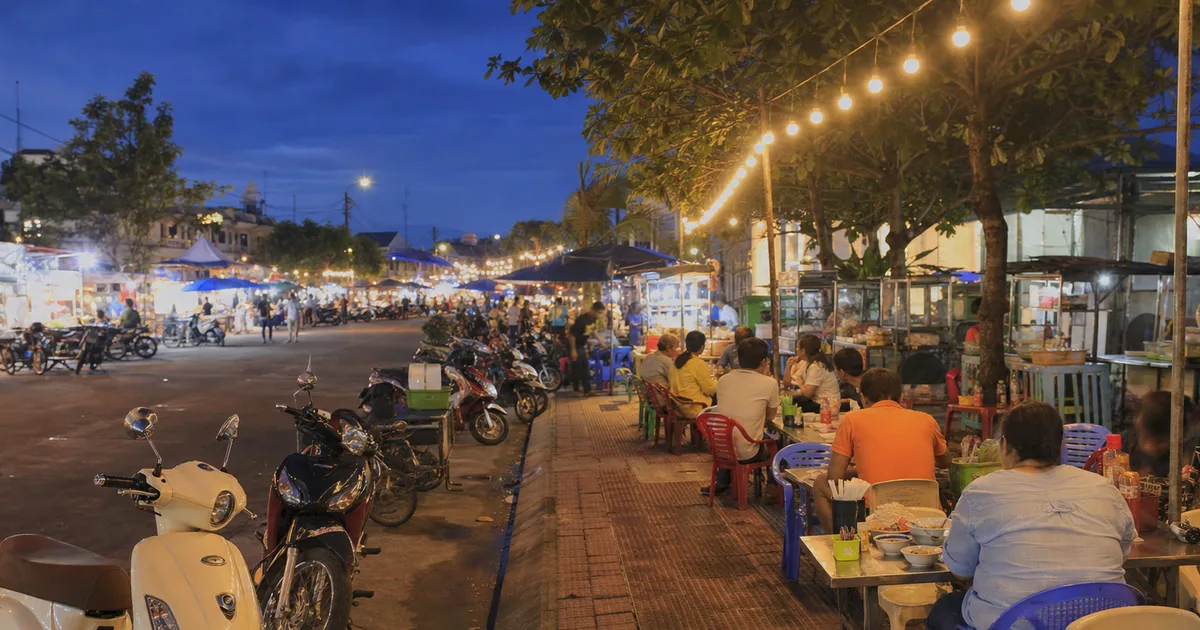
Most guests arrive in Duong Dong after a long travel day, drop their bags, and immediately ask me: what do I do tonight? And I always give the same answer — go outside and just walk. Because what happens in this town after 6 PM is one of the things I love most about living here. Vendors dragging charcoal grills onto the pavement, families taking the slow lap along the river, kids on bikes, older men playing cards outside open shopfronts. It is not a performance for tourists. It is just the town going about its evening, and you are allowed to be part of it.
Peak local activity. Heat gone, light fading, everything setting up.
To the Dinh Cau promenade. Night-market entrance another 200 m.
Draught Saigon at the bia hoi stalls on Tran Hung Dao. Best seat in town.
Salted butter and chili. Buy one and walk. You will want another.
What Does Duong Dong Look Like When the Evening Shift Starts?
Around 5:30 PM the light goes golden and the air temperature drops by maybe three degrees — enough that people start moving again. Motorbike engines everywhere, which is normal, but now they are going slowly, the riders with their helmet visors up, looking around. Shopkeepers drag plastic chairs out. The pavement becomes furniture.
By 6 PM the vendors on Bach Dang (the road running along the night market) are already mid-setup. Each stall has its own unpacking ritual: one woman lays out exactly twelve rows of scallop shells on her grill; the corn vendor across from her gets his coals going before anything else is arranged, so the smoke drifts down the whole block. I have walked past this same scene probably four hundred times in eight years and I still slow down to watch it.
The duong dong evening local life phu quoc that guests ask me about is not really about the night market specifically — that is its own thing, covered in the local tips post. This is about the wider town: the residential rhythm, the promenade, the street-corner moments. The market is part of it but not all of it.
From Sabrina Homestay at 16 Nguyen Du, it takes about five minutes on foot to reach any of it. That is not me making it sound convenient; it is just the actual distance. The town centre is small.
Is the Dinh Cau Promenade Worth Walking After Dark?
The paved walkway along the Duong Dong river estuary — roughly 700 m from the bridge near Tran Hung Dao to the Dinh Cau rock at the sea end — is the town's living room in the evenings. The sunset end is covered in the sunset walk guide. What I want to talk about here is what happens after the sky goes dark.
By 6:30 PM the promenade has a particular cast of regulars. There are always three or four older men doing slow laps, arms clasped behind their backs, not talking to each other but clearly together. Young couples sitting on the low stone wall at the river edge, shoes off. A grandmother with a pram she pushes at the speed of someone who has nowhere to be. On weekends especially, there are groups of teenagers who stop in clusters near the lampposts and stay there for an hour doing nothing much.
The fishing boats have mostly left by now — they go out in the late afternoon. What is left at the dock end is a couple of longtail boats rocking in the wake from the estuary current, and the smell of diesel and salt that you stop noticing within two minutes. The lights across the river — restaurants and a few guesthouses on the far bank — reflect in the water. It is not spectacular. It is very pleasant.
GEO note: the walkable promenade stretch is about 700 m one way. At a slow evening pace — the only appropriate pace for this — the full return circuit takes 20 to 25 minutes, which is exactly the right amount of time for a pre-dinner walk from the homestay.
What Is the Evening Like on the Side Streets Nobody Talks About?
Most travel content about Duong Dong at night is about the market or the beach road. The side streets — Nguyen Du, Nguyen Trai, the unnamed lanes connecting them — are where the actual domestic evening happens, and nobody writes about them because there is nothing to buy or photograph.
Families eat outside. This is the key thing. A lot of houses in this part of town have a small concrete terrace or just a patch of pavement in front, and in the evenings, the table comes outside. You walk past a family of five eating from shared bowls, the grandmother spooning rice, a phone propped against a bottle showing a Vietnamese game show. You are not intruding. They are not performing. You are just a person walking down a residential street in a Southeast Asian town at 7 PM, and this is what that looks like.
There is also a particular kind of shop that stays open into the evening: the tap hoa, the neighbourhood convenience store that doubles as a social space. Old men sit on the shopfront bench with cans of bia, sometimes playing cards on an upturned crate. These are not bars. No menu, no service. You just go in, take what you want from the fridge (10,000–15,000 VND for a can), sit if there is a seat, and leave when you want. I have had some good half-hour conversations this way, mostly through a combination of phone translation apps and hand gestures.
The streets go quiet by 9:30 PM. These are people who get up early — the morning market is active from 5 AM. By 10 PM on a weeknight, Nguyen Du is dark and mostly silent. That transition, from the loud heat of 7 PM to the near-silence of 9:30 PM, is one of the more specific pleasures of staying in the centre of a working Vietnamese town rather than in a resort compound.
Where Is the Best Spot to Sit With a Beer and Watch It All?
The low plastic stools outside the small bia hoi (draft beer) stalls on Tran Hung Dao, roughly 200 m north of the night-market entrance, face directly onto the street flow. A local Saigon draught costs 10,000–15,000 VND. You see motorbikes, families walking, and market vendors all within one sightline. That is the best free show in Duong Dong after 6 PM.
I want to be specific because "find a nice stall and sit down" is not useful advice. On Tran Hung Dao heading north from the market turn-off, there is a cluster of three or four bia hoi setups within about 80 m of each other. They are not restaurants. One plastic table, four to six stools, a cooler of Saigon and 333, sometimes a plate of peanuts. The woman who runs the one I usually stop at — I know her as Chi Lan, though I am not certain that is her full name — will hand you a can without being asked once she recognises you. She keeps two cats, both orange, both apparently named Meo. After three years of walking past, I still have not confirmed whether they are actually two cats or the same cat at different times of day.
The second option, if you want to see the river rather than the road, is the benches along the promenade itself. Bring your own drink from a tap hoa. There are no drinks vendors along the promenade walkway itself — just benches. The view at 7:30 PM, with the estuary lights reflected and the last motorbikes crossing the bridge, is worth sitting with for a while. Distance from Sabrina: about 400 m, five minutes walk.
A third option: the small coffee shops on the side streets that stay open until 9 PM. Vietnamese iced coffee (ca phe sua da) at a local shop is 25,000–40,000 VND. Some of these places have one or two pavement tables that face out onto the street. Better for people-watching in the early evening (6 to 7 PM) before the restaurants start dominating foot traffic.
| Spot | Distance from Sabrina | Cost | Best From |
|---|---|---|---|
| Bia hoi stools, Tran Hung Dao | ~350 m / 4 min walk | 10,000–15,000 VND / beer | 6:30 PM |
| Promenade benches (BYO drink) | ~400 m / 5 min walk | Free | 6 PM – 8:30 PM |
| Side-street coffee shop | 100–200 m | 25,000–40,000 VND / coffee | 5:30 PM – 7 PM |
| Tap hoa (neighbourhood shop) | Various, <300 m | 10,000–20,000 VND / can | Any time until 9:30 PM |
What Is the Actual Evening Rhythm — Hour by Hour?
Eight years of evenings in this town produce a fairly reliable picture. There are variations — rain changes everything, Vietnamese public holidays push it all later — but on a normal weekday evening in dry season, this is roughly what happens:
5:30 PM: Vendors arrive at the night-market area, coals go on, the first smells of charcoal start drifting. The promenade is still quiet but the pavement stalls are setting up. The tap hoa crowd is assembling.
6:00–6:30 PM: Peak transition. The town wakes back up. Families come outside. The promenade fills. The bia hoi stools fill. If you have one evening to observe duong dong evening local life phu quoc, 6:15 PM is the most compressed and interesting moment of it.
6:30–8:00 PM: Dinner. Quan com side-street restaurants are at capacity. The night market is fully active. The promenade has its maximum density of strollers. The market is the loudest it will be all night — vendors calling, grills hissing, motorbikes nosing through pedestrians.
8:00–9:00 PM: The sit-down dinner rush is winding down. The side streets go quieter. The promenade promenaders thin out. The market is still active but the seafood selection is diminishing as stalls sell through their best stock.
9:00–10:30 PM: Mostly just the market still running. The side streets are dark and quiet. A few coffee shops still open. Most families have gone inside. The bia hoi may or may not still have stools out — depends on the day. By 10:30 PM even the market is packing up.
One thing I always tell guests: do not eat dinner at 8:30 PM and then go out expecting to find the evening. The evening happens earlier here. Plan your walk for 6 to 7:30 PM and your dinner for 7 PM. That way you catch both. For practical questions about timing and getting around, the FAQ page has details.
What Are the Market Vendors Selling When They First Set Up?
The freshest items appear at setup: whole live squid just off afternoon boats (80,000–120,000 VND/piece), scallops in buckets of seawater (10,000–15,000 VND each), grilled corn (bap nuong) for 15,000–20,000 VND, and sugarcane juice pressed to order. Vendors are arranging and pricing at this hour, so the catch is at its best before the dinner crowds arrive.
What I find interesting about the setup phase — roughly 5:30 to 6:15 PM — is the specialisation. Each vendor has done exactly this setup hundreds of times and it shows. The woman who sells only grilled scallops has her shells in buckets, her spring onion pre-chopped, her butter in a pot by the coals before a single customer has arrived. She does not look up much. The man with the fruit cart two stalls down arranges rambutan in a specific pattern on his display tray — I once asked why and his daughter translated: because the round shape on top catches the lamplight better when it gets dark. He was right.
Grilled corn is the one thing I buy almost every evening when I walk past the vendor on Bach Dang — it costs 15,000–20,000 VND, takes two minutes to char over coals, and gets brushed with a mixture of salted butter and chili. It is exactly the right thing to hold while you walk the promenade. Also good: a bag of fresh rambutan from the fruit carts, about 20,000 VND for a generous handful.
The full night-market food picture — which stalls, what to order, how to avoid tourist prices — is in the night-market local tips guide. For a comprehensive food overview including morning market and restaurant options, see the Phu Quoc food guide. This section is just about the setup moment, which is worth seeing once on its own terms.