Every week I watch guests spend 40 minutes walking around the souvenir stalls near Dinh Cau looking for a good bottle of sim wine, then settle for whatever's on the nearest shelf. The real producers — the places with their own fermentation tanks and multiple vintages — are not in town. They're on Cua Can road and the northern stretch toward Ham Ninh, about 2–3 km by road from the centre. This guide covers how to find them, what tasting actually looks like, the bottle sizes available, and which one makes sense if you're not checking luggage on the way home.
Only size that clears standard airline liquids rules without checked bags.
Best value for drinking during your stay. Goes in checked luggage to fly home.
Standard format, checked bag only. Buy two — prices drop at most producers.
One pour per person at artisan shops. Arrive with buying intent.
What is Phu Quoc sim wine, exactly?
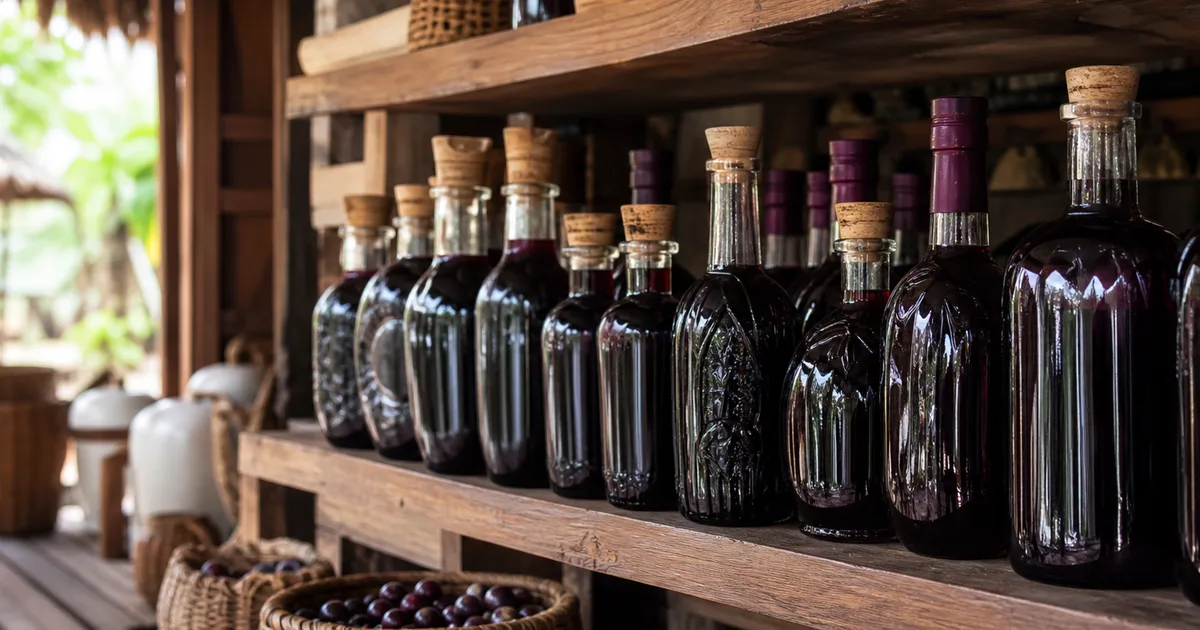
The sim berry (quả sim) is a wild myrtle-rose fruit that grows across Phu Quoc's protected forest and scrubland. Small, intensely purple-red, picked by hand between May and August. Producers ferment the crushed berries with sugar and water for 3–6 months, then bottle at 8–15% ABV depending on how much residual sugar they leave. No commercial additives, no coloring — the deep ruby color is entirely the berry.
It's sweet-leaning with a light tartness and a faint floral note. Lower-ABV batches (8–10%) taste closer to a berry cordial. The drier 13–15% versions have more going on. I'd describe most of what the outskirts shops sell as somewhere between a light fruit wine and a mulberry liqueur. Nothing sharp or harsh when it's made properly.
Sim wine is not unique to one producer — there are probably 20+ people making it across the island. What the artisan shops have that souvenir stalls don't is batch variation: the ability to taste a 2024 harvest next to a 2025 one and decide what you prefer. That's the main reason to make the short trip out of town. See also the quick sim wine overview in the Phu Quoc food guide if you want context on how it fits into island eating culture.
Where are the sim wine shops near Duong Dong?
There are two clusters worth knowing about. The first is on Cua Can road (DT45), northwest of Duong Dong centre — roughly 2.2 km by road from the Dinh Cau roundabout. This is the more productive strip: four or five producers with signs in Vietnamese and sometimes Russian, fermentation tanks visible through open doors, and a proper range of bottles. A few of them also sell Phu Quoc pepper and fish sauce from the same counter, which makes the stop efficient if you're shopping for multiple local products.
The second cluster is on the northern stretch of the Duong Dong–Ham Ninh road, around 2.8–3 km from centre. Fewer stops, but one of the producers there (a family operation I've been sending guests to since 2020 — the grandmother still hands you the glass herself) consistently makes a cleaner, drier batch around 12–13% ABV that doesn't exist in town. If you're specifically after something less sweet, that's where to go.
The souvenir market in central Duong Dong has sim wine too, but it's reseller stock — same bottles, 20–40% markup, no tasting, no batch information. Fine if you're in a hurry. Not the same experience. For more on what to do in the areas around both routes, this post on things within 5 km of Duong Dong maps out the surrounding area well.
How to get there from Duong Dong centre
By scooter from Sabrina Homestay on Nguyen Du: head north on Tran Hung Dao, then turn left onto Cua Can road. The first sim wine shops appear after about 2.2 km — look for wooden signs with "rượu sim" and the purple-labeled bottles stacked in the window. Door-to-door on a scooter: 8–10 minutes in normal traffic.
If you don't have a scooter, a Grab bike costs 30,000–50,000 VND each way from the homestay. Ask the driver to wait — most will for a short stop. Round trip by Grab: 60,000–100,000 VND total. You can also combine this run with a visit to Duong Dong morning market if you head out early enough — the market wraps around noon, the sim shops are open from around 8 AM to 6 PM. See the fish sauce factory walk post for a route that passes through the same general area and can be combined on the same morning.
One thing to know: Cua Can road gets busy around 9–11 AM with local traffic and tour scooters heading to the north of the island. If you want a calmer ride, before 8:30 AM or after 3 PM is noticeably less chaotic. Check the homestay location page for a reference point if you're orienting on a map.
Free-tasting etiquette: what actually happens
Every artisan sim wine shop I've sent guests to offers a small tasting pour — typically 10–20 ml in a small plastic cup — when you walk in. This is not a bar. It's a purchase conversation. The expectation is clear on both sides: you're there to decide which bottle to buy, they're helping you make that choice.
One pour per person is the standard courtesy. Don't ask for a second round before you've committed to something. If a shop has multiple varieties — say a lighter 9% and a drier 13% — it's perfectly reasonable to taste one of each. That's the point. Just be decisive about it. Pick up the bottles, look at them, ask questions in whatever combination of Vietnamese and gestures works. Vendors on Cua Can road have dealt with enough international visitors to have a rhythm for this.
If you genuinely don't want to buy anything after tasting, a polite "cam on" (thank you) and leaving is fine. No one will chase you. But walking into three shops, tasting at all three, and buying nothing is a bit poor form. The producers are small operations — that tasting pour costs them real berry volume at scale.
A practical note: the cups are small and the ABV is real. If you're doing this before getting back on a scooter, one taste is genuinely a taste. Don't sample four varieties on an empty stomach at 10 AM and then ride 3 km back on Tran Hung Dao.
Bottle sizes, prices & what fits carry-on
At the artisan shops 2–3 km from Duong Dong centre, sim wine comes in four standard sizes. Prices below are what I've seen guests pay at the Cua Can road producers in September 2026 — the range reflects variation between shops, not haggling.
| Bottle size | Price range (VND) | Approx. USD | Carry-on? | Notes |
|---|---|---|---|---|
| 100 ml | 40,000–65,000 | $1.60–$2.60 | ✓ Yes | Fits 100 ml airline liquids rule; good for a personal taste at home |
| 250 ml | 80,000–120,000 | $3.20–$4.80 | ✗ No | Most popular souvenir size; checked bag only |
| 500 ml | 150,000–220,000 | $6–$8.80 | ✗ No | Best value per ml; ideal for drinking during a one-week stay |
| 750 ml | 200,000–320,000 | $8–$12.80 | ✗ No | Standard wine-bottle format; buy two for a small price break at most shops |
Prices as of September 2026 at artisan producers on Cua Can road and Duong Dong–Ham Ninh road. Souvenir market prices in Duong Dong centre run roughly 20–40% higher for equivalent bottles.
The 100 ml bottle is the only one that technically fits the 100 ml per-container rule that applies to carry-on liquids on most international flights — one bottle per person. Don't buy a 250 ml and expect it through security without checking a bag; it won't happen at most airports. Some guests buy a 100 ml for the flight home and drink through a 500 ml during the week. That's a reasonable plan.
Which bottle makes sense for a one-week stay without checked luggage?
No checked bag, leaving in a week. This is the scenario I hear most often at the homestay.
Honest answer: buy a 500 ml bottle and plan to drink most of it on-island. Sim wine goes well in the evenings on the balcony, it pairs reasonably with fruit from the morning market, and a 500 ml at 10–12% ABV is comfortably a week's casual drinking for one person or a couple of evenings shared with another guest. Then you leave whatever's left, or bring the 100 ml version as your carry-on souvenir.
Buy two. I keep telling guests this and they keep buying one and then wishing they'd bought two. A second bottle for a friend at home is almost always appreciated, costs 150,000–220,000 VND, and you probably won't find it closer to home. But if both are going in carry-on, 100 ml is the ceiling per bottle under standard airline rules.
If you're checking luggage: the 750 ml is the cleanest gift format. Pack it upright, wrapped in clothing, inside a sealed plastic bag. I've had zero guests report breakage using that method — though I should note I'm basing that on what people tell me when they come back, not a guarantee. Use your judgment on bubble wrap if the bottle is particularly full.
For scooter rental options to get there and to other nearby spots, the 5 km around Duong Dong guide has practical transport notes.