Yes — Sung Hung Pagoda is worth visiting if you are already in or near Duong Dong town. Entry is completely free, the gates are open from 7:00 AM to 7:00 PM every day, and the temple sits a few minutes' walk from Phu Quoc Night Market, so it slots easily into an evening plan. Expect 30–60 quiet minutes of incense, old island history and sea views — but don't cross the island just for it.
Is Sung Hung Pagoda Worth Visiting? The Short Answer
Sung Hung Pagoda earns a cautious yes. It is generally described as the oldest pagoda on Phu Quoc, entry costs nothing, and the gates stay open 12 hours a day — 7:00 AM to 7:00 PM, every single day. On Tripadvisor it holds a 4.1/5 score from 46 reviews, and the words that keep appearing in those reviews are “peaceful” and “calm”, with several visitors singling out the splendid sea views and the panoramic look over Duong Dong from the top of the grounds.
The honest caveat, repeated by almost every reviewer: this is a “worth it if you are already nearby” attraction, not a destination you build a day around. The complex is quite large but easy to walk around, and most people spend between 30 and 60 minutes here. Because it stands on Tran Hung Dao Street — the island's main seafront road — directly opposite the Telecommunication Center and a short stroll from Phu Quoc Night Market, “already nearby” describes most visitors to Duong Dong anyway.
So the practical answer is this: if your hotel is in Duong Dong or along Long Beach, put it on the itinerary — ideally in the late afternoon, then walk to the night market for dinner. If you are staying at a resort 30–40 minutes away on the island's south or northeast coast and temples are not your thing, skip it without guilt. Phu Quoc's beaches, snorkeling and night markets are the real headliners; Sung Hung is the supporting act that costs you nothing but an hour.
Where Is Sung Hung Pagoda and How Do You Get There?
The pagoda sits at No. 7 Tran Hung Dao Street in Duong Dong Ward, the island's capital town, directly opposite the Telecommunication Center. Tran Hung Dao is the coastal boulevard that runs along Phu Quoc's western shore, so the temple is effectively one block from the sea — which is exactly where those much-mentioned sea views come from.
The location could hardly be more convenient. Phu Quoc Night Market and the little Dinh Cau sea temple at the harbor mouth are both within roughly a 5-minute walk. From Phu Quoc International Airport it is about 10–12 km into town, a 20–25 minute taxi or ride-hail trip. Most Long Beach resorts line the same Tran Hung Dao road, so many visitors simply walk or ride a scooter for a few minutes.
Getting around Duong Dong is easy: taxis and ride-hailing apps are plentiful, and renting a motorbike is the local way to move — the town is flat and the temple is easy to find just by following the seafront. Leave your bike at the gate; a small tip of around 5,000–10,000 VND (about $0.20–$0.40) to the caretaker is customary at Vietnamese temples.
Entrance Fee, Opening Hours and Practical Details
| Detail | Sung Hung Pagoda |
|---|---|
| Entrance fee | Free — listed as free on Phu Quoc's official tourism page |
| Opening hours | 7:00 AM – 7:00 PM, daily |
| Address | No. 7 Tran Hung Dao Street, Duong Dong Ward, Phu Quoc |
| Landmark | Opposite the Telecommunication Center, near Phu Quoc Night Market |
| Suggested visit length | 30–60 minutes |
| Tripadvisor rating | 4.1/5 (46 reviews) |
| Crowds | Rarely busy; visitors consistently describe the grounds as quiet |
| Dress code | Shoulders and knees covered; shoes off in the main hall |
One warning about “tickets”: you will come across pages such as Trip.com's “Sung Hung Pagoda Tickets [2026]” — that is simply how listing platforms label the attraction. Entry is genuinely free. There is no ticket booth, no turnstile and no fee at the gate, and anyone asking you to pay for admission is not official. Donations to the temple box are voluntary and always welcome.
The 7:00 AM–7:00 PM window is generous, but note that the main hall may close earlier than the outer grounds, and — as one recent visitor noted — renovation work occasionally sections off a shrine. That is normal for an active, centuries-old place of worship that is continually cared for. The upside of works, the same reviewer found, is that the grounds become even quieter.
What You'll See Inside the Pagoda Grounds
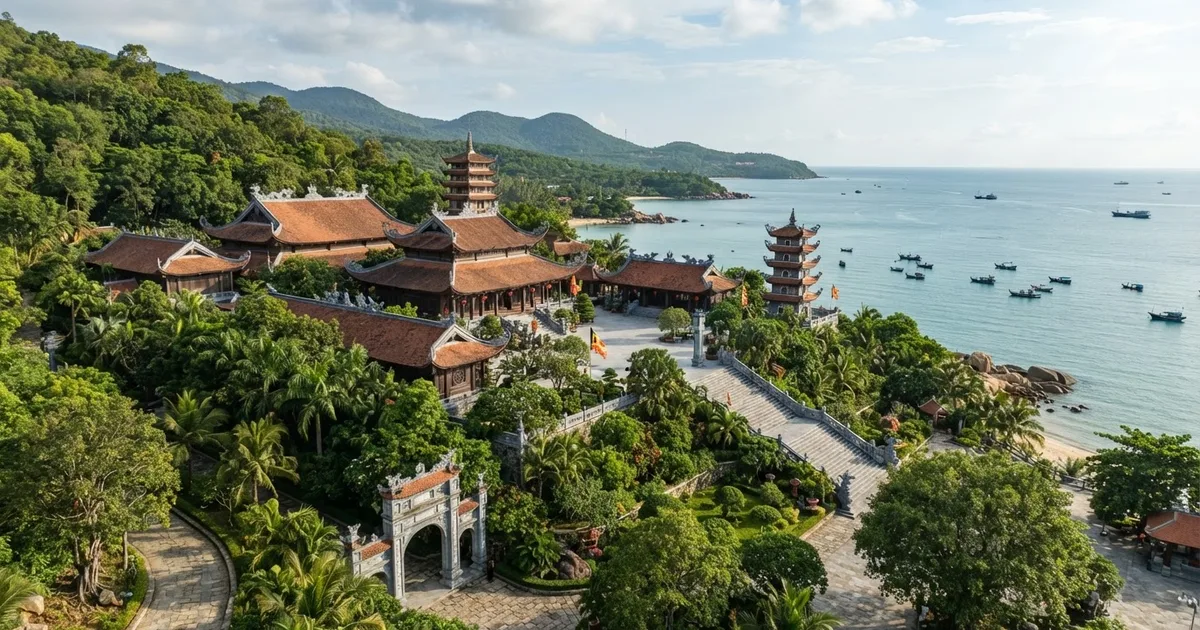
Sung Hung (often written Sung Hung Co Tu, meaning the “old” pagoda) is widely regarded as the oldest temple on Phu Quoc, with origins traced to the 19th century and several rebuilds and renovations since. It blends Mahayana Buddhist worship with the island's older folk beliefs, which is why you will see both Buddha altars and local deities honored under one roof — a very southern-Vietnam arrangement that tells you a lot about how the island was settled.
You enter through the tam quan triple gate with its curved, upturned tiled roofs and dragon ornaments, then pass into a courtyard anchored by a large incense burner that coils fragrant smoke through the grounds all day. Ceramic mosaic reliefs — the shattered-porcelain style this region is famous for — run along the walls and roof ridges, telling stories in dragons, phoenixes and flowers.
The payoff that reviewers mention most is at the top: climb the inner steps to the upper terrace for a panoramic view over the red roofs of Duong Dong, the fishing harbor and the Gulf of Thailand. Late afternoon light over the water here is superb, and it costs nothing. The complex is quite large but easy to walk around, with shaded corners, bonsai pots and frangipani trees, and a main hall where gilded statues sit behind rows of candle-lit offering tables.
Do manage expectations: this is a working neighborhood temple, modest in scale compared with the grand pagodas of Hue or Hanoi. Its charm is atmosphere — incense, chanting on festival days, locals praying quietly — rather than monumental architecture. Visitors who arrive expecting that atmosphere consistently rate it highly; those expecting a landmark attraction sometimes leave underwhelmed.
Who Will Love It — and Who Should Skip It
Perfect for culture-curious travelers
If you want to understand Phu Quoc beyond the beach, this is the island's most accessible history lesson: free entry, 30–60 minutes, and the oldest pagoda on the island a short walk from your dinner table.
Great for photographers and slow travelers
Golden-hour sea views from the upper terrace, mosaic roof details, drifting incense and grounds that are rarely crowded — reviewers call it “beautifully peaceful” for a reason.
Less suited to beach-first holidaymakers
If your ideal day is snorkeling the southern islets or lying by the pool, a small-town temple will not be the highlight of your trip. It is a pleasant hour, not a reason to reshape your day.
Less suited to landmark hunters
Calibrate expectations: this is not the scale of Bangkok's Wat Pho or Hue's imperial pagodas. It is also a poor fit if you cannot dress modestly, or if you are based far to the south or northeast and temples simply are not your thing.
Pair It With: Night Market, Dinh Cau and the Duong Dong Waterfront
The pagoda's location is its superpower. Phu Quoc Night Market — grilled seafood, pearl stalls, fresh sugarcane juice — is only a few hundred meters away, with stalls firing up around 5–6 PM. Dinh Cau, the small sea temple perched on rocks where the Duong Dong river meets the sea, is roughly 500 meters north and is the town's best sunset spot; locals consider it sacred to the whale god who protects fishermen.
A simple evening that works almost year-round: arrive at the pagoda at 4:30 PM and wander the grounds for 45 minutes; walk the seafront to Dinh Cau for sunset around 5:45 PM; then settle in at the Night Market by 6:15 PM for grilled scallops with scallion oil, sea urchin and a fresh coconut. The entire evening costs little more than your dinner — the temple and the sunset are both free.
Prefer mornings? Watch the fishing boats unload at Duong Dong harbor early, then reach the pagoda by 8:00 AM, before the heat builds. In the dry season (roughly November–April), midday temperatures regularly top 32–33°C, so the 7:00–9:00 AM window is the most comfortable time to be outdoors anywhere in town.
Sung Hung Pagoda vs Ba Pagoda: Which Phu Quoc Temple Should You Visit?
Phu Quoc's two best-known town temples get mixed up constantly, so here is the difference. Ba Pagoda, at 44 Vo Thi Sau in Duong Dong, is regarded as the island's most sacred temple for praying for peace and good fortune, and it preserves the legend of Thuy Long Thanh Mau, the Holy Mother of the Waters who protects seafarers. Its great event is the grand worship ceremony and traditional festival held on the full moon of the first lunar month (usually late January or February).
| Feature | Sung Hung Pagoda | Ba Pagoda |
|---|---|---|
| Address | No. 7 Tran Hung Dao Street | 44 Vo Thi Sau, Duong Dong |
| Known for | Oldest pagoda on the island; panoramic sea views | Sacredness; legend of Thuy Long Thanh Mau |
| Best for | Architecture, views, quiet | Blessings, festivals, local worship |
| Festival days | Busier on the 1st and 15th of each lunar month | Grand ceremony on the full moon of lunar January |
| Entry | Free | Free (donations customary at local temples) |
| Time needed | 30–60 minutes | 20–40 minutes |
Both are “worthwhile stop if you are nearby” temples — neither is a place to plan a full day around. Choose Sung Hung if you want architecture and that view over the harbor; choose Ba Pagoda if you are in town during the lunar-January full moon, when the worship ceremony and traditional festivals are genuinely spectacular. With an hour to spare in Duong Dong, you can realistically do both — they are only a few minutes apart by scooter.
Temple Etiquette: What to Wear and How to Behave
Sung Hung is a living temple, not a museum — you will almost always share it with people who have come to pray. The rules are simple and applying them takes no effort:
- Cover your shoulders and knees — a T-shirt and long shorts, a maxi dress or a light scarf over a tank top all work in the heat
- Remove your shoes before stepping into the main hall
- Keep your voice low and your phone on silent
- Never point your feet at altars or Buddha statues while sitting
- Do not touch or climb on statues, altars or offering tables
- Ask before photographing worshippers up close; the grounds themselves are fine to photograph
- If you offer incense, three sticks held in both hands is the customary gesture — place them in the large courtyard burner
- A donation in the temple box is optional; small notes are appreciated
- Apply the same dress code at Dinh Cau and Ba Pagoda, which are equally active places of worship
The Best Time of Day (and Year) to Visit
Within the day, two windows stand out. Early morning, 7:00–9:00 AM, is the coolest and quietest, with soft light and a chance of hearing morning chanting. Late afternoon, roughly 4:30–6:30 PM, delivers the best views over the water and the easiest link to the Night Market. Midday is the weakest slot: the courtyard is partly open to the sun and dry-season highs reach 32–34°C.
On the lunar calendar, the 1st and 15th of each lunar month bring local worshippers in greater numbers. The grounds get busier, but the extra incense, offerings and activity make it arguably the most atmospheric time to visit — just be extra mindful with photos. Renovation work, as one reviewer experienced, can occasionally drape a shrine in scaffolding; it also tends to make an already quiet temple quieter still.
Season-wise, the dry months from November to April are ideal. During the rainy season (roughly May–October), short, heavy afternoon downpours are common — shift your visit to the morning, when skies are usually clear. The temple's tiled roofs and stone courtyards dry quickly, and after rain the mosaic details gleam.
Frequently Asked Questions
Is Sung Hung Pagoda free to enter?
Yes. Phu Quoc's official tourism page lists Sung Hung Pagoda as free to enter, and there is no ticket booth at No. 7 Tran Hung Dao Street. Pages like Trip.com's “Sung Hung Pagoda Tickets [2026]” are just listing formats — no payment is needed or expected. Donations to the temple box are voluntary, so budget exactly $0 for admission.
What are the opening hours of Sung Hung Pagoda?
The pagoda is open from 7:00 AM to 7:00 PM daily, every day of the week — a 12-hour window that makes it easy to fit in before breakfast or before dinner. The main hall may close earlier than the outer grounds, and occasional renovation work can section off a shrine, but the complex itself stays accessible all day.
How much time should I plan for a visit?
Between 30 and 60 minutes. The complex is quite large but easy to walk around, and most visitors spend around 45 minutes covering the triple gate, the incense courtyard, the main hall and the upper terrace with its panoramic sea view. That makes it easy to pair with the Night Market the same evening.
How far is Sung Hung Pagoda from Phu Quoc Night Market?
A few hundred meters — about a 5-minute walk. The pagoda stands at No. 7 Tran Hung Dao Street, opposite the Telecommunication Center, and both the Night Market and the Dinh Cau sea temple lie within roughly 500 meters along the same seafront road, so the three spots combine naturally into one evening.
What should I wear to the pagoda?
Cover your shoulders and knees, as at any Vietnamese temple. Lightweight long trousers, a maxi dress, or a T-shirt with a light scarf over a tank top all work in the heat. You will also remove your shoes before entering the main hall, so slip-on footwear makes the visit easier.
Is Sung Hung the oldest pagoda on Phu Quoc?
It is generally described as the island's oldest, with origins traced to the 19th century and several renovations since — which also explains the occasional restoration work visitors notice. Its long local role shows in the mix of Buddhist and folk altars. For comparison, Ba Pagoda on Vo Thi Sau is considered the island's most sacred, hosting the big lunar-January festival.
Is it worth visiting with children?
Usually yes — admission is free, the grounds are quiet and traffic-free, and 30–45 minutes is short enough to hold most kids' attention. The climb to the viewing terrace and the giant smoking incense burner are the memorable moments. Keep voices low in the main hall and hold small children near the burners and candles.
Staying on Phu Quoc? Sabrina Rental is based right in Duong Dong — grab a well-maintained scooter for the seafront ride to Sung Hung Pagoda, or ask us for a local's evening itinerary covering the Night Market, Dinh Cau and the island's best sunset spots. Message us any time and we'll set you up.
Contact Sabrina Rental