The Khai Hoan fish sauce factory sits about 1.8 km east of central Duong Dong — a flat, easy walk that most guests never think to do, and that almost everyone who does comes back raving about. Free tour, no booking needed, and the barrel room smells exactly as intense as you are imagining. This is my honest rundown of the route, what to expect inside, and whether the gift-shop prices are actually worth it.
East of central Duong Dong. Flat road, footpath most of the way.
Each way. Add 20–30 min for the tour itself.
No entrance fee. Gift shop at the end — you decide what to buy.
Gift shop range. Highest grade: thuong hang, 30°N+.
Why Walk Instead of Just Buying at the Market?
Honestly? Because seeing it once changes the way you understand the bottle. I've had guests come back to the homestay after visiting Khai Hoan who have never thought twice about fish sauce in their lives — and now they're asking me which grade to cook with and whether they can bring two bottles in their carry-on. Something about standing next to a barrel the size of a small car, watching dark amber liquid drip slowly out of a wooden tap, makes the whole thing click.
Also: the walk itself is good. The 1.8 km route runs east along Nguyen Van Cu, through a part of Duong Dong that most tourists skip entirely. You pass a row of small hardware shops, a woman who sells really good banh mi from a cart outside her house around 7 AM (I have bought from her more times than I can count), and eventually the road quiets down and you start to smell the factory before you see it. That smell — salt, anchovy, wood, fermentation — is distinctive and not unpleasant once you get used to it.
For context on this part of town, see my Duong Dong town map for guests — Khai Hoan is marked on it.
How Do You Walk to Khai Hoan from Duong Dong Town Centre?
From the homestay on Nguyen Du, head north to Tran Hung Dao, turn right (east), and follow it until it becomes Nguyen Van Cu. The factory sits on the right side of the road, around 1.8 km from the town centre. The whole route is flat — no hills, no awkward junctions. You'll reach it in about 22–25 minutes at a normal pace.
A few things to note en route: the footpath disappears briefly in one section near a construction site, so step onto the road edge there and back up. Traffic on Nguyen Van Cu is light. There is almost no shade for the last 600 metres, which matters if you're going at noon. My standard advice is to leave before 9 AM or after 4 PM.
If the heat puts you off the walk, a xe om (motorbike taxi) from the homestay area runs 30,000–50,000 VND each way and takes about 5 minutes. But honestly — walk it once. You see a different Duong Dong. See also the broader what to do within 5 km of Duong Dong guide if you want to extend the morning.
What Happens on the Free Tour Inside?
There is no entrance fee. You walk in through the main gate, and someone from the factory — usually one of the regular staff rather than a dedicated guide — takes you through the process. The tour runs about 20–30 minutes.
Khai Hoan is typically open for visits during daytime hours. The exact schedule can shift slightly depending on production or the season, so I always tell guests: if the gate is open, the tour is on. Check on arrival. I have never heard of anyone turning up during normal daytime hours and being turned away, but I'm not going to promise specific times here because they do occasionally adjust.
The tour covers three things: the raw ingredient storage (the dried ca com anchovies are stacked in bags that look almost decorative), the fermentation barrel room (this is the main event — more on that below), and a brief explanation of how the first-press versus second-press grades differ. The staff speak Vietnamese and basic English; there are some printed panels in English if you want to read ahead while they explain in Vietnamese.
No need to book anything. Groups of up to around 15 people can move comfortably through the barrel room at once. If a large tour group is already inside, it's worth waiting 10 minutes until they clear — the space is more interesting with fewer people in it.
What Are the Wooden Fermentation Barrels Actually Like?
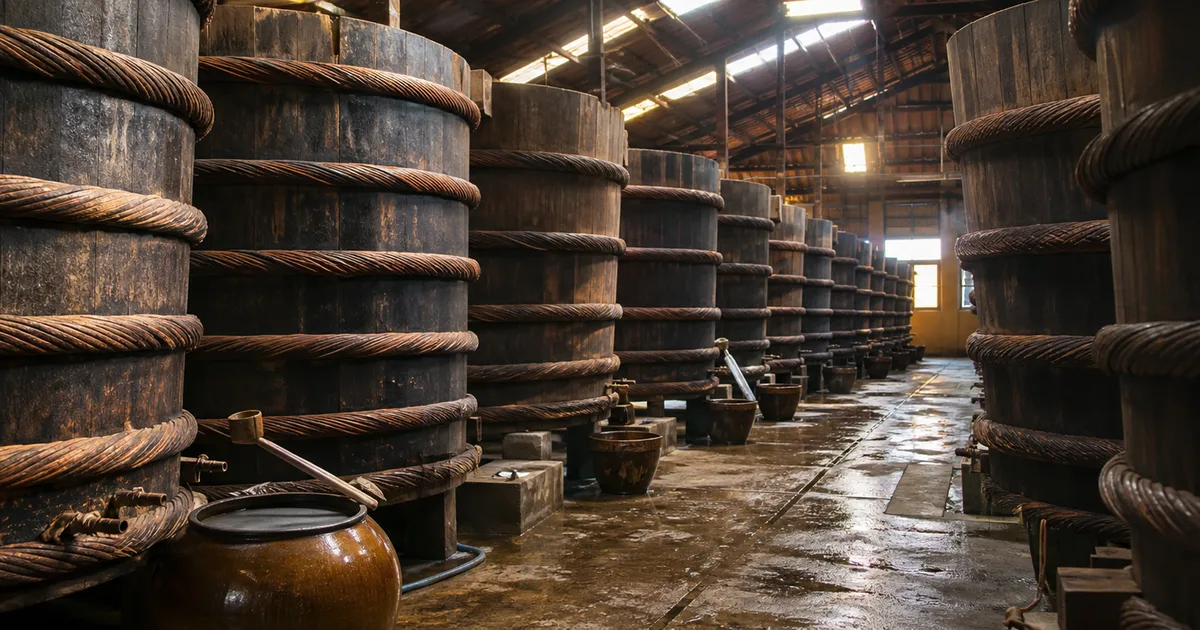
Bigger than you expect. The largest barrels at Khai Hoan hold several tonnes of anchovy and salt — they stand about 2.5 metres high and are wide enough that you cannot reach both sides with your arms outstretched. They are made from a traditional Vietnamese hardwood that has soaked up brine for decades. The wood has turned almost black in places. Some have metal hooping; others are held by thick rope that is tightened by hand each season.
The smell is the thing. It is not the thin, sharp smell of cheap fish sauce from a supermarket bottle. It is deeper than that — earthy, marine, fermented — and it fills the whole room. After a minute or two you stop noticing it, and then when you walk back outside it hits you again.
A guide will often open a small tap near the base of one of the barrels so you can watch the raw sauce flow. The colour is a dark copper-amber, almost like strong tea. That liquid, after filtering and grading, becomes what you pour over your pho at the restaurant around the corner. Seeing the source of it is a real shift in perspective.
If you have someone with you who is interested in photography: the barrel room has high windows that let in raking light in the late afternoon, and the scale of the wooden vats photographs really well. Worth a few minutes with the camera before the gift shop.
Is the Gift Shop Worth Buying From?
This is the question I get most often. Short answer: yes, for the high-grade bottles. Not necessarily for the standard ones.
The factory gift shop stocks the full Khai Hoan range — from everyday cooking-grade bottles to the labelled premium grades. The main thing you are paying for at the high end is protein content: the thuong hang (special grade) bottles carry 30 degrees N or above, meaning the liquid is denser, richer, and far more complex than anything you will find at a tourist souvenir stall. If you are buying something to cook with or to give as a genuine gift, buy this grade. The flavour difference versus the cheap stuff is not subtle.
On price: the factory shop runs roughly 40,000–120,000 VND per bottle depending on grade and size. A 500 ml bottle of thuong hang typically sits around 80,000–100,000 VND. You can sometimes find the same range slightly cheaper at Duong Dong market stalls, but you are also more likely to pick up something that is labelled 'Phu Quoc' but not actually from a certified producer. At the factory, you know exactly what you have.
Buy two. They travel fine in checked luggage wrapped in a few t-shirts, and you will wish you had more once you are home and the first bottle is gone. See also Phu Quoc food guide for more context on how nuoc mam fits into the island's cooking.
Factory Shop vs Duong Dong Market — Price Comparison
| Product | Factory Gift Shop (VND) | Duong Dong Market (VND) | Notes |
|---|---|---|---|
| Standard grade, 500 ml | 40,000–55,000 | 30,000–50,000 | Market slightly cheaper; authenticity varies |
| Mid-grade, 500 ml | 60,000–80,000 | 55,000–75,000 | Comparable; check the protein-content label |
| Thuong hang (special grade), 500 ml | 80,000–100,000 | 80,000–120,000 | Factory = guaranteed authentic; market = check carefully |
| Gift set (2–3 bottles, box) | 150,000–250,000 | 130,000–230,000 | Factory sets have branded packaging |
| Small souvenir bottle, 100 ml | 25,000–35,000 | 20,000–35,000 | Good for carry-on; same price range |
Prices reflect September 2026 rates. Ask staff to confirm current pricing before purchasing.
The gap between factory and market prices is small — usually 5,000–15,000 VND per bottle at most. The real difference is certainty. The Phu Quoc Protected Designation of Origin (PDO) covers nuoc mam from certified local producers including Khai Hoan, so buying direct gives you a clean audit trail on what's in the bottle.
Practical Tips Before You Go
A few things that save people time or discomfort:
Footwear. The factory floor can be damp in places. Closed shoes or solid sandals — not flip-flops you mind getting slightly wet. The wooden platforms between barrels are stable but not slippery if you're not in socks.
Smell on clothes. The fermentation room is pungent. Your clothes will carry a faint fish-sauce smell for a couple of hours after. Not strong, but noticeable. Worth keeping in mind if you have lunch plans immediately after.
Bags for bottles. The gift shop provides plastic bags, but they are thin. If you're buying more than two bottles, bring a tote bag from the homestay — I keep a few at the front desk exactly for this reason.
Combine with the morning market. The walk to Khai Hoan heads east, while the morning market is more central. Two options: do the market first (open from 5 AM, best before 8 AM), then continue east to the factory — the whole circuit is around 3.5 km and makes an excellent morning. Or reverse it if you want the factory cool and quiet before the market crowds build. See the Duong Dong morning market walk post for the market route detail. Our homestay location page has a map showing the relative positions of both.
Carrying liquids on flights. 100 ml bottles go in carry-on; larger ones need to be checked. The factory staff know this question well — they stock small formats specifically for travellers who only have hand luggage.
If you want to stay close enough to walk all of this easily, the homestay is 1.8 km from Khai Hoan and about 600 metres from the morning market. Most guests combine the factory walk with either the market or the Dinh Cau sunset walk on the same day — and that makes for a full, genuinely satisfying morning-to-evening in Duong Dong without a motorbike or taxi.
Any questions before you head out — just ask at the front desk. I have walked this route probably 40 times in the last few years and I am happy to adjust the route based on where you are going afterwards.