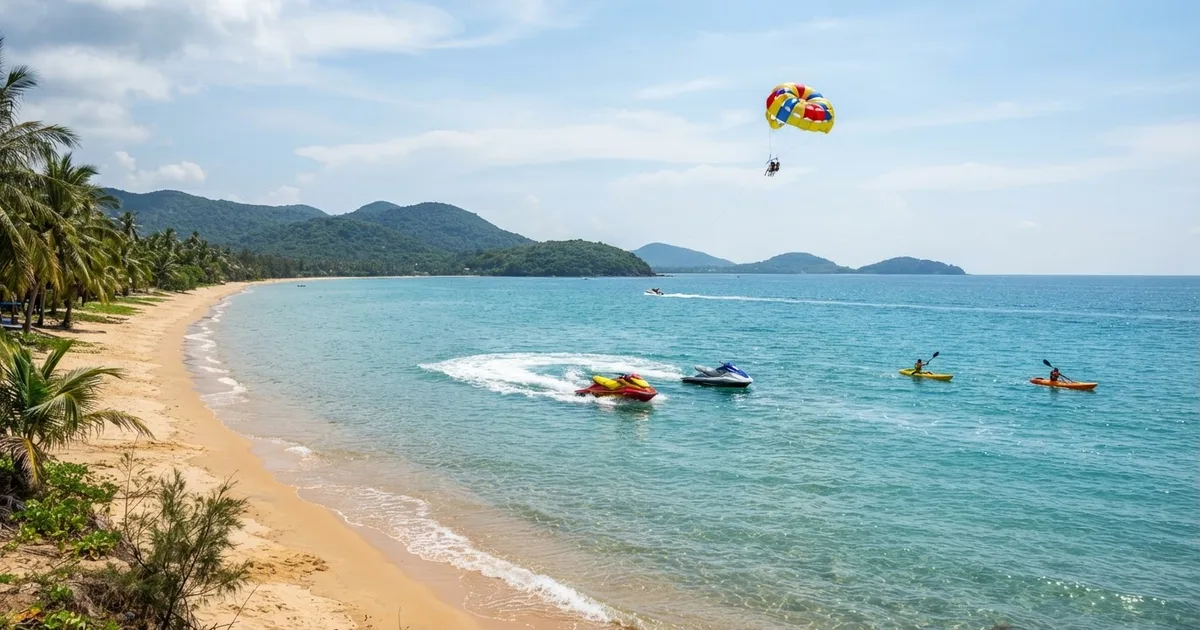
Phu Quoc's three headline water sports are jet skiing (from about $25 for 15 minutes), kayaking (from $10 per hour) and parasailing (from $35 per flight), and booking platforms currently list 674 water sports activities for the island in 2026. The south of Phu Quoc — the An Thoi archipelago and Sao Beach — is the single best area for all three, and the November-to-April dry season, peaking December to March, is when conditions and availability are at their best. Budget roughly $90–110 per person for a half-day combination of all three.
What Water Sports Can You Actually Do in Phu Quoc?
Phu Quoc is not a one-trick island. The 2026 activity inventory runs from ten-minute motorised blasts to slow, self-powered paddles through sheltered bays, and almost all of it is concentrated on the west and south coasts where the sea stays calmest. MakeMyTrip alone lists 674 water sports activities in Phu Quoc for 2026, with entry-level experiences starting from around INR 673 — roughly VND 200,000, or $8.
In practice you can group everything into two price tiers. Gentler, human-powered activities such as kayaking and stand-up paddleboarding (SUP) run about VND 200,000 per hour. Motorised thrills — jet ski and parasailing, plus the banana boats that are usually thrown in as a group add-on — run about VND 500,000 to 1,300,000, or roughly $20 to $50 per person depending on duration and season.
| Activity | Typical starting price | Typical duration | Where it runs on Phu Quoc |
|---|---|---|---|
| Jet ski | From $25–$35 | 10–15 minutes | Long Beach, Bai Dai, Sao Beach, An Thoi islands |
| Kayak | From $10 (~VND 200,000) | 1 hour | An Thoi archipelago, Cua Can river, Ong Lang, Sao Beach |
| Stand-up paddleboard (SUP) | ~VND 200,000 | 1 hour | Calm bays at Ong Lang, Cua Can, An Thoi |
| Parasailing | From $35 | 10–15 minutes in the air | Sao Beach, An Thoi archipelago, Long Beach |
| Banana boat | Per person, similar to kayak rates | 10–15 minutes | Sao Beach, An Thoi |
Who this is a poor fit for: if you want long, unbroken stretches of empty water, Phu Quoc's motorised sports zones at Sao Beach and the An Thoi islands get busy and noisy between December and March. Travellers who want a completely silent beach should head to the north-west coast instead and skip the jet ski strips entirely.
Jet Skiing in Phu Quoc: Prices, Locations and the Rules
Yes — jet ski rides are available in Phu Quoc, including at Long Beach, Bai Dai, Sao Beach and around the An Thoi islands. A jet ski typically carries up to 2 people, so the per-person cost roughly halves if you ride as a pair. You do not need a licence to ride within designated beach zones on Phu Quoc, but the operator will fit you with a heavy-duty life jacket and it must stay on for the whole session.
Pricing is tiered by time rather than by distance. Expect the shorter sessions to feel genuinely short: ten minutes on the water passes quickly, and most first-timers end up wishing they had booked the 30-minute slot.
| Session length | Typical price band | Notes |
|---|---|---|
| 10 minutes | $30.40–$34.30 | Taster ride; usually just enough for one lap of the bay |
| 15 minutes | $38.10–$45.70 | Most popular option; budget vendors advertise from $25 |
| 30 minutes | $68.50–$76.10 | Best value per minute if you want real time on the machine |
Where you ride matters more than you might expect. Long Beach (Bai Truong) is the closest strip to Duong Dong and the easiest to reach on foot or by a short ride. Bai Dai in the north-west is wide, shallow and less crowded but requires your own transport. Sao Beach and the An Thoi archipelago in the south offer the most picturesque water, though the far-south operators cluster tightly around the main access points.
A good fit for
- Couples and friends who want a shared 15-minute adrenaline hit for under $25 each
- First-time riders — no licence, no experience and no briefing course required
- Families with teenagers, as long as riders meet the operator's age and weight minimums
Less suited to
- Pregnant travellers, and anyone with back, neck or heart conditions
- Travellers wanting quiet, nature-first water time — kayaking is the better match
- Very small children, who are usually not permitted to ride regardless of the two-person capacity
Kayaking and SUP: Phu Quoc's Best Value Water Sport
At roughly VND 200,000 ($10) per hour, kayaking is the cheapest way to get onto the water and the easiest activity to do without booking ahead. Sit-on-top kayaks are standard, they need no skill to balance, and rental desks operate directly on the beach at Sao Beach, Ong Lang, Cua Can and around the An Thoi archipelago. Stand-up paddleboards rent at similar rates and suit the same calm, shallow bays.
The An Thoi archipelago is the standout area. The scattering of small islands south of Phu Quoc's main landmass creates sheltered channels, and because Rooty Trip rates An Thoi as the best overall area for a balanced water-sports mix, you can paddle in the morning and parasail in the afternoon without moving base. The Cua Can river on the west coast is the other classic: a slow, mangrove-lined paddle away from the open sea, which makes it the most reliable kayak option during the wet season from May to October.
- Go early or late. Morning or late afternoon gives the calmest sea and the best light — both matter far more for kayaking photos than for jet skiing.
- Check the tide. Shallow flats around An Thoi and Ong Lang can expose coral and rock at low tide; ask the rental desk which direction to paddle.
- Take a dry bag. Very few beach rental desks provide one, and splashes are guaranteed.
- Wear reef-safe sunscreen. You will be sitting on top of the water, not in it, and the sun reflects hard off the surface.
- Agree the return time. Hourly rentals are timed from the beach, not from the moment you float.
If you want a full half-day on the water at a low cost, a one-hour kayak plus a short SUP session will still come in under $25 per person — a fraction of what a single parasail flight costs.
Parasailing in Phu Quoc: What $35 Buys You
Parasailing starts from $35 per flight in Phu Quoc, and the operation is simpler than most people expect. You are strapped into a harness on the back of a boat, the canopy fills, and you are winched up to somewhere between 30 and 50 metres above the water. The flight itself lasts around 10 to 15 minutes in the air; the whole trip including the boat transfer and safety briefing usually runs 30 to 45 minutes.
Sao Beach is the most accessible hub for parasailing in Phu Quoc, and it is also where you will find jet ski and banana boat rides operating side by side — which makes it the single most efficient beach if you want to tick off several activities in one afternoon. The An Thoi archipelago, further south, offers the best beach-game cluster on the island and a more dramatic backdrop of scattered islands. Long Beach is the convenient option if you are staying in Duong Dong and do not want to travel.
Practical points before you book: ask for the combined weight limit before paying — operators set their own caps and will refuse a flight on the day if you exceed it. Tandem flights are common and often discounted per person. Anyone under about 12 years old generally needs to fly with an adult, and parasailing, like jet skiing, is suspended on rough days during the wet season.
Best Time of Year for Phu Quoc Water Sports
The dry season from November to April is the ideal window for water sports in Phu Quoc. Seas flatten, visibility improves and every operator on the island is running — which is exactly why December through March is peak season, and why prices and queues at Sao Beach and the An Thoi islands peak with it.
From May to October the wet season arrives. This does not shut down the island's water sports, but it does make the motorised ones unreliable: jet skiing and parasailing may be suspended on rough days, sometimes with only a few hours' notice. Kayaking and SUP survive the wet season far better, particularly in sheltered areas like the Cua Can river and the lee of the An Thoi islands.
| Period | Conditions | What runs reliably |
|---|---|---|
| November–April | Dry season, calm seas, clear water | Everything: jet ski, parasailing, kayak, SUP, banana boat |
| December–March | Peak season, busiest, warmest water | Everything — but book ahead and expect queues at Sao Beach |
| May–July | Onset of the wet season, mixed days | Kayaking and SUP fine; motorised sports weather-dependent |
| August–October | Wettest and roughest seas | Jet ski and parasailing often suspended; kayak only in sheltered bays |
Whatever the month, time your session for the morning or late afternoon. Rooty Trip recommends both windows for calm seas and the best light, and the practical benefit is real: mid-morning and mid-afternoon bring the strongest glare, the busiest beaches and, in the wet season, the highest chance of an afternoon squall rolling in off the Gulf of Thailand.
Which Area of Phu Quoc Is Best for Water Sports?
For a balanced mix of jet ski, kayak and parasailing in one place, the An Thoi archipelago in the south is the best overall area on the island. It combines sheltered paddling water, the densest cluster of beach games, and boat access to the small islands. Sao Beach is the accessible alternative — it is a genuine activity hub for parasailing, jet ski and banana boat rides, with everything bookable on the sand rather than from a marina.
An Thoi archipelago (south)
- Best for: the widest choice in one area, island scenery, combining kayak and parasail in a single day
- Travel time: roughly 30 km and 45–60 minutes from Duong Dong
- Poor fit for: travellers prone to seasickness — most activities here involve a boat transfer
Sao Beach (south-east)
- Best for: walk-up bookings, parasailing, jet ski and banana boats side by side
- Travel time: about 25 km from Duong Dong, 40–50 minutes by scooter or taxi
- Poor fit for: anyone wanting a quiet beach day in peak season — it is the busiest activity beach on the island
Long Beach / Bai Truong (west)
- Best for: convenience if you are staying in Duong Dong — jet ski operators work the beach directly
- Travel time: walkable or a few minutes' ride from most central hotels
- Poor fit for: kayaking and SUP, where the open west-facing swell and boat traffic make the southern bays far better
Bai Dai (north-west)
- Best for: jet skiing on a wide, less crowded beach with shallow water
- Travel time: around 30 km north of Duong Dong
- Poor fit for: travellers without their own transport or a booked transfer — there is little walk-up rental infrastructure
Budget, Safety and Booking Practicalities
Phu Quoc water sports are cheap by international standards, and the pricing is transparent enough that you can plan a full day on the water without a tour package. The one thing to watch is that most beach operators quote in cash, in US dollars or Vietnamese dong, and card payment is uncommon outside the larger resort-run operations.
| Item | Typical cost | Notes |
|---|---|---|
| Kayak or SUP, 1 hour | ~VND 200,000 ($8–10) | Pay on the beach; life jacket included |
| Jet ski, 15 minutes | $25–$45 | Price covers the machine, up to 2 riders |
| Parasail flight | From $35 per flight | Includes boat transfer and briefing |
| Half-day combo (jet ski + kayak + parasail) | ~$90–110 per person | Illustrative; build it yourself rather than buying a packaged tour |
On safety, the rules are simple and enforced. A heavy-duty life jacket is required at all times on a jet ski, no licence is needed inside designated beach zones, and riders must follow the operator's boundaries and speed instructions. Jet ski and parasailing operators suspend service on rough days — that is a safety decision, not a scam, and it is the main reason to build flexibility into your itinerary during the May-to-October wet season.
Two habits prevent almost every problem. First, confirm whether the quoted price is per machine or per person before you hand over cash — jet ski rates are per machine, while parasailing is usually per flight or per person. Second, check the condition of the life jacket and the kill-cord before you leave the beach. Reputable operators on Phu Quoc do this without being asked; on a busy peak-season afternoon, some do not.
Frequently Asked Questions
How much does jet skiing cost in Phu Quoc?
Jet ski rides are priced by duration: roughly $30.40–$34.30 for 10 minutes, $38.10–$45.70 for 15 minutes and $68.50–$76.10 for 30 minutes. Some beach vendors advertise entry-level rates from $25 for 15 minutes. Each jet ski carries up to 2 people, so a pair riding together pays roughly half each.
Do I need a licence to ride a jet ski in Phu Quoc?
No. Tourists do not need a licence to ride within designated beach zones in Phu Quoc. You will be given a short briefing, a heavy-duty life jacket must be worn at all times, and you must stay inside the operating area the rental operator sets. The same applies to parasailing — no certification or experience is required.
What is the cheapest water sport in Phu Quoc?
Kayaking and stand-up paddleboarding are the cheapest options, at around VND 200,000 ($8–10) per hour, with the equipment and a life jacket included. Booking platforms list Phu Quoc water sports activities from roughly INR 673. A one-hour kayak session costs a fraction of a single parasail flight at $35.
Where is the best place to go parasailing in Phu Quoc?
Sao Beach is the most accessible hub for parasailing and also hosts jet ski and banana boat rides, making it easy to combine activities in one afternoon. The An Thoi archipelago in the south offers the best overall cluster of beach games and more dramatic island scenery. Flights start from $35 and last about 10–15 minutes in the air.
What is the best time of year for water sports in Phu Quoc?
The dry season from November to April is ideal, with December through March the peak months. Seas are calm, water clarity is at its best and every operator is running. From May to October, jet skiing and parasailing may be suspended on rough days, while kayaking and SUP remain viable in sheltered bays.
Can beginners kayak in Phu Quoc?
Yes. Rentals use stable sit-on-top kayaks that require no prior experience, and the sheltered channels of the An Thoi archipelago, the calm bay at Ong Lang and the mangrove-lined Cua Can river are all beginner-friendly. An hour's rental costs about VND 200,000. Ask the rental desk which direction to paddle at low tide, when shallow flats can expose rock and coral.
Is a full day of Phu Quoc water sports expensive?
Not by international standards. Building your own combination of a one-hour kayak (about $10), a 15-minute jet ski shared between two (roughly $19–23 each) and a parasail flight (from $35) comes to roughly $65–70 per person. Packaged half-day combos with transfers typically run $90–110 per person.
What happens to water sports during the Phu Quoc wet season?
From May to October, jet skiing and parasailing can be suspended when the sea is rough, sometimes at short notice. Kayaking and SUP stay workable in sheltered spots such as the Cua Can river and the lee of the An Thoi islands. Plan water sports for the morning or late afternoon, when seas are calmest and the light is best.
Planning your days on the water? Sabrina Rental is based on Phu Quoc and can sort out your scooter, your room and your boat trips, and point you to the operators actually running on the day you arrive — no guesswork, no wasted mornings.
Ask Sabrina about water sports on Phu Quoc