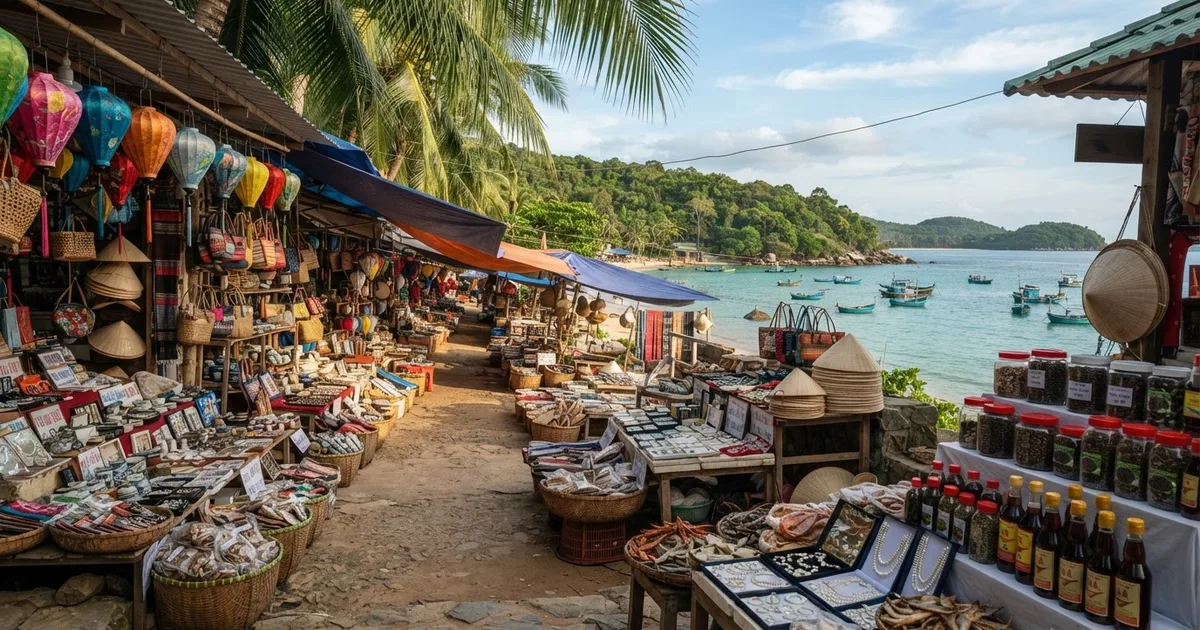
The three souvenirs Phu Quoc is genuinely famous for are pepper, pearls and fish sauce, and all three cost far less here than they do at home. Expect to pay roughly $3-6 for a 500 ml bottle of authentic Phu Quoc fish sauce, $2-4 for 100 g of black pepper, $3-6 for a bottle of local sim wine and from $20 for a cultured pearl strand. Buy food items at Duong Dong Market (open daily 5:00 AM-7:00 PM) or straight from a producer, and buy gifts at Dinh Cau Night Market (5:00-11:00 PM).
What Is Phu Quoc Famous For Buying? The Pepper, Pearl and Fish Sauce Trio
Phu Quoc has three products that carry real local identity, and they are the ones worth making room for in your suitcase. Fish sauce has been produced on the island for roughly 200 years, and Phu Quoc fish sauce was granted protected geographical indication status by the European Union in 2012 - the first Vietnamese product to receive it. The island's pepper farms, concentrated in the centre and north, grow a peppercorn with a sharper, more floral bite than the mass-market product. And pearls - cultured, not wild - are farmed in the calm waters off the east and south coasts.
Price is the reason to buy here rather than at home. A 500 ml bottle of genuine Phu Quoc fish sauce sells for around $3-6 at the producer or at Duong Dong Market; the same bottle re-exported to Europe or North America often costs three to four times that. Pepper runs $2-4 per 100 g. Sim wine, a sweet deep-red wine made from the island's rose myrtle berries, costs $3-6 per bottle and is almost impossible to find outside Vietnam.
Beyond the trio, the most commonly recommended souvenirs are dried seafood (shrimp, fish and squid), fruit jams, and the local sweets bánh khéo and bánh tét mật cật - sticky rice cakes filled with palm sugar and mung bean. None of these cost more than a few dollars, and all of them travel well if packed properly.
| Souvenir | Typical price (USD) | Best place to buy | Watch out for |
|---|---|---|---|
| Phu Quoc fish sauce, 500 ml | $3-6 | Producer factory or Duong Dong Market | Unlabelled refills sold in plain plastic bottles |
| Black pepper, 100 g | $2-4 | Pepper farm, night market | Blends cut with cheaper imported pepper |
| Sim wine, 750 ml | $3-6 | Night market, King Kong Mart | Very sweet; roughly 15-18% ABV |
| Dried shrimp, 500 g | $8-15 | Duong Dong Market, Ham Ninh | Ammonia smell means old stock |
| Dried squid, 500 g | $10-18 | Duong Dong Market | Ask for vacuum packing before you fly |
| Cultured pearl strand | $20-150 | Pearl farm showroom | No certificate of origin means walk away |
| Fruit jam or bánh khéo box | $1.50-4 | Night market, bakery stalls | Short shelf life; check the date |
Phu Quoc Markets: Opening Hours, Addresses and What to Buy at Each
Phu Quoc's shopping is spread across a handful of markets, and each one suits a different job. Dinh Cau Night Market is the tourist-facing one: Vo Thi Sau Street in Duong Dong town, open daily from 5:00 PM to 11:00 PM, with the widest variety of souvenirs and the best atmosphere. It is also the most expensive and the most crowded, so it is a poor fit if you dislike being approached by vendors every few metres or if you want a quiet, unhurried browse.
Phu Quoc Night Market on Tran Hung Dao Street also opens at 5:00 PM, but most vendors do not fully operate until around 6:00 PM - arriving at 5:00 PM means half the stalls are still under tarpaulins. Duong Dong Market is the working local market: open 5:00 AM to 7:00 PM daily, it is where you buy fish sauce by the crate, dried seafood by weight and pepper by the kilo. The best time to buy fresh seafood there is 6:00-9:00 AM or 3:00-5:00 PM, when the boats have just come in.
Two smaller options are worth knowing. Bach Dang Night Market sits at the intersection of Bach Dang Street and 30/4 Street in Duong Dong Town - smaller, cheaper and noticeably less touristy than Dinh Cau. Ham Ninh Market, on the east coast near the fishing village, is listed as open 24 hours every day, which makes it the only place on the island where you can shop for dried seafood at 2:00 AM. Ham Ninh is also where the crab and dried-shrimp trade is concentrated, so prices for bulk dried seafood are often the lowest on the island.
For everyday convenience, King Kong Mart at 141A Đường Trần Hưng Đạo is open 08:00-23:00 and stocks packaged fish sauce, pepper, sim wine and snacks at fixed prices - useful if you are short on time, bad at haggling, or shopping at 10:00 PM after the food stalls have packed up.
| Market | Location | Hours | Best for |
|---|---|---|---|
| Dinh Cau Night Market | Vo Thi Sau Street, Duong Dong | 5:00 PM-11:00 PM daily | Souvenir variety, atmosphere, pearls, gifts |
| Phu Quoc Night Market | Tran Hung Dao Street, Duong Dong | Opens 5:00 PM; fully running from 6:00 PM | Street food plus small souvenirs |
| Duong Dong Market | Duong Dong town centre | 5:00 AM-7:00 PM daily | Fish sauce, pepper, dried seafood, fresh catch |
| Bach Dang Night Market | Bach Dang St and 30/4 St intersection | Evening | Cheaper gifts, local crowd, less pressure |
| Ham Ninh Market | Ham Ninh fishing village, east coast | 24 hours daily | Bulk dried shrimp, crab, late-night shopping |
| King Kong Mart | 141A Đường Trần Hưng Đạo | 08:00-23:00 daily | Fixed-price packaged souvenirs, convenience |
Timing tip: if you only have one evening for shopping, start at Duong Dong Market between 3:00 PM and 5:00 PM for food items, then walk or ride the short distance to Dinh Cau Night Market as it opens at 5:00 PM. You get the local prices first and the souvenir selection second, all in one loop.
Fish Sauce and Pepper: Why Buying Direct From the Producer Beats the Gift Shop
Buying fish sauce and pepper directly from a producer gives you fresher stock and often a better price than hotel gift shops or airport kiosks. The difference is not trivial: a bottle bought at a factory gate typically costs $3-6 for 500 ml, while the same volume in a resort lobby shop can be double that, and airport pricing is higher again. More importantly, producer-direct stock has not been sitting in a display window under tropical light for months.
Phu Quoc fish sauce is made by layering anchovies with salt in wooden vats and letting them ferment for 12 months or more. The first pressing, called nước mắm nhĩ, is the clearest and most expensive grade, with a protein content usually stated as 40-43 degrees on the label. Cheaper bottles are second or third pressings diluted with brine. If a bottle does not state a protein degree or a producer name, it is not a bottle worth carrying home.
Pepper is simpler to judge. Good Phu Quoc peppercorns are uniform in size, heavy for their volume, and smell sharp when you crush one between your fingers. Black pepper is the most common, white pepper is milder and more expensive, and red pepper is the least common. Prices hover around $2-4 per 100 g, with farm-gate sales sometimes offering 250 g or 500 g bags at a discount. If you are buying several kilos as gifts, ask the farm to vacuum-seal it - humidity is the enemy of pepper, and Phu Quoc's is brutal.
Both products are also the two most commonly counterfeited. Look for a label with a producer name and address, and for fish sauce specifically, the PGI marking that confirms it was actually made on the island rather than blended elsewhere in Vietnam and bottled here.
Phu Quoc Pearls: How to Tell a Real Cultured Pearl From a Fake
Phu Quoc pearls are cultured, which means a technician has implanted a nucleus into an oyster and the oyster has coated it in nacre over months or years. That is a genuine process and a genuine product - it is simply not the same thing as a natural wild pearl, and no seller should tell you otherwise. Prices reflect the difference: a simple cultured pearl strand starts around $20, while larger, rounder, higher-lustre pieces run $100-150 and well beyond.
The single most useful rule is to ask for a label or certificate of origin. Reputable pearl farms on the island issue them as standard, and a seller who cannot produce one is a seller to walk away from. Beyond paperwork, use your hands and eyes: real nacre feels slightly gritty against your teeth, while a plastic or glass bead slides smoothly. Roll the pearl across a flat surface - a perfectly round one rolls straight, an irregular one wobbles. And check the drill hole: a fake with a painted coating often shows chipped colour around the hole.
Where you buy matters as much as what you buy. Pearl farm showrooms, mostly on the east and south coasts, let you see the oysters and the grading process, and their pricing is tied to the actual quality grade. Night market pearl stalls are fine for cheap fashion pieces at $5-15, but they are a poor fit if you are shopping for an investment piece or a significant gift - there is no recourse if the strand turns out to be coated glass.
Buy pearls at a farm showroom if...
You want a certificate of origin, graded quality, and a price that reflects real nacre thickness. Expect $20-150 for a strand and 30-60 minutes for a proper look.
Buy pearls at a night market if...
You want a $5-15 fashion piece for yourself, you are buying several as small gifts, and you accept that there is no certificate and no returns.
Skip the purchase entirely if...
You cannot tell nacre from glass, the seller refuses to show a certificate, or you are being rushed. Pearls are the one Phu Quoc souvenir where a bad buy is expensive rather than merely disappointing.
Sim Wine, Dried Seafood, Jams and Local Sweets: The Food Souvenirs
Sim wine is the most distinctive edible souvenir on the island and the one most visitors have never heard of. It is made by fermenting the rose myrtle berry (sim) that grows wild across Phu Quoc, producing a deep red, sweet, slightly tannic wine at roughly 15-18% ABV. A 750 ml bottle costs $3-6 at a night market or King Kong Mart. It is very sweet - if you prefer dry wines, this is not a good fit for your own table, though it works well as a gift because the bottle and colour are striking.
Dried seafood is the workhorse souvenir. Dried shrimp runs $8-15 per 500 g, dried squid $10-18 per 500 g, and dried fish sits in a similar range depending on species. Duong Dong Market and Ham Ninh Market are the two best sources; Ham Ninh, as the fishing village, often has the lowest bulk prices. The quality test is smell: fresh dried seafood smells of the sea and slightly sweet, while anything with an ammonia edge has been sitting too long. Ask for vacuum packing - it prevents the smell from permeating your clothes and satisfies most customs inspectors.
Fruit jams and local sweets are the cheap, easy gifts. Small jars of jam made from mango, pineapple, rose myrtle or coconut sell for $1.50-4, and boxes of bánh khéo - crisp, light coconut-and-sesame cakes - and bánh tét mật cật, sticky rice cakes with palm sugar and mung bean, cost about the same. Both have short shelf lives, usually a few weeks, so check the production date and buy them near the end of your trip rather than the start.
Souvenir packing checklist
- Fish sauce and sim wine: double-bag and wrap in clothing; both are liquids and both leak.
- Dried seafood: ask for vacuum sealing at the stall; it is usually free or about $0.50.
- Pepper: vacuum-seal or transfer to an airtight container before the flight home.
- Pearls: keep the certificate of origin with the receipt in your hand luggage.
- Jams and cakes: buy in the last 48 hours of the trip and check the date stamp.
- Liquids over 100 ml: check into hold baggage, not cabin.
Prices, Haggling and Who This Shopping Style Is Not For
Phu Quoc pricing is not fixed at markets, and the opening quote is rarely the real price. The reliable method is to compare prices first across two or three stalls for the same item, then haggle politely. A 10-20% reduction off the opening price is normal at Dinh Cau and Bach Dang night markets, and more is possible on multi-item purchases. Fixed-price venues - King Kong Mart, most pearl farm showrooms, supermarkets - do not negotiate, so do not try.
Haggling etiquette matters more than the amount. Smile, keep it light, name a specific number rather than asking for a discount, and be willing to walk away - the walk-away is what actually moves the price. Do not haggle over a $1 item; it costs the vendor more in time than it saves you. And never open a negotiation you do not intend to complete if your number is met.
This style of shopping is a poor fit for some travellers, and it is worth saying so plainly. If you hate negotiating, buy at King Kong Mart or a producer showroom at fixed prices and accept paying 20-40% more. If you are travelling with hand luggage only, skip fish sauce, sim wine and jams entirely - the liquid rules make them impractical. If you are on a 24-hour stopover, skip Ham Ninh and Duong Dong Market and go straight to Dinh Cau Night Market between 6:00 PM and 9:00 PM, which compresses the whole island's souvenir range into one street.
Budget roughly $30-60 per person for a solid souvenir haul: one bottle of fish sauce, 250 g of pepper, a bottle of sim wine, 500 g of dried shrimp and a couple of small gifts. Add $20-150 if pearls are on your list.
Frequently Asked Questions
What are the must-buy souvenirs in Phu Quoc?
The three signature buys are Phu Quoc fish sauce, Phu Quoc pepper and cultured pearls. Rounding out the list are local sim wine, dried seafood such as shrimp, fish and squid, fruit jams, and the local sweets bánh khéo and bánh tét mật cật. All are available at Dinh Cau Night Market, open daily 5:00 PM to 11:00 PM.
What time do Phu Quoc's night markets open?
Dinh Cau Night Market on Vo Thi Sau Street in Duong Dong opens daily from 5:00 PM to 11:00 PM. Phu Quoc Night Market on Tran Hung Dao Street also opens at 5:00 PM, but most vendors do not fully operate until around 6:00 PM, so arriving at 6:00 PM or later gives you the full selection.
Where can I buy fresh seafood in Phu Quoc?
Duong Dong Market, open daily 5:00 AM to 7:00 PM, is the main spot. The best times to buy fresh seafood there are 6:00-9:00 AM or 3:00-5:00 PM, when the fishing boats have just landed. Ham Ninh Market on the east coast is open 24 hours every day and is strongest for crab and bulk dried shrimp.
How much does Phu Quoc fish sauce cost?
Expect $3-6 for a 500 ml bottle of genuine Phu Quoc fish sauce bought at a producer or at Duong Dong Market. Hotel gift shops and airport kiosks typically charge double. Check the label for a producer name, a protein degree of around 40-43, and the protected geographical indication marking that confirms island production.
How do I know if Phu Quoc pearls are real?
Ask for a certificate of origin - reputable farms issue them as standard. Then test by hand: real nacre feels slightly gritty against your teeth, while glass or plastic slides smoothly. Check the drill hole for chipped paint, which indicates a coated fake. Cultured pearl strands start around $20 at farm showrooms.
Is it cheaper to buy souvenirs from a producer or a market?
Producers usually win on both freshness and price for fish sauce and pepper, often 20-40% cheaper than hotel gift shops and with stock that has not sat in a display window. Markets win on variety and on small items like jams, cakes and cheap fashion pearls. Compare two or three stalls before committing either way.
Can I bring fish sauce and sim wine home on a plane?
Yes, but only in checked baggage if the container exceeds 100 ml. Double-bag both and wrap them in clothing, because leaks are common. Sim wine is roughly 15-18% ABV, so check your destination country's alcohol allowance before packing more than a bottle or two. Vacuum-sealed dried seafood travels far more easily.
How much should I budget for souvenirs in Phu Quoc?
Around $30-60 per person covers a solid haul: a bottle of fish sauce at $3-6, 250 g of pepper at $5-10, a bottle of sim wine at $3-6, 500 g of dried shrimp at $8-15 and a few small gifts. Add $20-150 if you plan to buy a cultured pearl strand.
Need help finding the right producer, a trustworthy pearl showroom or a market run timed around your itinerary? Sabrina Rental is based on Phu Quoc and can point you to the stalls and farms locals actually use, arrange a motorbike so you can reach the pepper farms and pearl showrooms yourself, and hold your shopping bags while you explore.
Ask Sabrina for Local Shopping Tips