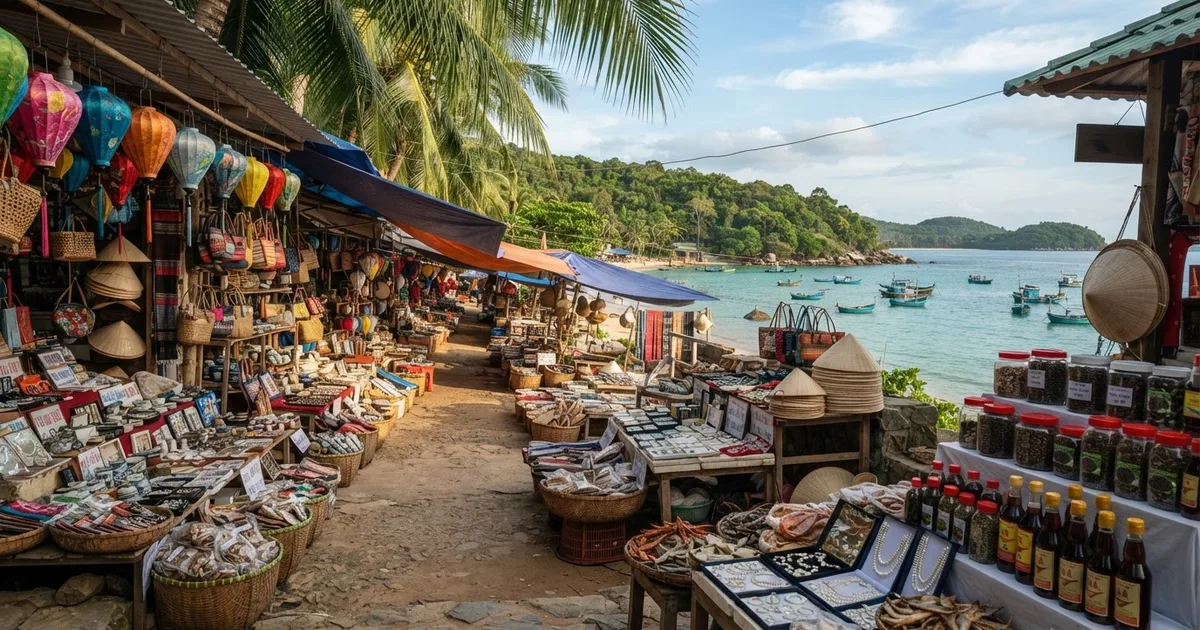
The quickest way to tell a real Phu Quoc pearl from a fake is the teeth test: gently rub the pearl along a tooth, and a genuine pearl feels slightly gritty, like fine sandpaper, while an imitation feels smooth like glass. Real pearls also feel cool to the touch at first and show slight surface irregularities. Buy from certified farms — Long Beach Pearl, Le Quang Pearl, Ngoc Hien, or Quoc An — where single freshwater pearls cost $30–$60 and saltwater South Sea pearls start at $200+; the Dinh Cau Night Market sells pearl items at roughly a third of farm prices but without certificates and with a high risk of fakes.
What You Are Actually Buying: Pearl Farming on Phu Quoc, Explained Honestly
Phu Quoc has spent decades building a reputation as Vietnam's pearl island. The warm, calm waters around the archipelago suit pearl oysters well, and cultivated pearls — both affordable freshwater and premium saltwater South Sea — have become one of the island's signature products. Pearls sit alongside fish sauce, Phu Quoc pepper, sim wine, and dried seafood on virtually every list of souvenirs actually worth carrying home from the island.
But there is a caveat most shopfronts will not volunteer: despite the dozens of pearl shops clustered around Duong Dong, Long Beach, and the main roads, an official count by Le Quoc Tuan of the Kien Giang Planning and Investment Department puts the number of genuine pearl producing enterprises on the island at just two. Every other shop is a reseller at best — and at worst, a seller of glass and shell imitations marketed under the same island name.
The practical takeaway: the words Phu Quoc pearl on a label guarantee nothing on their own. Price, paperwork, and a sixty-second physical inspection are what separate a real gem from a souvenir bead, and the rest of this guide walks through each one.
The Five Tests You Can Run at the Counter
You do not need laboratory equipment to screen out most fakes — five quick checks at the counter will catch the overwhelming majority of imitations. The first three take under a minute. If you are buying a set piece, ask to inspect a loose pearl or the clasp end of a strand rather than something already glued into a mounting.
| Test | Real pearl | Fake / imitation |
|---|---|---|
| Teeth test | Slightly gritty against a tooth, like fine sandpaper | Smooth like glass or plastic |
| Touch test | Cool to the touch at first, then warms slowly against your skin | Matches room temperature almost immediately |
| Surface look | Slight irregularities under close inspection — tiny bumps, ridges, natural texture | Pore-free, flawless, factory-perfect coating |
| Shape and size | Vary a bit in size and shape, even within a single strand | Uniformly round and perfectly matched |
| Drill hole | Clean hole through solid nacre, no flaking around the edge | Paint or coating chipping and peeling at the hole |
The teeth test is the classic for good reason: real pearls feel slightly gritty because nacre has a microscopic crystalline texture, while fakes feel smooth like glass. Run the pearl gently along the biting edge of a tooth — never scrub — and, if the seller has a known imitation on display, compare the two side by side. Real pearls also feel cool to the touch at first and warm slowly in your hand, and under a close look they show slight surface irregularities and vary a little in size and shape. A strand in which every pearl is uniformly round and identically sized is itself a warning sign, not a selling point.
Tip: if a vendor refuses to let you handle or closely inspect the pearls, treat that as your answer. Staff at reputable farms such as Long Beach Pearl and Le Quang Pearl expect the teeth and touch tests — genuine nacre takes a gentle rub without any damage.
Where to Buy Pearls on Phu Quoc: Certified Farms vs Dinh Cau Night Market vs Roadside Stalls
Pearl shopping on Phu Quoc effectively happens at three tiers, and knowing which tier you are standing in matters more than any single shop recommendation.
| Venue | Typical prices | Certificates | Fake risk | Best for |
|---|---|---|---|---|
| Certified farms — Long Beach Pearl, Le Quang Pearl, Ngoc Hien, Quoc An | Single freshwater pearls $30–$60, small strands $100–$200, South Sea pearls $200+ | Yes — Long Beach Pearl and Le Quang Pearl are GIA-backed with clear prices; Ngoc Hien advises checking certificate of origin and quality inspection papers | Very low | Genuine keepsakes and gem-value purchases |
| Dinh Cau Night Market | About 3 times lower than farm prices; bargaining expected | No — items sold without certificates | High | Fashion and costume jewellery where authenticity does not matter |
| Roadside stalls | Random, often rock-bottom | Almost never | Very high — often fake or imitation pearls | No one; simply skip them |
The honest framing: the night market is a poor fit for anyone buying pearls as valuables — you are paying for the look, not the gem, and no paperwork exists to prove otherwise. Certified farms are a poor fit in the opposite direction for travelers who only want a $5 souvenir bracelet for the beach; there you would be overpaying for documentation you do not need. Roadside stalls fit nobody: the combination of unverifiable goods and zero after-sales presence is exactly where the imitation trade thrives, so treat them as a hard pass.
What Real Pearls Should Cost: A Phu Quoc Price Guide
At the GIA-backed operations — Long Beach Pearl Farm and Le Quang Pearl both fall into this category, with clearly posted prices — genuine pearls follow a fairly predictable price ladder:
| Item | Typical farm price (USD) | What to know |
|---|---|---|
| Single freshwater pearl | $30–$60 | The entry point for a genuine, certified Phu Quoc pearl |
| Small strand of pearls | $100–$200 | Everyday-wear pieces; ask for the quality inspection papers |
| Necklace | From about $150–$300 | Listed range at Long Beach Pearl in Phu Quoc |
| Saltwater South Sea pearl | $200+ | The premium tier; prices climb steeply with size and luster |
Use these numbers as a sanity check before you buy anything anywhere on the island. The night market's roughly three-times-lower pricing means a strand might change hands for $40–$70 — plausible only for imitation or heavily flawed, uncertified goods. And a so-called South Sea pearl offered for $10 is not a bargain; at farm prices it is mathematically impossible, because real South Sea pearls start north of $200 before they ever reach a display case.
One behavioral difference to expect: farm prices are fixed and transparent, while bargaining is expected at Dinh Cau. Haggling at the market is part of the experience — just do not let a 70 percent discount convince you that you have beaten the laws of gem pricing.
Certificates and Paperwork: What to Ask For Before You Pay
Paperwork is what turns a pleasant purchase into a defensible one. Ngoc Hien pearl farm — one of the island's established names — explicitly advises buyers to check two documents: the certificate of origin and the quality inspection papers. The certificate ties the pearl to Phu Quoc production; the inspection papers state what you are actually holding, from pearl type to grade.
For higher-value purchases, look for GIA alignment. Long Beach Pearl Farm and Le Quang Pearl are described as GIA-backed with clear prices, which means their grading follows the Gemological Institute of America's standards rather than an in-house leaflet.
- Certificate of origin – confirming Phu Quoc provenance; Ngoc Hien's own buying advice
- Quality inspection papers – stating pearl type, size, and grade
- GIA-aligned documentation – expected at GIA-backed shops such as Long Beach Pearl and Le Quang Pearl
- Itemized receipt – with the shop's full name and address in case of a later dispute
- Your own 60-second check – teeth, touch, and surface, done before money changes hands
If a shop cannot produce the first three, your decision is effectively made for you: either accept that you are buying costume jewellery at costume-jewellery prices, or walk out and take your budget to a certified farm.
Red Flags: When to Walk Away
With only two genuine producing enterprises on the island, the supply of authentic Phu Quoc pearls is inherently limited — which is exactly why imitations fill the gap. These patterns should end the conversation and your visit:
- Uniform perfection at a low price – perfectly round, perfectly matched pearls at a fraction of farm prices is the signature of imitation
- Refusal to inspect – any pushback on handling, the teeth test, or a close look through a loupe
- Flaking at the drill hole – paint or coating peeling means it is a coated bead, not nacre
- A photocopied certificate – a leaflet with no laboratory or company details proves nothing
- Countdown pressure – last pieces, closing-today sales, and special price for you, my friend
Remember: the teeth test beats every sales pitch. Real pearls feel slightly gritty on the teeth, fakes feel smooth like glass — and it works on drilled beads, pendants, and strands alike.
Caring for the Pearls You Buy in Phu Quoc
Pearls are organic gemstones, and nacre is softer than almost any other gem material. Follow the jeweler's rule of last on, first off: perfume, sunscreen, and insect repellent go on before the pearls, because cosmetics and chemicals dull the nacre over time.
After a beach day or a humid evening at the night market, wipe pearls with a soft, slightly damp cloth and let them dry flat. Store them separately in a soft pouch — harder stones in the same bag will scratch them — and never put pearls in an ultrasonic cleaner. A well-cared-for strand from a Phu Quoc farm will outlast your tan by decades.
Frequently Asked Questions
How can I tell if a Phu Quoc pearl is real?
Run the teeth test: gently rub the pearl along a tooth — a real pearl feels slightly gritty, like fine sandpaper, while a fake feels smooth like glass. Real pearls also feel cool to the touch at first, show slight surface irregularities, and vary a little in size and shape. Imitations look uniformly round and flawlessly smooth.
How much should a real pearl cost in Phu Quoc?
At GIA-backed farms such as Long Beach Pearl Farm and Le Quang Pearl, a single freshwater pearl lists at $30–$60, a small strand at $100–$200, and necklaces from about $150–$300. Saltwater South Sea pearls start at $200+. Anything offered far below these numbers should be treated as imitation.
Is it safe to buy pearls at the Dinh Cau Night Market?
Safe enough for your wallet, not for gem value. Prices run about 3 times lower than at the farms and bargaining is expected, but items are sold without certificates and the risk of fakes is high. Treat night-market pearls as fashion jewellery, and buy genuine keepsakes at a certified farm instead.
Which pearl shops on Phu Quoc are trustworthy?
The established names are Long Beach Pearl and Le Quang Pearl — both GIA-backed with clear prices — plus Ngoc Hien and Quoc An among the island's reputable farms. Keep in mind that, per Le Quoc Tuan of the Kien Giang Planning and Investment Department, only two enterprises on the island genuinely produce pearls; everyone else resells.
Should a real pearl come with a certificate?
Yes. Ngoc Hien pearl farm advises every buyer to check the certificate of origin and the quality inspection papers. For high-value pearls, GIA-aligned documentation from shops like Long Beach Pearl and Le Quang Pearl adds an independent grading standard. No papers usually means no proof — so buy only at fashion-jewellery prices.
Are Phu Quoc pearls freshwater or saltwater?
Both types are sold on the island. Freshwater pearls are the entry tier at $30–$60 for a single pearl and $100–$200 for a small strand, while saltwater South Sea pearls — the premium category — start at $200+. Ask for the pearl type in writing on your quality inspection papers so you know exactly what you paid for.
What else is worth buying in Phu Quoc besides pearls?
The island's classic souvenirs are fish sauce, Phu Quoc pepper, sim wine, and dried seafood such as dried shrimp, dried fish, and dried squid — usually far harder to fake than pearls and easier to fit in a suitcase. Pearls remain the flagship gift, provided you buy certified from a reputable farm.
Planning a pearl-shopping run around Duong Dong and Long Beach? The local team at Sabrina Rental rents motorbikes by the day and can arrange a driver who knows which farms are worth the trip — just ask when you book your bike or room.
Get Local Tips from Sabrina Rental