If you only visit one temple on Phu Quoc, make it Ho Quoc Pagoda: it is the largest Buddhist temple on the island, entry is free, it opens daily from 06:00 to 18:00, and it sits on a hillside in Suoi Lon Hamlet, Duong To Commune, roughly 1 km from Bai Sao beach. Most visitors find that two temples are enough — Ho Quoc for the cliffside sea views and Dinh Cau Shrine for the harbor setting in Duong Dong. Every temple and pagoda on this list has free entry, and donations are optional.
Which Phu Quoc Pagodas and Temples Are Actually Worth Visiting?
Phu Quoc is not a temple destination in the way that Hue, Hoi An or Ninh Binh are. Local guides are honest about this: the island's temples are generally small, local and easy to visit rather than large architectural landmarks. That is exactly why they work so well as a half-day add-on to a beach trip — you are not committing to a full sightseeing day, and you are not paying an entrance fee.
Six places come up again and again in local recommendations: Ho Quoc Pagoda, Su Muon Pagoda, Dinh Cau Shrine, Dinh Ba Shrine, Sung Hung Pagoda and Nguyen Trung Truc Temple. Four of them sit within a few minutes of each other in and around Duong Dong, the island's main town, which makes them easy to combine in a single morning or a single late afternoon.
| Temple / Shrine | Type | Where | Entry | Time needed | Best for |
|---|---|---|---|---|---|
| Ho Quoc Pagoda | Buddhist pagoda | Suoi Lon Hamlet, Duong To Commune, near Bai Sao | Free | 45-60 min | Sea views; the island's largest temple |
| Dinh Cau Shrine | Sea shrine | Mouth of Duong Dong harbor | Free | 20-30 min | Sunset, harbor atmosphere, easy walk |
| Dinh Ba Shrine | Sea shrine | Duong Dong, near the harbor | Free | 15-20 min | Quiet local worship, older shrine |
| Sung Hung Pagoda | Buddhist pagoda | Duong Dong town center | Free | 1-2 hours | Classic architecture, peaceful atmosphere |
| Su Muon Pagoda | Buddhist pagoda | Hillside above Duong Dong | Free | 30-45 min | Elevated views over town |
| Nguyen Trung Truc Temple | Hero temple | Duong Dong area | Free | 15-20 min | Vietnamese history and local heritage |
If your Phu Quoc trip is short — three or four nights — do not try to tick off all six. Two temples are enough for most visitors: Ho Quoc Pagoda for the scenery and Dinh Cau Temple for the harbor location. Add Sung Hung Pagoda only if you already have a spare hour in Duong Dong.
Ho Quoc Pagoda: The One Temple Most Visitors Should Prioritize
Ho Quoc Pagoda (also written Ho Quoc Temple) is the single temple on Phu Quoc that people consistently say is worth rearranging your day for. It is described as the largest Buddhist temple on the island and one of its most peaceful, and TripAdvisor reviewers use phrases like stunning location, breathtaking views and must-visit in Phu Quoc. One reviewer noted it was well worth the time and that they spent up to an hour there.
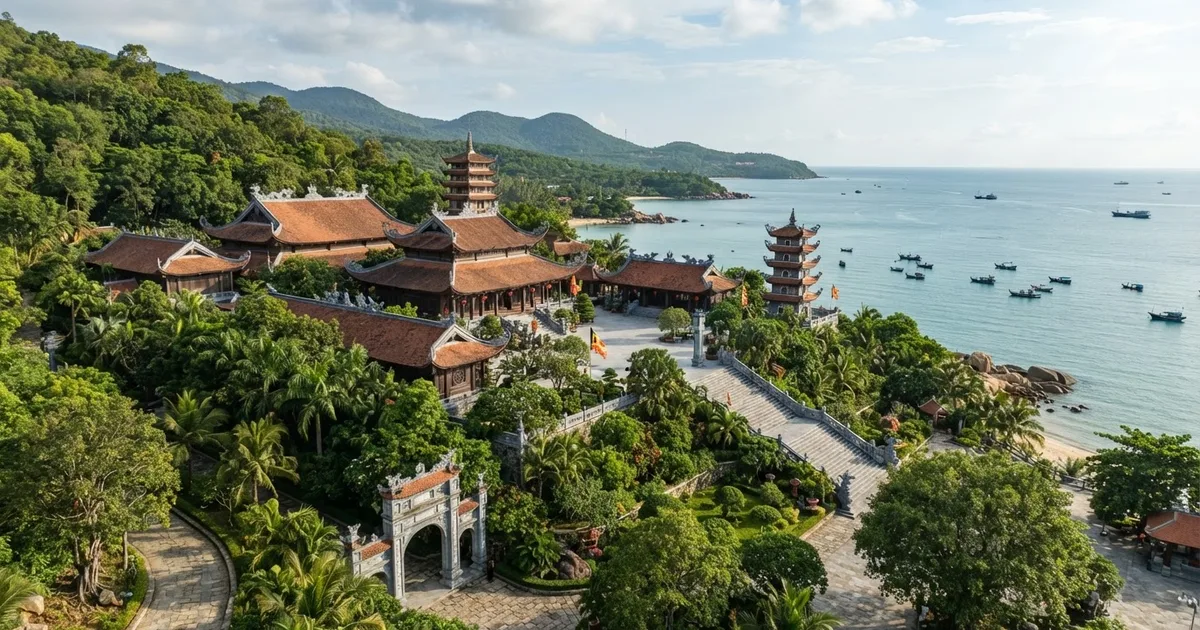
The setting is the whole point. The pagoda is built into a hillside on the island's southeast coast, in Suoi Lon Hamlet, Duong To Commune, Phu Quoc City, Kien Giang Province, with terraced steps and temple buildings facing out over the sea. VinWonders describes it as the largest temple in Phu Quoc, with serene sea views and real cultural depth. It is about 1 km from Bai Sao, one of Phu Quoc's best-known white-sand beaches, which makes it an obvious pairing: temple first, beach straight after, or the reverse if you want softer light for photos.
Practical details: entry is free, the pagoda is open daily from 06:00 to 18:00, and visitors are free to explore at their own pace. There is no ticket booth and no mandatory donation. Allow 45 to 60 minutes if you want to walk the terraces, take photos and sit for a few minutes — longer if you plan to linger over the view.
Local tip: Ho Quoc is roughly 25 km southeast of Duong Dong town, about 35-45 minutes by motorbike along the coastal road toward An Thoi. Pair it with Bai Sao in the same trip — the beach is only 1 km away — and you have a complete half-day without doubling back.
Because the pagoda faces east and southeast, morning light hits the sea and the temple front most cleanly. Late afternoon is quieter and cooler, but the sun drops behind the hill, so the water loses its color earlier than you might expect.
Dinh Cau Shrine and the Duong Dong Temple Cluster
Dinh Cau Shrine is the second temple most visitors should see, and it is the easiest one to fit into any day because it sits right at the mouth of Duong Dong harbor, on a rocky point you can walk to from the night market in under ten minutes. It is a sea shrine rather than a Buddhist pagoda — local fishermen have long come here to ask for safe passage and good catches — and it is free to enter. Budget 20 to 30 minutes.
The reason to time your visit is the sunset. Dinh Cau faces west across the water, so late afternoon and early evening give you the best combination of light, cooler air and harbor activity. Local guides consistently recommend morning or late afternoon for Phu Quoc temples generally, because that is when it is quieter and cooler, and Dinh Cau is the clearest example of that advice paying off.
From Dinh Cau you can walk or ride a few minutes to the rest of the Duong Dong cluster:
- Dinh Ba Shrine — a second, older sea shrine near the harbor, quieter than Dinh Cau and usually done in 15-20 minutes.
- Sung Hung Pagoda — a significant Buddhist temple in the town center with classic architecture and a peaceful atmosphere; guides recommend allowing 1-2 hours here, making it the second-biggest time commitment on this list after Ho Quoc.
- Su Muon Pagoda — set on a hillside above Duong Dong, which gives it elevated views back over the town and harbor; 30-45 minutes is enough.
- Nguyen Trung Truc Temple — a small temple dedicated to the 19th-century Vietnamese resistance leader Nguyen Trung Truc, worth 15-20 minutes if you are interested in local history.
Done back to back, Dinh Cau, Dinh Ba, Sung Hung, Su Muon and Nguyen Trung Truc make a comfortable half-day in and around Duong Dong, with no entrance fees at any of them.
Sung Hung Pagoda, Su Muon Pagoda and the Smaller Shrines: Who They Suit
Sung Hung Pagoda is the one to choose if you want a proper Buddhist temple visit rather than a viewpoint. It is described as a significant Buddhist temple with classic architecture and a peaceful atmosphere, and it is the only temple on this list where local guides suggest setting aside 1-2 hours. If you are interested in how Buddhism is actually practised on the island — rather than in photography — this is your stop.
Su Muon Pagoda suits travellers who want a view without a long ride. It sits on a hillside above Duong Dong, so you get elevated outlooks over the town and harbor in 30-45 minutes, and it is close enough to combine with the harbor shrines on the same afternoon.
These temples are a great fit if you...
- Have a spare morning or late afternoon and want something beyond beaches and night markets.
- Are travelling with a scooter and want a scenic ride as much as a destination.
- Prefer free, low-commitment stops over ticketed attractions.
- Want one standout photo stop — Ho Quoc delivers that in under an hour.
They are a poor fit if you...
- Are expecting Vietnam's grand imperial or UNESCO-scale temples. Phu Quoc's are small and local by comparison.
- Only have two nights and want to maximise beach and island-hopping time.
- Dislike heat and steps — Ho Quoc in particular involves terraces and staircases in full sun.
- Want a guided, ticketed, air-conditioned attraction. There is no such thing here.
Nguyen Trung Truc Temple and Dinh Ba Shrine are the two most optional stops. Neither takes more than 20 minutes, and both are best treated as something you drop into while you are already in Duong Dong rather than a reason to travel across the island.
Temple Etiquette, Dress Code and the Best Time to Visit
Phu Quoc's temples are working places of worship, not attractions with staff and turnstiles. Entry is free everywhere on this list, and donations are entirely optional — you are never expected to pay, and there is no pressure to buy incense or offerings, though you can if you wish.
Before you go in
- Cover shoulders and knees. A sarong or light scarf over beach clothes is usually enough.
- Take your shoes off before entering the main prayer halls — look for the step at the doorway.
- Keep your voice down and avoid walking in front of people who are praying.
- Ask before photographing people, and avoid pointing your camera at Buddha statues in a way that blocks worshippers.
- Go in the morning or late afternoon. It is cooler and quieter, and Ho Quoc in particular has very little shade on the terraces.
- Bring small cash for a donation box if you want to contribute, and water for the ride.
Timing matters more than most guides admit. Midday on Phu Quoc is hot enough that a staircase-heavy visit like Ho Quoc becomes uncomfortable, and the light is flat for photos. Early morning — right after the 06:00 opening — gives you empty terraces and clean light. Late afternoon works well for Dinh Cau and the Duong Dong shrines, where you are there for the sunset rather than the architecture.
Also check the calendar before you plan a temple day. During Tet (Vietnamese New Year, usually late January or February) and on full-moon days, temples are far busier with local worshippers. That is genuinely interesting to see, but it is not the quiet visit most travellers are picturing, and some areas may be restricted while ceremonies are underway.
How to Fit Phu Quoc's Temples Into Your Itinerary
The efficient way to do this is geographically, not by ranking. Phu Quoc's temples fall into two clusters, and mixing them into one day means a lot of unnecessary riding.
Cluster 1 — the southeast coast. Ho Quoc Pagoda plus Bai Sao beach. Ride from Duong Dong toward An Thoi, spend 45-60 minutes at the pagoda, then continue 1 km to the beach. This is the single best temple day on the island and needs roughly half a day including travel.
Cluster 2 — Duong Dong town. Dinh Cau Shrine, Dinh Ba Shrine, Sung Hung Pagoda, Su Muon Pagoda and Nguyen Trung Truc Temple. All are within a few minutes of each other and of the night market. Do this on the afternoon of your arrival day, or on an evening when you are already heading into town for dinner — walk to Dinh Cau for sunset, then eat.
If you are renting a motorbike, both clusters are straightforward rides on paved roads, and the coastal road toward An Thoi is one of the more pleasant stretches on the island. If you would rather not ride, a car or driver for a half-day is the simplest alternative, and it lets you combine Ho Quoc with Bai Sao and a stop in An Thoi without worrying about parking or heat.
One last planning note: because every temple here is free and none of them require advance booking, you can decide on the day. Check the weather in the morning — if it is clear, go to Ho Quoc; if it is overcast or raining, keep the Duong Dong shrines as your backup, since they are close to town and easy to abandon if the weather turns.
Frequently Asked Questions
Is Ho Quoc Pagoda free to enter?
Yes. Ho Quoc Pagoda has free entry and is open daily from 06:00 to 18:00. There is no ticket booth and no mandatory donation — donations are optional, as they are at every temple and pagoda on Phu Quoc. Allow 45-60 minutes for the visit.
Which Phu Quoc temple should I visit if I only have time for one?
Ho Quoc Pagoda. It is the largest Buddhist temple on the island, has the most dramatic setting with cliffside sea views, and is free. Most visitors who include temples on a Phu Quoc trip say it is the one to prioritise, and TripAdvisor reviewers call it a must-visit.
How long does a visit to Ho Quoc Pagoda take?
Plan for 45 to 60 minutes. One reviewer said they spent up to an hour there and found it well worth the time. Add 35-45 minutes each way if you are riding from Duong Dong, since the pagoda is about 25 km southeast of town.
Where exactly is Ho Quoc Pagoda?
It is in Suoi Lon Hamlet, Duong To Commune, Phu Quoc City, Kien Giang Province, on the island's southeast coast. It sits about 1 km from Bai Sao beach, which makes the two easy to combine in a single half-day trip.
Do I need to pay to enter Phu Quoc's other temples?
No. Temples and pagodas listed in local guides generally have free entry, including Dinh Cau Shrine, Dinh Ba Shrine, Sung Hung Pagoda, Su Muon Pagoda and Nguyen Trung Truc Temple. Donations are optional at all of them, and there is no pressure to give.
What is the best time of day to visit temples in Phu Quoc?
Morning or late afternoon. Local guides recommend those windows because it is quieter and cooler, which matters at Ho Quoc where the terraces have little shade. For Dinh Cau Shrine specifically, late afternoon is best because it faces west over the harbor at sunset.
How much time should I allow at Sung Hung Pagoda?
Local guides recommend 1-2 hours at Sung Hung Pagoda, making it the second-biggest time commitment after Ho Quoc. It is a significant Buddhist temple with classic architecture and a peaceful atmosphere, in Duong Dong town centre, and entry is free.
How many temples can I realistically visit in one day?
Two or three, if you group them geographically. Ho Quoc Pagoda plus Bai Sao beach is a comfortable half-day. Alternatively, do Dinh Cau, Dinh Ba and Sung Hung in Duong Dong in one afternoon — they are all within a few minutes of each other and of the night market.
Planning your temple days around the rest of your Phu Quoc trip? Sabrina Rental can sort your motorbike or car, suggest the best route to Ho Quoc and Bai Sao, and help with rooms and boat trips — just ask and we will build the day around your schedule.
Get in touch with Sabrina Rental