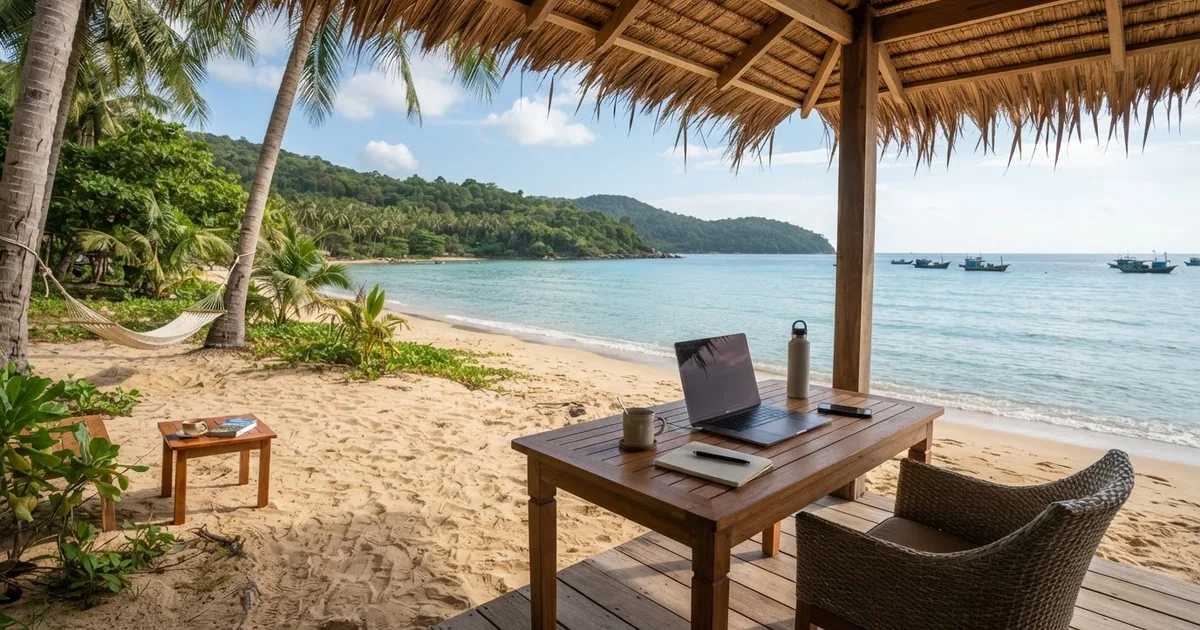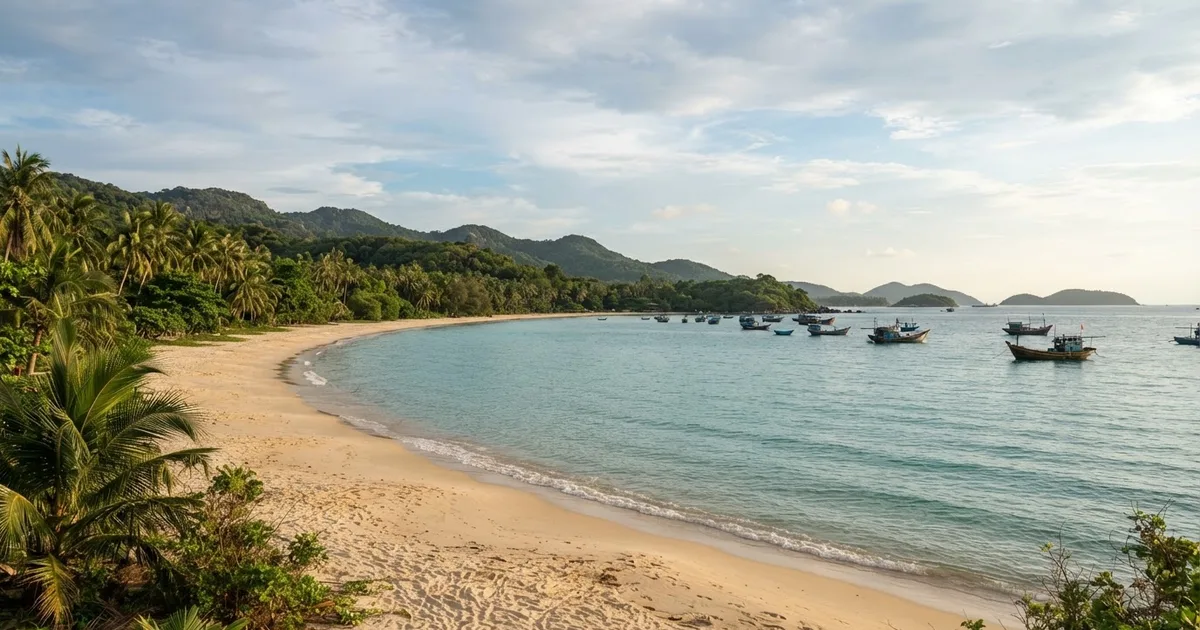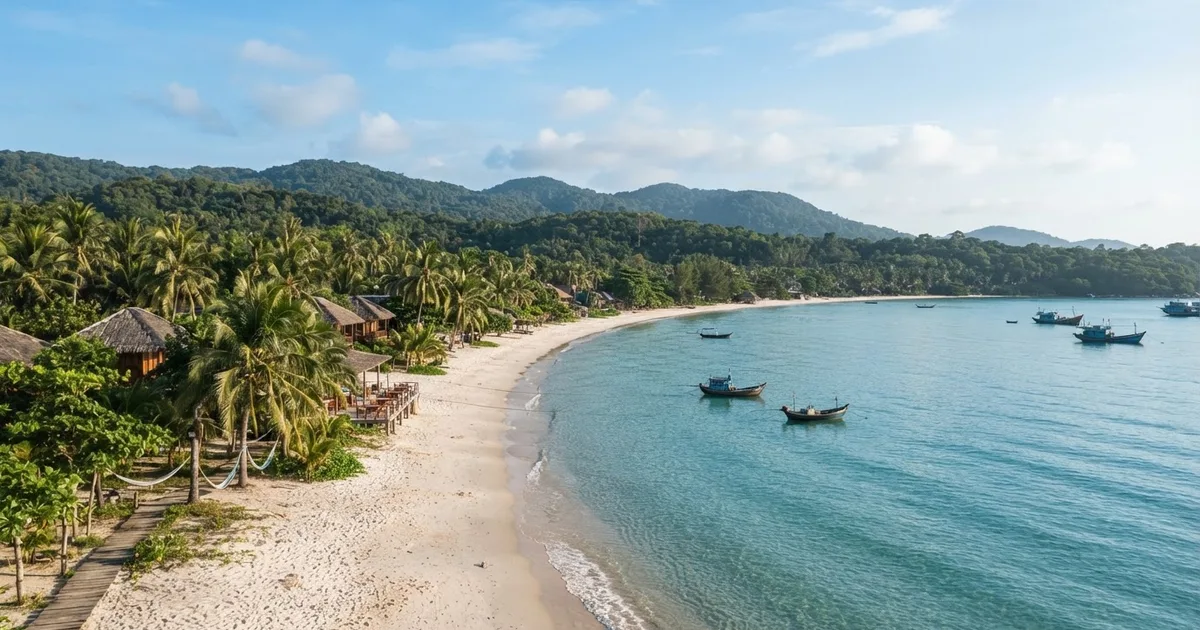
Living in Phu Quoc as an expat or retiree costs a realistic $800-$1,500 per month for a single person, with a comfortable lifestyle at $1,100-$2,000. Rent is the biggest variable at $350-$1,100 per month, a monthly motorbike rental runs 2,500,000-3,000,000 VND ($95-$115), and Vietnamese law grants a 30-day visa exemption to every nationality that flies directly to Phu Quoc and stays on the island. The trade-offs are real too: there is no retirement visa, the nomad scene is quiet rather than social, and May to October rain cuts rents by 20-35% precisely because fewer people want to be here.
What Does It Actually Cost to Live in Phu Quoc?
The numbers published by long-stayers all converge on the same range, and they hold up in practice: a realistic monthly budget for a single expat is $800 to $1,500, a frugal setup lands around $800, and a comfortable one sits near $1,500. Once you add a nicer house, regular restaurant meals and international health insurance, a comfortable single expat total reaches roughly $900-$1,600, and up to $2,000 if you want sea views and a car or a large bike.
Rent drives everything else. A one-bedroom apartment in Duong Dong or Ong Lang costs about $350-$600 per month, furnished, usually with air conditioning and WiFi included. Across the whole island, monthly rent ranges from roughly $350 to $1,100, with the top of that range being beachfront houses, two-bedroom villas and short-term-style units near Long Beach or Sao Beach.
| Monthly cost | Frugal expat | Comfortable expat |
|---|---|---|
| Rent (1-bedroom, furnished) | $350-$450 | $500-$1,100 |
| Food (mixed local and Western) | $250-$300 | $350-$450 |
| Transport (motorbike rental plus fuel) | $50-$70 | $80-$100 |
| SIM card and mobile data | $8-$16 (200,000-400,000 VND) | $8-$16 |
| Utilities (electricity, water, gas) | $30-$60 | $70-$120 |
| Insurance, visa runs, misc. | $50-$80 | $100-$200 |
| Total per month | about $750-$900 | about $1,100-$2,000 |
Two lines catch newcomers out. Electricity is metered at roughly 3,000-4,000 VND per kWh, which sounds trivial until you run air conditioning around the clock in April: a heavy AC user can add $60-$100 to a small apartment's bill. And visa costs are recurring, not one-off. The 30-day exemption is free, but anyone staying three months or more is cycling e-visas or leaving the country every 90 days, which is a genuine budget item.
Cheap local food is where the savings show. A bowl of pho or a rice plate at a Duong Dong market stall costs 30,000-50,000 VND ($1.20-$2), a Vietnamese coffee is 20,000-30,000 VND, and a Western meal at an expat cafe runs 120,000-250,000 VND ($5-$10). A single person eating mostly local can hold food to $250 a month; regular Western breakfasts and imported groceries push it toward $450.
Buy your own scooter rental by the month, not by the day. Daily rates of 120,000-150,000 VND add up fast, while monthly rental on Phu Quoc costs 2,500,000-3,000,000 VND ($95-$115) including servicing, so the monthly deal is cheaper after about 18 days. Transport overall is estimated at $50-$100 a month, and a motorbike is genuinely essential unless you live in central Duong Dong.
The Best Areas to Live in Phu Quoc: Duong Dong, Ong Lang and Duong To
The three best areas to live in Phu Quoc are Duong Dong, Ong Lang and Duong To, and they suit very different people. Duong Dong is the island capital: the night market, the main hospital, banks, the ferry pier and the widest choice of apartments. Ong Lang sits about 10 km north of town, a low-key beach village of bungalows, yoga studios and small cafes. Duong To stretches south along Long Beach toward the airport, with supermarkets, bakeries and a large long-stay expat population.
| Area | Feel | 1-bedroom rent | Best for | Watch out for |
|---|---|---|---|---|
| Duong Dong | Island capital, busy, walkable centre | $350-$600 | People without a motorbike, market lovers, anyone needing hospitals and banks nearby | Traffic noise, less beach frontage, higher prices for less space |
| Ong Lang | Quiet beach village, relaxed expat pocket | $350-$600 | Beach access, remote workers who want calm, long-stay bungalow living | Fewer shops and services, you need a scooter for everything |
| Duong To | Long Beach strip, supermarkets and restaurants | $300-$550 | Value rent, 10 minutes to the airport, mixed local and Western amenities | Construction, busy main road, some stretches lack footpaths |
| An Thoi | Southern port town, near cable car and islands | $250-$450 | Budget-focused long stays, ferry access, diving | Far from the north of the island, fewer Western restaurants |
| Cua Can | Riverside and beach hamlet on the west coast | $300-$500 | Nature, quiet, resorts nearby | Very limited services, 20 minutes or more to town |
Where you live changes your monthly bill more than any other decision. Moving one or two kilometres inland from the beach in Ong Lang or Duong To can cut $100-$150 off rent for the same amount of space, and the sea is still five minutes away by bike.
Be honest about who this is not right for. Phu Quoc is a poor fit if you need walkable city life, if you want international schools with a deep curriculum, if you rely on specialist medical care, or if you cannot or do not want to ride a motorbike. It is also a poor fit for anyone who expects a large, organised expat social calendar: there are meetups and a handful of regular bars, but this is a small island community, and people who need a dense social scene tend to move on to Da Nang or Ho Chi Minh City within a few months.
Visas: The 30-Day Phu Quoc Exemption and What Comes After
Phu Quoc runs a special immigration regime that no other part of Vietnam offers. Foreigners who fly directly to Phu Quoc and stay only on the island receive a 30-day visa exemption, and it applies to any nationality, not just those with bilateral agreements. You need a return or onward ticket, and you must not travel to the mainland during those 30 days, because the exemption covers the island only. If you want to visit Ho Chi Minh City or Hanoi, you need a proper visa for Vietnam before or during your trip.
For stays longer than 30 days, the standard tool is the Vietnamese e-visa, which since 2023 is issued for up to 90 days with single or multiple entry and is open to all nationalities. Official fees are around $25 for single entry and $50 for multiple entry. Apply online before you travel, and allow several working days.
Here is the part that surprises retirees most: Vietnam has no retirement visa. There is also no dedicated digital nomad visa. Long-stayers therefore run one of a few patterns:
- 90-day e-visa cycles - live on the island for 90 days, then exit and re-enter with a new e-visa.
- Border runs - the nearest land crossing is at Ha Tien, roughly 3-4 hours by road and ferry from Phu Quoc, continuing into Cambodia at the Xa Xia / Prek Chak gate.
- Direct re-entry flights - flying out to Bangkok, Kuala Lumpur or Singapore and back into Phu Quoc is the simplest reset, and it restarts the 30-day island exemption if you arrive directly.
Do not overstay. Vietnamese overstay fines are charged per day and escalate quickly, and an overstay stamp can complicate future e-visa approvals. Set a phone reminder for seven days before your e-visa expires, and check current rules with Phu Quoc immigration in Duong Dong or with your airline before booking anything irreversible.
Renting Long-Term: Prices, Deposits and What to Check
Long-term rentals on Phu Quoc are informal compared with Europe or North America. Most one-bedroom apartments and bungalows are advertised monthly, utilities are metered separately, and a deposit of one month plus rent in advance is standard. Furnished means a bed, air conditioning, a fridge, a small kitchen or kitchenette, and usually WiFi; it rarely means a washing machine, a proper oven or a sofa you would choose yourself.
The best time to negotiate is the wet season. From May to October, rents fall 20-35% below peak rates, and landlords who would not move a dollar in January will often include a scooter, weekly cleaning or the electricity bill in July. If your dates are flexible, arrive in June and lock in a 6 or 12-month contract at the wet-season price.
- Test the water pressure - turn on the shower and the kitchen tap at the same time; many island rentals rely on pumps or tanks.
- Run the air conditioning for 10 minutes - check for smells, weak airflow and dripping inside the room.
- Speed test the WiFi - ask for a fibre line, not a shared mobile hotspot, and test on your own device.
- Look up at the ceiling - and behind wardrobes. Damp patches and black mould come back every wet season.
- Ask who pays for electricity - and at what rate per kWh, since 3,000-4,000 VND per unit is normal and some landlords add a markup.
- Check the road access - a scenic dirt track is fine in February and a mud bath in August.
- Confirm the notice period - one month is standard, but get the deposit return terms in writing, in English or Vietnamese.
- Meet the landlord or manager in person - on an island this small, a responsive manager matters more than the condition of the bathroom.
A monthly motorbike rental costs about 2,500,000-3,000,000 VND ($95-$115) and should include servicing, insurance documentation and a helmet. Fuel is roughly 25,000 VND per litre, and a 110-125cc scooter uses about 2 litres per 100 km, so daily running costs are a few dollars a week at most.
Working Remotely from Phu Quoc: Internet, Cafes and the Real Nomad Picture
Remote work on Phu Quoc is entirely practical. WiFi is widely available, and dedicated fibre connections in apartments and cafes commonly deliver 50-100 Mbps, which is more than enough for video calls, cloud work and file transfers. Mobile data is cheap: a tourist or local SIM with a generous data package costs about 200,000-400,000 VND ($8-$16) per month in total, which makes a phone hotspot a viable backup for any fibre outage.
The honest framing is that Phu Quoc is a live and work quietly destination, not a structured nomad hub. There is no large coworking scene, no weekly founder meetups and no critical mass of remote workers the way you find in Chiang Mai, Canggu or Da Nang. That is exactly why some people love it: low cost, fast internet, beach access and a peaceful working environment with few distractions.
It suits digital nomads who want a slow routine, morning swims and quiet deep work, and who are comfortable building a small social circle rather than stepping into an existing one. It is a poor fit if you need a dense social calendar, networking events, a co-working community or high-end city services on your doorstep. People who come here expecting the Da Nang nomad scene are usually disappointed within a month.
Two practical notes for anyone taking calls across time zones: Vietnam runs on GMT+7 with no daylight saving, which means European morning calls are early afternoon here and US West Coast mornings are late evening. And island power cuts and cable faults do happen, especially in storm season, so a charged phone hotspot and a cafe backup plan within riding distance are worth having.
Healthcare, Insurance and Everyday Practicalities
Phu Quoc has basic medical care, not comprehensive care. Duong Dong has the island's main hospital, plus private clinics and pharmacies that handle everyday issues: minor infections, food poisoning, motorbike scrapes and routine prescriptions. An international clinic run by a major Vietnamese hospital group also operates on the island and is the usual first stop for expats who want English-speaking staff and clearer billing.
Anything serious means leaving the island. Complex surgery, cardiac care, oncology and specialist diagnostics are handled in Ho Chi Minh City or Bangkok, both roughly one hour by air from Phu Quoc International Airport. That is a genuine consideration for retirees managing chronic conditions, and it is the single strongest argument for carrying proper medical insurance rather than relying on travel cover.
Typical costs look like this: a basic travel medical policy runs $50-$150 per month depending on age and coverage, while a proper international health insurance policy with evacuation cover for a person in their 60s can cost several hundred dollars a month. Given that a medical evacuation flight from Phu Quoc to Bangkok can exceed $10,000 without cover, insurance is not the place to save.
Other everyday practicalities on the island:
- Banking - Vietnamese banks in Duong Dong open accounts for foreigners with the right visa paperwork, but many long-stayers keep a Wise or Revolut account and withdraw from ATMs; expect a 3-5% foreign card fee at some machines.
- Pharmacies - well stocked for common medicines; bring specific prescription drugs, since brand availability differs from Europe and North America.
- Groceries - local markets are cheap and fresh, while imported goods cost 2-3 times European prices at specialist shops in Duong Dong and Duong To.
- Pets and vehicles - both are possible long-term but involve more paperwork than most newcomers expect; ask locally before committing.
Is Phu Quoc a Good Place to Retire?
Phu Quoc suits a particular kind of retiree: someone healthy, independent, warm-weather-loving and content with a slow, small-island routine. The cost of living is genuinely low, the island is safe by any international standard, fresh seafood is cheap, and a retired couple can live very comfortably on $1,600-$2,500 a month including rent. What it will not do is provide a formal retirement pathway, a large expat club, or first-class hospitals.
A strong fit if you are
- Healthy and able to ride a scooter
- Happy with a quiet routine and a small circle of friends
- Comfortable managing your own visa cycles every 90 days
- Budgeting $1,100-$2,000 a month for a comfortable single life
- Flexible enough to travel to Ho Chi Minh City or Bangkok for specialist care
A poor fit if you need
- A retirement visa or permanent residency path, which Vietnam does not offer
- Reliable specialist healthcare on the island
- An organised expat community with clubs, classes and events every week
- Guaranteed dry weather, since May to October is genuinely wet
- To avoid motorbikes, paperwork and negotiating in a second language
Worth knowing before you commit
- The 30-day exemption applies to any nationality if you arrive directly and stay on the island
- Wet-season rent discounts of 20-35% make a June move financially smart
- A SIM with data costs only 200,000-400,000 VND per month, so staying connected is cheap
- Phu Quoc is one of the safest places in Southeast Asia for solo residents and older couples
Seasons: When to Move and How to Time Your Apartment Hunt
Phu Quoc has two clear seasons, and both your comfort and your rent depend on which one you arrive in. The wet season runs from May to October, with September and October typically the wettest months. The dry season runs from November to April, with the calmest seas and the best beach weather from December to March.
The wet season is not a washout. Rain usually arrives in heavy afternoon or evening bursts rather than all-day drizzle, mornings are often bright, and the island is dramatically quieter and greener. The compensation is financial: rents drop 20-35% versus peak rates, restaurants are empty, and landlords negotiate.
If you are moving long-term, the smart play is to arrive in late May or June, rent for six or twelve months at wet-season pricing, and enjoy the peak season on a contract signed at low-season rates. If you are visiting first to decide, come in December or January to see the island at its best, then return to sign a lease in the low season.
Frequently Asked Questions
How much does it cost to live in Phu Quoc per month?
For a single person, a realistic monthly budget is $800 to $1,500, with a frugal setup around $800 and a comfortable one near $1,500. Rent takes $350-$600 for a furnished one-bedroom in Duong Dong or Ong Lang, food $250-$450, transport $50-$100, a SIM 200,000-400,000 VND, and utilities $30-$120 depending on air conditioning use.
Do I need a visa to stay long term in Phu Quoc?
If you fly directly to Phu Quoc and stay on the island, you get a 30-day visa exemption regardless of nationality. Beyond 30 days you need a Vietnamese e-visa, issued online for up to 90 days, costing roughly $25 single entry or $50 multiple entry. Most long-stayers then exit and re-enter every 90 days.
Can foreigners retire in Vietnam or on Phu Quoc?
Vietnam has no retirement visa and no permanent residency route for retirees. Long-term residents stay on 90-day e-visas, leaving the country and re-entering every three months, or on business and investment visas tied to a Vietnamese company. Phu Quoc is popular with retirees because of the 30-day island exemption and low costs, but the visa cycle is a permanent part of the lifestyle.
Do I need a motorbike to live in Phu Quoc?
It is close to essential outside central Duong Dong. Public transport is limited, taxis add up quickly and the island is 50 km long. A monthly motorbike rental costs about 2,500,000-3,000,000 VND ($95-$115), and total transport is estimated at $50-$100 per month. Carry an International Driving Permit and always wear a helmet.
Is the internet fast enough to work remotely from Phu Quoc?
Yes. WiFi is widely available and dedicated fibre connections commonly deliver 50-100 Mbps, which comfortably handles video calls and cloud work. A SIM with a large data package costs 200,000-400,000 VND ($8-$16) per month, so a phone hotspot makes a reliable backup during the occasional storm-season outage.
What is the cheapest area to rent in Phu Quoc?
An Thoi in the south and inland pockets of Duong To are the cheapest, with one-bedroom rentals from about $250-$450 per month. Duong Dong and Ong Lang cost more at $350-$600 for the same size, but you save on transport because shops, markets and services are closer. Inland addresses a few hundred metres from the beach cut roughly $100-$150 off rent.
When is the cheapest time to rent on Phu Quoc?
May to October, the wet season, when monthly rents fall 20-35% below peak rates and landlords are far more willing to include a scooter, cleaning or utilities in the deal. Signing a 6 or 12-month contract in June means you keep those low-season rates through the busy December to March period.
Is Phu Quoc safe for expats and retirees?
Yes, it is one of the safer places in Southeast Asia for foreign residents. Violent crime against foreigners is rare and the island is small enough that problems are quickly known. The main real risks are motorbike accidents and petty theft of phones or bags left on scooters, so ride defensively, wear a helmet and use a locked storage box.
What happens if I get seriously ill on Phu Quoc?
Duong Dong has a main hospital and international clinics for everyday care, but complex treatment means evacuation to Ho Chi Minh City or Bangkok, about one hour by air. A medical evacuation can exceed $10,000 without insurance, so a policy with evacuation cover is essential. Basic travel medical cover runs $50-$150 per month, more for older residents.
Planning a long stay on Phu Quoc? Sabrina Rental helps expats and retirees with monthly motorbike rental, long-term rooms and apartments in Duong Dong, Ong Lang and Duong To, plus practical local advice on rents, contracts and getting settled. Message us with your dates and budget and we will tell you honestly what is available.
Ask Sabrina Rental about long stays