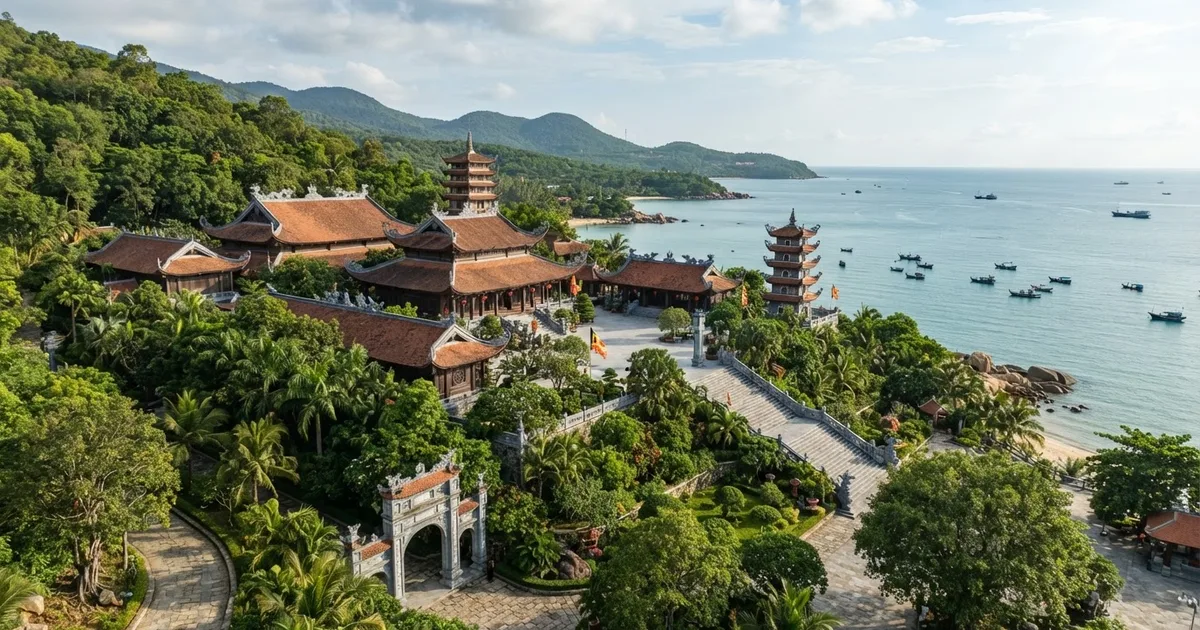
Yes — Nguyen Trung Truc Temple is worth visiting if you are already exploring Phu Quoc's far north. It is free to enter, listed as open 24 hours a day (typically staffed from 06:00 to 18:00), and rewards a 20–30 minute stop with quiet grounds, traditional Vietnamese architecture, and the story of one of southern Vietnam's most revered resistance heroes. At 20–25 km from Duong Dong, however, it works best as a short pause between Bai Dai beach and Ganh Dau Cape — not as a trip on its own.
Who Was Nguyen Trung Truc? The Hero Behind the Temple
Before you decide whether the temple is worth your time, it helps to know whose name is on the gate. Nguyen Trung Truc was a fisherman-turned-guerrilla leader born in the Rach Gia region around 1837, who became one of the most celebrated figures of Vietnamese resistance against French colonial forces in the late 1860s. His most famous exploit came in 1861, when his fighters staged a daring night raid and burned the French river warship L'Esperance — an act of defiance so bold that it is still taught in Vietnamese schools today.
For several years Nguyen Trung Truc and his men used the tangled coastlines and islands of what is now Kien Giang province — including the area around Ganh Dau on Phu Quoc's northwest tip — as bases for hit-and-run attacks. Captured by the French in 1868, he was executed in Rach Gia and, according to well-known accounts, refused under interrogation to give up a single name, reportedly declaring that as long as Vietnam had grass and Vietnamese people, there would be resistance. That defiance turned him into a folk hero, and across southern Vietnam he is venerated almost as a guardian spirit.
The temple at Ganh Dau is one of several shrines built in his honor, and its location is no accident: this quiet corner of the island, facing the open sea toward Cambodia, is closely tied to his story. That is why the site feels less like a tourist attraction and more like a place of genuine remembrance — local families come to burn incense, and during the annual memorial days the temple fills with pilgrims, staying open day and night.
Where Is the Temple and How Do You Get There?
Nguyen Trung Truc Temple sits in Ganh Dau commune at Phu Quoc's northwestern tip, close to both Bai Dai (the long, quiet beach often called one of the island's best) and Ganh Dau Cape, where you can look across the water toward the Cambodian coast. It is a genuinely remote-feeling spot: the road out of Duong Dong passes pepper farms and national park forest before opening up near the coast. Approximate distances:
| Starting point | Distance | Typical travel time |
|---|---|---|
| Duong Dong town center | 20–25 km | 35–45 minutes by motorbike |
| Bai Dai beach | ~1 km | 3–5 minutes |
| Ganh Dau Cape viewpoint | ~3–4 km | About 10 minutes |
| Phu Quoc International Airport | ~35 km | Roughly 50–60 minutes |
| An Thoi / southern tip | ~55–60 km | 1.5 hours or more |
The roads all the way to Ganh Dau are paved and in good condition, so any standard scooter handles the trip easily. A rented motorbike (typically around $6–10 per day on Phu Quoc) is by far the most flexible option and lets you chain the temple together with the other north-island stops. If you prefer not to ride, a taxi or private car from Duong Dong runs roughly $15–20 each way — which is exactly why most visitors combine the temple with a full north-island loop rather than making the drive twice. Parking at the temple is free, though a small tip for the attendant is appreciated.
What You'll See: Architecture, Altars, and Atmosphere
The temple is a classic example of southern Vietnamese religious architecture, and its traditional design is one of the main reasons tourists and locals alike make the trip. You enter through a decorated gate into a shaded courtyard, then reach the main hall with its curved tiled roof, dragon motifs, and warm red-and-gold detailing. Inside, the altar to Nguyen Trung Truc stands at the center, usually layered with fruit offerings, flowers, and slowly burning incense coils. The site was built in 1993 and, after a thorough renovation, reopened to the public in October 2016 — and it shows, because visitors consistently describe the grounds as beautifully maintained.
What surprises most first-time visitors is the atmosphere. Despite drawing thousands of visitors each year, the temple rarely feels busy outside festival periods; it is described again and again as peaceful, tranquil, and sacred — one of the holiest places on the island. You will often share the courtyard with a handful of local worshippers rather than tour groups. The sea breeze coming off the nearby coast, the smell of incense, and the near-silence (apart from distant roosters and the odd motorbike on the Ganh Dau road) make it a genuinely restorative stop, even for travelers with no particular interest in temples.
Opening Hours, Admission, and the Best Time to Visit
Here is the practical picture. The island's official tourism listing shows the temple as open 24 hours a day, and during the Nguyen Trung Truc memorial days it truly is — staying open day and night so pilgrims can pay their respects at any hour. On ordinary days, however, a reliable 2026 guide puts the practical visiting window at roughly 06:00 to 18:00, when the grounds are tended and the incense table is staffed. Admission is free at all times; there is no ticket booth, only an optional donation box that helps with upkeep.
| When | Access | Notes |
|---|---|---|
| Normal days | ~06:00–18:00 | Quietest before 09:00 and after 16:00 |
| Tourism portal listing | 24 hours | Grounds technically accessible at all times |
| Memorial festival days | Day and night | Pilgrims, ceremonies, and the biggest crowds of the year |
For the best experience, come early in the morning when the light is soft, the air is cool, and you may have the courtyard to yourself — or in the late afternoon, when you can continue on to Ganh Dau Cape for sunset over the Cambodian horizon. Weather-wise, the dry season from November to April offers the calmest seas and clearest skies in the north of the island. If your trip happens to coincide with the temple's memorial festival, it is worth adjusting your plans: watching hundreds of locals in their finest clothes offering incense is a cultural experience far richer than a quiet weekday visit.
So, Is Nguyen Trung Truc Temple Worth Visiting? An Honest Verdict
Reviews of the temple split in a very consistent way, and it is worth understanding both sides before you ride 25 km. On one hand, visitors call it peaceful, tranquil, beautifully maintained, and even a "must see" — praise that many bigger, more famous attractions on the island do not earn. On the other hand, some travelers point out that it is far from the city center and only takes about 15 minutes to see, so it may not justify the travel time if you are not already nearby. Both camps are right, which is why the honest answer depends entirely on what else is on your itinerary that day.
You'll love it if…
- You are already doing the north-island loop — the temple sits about 1 km from Bai Dai and a few minutes from Ganh Dau Cape, so it adds almost zero extra driving.
- You enjoy culture and history: the story of Nguyen Trung Truc is one of the most compelling on the island, and the temple is one of its holiest places.
- You want a free, uncrowded, 20–30 minute stop that photographs beautifully in morning light.
- You are traveling by motorbike and value quiet roads — the ride to Ganh Dau is arguably as rewarding as the destination.
It's a poor fit if…
- You are staying in An Thoi or the far south — at 55–60 km each way, the temple alone cannot justify that drive.
- You expect a large temple complex like those on the mainland; this is a simple, small shrine, not a half-day attraction.
- You have only a short stay and no plans in the north — spending 1.5–2 hours round trip from Duong Dong for a 15-minute look is a poor trade.
- You have no interest in religious sites; there is no beach, cafe, or entertainment attached to the temple itself.
Our bottom line: as a standalone destination, Nguyen Trung Truc Temple is a 5 out of 10. As part of a north Phu Quoc day trip, it is a 9 — free, atmospheric, historically rich, and perfectly placed. Plan it as a stop, not a destination, and you will not be disappointed.
Build a North-Island Day Around the Temple
The smartest way to visit is to fold the temple into a full day in Phu Quoc's north, where several of the island's headline sights sit within a few kilometers of each other. A realistic loop from Duong Dong looks like this:
- 07:30–08:00 — Leave Duong Dong by motorbike; the 20–25 km ride north takes 35–45 minutes on quiet, scenic roads.
- 08:15 — Nguyen Trung Truc Temple: 20–30 minutes in the cool morning, before tour vehicles arrive and before the midday heat.
- 09:00 — Bai Dai beach, about 1 km away: one of the island's longest and calmest stretches of sand, good for a swim or a coconut coffee at a beach shack.
- 10:30 — Ganh Dau Cape viewpoint, a few minutes further: on clear days you can see the Cambodian coastline across the water.
- 12:00 — Lunch near Ganh Dau village or head toward Rach Vem fishing village on the north coast, famous for its stilted seafood restaurants and starfish in the shallows.
- Afternoon — VinWonders Phu Quoc and Vinpearl Safari (both in the Bai Dai area) if you are traveling with family, or a pepper farm stop on the road back south.
- 17:30 — Back in Duong Dong in time for sunset and the night market.
Done this way, the temple costs you half an hour of a day you were already spending in the north — which is exactly the level of commitment this site deserves.
Nguyen Trung Truc Temple vs Ba Pagoda: Which Should You Choose?
Travelers researching Phu Quoc's spiritual sites almost always come across two names: Nguyen Trung Truc Temple in the far north and Ba Pagoda in Duong Dong itself. They offer completely different experiences, and choosing between them is mostly a question of where you are staying.
| Nguyen Trung Truc Temple | Ba Pagoda | |
|---|---|---|
| Location | Ganh Dau commune, northwest coast | 44 Vo Thi Sau, central Duong Dong |
| Distance from Duong Dong | 20–25 km | Walkable from most town hotels |
| Dedicated to | Hero Nguyen Trung Truc, resistance leader | Goddess Thuy Long Thanh Mau, whose legend the pagoda preserves |
| Known for | Peaceful setting, traditional architecture, one of the island's holiest places | Praying for peace and good fortune; a famous, sacred site |
| Best festival time | Memorial days, when it opens day and night | Full moon of the first lunar month, with a grand worship ceremony and traditional festivals |
| Time needed | 20–30 minutes | 15–30 minutes |
| Admission | Free | Free |
Ba Pagoda is the easier choice: it sits in the middle of Duong Dong, so you can duck in for 20 minutes between the market and the beach, and it is an easy and worthwhile stop if you are already nearby. Like the northern temple, though, it is not a place to plan a full day around. If you are based in town, Ba Pagoda is your default; if you are heading north for Bai Dai anyway, Nguyen Trung Truc Temple is the more memorable and atmospheric of the two. Many visitors with a full week simply do both.
Temple Etiquette and Practical Tips
Because this is a working place of worship rather than a staged attraction, a little courtesy goes a long way. Dress modestly, covering shoulders and knees; speak quietly in the main hall; and remove your shoes if you step up onto the altar platform. Never point your feet toward the altar when sitting, and ask before photographing worshippers up close. Incense sticks are usually available near the entrance — light them with both hands and place them in the urn as a small gesture of respect, even if you share no faith.
One last practical note: the temple's free admission and 24-hour listing make it forgiving to visit at almost any time, but the grounds are at their best — and their most photogenic — in the first two hours after the 06:00 opening, when low sunlight hits the roof tiles and the incense smoke hangs in the cool air.
Frequently Asked Questions
Is there an entrance fee for Nguyen Trung Truc Temple?
No. Admission is completely free in 2026, with no ticket booth or mandatory charge. There is an optional donation box that contributes to the upkeep of the grounds, and most visitors leave a small amount — roughly 10,000–20,000 VND (under $1) is a normal, appreciated gesture.
What are the opening hours?
The island's tourism site lists the temple as open 24 hours a day. In practice, the grounds are tended and most welcoming from about 06:00 to 18:00 on normal days. During the Nguyen Trung Truc memorial days, the temple stays open day and night to accommodate pilgrims arriving at all hours.
How far is the temple from Duong Dong?
About 20–25 km from Duong Dong town center, which takes 35–45 minutes by motorbike on fully paved roads. It sits in Ganh Dau commune on the island's northwest coast, roughly 1 km from Bai Dai beach and a few minutes' ride from the Ganh Dau Cape viewpoint.
How much time should I allow for a visit?
Plan for 20–30 minutes, which is enough to see the gate, courtyard, and main hall and absorb the atmosphere. Some visitors cover the site in about 15 minutes. It is a quick-stop attraction by design — most people pair it with Bai Dai and Ganh Dau Cape rather than visiting it alone.
When is the best time of year to visit?
The dry season from November to April offers the best weather in the island's north. Within any day, arrive before 09:00 or after 16:00 for cooler temperatures and softer light. If your trip coincides with the annual memorial festival, prioritize it — the temple opens day and night and draws its biggest crowds of the year.
Can I combine the temple with Bai Dai beach?
Absolutely — it is the ideal combination. Bai Dai is only about 1 km away, so you can visit the temple in the cool morning, then be on the sand within five minutes. Add the Ganh Dau Cape viewpoint and Rach Vem fishing village and you have a complete north-island day with barely any extra driving.
Is the temple worth visiting if I'm staying in Duong Dong?
Only if you are already planning a north-island trip. Because the temple takes just 15–30 minutes to see and lies 20–25 km from town, most travelers agree it is not worth the 1.5–2 hour round trip on its own. If you want a spiritual stop in town instead, Ba Pagoda at 44 Vo Thi Sau is free, central, and takes a similar amount of time.
Who was Nguyen Trung Truc?
He was a Vietnamese resistance leader from the Rach Gia region, born around 1837, famous for burning the French warship L'Esperance in 1861 and for refusing to betray his comrades before his execution in 1868. He used the Ganh Dau area as a base, which is why the temple honoring him stands on Phu Quoc's northwest coast.
Planning a north Phu Quoc day trip to Nguyen Trung Truc Temple, Bai Dai, and Ganh Dau Cape? Sabrina Rental can set you up with a reliable motorbike, a private car with driver, and honest local advice on timings, fuel stops, and the best order for your loop. Message us and we'll help you build the perfect island itinerary.
Contact Sabrina Rental