Money questions come up every week at check-in. Where is the nearest ATM? Will my card work? Is the airport exchange worth it? Can I pay in dollars at the night market? This is my honest answer — built from watching a few hundred guests navigate exactly these questions, including a couple who arrived on a Sunday evening with nothing but a Revolut card and 200 baht in their pocket.
Tran Hung Dao street cluster, ~350–500 m from the homestay.
Tiem vang on Tran Hung Dao beat airport rates. Bring USD or EUR.
A few stalls will take it; change in VND at a bad rate. Use dong.
Market, most restaurants, tuk-tuks — cash only. Co.opmart takes cards.
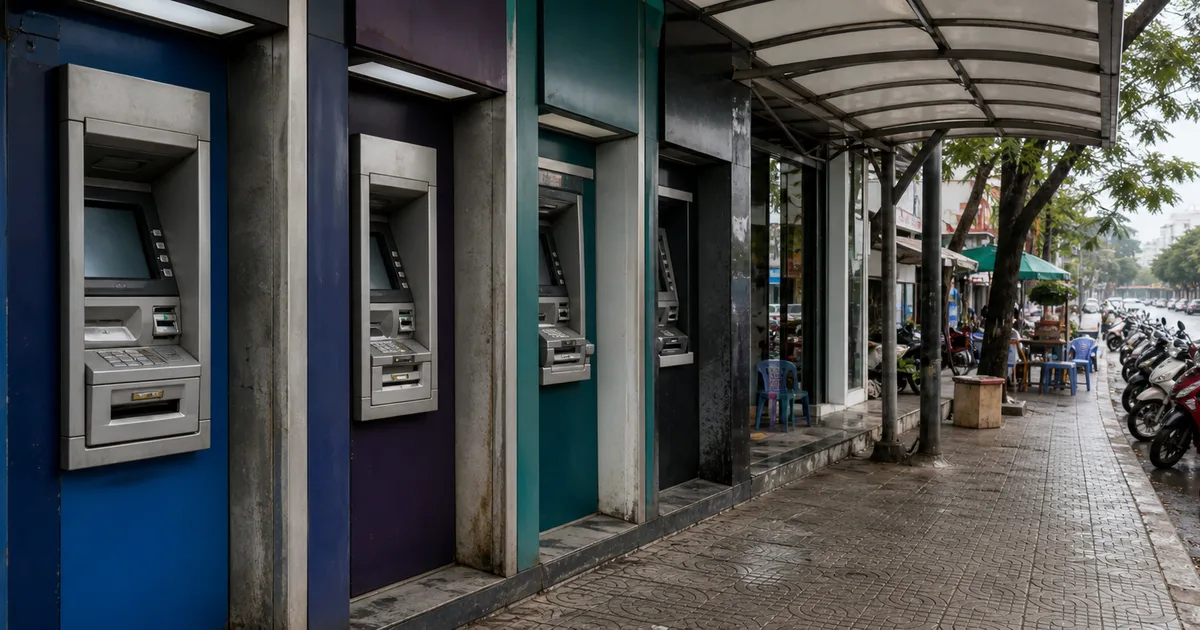
The ATMs on Tran Hung Dao — What to Expect
The main ATM concentration in Duong Dong runs along Tran Hung Dao street — the town's central road — over a stretch of roughly 600 metres between the Dinh Cau roundabout and the junction near Co.opmart. That cluster is your go-to. From Sabrina Homestay on Nguyen Du, it is about 350–500 metres on foot: turn left out of the gate, walk up to Tran Hung Dao, turn right, and you will start seeing bank signage within a few minutes. Most guests manage it in 5–7 minutes.
There are also a few standalone machines in front of some larger shops on the same street, but I would not rely on them for large withdrawals — they tend to run out of cash on busy weekends, and some only dispense 500,000-dong notes, which can be inconvenient if you need to pay a tuk-tuk driver.
The opening hours for the ATM booths themselves are 24 hours, but the bank branches behind them are open weekdays roughly 8:00 AM to 5:00 PM and half-day Saturday. For anything beyond a cash withdrawal — like a card problem that needs resolving — you need to be there during branch hours.
Vietcombank, BIDV, Techcombank — Which One for Foreign Cards?
All three main banks on Tran Hung Dao accept international Visa and Mastercard. In practice, Vietcombank and BIDV have the most consistently reliable connections for foreign cards based on what guests report back to me. Techcombank works fine too — I would not go out of my way to avoid it.
Connection drops are the real issue on this island, not which bank you pick. Some mornings every machine on the strip declines cards for 20 minutes and then everything works again. If the first ATM says "unable to process," walk 50 metres to the next one. Nine times out of ten it goes through immediately.
| Bank | Location on Tran Hung Dao | Foreign cards | Notes |
|---|---|---|---|
| Vietcombank | Mid-section, ATM booth | Visa, Mastercard, UnionPay | English interface, generally reliable connection |
| BIDV | Near Dinh Cau end | Visa, Mastercard | Higher per-transaction cap on some machines |
| Techcombank | Central stretch | Visa, Mastercard | Works well; branch nearby if you need help |
| Agribank | Various spots around town | Visa, Mastercard | Less consistent for international cards; use as backup |
Per-transaction withdrawal limits vary but most machines cap at 2,000,000–5,000,000 VND per transaction. Some guests doing a bigger cash-up for a week on the island do two withdrawals at the same machine — the second one usually goes through. Just be aware that fees stack per transaction, so check your bank's fee structure before you travel. See our full FAQ for general money tips on Phu Quoc, or find us on the map to plan your route to the ATM cluster from our street.
Airport Exchange vs. Duong Dong Town Rates
Phu Quoc Airport sits about 9–10 km southeast of Duong Dong. The exchange counters inside arrivals are staffed and convenient, but their rates are typically less favourable than what you will find in town. The margin is not dramatic — we are talking about the difference on a $200 exchange that might be 30,000–60,000 VND in your favour if you wait for town. Whether that is worth it depends on how much you are exchanging and how patient you feel after a flight.
My suggestion: change just enough at the airport to cover a taxi to town (200,000–300,000 VND is plenty for most routes) plus your first meal or two. Then do the rest at a gold shop or ATM once you have settled in. The airport taxi to Duong Dong takes roughly 20–25 minutes by road.
One more thing about the airport: there are also ATMs airside and in the arrivals hall. If you have a card with low foreign fees (Wise, Revolut, Charles Schwab, etc.), withdrawing VND from an airport ATM may beat the exchange counter rate even after the machine fee. Do the maths for your specific card before you queue at the exchange counter.
Where to Exchange Currency in Duong Dong
The gold and jewellery shops — tiem vang in Vietnamese — are the standard place locals and regular visitors exchange foreign cash. Several of these shops sit on and just off Tran Hung Dao, and most display a rate board outside. USD and EUR are exchanged without any fuss; other currencies are harder. If you have British pounds, Australian dollars, or anything less common, call ahead or ask at the shop before assuming they will take it.
A few informal exchange points exist near the Dinh Cau Night Market entrance, particularly in the small tourist shops along the approach road. Convenient at 6 PM when you want dong for dinner and do not want to walk to a bank. The rates are workable — not the best you will find, but not a disaster for small amounts.
The banks on Tran Hung Dao will exchange currency too, but the process involves a passport, a form, and a wait. For amounts over the equivalent of a few hundred USD and where you want a guaranteed clean transaction, the bank is fine. For normal day-to-day amounts, the gold shops are quicker and the difference is small. See our town map guide to find these spots on foot.
Does USD Cash Work Near the Night Market?
Technically yes, in a few places. Practically, not really.
Some stalls around the Dinh Cau Night Market entrance and a handful of souvenir shops will take USD bills and hand you change in VND. But the implied exchange rate is rough — typically worse than the gold shop rate — and the change arithmetic happens fast in a loud market environment. Easy to lose track of whether you got the right amount back.
The food stalls themselves — the ones grilling the squid and scallops, the pho places on the side streets, the banh mi carts at 7 AM — are cash-only and expect VND. No exceptions. If you try to pay in USD at a food stall, the vendor will either wave it away or try to work out a rate on the spot, and either way you are holding up the queue and creating confusion for both of you.
My straightforward advice: get dong before you go to the night market. The ATMs on Tran Hung Dao are a 5–8 minute walk from the market entrance. Do it in the afternoon while you are out exploring; do not leave it until you are hungry and standing at a seafood stall at 6 PM. Read more about navigating the area in our Duong Dong town map for guests.
Card Payments Around Duong Dong — Where They Work
Card acceptance has grown in the last two years but remains unreliable enough that cash is still essential. Co.opmart on Nguyen Trung Truc accepts Vietnamese debit cards and usually Visa/Mastercard at the main checkout — though the terminal drops connection occasionally, so the staff will just ask you to pay cash if it fails. Read more in our supermarket and convenience store guide.
Larger tourist-facing restaurants on the main road sometimes have card terminals, but the small local eateries off Tran Hung Dao — the places where you get the best food at the lowest prices — are cash only, full stop. So are the minimarts near the night market, most scooter rental shops, most pharmacies, the morning market, and every food stall on the island.
QR code payments (via VietQR) are growing fast among local vendors, but as a foreign visitor you typically cannot link an overseas card to a Vietnamese QR system without a Vietnamese bank account. Some guests who are staying for a month or more open a Techcombank account locally and use it for everything — genuinely convenient once set up.
Practical Tips Before You Land
A few things that save guests the most stress:
Tell your bank you are travelling. Not because banks always block cards without notification — many do not anymore — but because it takes ten minutes to do and avoids a possible problem on your first evening here when you cannot reach anyone at home to sort it out. Worth doing.
Arrive with some cash already in hand. Even 50–100 USD converted at home is enough to cover a taxi, dinner, and the first morning. The airport exchange has long queues on busy arrival days and the rates, as mentioned, are not ideal.
Carry a mix of note sizes. 500,000-dong notes are useful for larger payments; 50,000 and 100,000-dong notes handle the night market, banh mi, coffee, and tuk-tuks without creating change problems for the vendor. ATMs often dispense only 500,000-dong notes, so if you have time, stop at a gold shop and ask them to break a note or two when you exchange. Most will do this without complaint.
Have a backup card. Preferably in a different network (if your main card is Visa, carry a Mastercard backup). Not common to need it, but ATM swallowing a card is a real thing that happens occasionally, and it is genuinely unpleasant to sort out without a fallback.
For the full picture of where everything is in relation to our place, check the food guide — the night market, market, and ATM zone are all in the same general area and easy to combine in one afternoon walk.