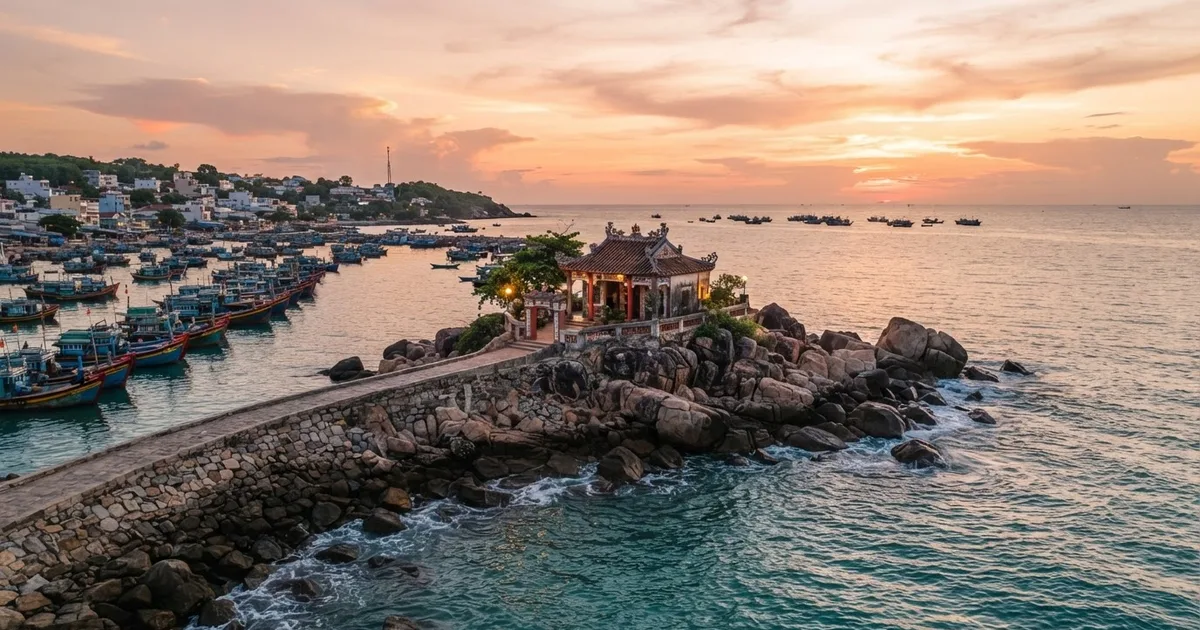
Yes, Dinh Cau Temple is worth visiting if you want a free, convenient sunset viewpoint in Duong Dong. Entry costs nothing, the shrine is open daily from approximately 7:00 AM to 8:30 PM, and most visitors need only 15 to 30 minutes. Come between 4:30 PM and 6:00 PM for the best chance of seeing the sun set over the water, although you should expect a compact temple visit rather than a large attraction.
Is Dinh Cau Temple worth visiting?
Dinh Cau Temple is worth visiting for travelers who are already staying in or passing through Duong Dong. It is not a full-day attraction and does not have a large museum, extensive grounds, or a long sightseeing route. Its appeal comes from three things that are difficult to combine elsewhere in the town: a locally important shrine, a rocky coastal setting, and a free view toward the sea at sunset.
The temple stands on a rocky cape by the beach and lighthouse, close to the center of Duong Dong Ward. VnExpress places the shrine about 200 meters west of Duong Dong Town, while other local listings give the address as Quarter 2, Duong Dong Town, Phu Quoc, Kien Giang 92500, Vietnam. This central position makes it an easy addition to an evening walk, dinner plan, or visit to the nearby waterfront.
The honest verdict is that Dinh Cau is a worthwhile short stop, not a major landmark that needs several hours. Local travel guides generally estimate 15 to 20 minutes, while other guides allow 30 to 45 minutes for exploring and waiting for sunset. Travelers who dislike religious sites, short viewpoints, or busy town attractions may find it underwhelming. Travelers seeking a no-cost cultural stop with a memorable coastal setting are likely to consider it good value because the price is zero and the time commitment is small.
A good fit for
Visitors staying in Duong Dong, sunset photographers, first-time visitors, couples, families wanting a short stop, and anyone looking for a free viewpoint.
Less suited to
Travelers expecting a large historical complex, a quiet beach, an all-day cultural experience, or a guaranteed uninterrupted sunset view in poor weather.
What is Dinh Cau Temple known for?
Dinh Cau Temple is a coastal shrine associated with local beliefs, seafaring, and prayers for safety and good fortune. It is often described as the most visited shrine on Phu Quoc and is also known as a spiritual site that visitors come to see before walking out to the rocky cape. The setting beside the sea gives the small temple a stronger sense of place than an inland building would have.
The shrine is sometimes discussed together with Ba Pagoda, another famous and sacred temple on Phu Quoc where people pray for peace and good fortune. They are useful additions to a cultural itinerary, but Dinh Cau Temple itself is the attraction most directly connected with the rocky shoreline and sunset viewpoint. Check local signs and follow any instructions about where visitors may stand, take photographs, or enter.
For visitors, the experience is primarily visual and atmospheric. You can observe the shrine, walk around the accessible viewpoint, look toward the beach and sea, and watch the changing light in the late afternoon. It is best approached as a living place of worship rather than as a monument designed only for sightseeing. Keep conversations quiet near worshippers and avoid treating religious objects as photo props.
Practical expectation: Dinh Cau Temple is compact. The temple, cape, lighthouse area, and nearby waterfront can be combined into one short outing, but the site alone is usually finished in 15 to 30 minutes.
When should you visit Dinh Cau Temple?
The best time to visit is from 4:30 PM to 6:00 PM, with around 5:30 PM often recommended for sunset views. Arriving before the final light gives you time to locate the entrance, look around the shrine, and choose a safe viewing position before the sky becomes colorful. Sunset times change during the year, so treat 5:30 PM as a useful planning guide rather than a fixed daily event.
Dry-season travel from November to April generally offers the most favorable conditions for visiting. Clearer skies improve the chance of seeing the sunset and make the coastal viewpoint more comfortable. Even during the dry season, clouds can cover the horizon, so Dinh Cau should be considered a good sunset opportunity rather than a guarantee.
A morning visit is also possible. Visitor reports confirm that the temple can be visited in the morning, and the admission remains free. Morning is better for travelers who want a quieter cultural stop, who have an island tour scheduled later, or who prefer to avoid gathering at sunset. The light is different, however, and you will not get the main reason many visitors choose the site.
| Visit time | What to expect | Best for |
|---|---|---|
| 7:00 AM to late morning | Cooler conditions, morning light, and a short shrine visit | Early risers and travelers avoiding sunset crowds |
| 4:30 PM to 5:30 PM | Time to explore before the sun reaches the horizon | First-time visitors and photographers |
| Around 5:30 PM to 6:00 PM | Warm sunset light and the busiest viewing period | Sunset seekers and couples |
| After sunset until closing | Evening atmosphere, but limited natural light | People already in Duong Dong for dinner or a walk |
Opening hours, admission, and how long to stay
Dinh Cau Temple is free to enter, so there is no ticket counter or admission budget to plan for. The most frequently reported hours are 7:00 AM to 8:30 PM daily. Trip.com also lists 07:00 to 20:30, while some sources give a closing time of 8:00 PM and one listing gives 6:00 PM. Because these published hours conflict slightly, plan to arrive before 8:00 PM if you are visiting in the evening, and confirm locally if your itinerary depends on a late visit.
Allow 15 to 30 minutes for a normal visit. That covers walking to the shrine, observing the religious setting, taking photographs from permitted areas, and looking over the coast. Allow 30 to 45 minutes if you arrive early for sunset or want time for a slower visit. The temple does not require a full afternoon, and adding it to a longer Duong Dong route is usually more efficient than traveling across the island only for this one stop.
| Planning detail | Practical answer |
|---|---|
| Admission | Free; no entrance fee or advance ticket is required. |
| Commonly listed hours | 7:00 AM to 8:30 PM daily. |
| Safer evening arrival | Before 8:00 PM because some listings show an earlier closing time. |
| Typical visit | 15 to 30 minutes. |
| Visit including sunset | 30 to 45 minutes, depending on arrival time and weather. |
There may be no charge for entry, but visitors should still budget for transport and any food or drinks purchased nearby. Do not confuse free admission with free parking or guaranteed access to every part of the cape; local conditions and access arrangements can change.
Where is Dinh Cau Temple and how can you include it in a day?
The temple is in Quarter 2 of Duong Dong Town, Phu Quoc, Kien Giang 92500, Vietnam. It is near the center of Duong Dong Ward, on a rocky cape by the beach and lighthouse. Bach Dang Street is also used in location listings. On a map, search for Dinh Cau Temple or the Dinh Cau coastal area rather than relying only on a broad search for Duong Dong.
Its central location makes the temple particularly practical for visitors staying in Duong Dong. You can schedule it after an afternoon at the local market or waterfront, before dinner, or as the final stop on a town walk. Arrive around 4:30 PM, spend 15 to 20 minutes seeing the shrine and cape, then remain nearby for sunset. This plan avoids making a special long-distance journey for a site that is intentionally compact.
Visitors based outside Duong Dong can combine Dinh Cau with other stops rather than visiting alone. A south-island day that includes a beach or cable-car excursion can finish in town for sunset, provided the return journey is realistic. Those staying in the north should check traffic and travel time before promising themselves a fixed sunset arrival. The attraction is free, but a missed sunset caused by an overpacked itinerary is not easily recovered.
Simple visit plan
- Arrive in the Duong Dong waterfront area by about 4:30 PM.
- Walk to the rocky cape and enter respectfully.
- Spend 15 to 20 minutes observing the shrine and viewpoint.
- Remain in an appropriate public viewing area for sunset around 5:30 PM.
- Leave before closing if your schedule depends on the earlier 8:00 PM listing.
What should visitors know before going?
Dinh Cau is a religious site, not simply a scenic platform. Wear clothing that is comfortable but respectful, especially if you intend to enter a worship area. Avoid loud behavior, smoking near the shrine, touching religious objects, or blocking people who are praying. Ask before photographing worshippers or ceremonies. These small choices help preserve the atmosphere for residents and other visitors.
The cape is exposed to the sea, so use care around edges, wet surfaces, and uneven rock. Children should remain close to an accompanying adult, particularly when the area is busy or the light is fading. Comfortable footwear is sensible even though the visit is short. Bring a phone or camera only if you can use it without stepping into restricted areas or disturbing worship.
Sunset is the most popular period, so the viewpoint may feel busier between 5:00 PM and 6:00 PM. Arriving at 4:30 PM gives you a better chance to look around before the busiest moment. On cloudy or rainy days, the spiritual and cultural visit can still be worthwhile, but the sunset may be muted or invisible. A clear-weather forecast improves your odds without guaranteeing the result.
Do not expect a ticketed attraction with staff providing a formal tour, extensive explanations, or a large collection of exhibits. The value comes from the location, the local religious importance, and the convenience. If you want deeper historical context, consider reading about Phu Quoc's coastal worship traditions or asking a local guide to explain the shrine respectfully.
What can you do nearby after the temple?
Dinh Cau Temple works well as the beginning or end of a Duong Dong evening. After the visit, you can continue along the nearby waterfront, find a meal in town, or explore other central streets. Because the shrine is close to the town center, there is no need to spend the entire evening at the temple itself. This is one reason local travel guides describe it as an easy and worthwhile stop when you are already in the area.
A visit to Ba Pagoda can add another spiritual stop to a cultural itinerary, although you should check its location and opening arrangements separately rather than assuming the two sites have identical access. Travelers interested mainly in food can combine the sunset with a local market or seafood dinner. Travelers interested in photography can arrive early, observe the changing coastal light, and continue walking after sunset.
The strongest nearby itinerary is usually simple: explore central Duong Dong during the late afternoon, visit Dinh Cau at around 4:30 PM, watch the sunset near 5:30 PM, and have dinner afterward. This arrangement uses the temple's free admission and central location without overestimating how much time the site itself requires.
Frequently Asked Questions
Is Dinh Cau Temple free to visit?
Yes. Dinh Cau Temple has free entry and visitors do not need to buy a ticket. You may still need to pay for transport, parking, food, or drinks nearby. Because it is a place of worship, follow local instructions and behave respectfully even though admission is free.
What are Dinh Cau Temple's opening hours?
Most current listings show Dinh Cau Temple open daily from 7:00 AM to 8:30 PM. Some sources list closing at 8:00 PM, and another listing gives 6:00 PM, so the published information is not completely consistent. For an evening visit, arrive before 8:00 PM and confirm locally if late access is important.
What is the best time to visit Dinh Cau Temple?
The best time is approximately 4:30 PM to 6:00 PM, especially if you want sunset. Around 5:30 PM is commonly recommended, but the exact sunset changes by date and clouds can obscure the horizon. Arrive at 4:30 PM to allow 15 to 20 minutes for the shrine before waiting for the view.
How long do you need at Dinh Cau Temple?
Most visitors need 15 to 30 minutes for the temple and rocky viewpoint. Allow 30 to 45 minutes if you plan to arrive early, take photographs, and wait for sunset. The site is compact, so it usually works best as part of a Duong Dong walking or dinner itinerary rather than as a half-day excursion.
Where is Dinh Cau Temple located?
Dinh Cau Temple is in Quarter 2, Duong Dong Town, Phu Quoc, Kien Giang 92500, Vietnam. It is near the center of Duong Dong Ward, on a rocky cape by the beach and lighthouse. VnExpress describes it as roughly 200 meters west of Duong Dong Town, and Bach Dang Street is also used in address listings.
Is Dinh Cau Temple suitable for children?
It can be suitable for children as a short family stop, but adults should supervise them closely near the rocky coastal edge and uneven surfaces. Visit in daylight or before the light fades, use appropriate footwear, and do not allow children to climb on restricted or wet rocks. The 15 to 30 minute visit length is manageable for most families.
Should you visit Dinh Cau Temple in the morning?
Yes, a morning visit is possible and admission is still free. Morning is useful if you want a shorter, quieter cultural stop or have an island tour planned for the afternoon. The main advantage of visiting later is the sunset between approximately 4:30 PM and 6:00 PM, so choose morning only if the spiritual setting matters more than sunset photography.
Is Dinh Cau Temple worth visiting in bad weather?
It can still be worthwhile for a brief look at an important coastal shrine, but do not expect a strong sunset viewpoint during heavy cloud or rain. The temple is free and normally takes only 15 to 30 minutes, so you can make a quick decision based on conditions. Take extra care on wet surfaces and exposed rocks during rain.
Planning a sunset visit or need help arranging transport around Phu Quoc? Contact Sabrina Rental for local advice, bookings, and practical island assistance.
Contact Sabrina