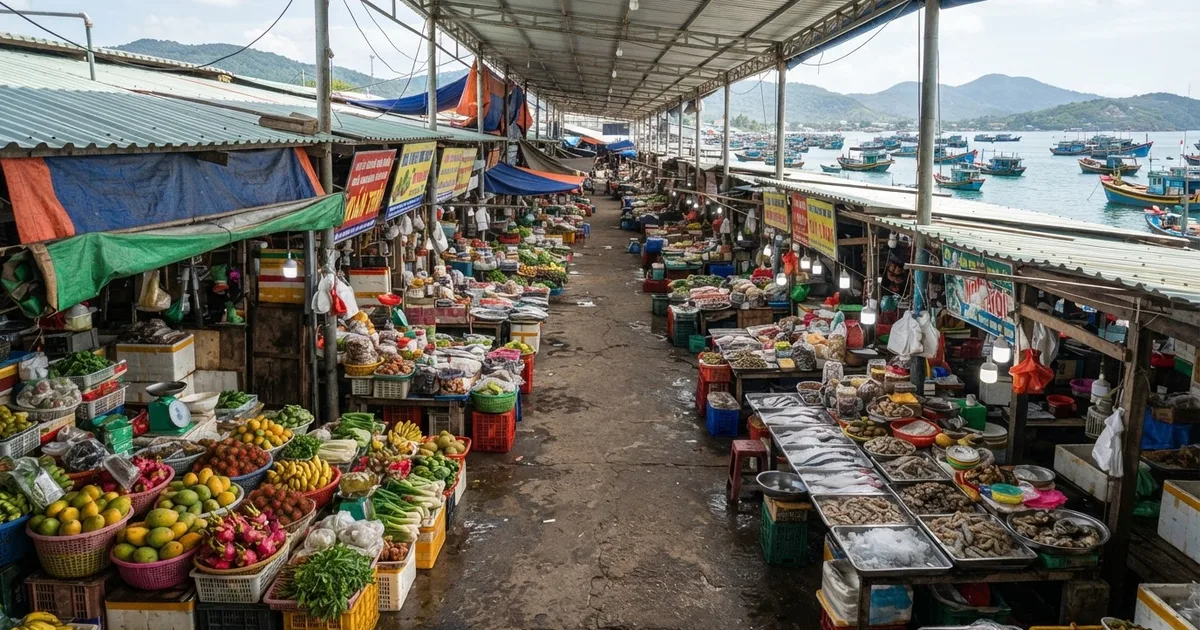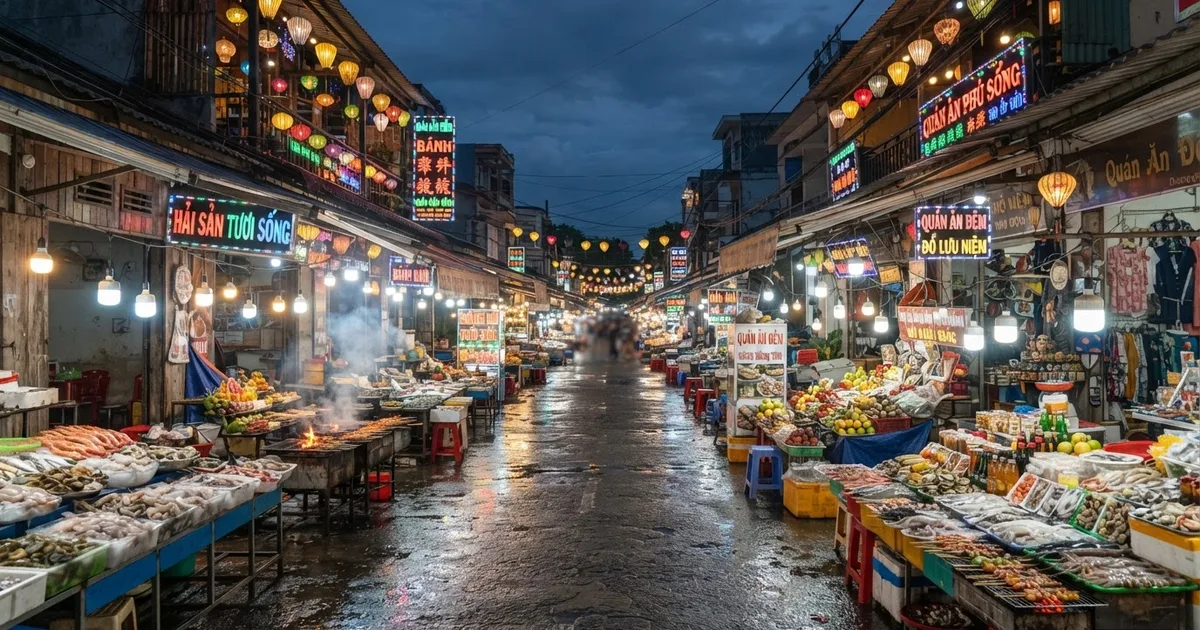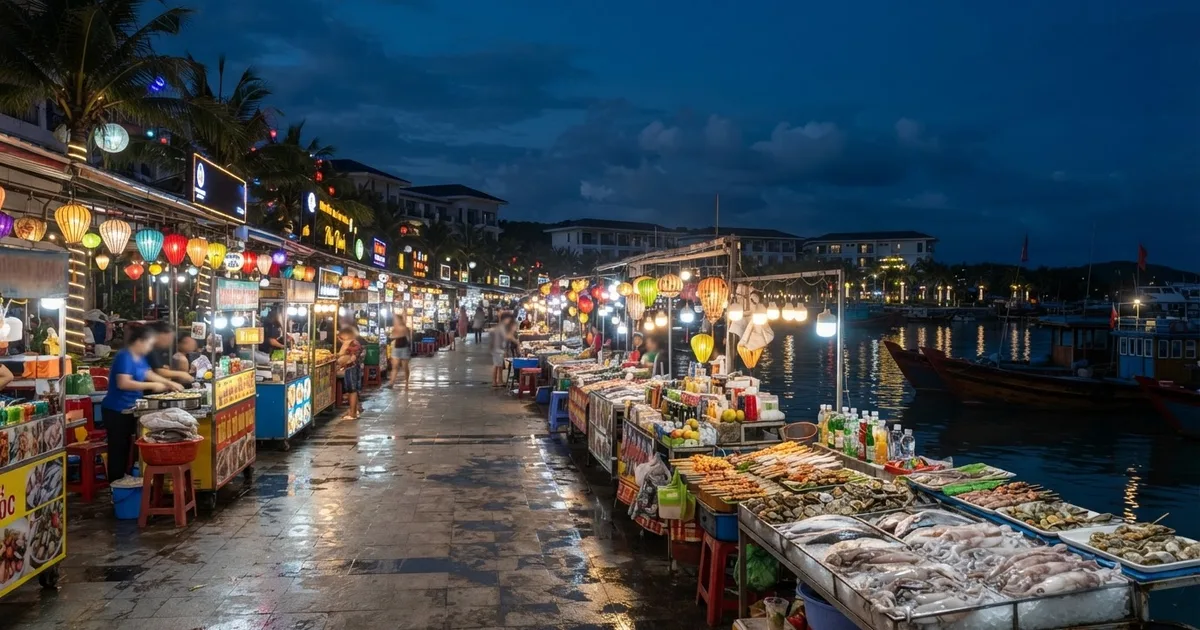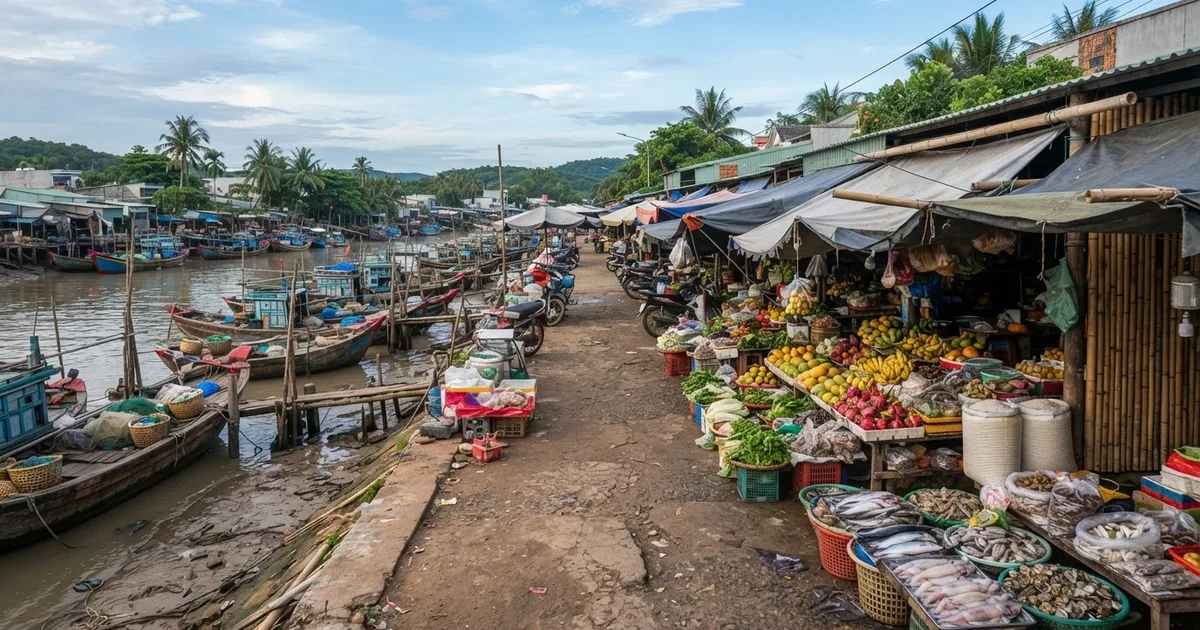
Cau Sau Market is an affordable seafood market on Nguyen Van Cu Street in An Thoi, southern Phu Quoc. It is listed as open 24 hours every day, but the most worthwhile time to visit is between 5:00 and 8:00 AM, when boats arrive and the roadside stalls are busiest. Expect fresh and dried seafood, snacks, produce, and simple meals, with typical seafood prices of about 100,000–1,000,000 VND per kilogram.
Where is Cau Sau Market and what is it like?
Cau Sau Market is located on Nguyen Van Cu Street in An Thoi, the main urban area in southern Phu Quoc. It is approximately 3 kilometers from An Thoi center, making it a practical short motorbike or taxi trip rather than a destination in the middle of the island. The market is also useful for visitors staying around the southern resorts who want to see where residents and resort staff buy everyday food.
Unlike a purpose-built indoor shopping hall, Cau Sau Market is known for products sold directly along the roadside. Seafood may be displayed in simple stalls, baskets, trays, or containers close to the road. This gives the market a working, local atmosphere, but it also means conditions are busiest and messiest during the early morning seafood arrival. Wear practical footwear and keep valuables secure while moving between stalls.
The market is primarily a place to buy food rather than a sightseeing attraction with fixed exhibits or formal visitor facilities. You may find fresh and dried seafood, vegetables, fruit, snacks, and cheap meals in the same general area. Availability changes according to the day's catch, season, weather, and individual sellers, so a product seen in one visit may not be available the next.
Practical expectation: “Open 24 hours” describes the market's listed operating schedule, not a guarantee that every seafood seller operates throughout the night. For the widest choice, plan to arrive between 5:00 and 8:00 AM.
When should you visit Cau Sau Market?
The best time to visit is early morning, especially from 5:00 to 8:00 AM. Boats arrive during this period, so fresh seafood is brought into the market and sellers are actively sorting and selling it. This is also when you are most likely to see the market at its most energetic, with residents shopping for the day and local food activity taking place around the roadside stalls.
An early visit is particularly useful if you want to choose from fresh fish, squid, or shellfish before the day's supply becomes limited. It is also the better option for travelers who want photographs of the market's working atmosphere. Ask permission before photographing people, boats, or close-up displays, especially when sellers are busy serving customers.
Cau Sau Market also operates in the afternoon, but it is generally less busy than in the morning. An afternoon visit can be more comfortable if you prefer a quieter walk or have no interest in seeing the landing-time trade. However, the range of fresh seafood may be different, and some morning sellers may have finished for the day. The market's listed 24-hour opening also makes it flexible for residents and shift workers, but late-night shopping should not be expected to offer the same selection as the morning.
| Visit time | What to expect | Best for |
|---|---|---|
| 5:00–8:00 AM | Peak activity as boats arrive; the strongest choice of fresh seafood. | Fresh catches, atmosphere, and serious food shopping. |
| Afternoon | Open and generally less busy than the morning; some products may be limited. | A calmer visit and flexible sightseeing plans. |
| Late evening or night | The market is listed as open 24 hours, but individual stalls and product availability can vary. | Convenience rather than the full market experience. |
What can you buy at Cau Sau Market?
Fresh and dried seafood are the main reasons to visit Cau Sau Market. Depending on the day's supply, shoppers may find fresh fish, squid, shellfish, and other locally traded seafood sold directly from roadside vendors. Prices are commonly reported at approximately 100,000–1,000,000 VND per kilogram. The broad range reflects differences in species, size, freshness, preparation, and seasonal availability, so the lower end should not be treated as the price of every item.
Dried seafood is useful for visitors who want a more travel-friendly product. Dried squid, dried shrimp, and dried fish are associated with the wider An Thoi market area and are among the most practical local food purchases. Dried goods are easier to carry than fresh seafood, but they should still be wrapped securely, particularly if you are continuing to travel or staying in accommodation without a kitchen.
Other market goods include fresh produce and vegetables, snacks, and cheap prepared meals. You can use the market for everyday supplies rather than making a special seafood purchase. Local pepper and fish sauce are also good options if you want compact Phu Quoc food products to take home. Check packaging and travel regulations before carrying food across borders, and ask the seller how a product should be stored.
Good choice for
Fresh fish, squid, shellfish, dried squid, dried shrimp, dried fish, vegetables, local pepper, fish sauce, snacks, and inexpensive meals.
Less suitable for
Visitors looking for air-conditioned shopping, fixed prices on every item, a curated souvenir collection, or a quiet market with no roadside activity.
How much does seafood cost?
Typical seafood prices at Cau Sau Market are reported at 100,000–1,000,000 VND per kilogram. This is a useful planning range, but it is not a universal price list. A small shellfish purchase and a large, premium seafood purchase will naturally fall at different points within that range. Freshness, size, species, the day's catch, and whether the product is cleaned or prepared can all affect the final amount.
Before agreeing to buy, confirm the price and the unit. In a busy market, make sure you understand whether the quoted amount is per kilogram, per portion, or for the complete basket. If you are buying several items, ask for the total before the seafood is packed. Carry small Vietnamese notes when possible, as this makes modest purchases easier and avoids relying on change.
Cau Sau Market is known for affordable seafood, but low prices should not mean skipping basic checks. Look at the seafood you are buying, confirm the quantity, and ask how it will be packed for transport. If you do not have access to a refrigerator, buy only what you can use promptly. Travelers staying in a room without cooking equipment may find a prepared meal or a small portion more practical than a large fresh purchase.
| Purchase consideration | What to confirm |
|---|---|
| Price | Confirm the amount in VND and whether it is quoted per kilogram or per serving. |
| Quantity | Check the weight or total number of items before packing. |
| Preparation | Ask whether cleaning, cutting, or other preparation is included. |
| Storage | Ask for suitable wrapping and buy only what you can store safely. |
What food should you try near An Thoi Market?
Cau Sau Market and the wider An Thoi market area are useful for trying traditional breakfast dishes. Commonly mentioned options include Bun Quay, Bun Ca, and Banh Canh Cha Ca. These dishes are a practical way to eat locally after an early seafood-market visit, particularly if you are already in An Thoi before the resort breakfast period begins.
An Thoi Market also sells fresh produce, vegetables, seafood, and essential goods. The food selection makes it more than a place for visitors to purchase seafood: it is part of the everyday supply network for the local community. Look for simple portions and observe how local customers order. If a stall is crowded with residents during breakfast hours, that is often a useful indication that the food service is active and popular.
Do not expect every dish or ingredient to be available at every hour. Breakfast items are generally most relevant in the morning, while seafood availability follows the arrival and sale of the day's catch. If you want both a market walk and breakfast, an arrival between 6:00 and 8:00 AM gives you the best chance of combining them, although individual food stalls may keep their own schedules.
Cau Sau Market or An Thoi Market: which should you visit?
The names can be confusing because both markets are associated with southern Phu Quoc and seafood shopping. Cau Sau Market is specifically located on Nguyen Van Cu Street, about 3 kilometers from An Thoi center, and is especially associated with roadside seafood sales and affordable fresh catches. An Thoi Market is a broader everyday market reference, with fresh and dried seafood, vegetables, essential goods, breakfast dishes, and local products.
Choose Cau Sau if your priority is seeing a seafood-focused roadside market and shopping around the early-morning arrival period. Choose An Thoi Market if you want to combine seafood with breakfast, vegetables, household essentials, local pepper, or fish sauce. Depending on your route and time, visiting both can give you a more complete view of food shopping in southern Phu Quoc.
| Market | Main reason to visit | Best suited to |
|---|---|---|
| Cau Sau Market | Fresh and dried seafood sold directly along the roadside; affordable local shopping. | Travelers focused on seafood and early-morning market activity. |
| An Thoi Market | Fresh and dried seafood, produce, vegetables, essential goods, breakfast, pepper, and fish sauce. | Visitors wanting a wider everyday market experience. |
Cau Sau is a poor fit for travelers who want a formal tourist attraction, guaranteed English-language service, or a single indoor venue with clearly displayed prices. It is also less suitable for a last-minute souvenir stop if you are carrying fresh food without cold storage. In those cases, dried seafood or packaged local products from the wider An Thoi area are usually easier to manage.
How to plan a responsible and practical visit
Use the market as a working food market, not just a photo location. Keep to the side of the road and leave room for sellers, shoppers, and deliveries. Early morning is the busiest period, so be especially aware of motorbikes and people carrying baskets or seafood containers. A small reusable bag can help with dry goods, while fresh seafood should be packed as the vendor recommends.
Cash in Vietnamese dong is the safest payment method for small roadside purchases. Learn the price and quantity before accepting a bag, and keep a note of the total if you are buying several products. If you do not speak with confidence, showing the desired quantity and using a calculator can reduce misunderstandings. Do not handle seafood without permission.
For a self-catering stay, visit early, compare a few stalls, buy a manageable quantity, and return directly to accommodation with suitable refrigeration. For a hotel or resort room without a kitchen, focus on breakfast, snacks, dried seafood, pepper, fish sauce, or a ready-to-eat meal. Visitors staying near Grand World or Vinpearl resorts may find the market practical for everyday food shopping, but the approximately 3-kilometer distance from An Thoi center and the much greater distance from northern resorts should be included in the day's transport plan.
Before you go
- Plan an arrival between 5:00 and 8:00 AM for the liveliest seafood trade.
- Carry Vietnamese dong and keep smaller notes available.
- Bring a reusable bag for dry goods and allow space for fresh-food packaging.
- Confirm the price, unit, quantity, and preparation before paying.
- Bring a cooler or return quickly if buying seafood for later.
- Choose dried seafood, pepper, or fish sauce if you cannot refrigerate fresh products.
- Ask before taking close-up photographs of sellers or their goods.
Is Cau Sau Market worth visiting?
Cau Sau Market is worth visiting if you want affordable seafood, a local shopping experience, or a practical food stop in southern Phu Quoc. Its strongest feature is the early-morning trade, when boats arrive and fresh fish, squid, and shellfish are sold along Nguyen Van Cu Street. The market is less compelling for travelers who only want polished souvenirs or a quiet, highly organized attraction.
The market is also valuable because it connects several types of travel experience in one stop. You can watch the morning seafood trade, buy dried squid or dried shrimp, pick up vegetables or local pepper, and eat a traditional breakfast in the wider An Thoi area. The reported seafood range of 100,000–1,000,000 VND per kilogram gives you a broad planning guide, but checking the exact price and quantity at the stall remains essential.
For the most rewarding visit, treat Cau Sau as part of a southern Phu Quoc morning itinerary rather than a quick photo stop. Start early, keep your plans flexible, and allow time for breakfast or a second stop at An Thoi Market. That approach gives you a better chance of seeing the market when it is active and finding the products that match your budget and storage arrangements.
Frequently Asked Questions
Where is Cau Sau Market in Phu Quoc?
Cau Sau Market is on Nguyen Van Cu Street in An Thoi, southern Phu Quoc. It is about 3 kilometers from An Thoi center. The market is a practical stop for visitors exploring the island's southern area and for residents or resort staff shopping for fresh food.
Is Cau Sau Market open 24 hours?
Cau Sau Market is listed as open 24 hours every day. However, that schedule does not mean every vendor operates throughout the night. Seafood activity is strongest from approximately 5:00 to 8:00 AM, while afternoon and late-night visits may have fewer sellers and a smaller selection.
What is the best time to visit Cau Sau Market?
The best time is between 5:00 and 8:00 AM, when boats arrive and fresh seafood is brought to the roadside stalls. This is the busiest period and generally offers the strongest choice of fish, squid, and shellfish. Visit in the afternoon for a quieter experience, but expect less activity.
How much does seafood cost at Cau Sau Market?
Typical seafood prices are reported at approximately 100,000–1,000,000 VND per kilogram. The actual price depends on the type, size, freshness, season, and preparation. Confirm whether a quote is per kilogram or per portion, and check the total and quantity before the seller packs your purchase.
What can I buy at Cau Sau Market?
The market specializes in fresh and dried seafood, including fish, squid, and shellfish. You can also find snacks, fresh produce, vegetables, and cheap meals. In the wider An Thoi market area, common purchases include dried squid, dried shrimp, dried fish, local pepper, and fish sauce.
Is Cau Sau Market suitable for tourists without a kitchen?
Yes, but fresh seafood may be inconvenient without refrigeration or cooking equipment. Travelers staying in rooms can choose breakfast, snacks, cheap prepared meals, dried seafood, pepper, or fish sauce. If you buy fresh seafood, purchase a small quantity and return promptly to accommodation with appropriate cold storage.
What is the difference between Cau Sau Market and An Thoi Market?
Cau Sau Market is especially associated with affordable fresh and dried seafood sold directly along the roadside on Nguyen Van Cu Street. An Thoi Market offers a broader everyday selection, including seafood, vegetables, essential goods, traditional breakfast dishes, local pepper, and fish sauce. Visiting both gives a fuller view of southern Phu Quoc food shopping.
Can I buy dried seafood to take home?
Yes. Dried squid, dried shrimp, and dried fish are practical choices because they are easier to carry than fresh seafood. Ask the seller to wrap the product securely and check your airline, destination, and customs rules before traveling. Local pepper and fish sauce are other compact products commonly associated with the An Thoi market area.
Need help planning a market visit, arranging transport, or choosing a motorbike for southern Phu Quoc? Contact Sabrina Rental for local assistance with your itinerary and booking.
Contact Sabrina Rental