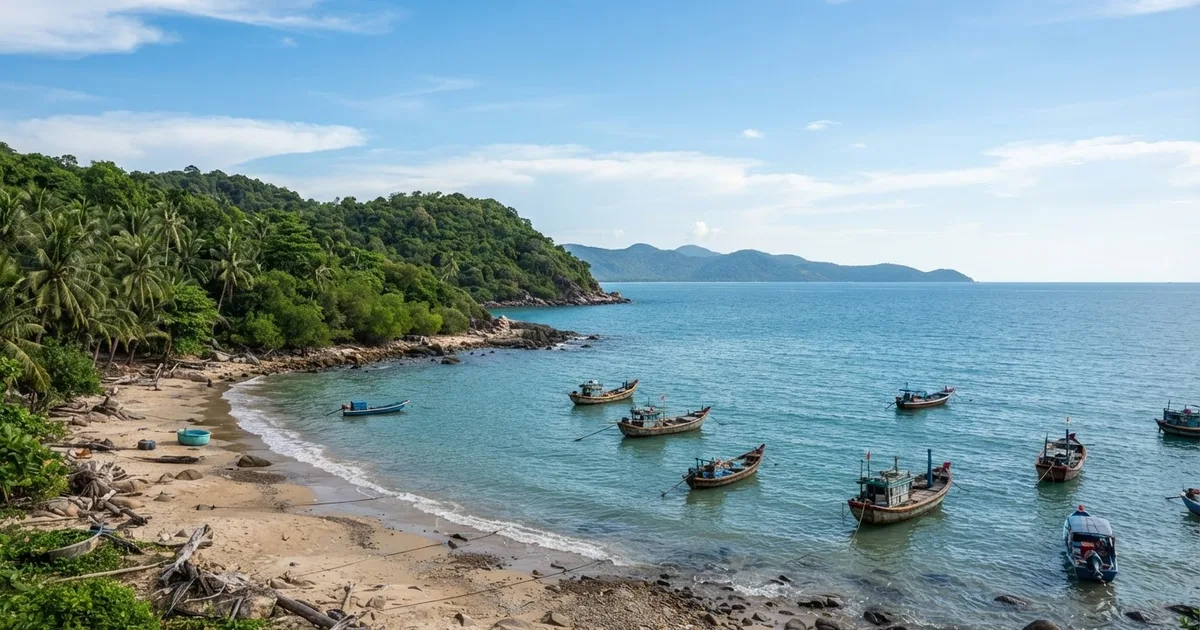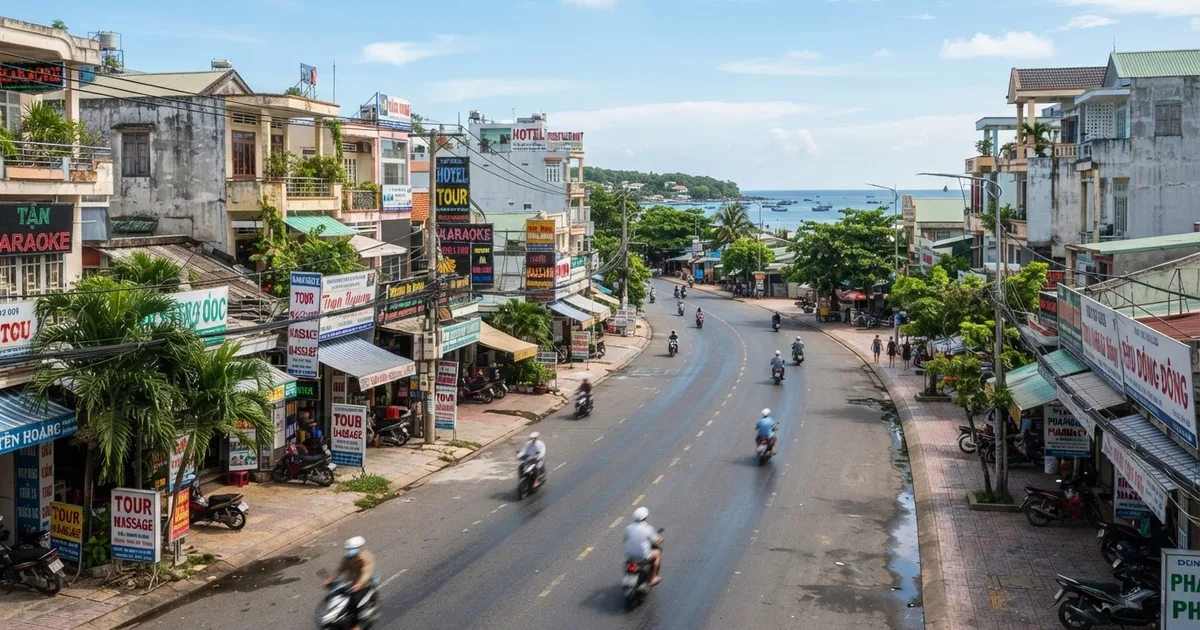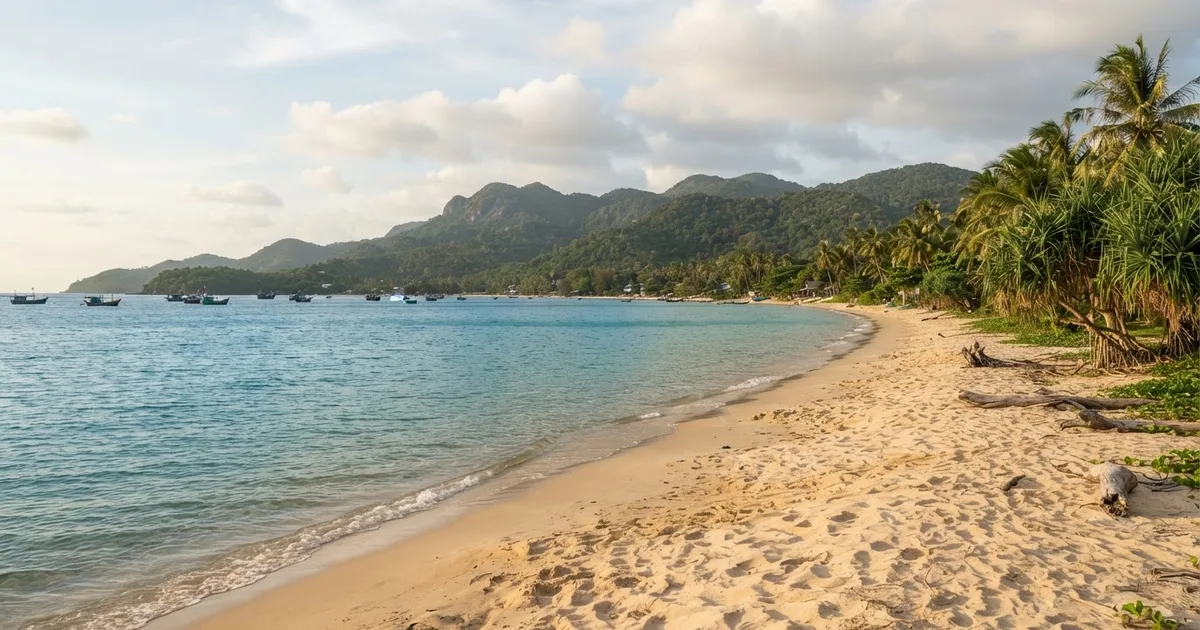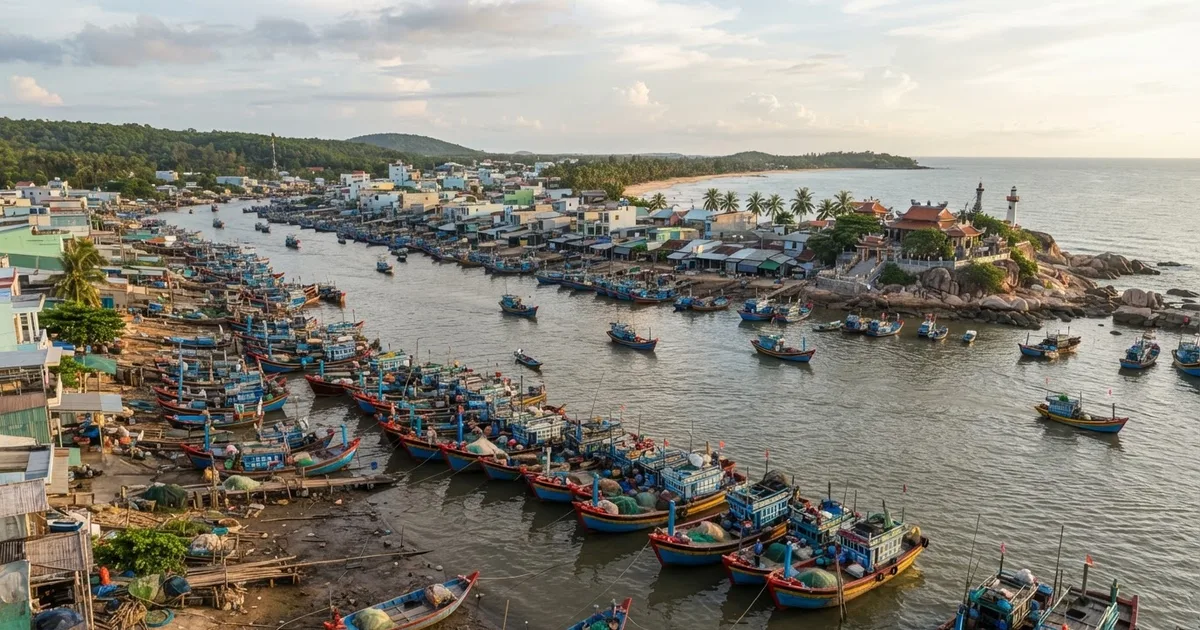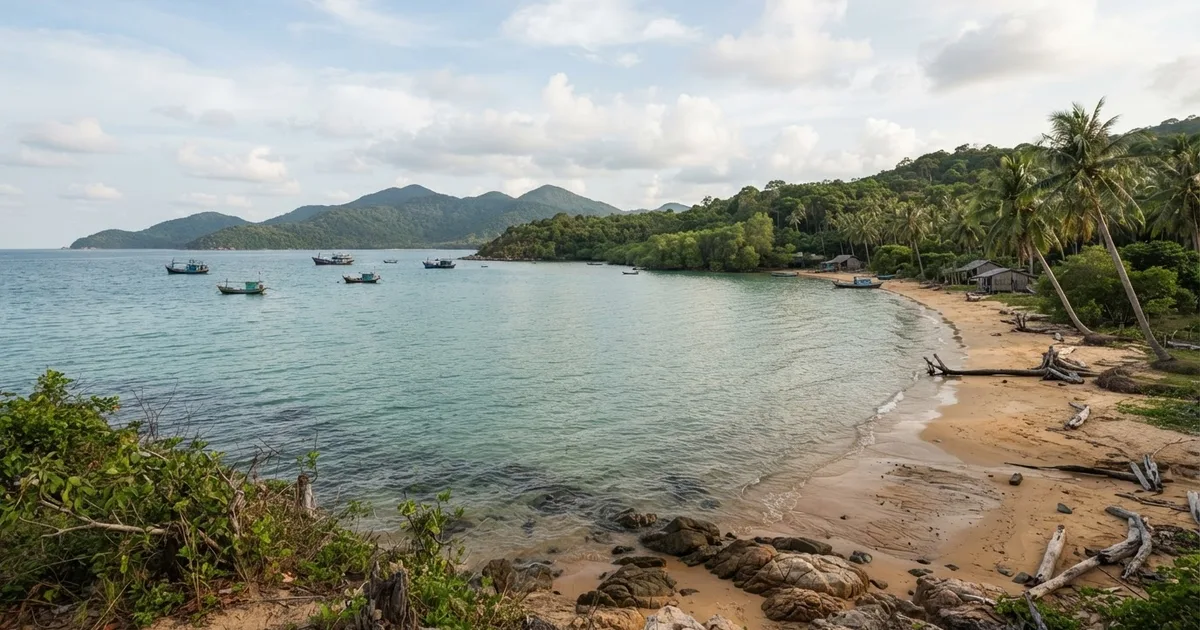
Bãi Thơm is Phu Quoc's quiet northeast coast: about 2 km of shoreline roughly 35 km from Duong Dong, reached in 50-60 minutes by motorbike or car. The sand strip is narrow and the sea is shallow, and by island standards the beach itself is honestly mediocre. What you get instead is mangrove forest, fishing-village mornings, mountain scenery and almost no crowds - the most genuinely unhurried corner of Phu Quoc.
Where Is Bãi Thơm, and Why Does It Feel So Different?
Bãi Thơm occupies Phu Quoc's northeast coast, roughly 35 km from Duong Dong town and the international airport. It is the main settlement of Bãi Thơm commune, the administrative area that runs up toward the island's northern tip. Drive here and you leave behind the condo towers, the night-market traffic and the beach clubs of the south - the road narrows, the rubber and pepper plantations take over, and the final kilometres pass through fishing hamlets rather than hotel driveways.
The commune is consistently described in the same terms: rugged beaches, mangrove forests, abundant wildlife and mountain scenery. That is not marketing copy. More than half of Phu Quoc is protected national park, and the forested interior directly behind Bãi Thơm is part of it, which is why you can hear hornbills at dawn and spot monkeys and squirrels on the edge of the village if you are up early and quiet.
The name translates roughly as fragrant beach, and Bãi Thơm has been a fishing community far longer than it has been a tourism destination. Boats still head out before dawn and return mid-morning; for the rest of the day the waterfront belongs to whoever happens to be standing on it, which is usually nobody.
Visitors repeatedly describe days in Bãi Thơm as feeling slower and less rushed than the southern resort areas. That is the single most accurate thing anyone says about it. There is no strip to walk, no bar scene, no queue for anything, and no soundtrack other than boat engines and crickets.
Island planning documents designate the Bãi Thơm area as an eco-tourism zone, with services aimed largely at younger travellers and outdoor-minded visitors rather than the family-resort market. In practice that means the infrastructure is thin on purpose: a scatter of small seafood restaurants, guesthouses and homestays, a few cafés, and a great deal of empty coastline. Tripadvisor's Bãi Thơm page frames the area as combining charm, modernity and authenticity - the charm and authenticity are obvious, while the modernity shows up mostly in the newer rooms and Wi-Fi rather than in the streetscape.
Local tip: Bãi Thơm faces east and northeast, so it is a sunrise coast, not a sunset one. Structure your day around a 5:45-6:15am start and you will see the best light of your entire Phu Quoc trip.
Getting to Bãi Thơm: Distance, Time and Route
There is no useful public transport to Bãi Thơm. Your options are a rental motorbike, a rental car, or a taxi - and once you arrive you will want wheels anyway, because the beach, the village and the mangrove areas are spread over several kilometres.
| Starting point | Approx. distance | Approx. ride time | Notes |
|---|---|---|---|
| Duong Dong town centre | 35 km | 50-60 min | The standard reference point; mostly sealed road |
| Phu Quoc International Airport | ~36 km | 55-65 min | Allow extra time in the first hour after landing |
| Ham Ninh fishing village | ~25 km | 35-40 min | East-coast road; easy to combine in one loop |
| Rach Vem / Starfish Beach | ~20 km | 35-45 min | Some unsealed sections after heavy rain |
| An Thoi (southern tip) | ~70 km | 1 hr 45 min | Opposite end of the island; a full-day transfer |
By motorbike the ride takes about an hour from Duong Dong and is one of the better drives on the island: quiet tarmac, plantation country, and glimpses of the sea on the final stretch. By car or taxi the same trip runs 50-60 minutes, with a one-way taxi from Duong Dong typically costing in the region of US$20-28 depending on the operator and how you book. Motorbike rental on Phu Quoc generally costs about US$8-15 per day depending on the model and season, and a full tank is only a few dollars, which makes this one of the cheapest day trips available.
Two practical warnings. First, ride-hailing coverage thins out badly in the north, so do not assume an app car will appear to take you home - keep your own vehicle or arrange a return pickup when you arrive. Second, fuel up in Duong Dong or Cua Can before heading north. There are small roadside fuel stalls in the commune, but hours are unpredictable and quality varies.
Road conditions are generally fine in the dry season, roughly November to April. In the rainy months from May to October, the northern roads develop potholes and standing water, and the last stretch toward the far north can turn slick. Ride more slowly than you think you need to, and avoid the route after dark: there is almost no street lighting between Cua Can and Bãi Thơm.
The Beach Itself: An Honest Look
Here is the part most guides soften. The Bãi Thơm coastline runs about 2 km, but the usable sand is a narrow ribbon, often only a few metres wide, backed by vegetation and rock in places. The water is shallow a long way out, which is safe for paddling but not satisfying for anyone who wants to swim properly. The sand carries a lot of broken shell, and depending on the season there can be algae along the tideline.
One beach guide names Bãi Thơm's real problem bluntly: plastic trash, particularly after windy weather, when debris is pushed ashore from the water and the neighbouring coast. It is not constant, and local businesses and residents do clean up, but if you visit within a few days of a strong wind or a storm you may find the tideline strewn with litter. Bring a bag and spend ten minutes on it if you feel like it - the difference it makes is immediate and obvious.
Set against that: the water is calm and clear on most mornings, the bay is sheltered, and the view east toward the small islands and the horizon is genuinely beautiful. Because so few people come, you can walk a kilometre of shoreline at 7am and see no footprints but your own, which is now almost impossible at Sao Beach or anywhere along the southern strip.
If your priority is a wide, white, photo-perfect beach with sunbeds and bar service, Bãi Thơm will disappoint you - that is simply not what it is. If your priority is having an entire coastline to yourself, with mangroves behind you and fishing boats in front, it overdelivers.
Note on tides: at low tide the shallow shelf at Bãi Thơm extends a long way out, exposing mud and rock in places. Time your swim or your photographs for the two or three hours either side of high tide.
What There Actually Is to Do in Bãi Thơm
This is not an activity destination in the usual sense. There is no water park, no cable car and no night market. What there is, is enough to fill two or three unhurried days.
Sunrise and the fishing fleet. Be on the waterfront by 5:45am. Boats return between roughly 6am and 9am, and the small harbour area becomes a working scene of ice boxes, nets and motorbikes. Nobody minds a respectful observer with a camera.
Mangroves and the national park edge. The mangrove belt behind the commune is the reason birdlife is so good here - herons, egrets, kingfishers and, if you are lucky, hornbills moving between the forest and the coast. There is no formal trail network or ticket office; the practical way to explore is on foot along the edges of the village, or by kayak if your accommodation has one.
Mountain and forest scenery. The road up to the northern tip passes through genuinely dramatic country, with the national park ridge on one side and the sea on the other. This is the classic Phu Quoc motorbike loop for people who have already done the south.
Rach Vem and Starfish Beach. About 20 km west along the north coast, Rach Vem is a floating fishing village with seafood restaurants on stilts and the well-known Starfish Beach nearby. Combine it with Bãi Thơm in one day for a full northern loop. Note that the starfish are protected and should never be lifted out of the water for photos.
Ham Ninh. On the way back south, Ham Ninh is a working fishing village known for its seafood and its morning market. It is 25 km from Bãi Thơm and makes a natural lunch stop.
Wellness and digital detox. The area is developing a small reputation for luxury wellness resorts and deliberate off-grid stays. With very little to do in the evenings, early nights, long reads and no notifications become the default rather than a discipline.
Where to Stay and Eat in Bãi Thơm
Accommodation splits into two clear tiers: small local guesthouses and homestays, and a handful of more polished retreat-style properties. Bai Thom Retreat is the most frequently cited example of the second tier - it offers free Wi-Fi plus a garden, a private beach area and a terrace, and its accommodation is air-conditioned, which matters more than you might expect on a coast where daytime humidity is high year-round.
| Type | Typical nightly rate | What you get |
|---|---|---|
| Local guesthouse / homestay | US$12-30 | Fan or A/C room, cold shower, basic Wi-Fi, family-run |
| Mid-range bungalow or retreat | US$45-90 | A/C, private bathroom, garden, breakfast, sometimes beach access |
| Wellness / boutique retreat | US$120-250+ | Designed rooms, terrace, spa or yoga programmes, digital-detox focus |
Book direct or by phone where you can. Many northern properties have limited online inventory and rates that shift with the season, and in high season from December to March the good rooms in the commune genuinely do fill up. This is one of the few places in Phu Quoc where demand is driven by people who already know what they are coming for.
Eating is straightforward and cheap. Expect small family restaurants serving fresh squid, crab, grouper, sea snails and hotpot, usually priced well below Duong Dong levels - a hearty seafood meal for two commonly lands between US$10 and US$20. Menus are short because the catch dictates them. Vegetarian options are limited to rice, noodles, morning glory and egg dishes, so if you have dietary restrictions, plan around that or bring supplies from Duong Dong.
There is no supermarket in Bãi Thơm and no ATM that you should rely on. Bring cash in Vietnamese dong, bring any medication you need, and buy water and snacks in Duong Dong before you drive north. Mobile signal exists in the village but drops out along parts of the coast road.
Bãi Thơm vs An Thới and the South: Which Coast Fits You?
Most travellers end up comparing the island's two extremes, because they offer opposite holidays. An Thới sits at the southern tip of Phu Quoc and is one of the island district's main tourist areas - a lively, busy fishing port with a ferry terminal, a night market and a lot of concrete. From An Thới you reach the An Thới Islands by boat day trip or via the Hòn Thơm cable car, and the archipelago is best known for snorkelling and diving over coral reefs, with quieter beaches than the mainland.
One caveat worth knowing before you book a southern island day: a 2026 beach guide notes that Bai Trao Beach Restaurant on Hon Thom feels more like a resort or theme-park area than a pristine natural escape. The cable car and the entertainment complex around it have transformed that specific corner. It is fun, but it is not wilderness.
Bãi Thơm is the better choice if you want
- Emptiness - a 2 km coast where you may see no other visitors
- Mangroves, national park forest and real birdlife
- Rooms from US$12-30 and seafood dinners under US$20
- Sunrise photography and a slow, silent day
- A genuine digital-detox stay with no bar scene to resist
An Thới is the better choice if you want
- Snorkelling and diving over coral reefs
- Cable-car and island-hopping day trips
- Restaurants, bars and nightlife within walking distance
- Easy transfers from the airport and ferry connections
- Swimmable, wider beaches and more reliable boat trips
The mistake people make is treating Bãi Thơm as a beach destination and then feeling let down by the narrow sand. Treat it as a landscape and a pace instead - mangroves, mountains, fishing boats, long mornings - and it can be the best two nights of your trip. Budget travellers, photographers and outdoor-adventure travellers consistently rate it highest; resort-style holidaymakers consistently rate it lowest.
Practical Checklist Before You Drive North
- Cash: carry enough dong for your whole stay - no reliable ATMs in the commune.
- Fuel: fill up in Duong Dong or Cua Can; roadside stalls are unreliable.
- Transport: arrange your return trip, or keep a rental bike for the duration.
- Riding: avoid the drive after dark; the coast road has almost no lighting.
- Timing: November to April is the dry, calm season; May to October brings rough seas and debris on the beach.
- Tides: check high tide before planning a swim - low tide exposes a long shallow shelf.
- Sun: the east-facing coast gets fierce morning sun; bring reef-safe sunscreen and a hat.
- Insects: mosquito repellent is essential near the mangroves, especially at dusk.
- Medical: the nearest hospital is in Duong Dong, about 50-60 minutes away.
Two to three nights is the right length. One night feels rushed given the hour-long drive each way; more than three and you will have exhausted the walks, the food options and the sunrise shots. Combine it with Ham Ninh or Rach Vem on the way in or out to make the most of the drive.
Frequently Asked Questions
How far is Bãi Thơm from Duong Dong?
About 35 km northeast, which takes roughly 50-60 minutes by motorbike or car. Allow a little longer if you are coming straight from Phu Quoc International Airport, around 36 km and 55-65 minutes, and expect no useful public transport on this route.
Is Bãi Thơm Beach good for swimming?
Only moderately. The coastline is about 2 km long but the sand is narrow and the water stays shallow far out. It is fine for paddling and wading, less satisfying for proper swimming, and at low tide a long shallow shelf of mud and rock is exposed. Aim for the hours around high tide.
Why is there trash on the beach at Bãi Thơm?
Plastic debris is pushed ashore from the water, particularly after windy weather or storms. It is seasonal rather than constant, and residents and businesses do clean up, but if you visit within a few days of strong winds you may find litter along the tideline. Locals appreciate visitors who help clear it.
How much does it cost to stay in Bãi Thơm?
Local guesthouses and homestays typically run US$12-30 per night, mid-range bungalows and retreats US$45-90, and wellness or boutique retreats US$120-250 and up. Bai Thom Retreat is the most commonly cited higher-end option, offering air-conditioned rooms, free Wi-Fi, a garden, a terrace and a private beach area.
Is Bãi Thơm worth visiting if I only have one day?
Yes, but treat it as a day trip rather than a beach day. Leave Duong Dong by 5am, catch sunrise over the bay, spend the morning walking the village and mangrove edges, then loop back via Rach Vem and Ham Ninh. Two nights is better - one day means roughly two hours of driving for a short stay.
What is there to do in Bãi Thơm in the evening?
Almost nothing, which is the point. There is no bar strip or night market; dining is limited to small seafood restaurants that close early. The area is increasingly known for luxury wellness resorts and digital-detox stays, so evenings are for reading, early nights and watching the boats rather than going out.
Should I choose Bãi Thơm or An Thới?
Choose Bãi Thơm for emptiness, mangroves, national park scenery and rooms from US$12-30 per night. Choose An Thới, at the southern tip of Phu Quoc, for snorkelling and diving over coral reefs, boat day trips to the An Thới Islands and the Hòn Thơm cable car, plus restaurants and nightlife within walking distance.
Do I need a motorbike to get around Bãi Thơm?
Effectively yes. The beach, village, harbour and mangrove areas are spread over several kilometres with no public transport and very limited ride-hailing coverage. A rental scooter costs about US$8-15 per day and is the difference between a frustrating stay and a good one. Fuel up before you leave Duong Dong.
Planning a few slow days on Phu Quoc's northeast coast? Sabrina Rental can sort your motorbike or car for the drive north, arrange rooms in Bãi Thơm, and tell you exactly which mornings the fishing boats come in and which roads to avoid after rain.
Ask Sabrina Rental About Bãi Thơm